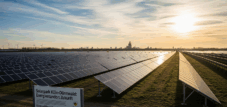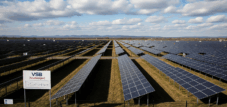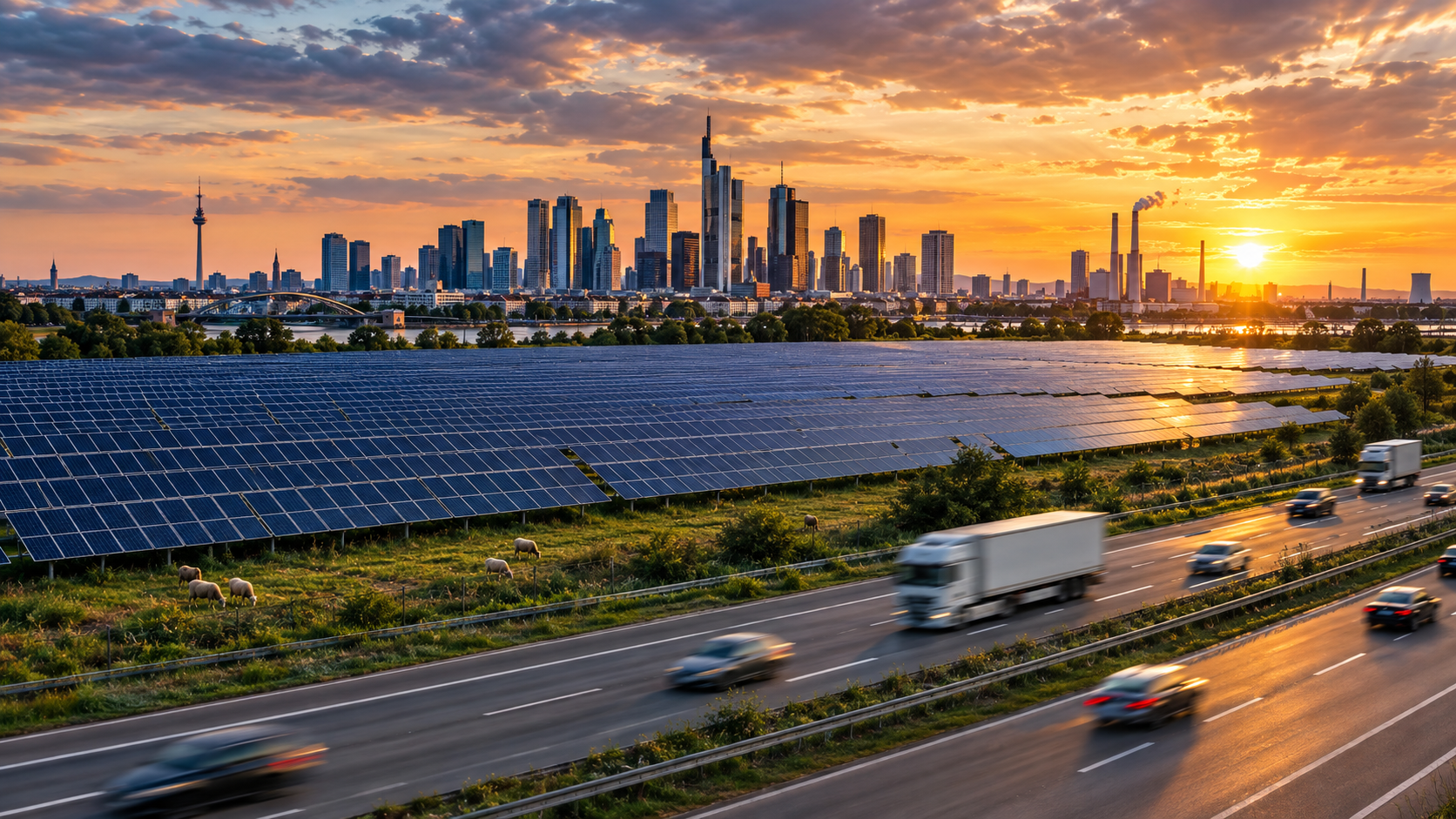
Rhein-Energie is building an urban solar park in the Rondorf district along the A555 – creative image on the topic, created with AI: Xpert.Digital
The end of the old solar logic: What the new mega solar park on the A555 reveals
Electricity transformation along the motorway: How 17,000 solar modules in Cologne are revolutionizing the market
Negative electricity prices: How batteries and smart solar parks are now saving the business
Germany's energy transition is facing a radical paradigm shift – and an unassuming piece of farmland by the A555 motorway in southern Cologne is unwittingly becoming a symbol of this new era. When RheinEnergie builds its largest urban photovoltaic project to date in Rondorf, it's no longer just about green kilowatt-hours or a polished climate protection record. The 10.5-megawatt solar park marks the quiet but definitive end of a decades-old industry logic: away from small-scale rooftop installations and uncontrolled feed-in, towards gigantic, grid-supporting plants located close to consumers. In times of rapidly increasing negative electricity prices, when solar power is temporarily devalued at midday, it's no longer enough for energy suppliers to simply generate electricity. The crucial factor today is making it available in the right place, at the right time, and with intelligent buffering. This analysis, using the Cologne lighthouse project as an example, shows why the future of renewables lies in a networked system of storage, proximity to industry and services – and what harsh economic realities dictate this billion-dollar transformation.
When electricity is generated where it is needed
Why the small field by the A555 reveals the biggest transformation of the energy industry
Ten hectares of farmland between a motorway and a Cologne suburb might seem at first glance like a footnote to the energy transition. But the solar park that RheinEnergie is building in the Rondorf district along the A555 motorway is more than just the largest photovoltaic project currently underway in Cologne. It's a prime example of how the economics of renewable energies in Germany is undergoing a fundamental shift: away from simply kilowatt-hours of output across a given area, and towards a question of location, timing, and system benefits. This text uses the Rondorf plant as a starting point to uncover and critically analyze the economic logic behind the trend towards localized, "system-serving" solar energy.
The hard facts behind the record
The Rondorf solar park is being built on approximately ten hectares of land, previously used for agriculture, between the A555 motorway and the Rondorf district in southern Cologne. With an installed peak capacity of 10.5 megawatts, it will be the largest solar park within Cologne's city limits and can theoretically supply around 3,000 households with electricity. More than 17,000 solar modules will be installed, stretching approximately 500 meters along the motorway. Construction will take place from June to September, with commissioning planned for autumn 2026.
The area is roughly equivalent to 14 football fields, and the land largely belongs to RheinEnergie itself, with a smaller portion leased on a long-term basis. The approach to the landscape is noteworthy: the wooded area between the motorway and the farmland will be preserved, and grazing by sheep is being considered to maintain the area under and between the modules. This reflects a principle that is gaining importance across the industry: an area should ideally serve more than one function.
The following overview summarizes the key technical and economic data.
| Key figure | Value |
|---|---|
| Location | Cologne-Rondorf, along the A555 |
| Area | approximately 10 hectares (about 14 football fields) |
| Top performance | 10.5 MWp |
| Number of modules | over 17,000 |
| Theoretically supplied households | approximately 3,000 |
| Construction period | June to September 2026 |
| commissioning | Autumn 2026 |
| Building owner and operator | RheinEnergie |
The silent departure from the roof
The truly revealing aspect of the Rondorf project is not its size, but the strategic shift it represents. RheinEnergie is departing from its previous approach with this project: instead of primarily focusing on rooftop installations, the company is now investing in large-scale, ground-mounted systems. This isn't just a whim of a single utility company, but rather a sound business decision in response to the cost structure of photovoltaics.
Ground-mounted solar power plants are simply significantly cheaper per kilowatt-hour generated than rooftop systems. According to the Fraunhofer ISE's levelized cost of electricity study, the specific costs of large ground-mounted plants over one megawatt range from approximately 700 to 900 euros per kilowatt, while large rooftop systems in the commercial and industrial sector cost between 900 and 1,600 euros per kilowatt. For a 10.5-megawatt plant, this difference adds up to millions of euros over its lifetime. The industry-cited investment benchmark of around one million euros per megawatt for Rondorf fits into this picture and marks the lower end of the cost scale, which makes ground-mounted plants so attractive.
Added to this is the scalability of permitting and operating costs. A single open space with over 17,000 modules at one location incurs significantly lower transaction costs than the same output distributed across hundreds of individual roofs, each with its own structural engineering, owner, and grid connection point. For a utility company whose core business is generation and not simply a solar installer for individual customers, concentrating on large, owned sites is therefore the path of least economic resistance.
The value shifts from quantity to moment
This describes the first part of the economic shift. The second, far more profound, concerns the revenue side. For decades, a simple logic prevailed in photovoltaics: the more kilowatt-hours a system produced, the better. This logic is now dissolving, and the reason can be summed up in a single figure. In the first half of 2026, every fourth megawatt-hour of solar power was fed into the grid during periods of negative electricity prices; a year earlier, it was even every third.
Negative electricity prices occur when the uncontrollable supply exceeds demand, and they happen almost exclusively during the sunniest midday hours when all photovoltaic systems simultaneously reach their peak output. The phenomenon has accelerated dramatically. In 2023, Germany recorded around 300 hours with negative prices, in 2024 there were approximately 460, and in 2025 a record of around 573 hours was set. This trend continued in 2026: By July 1st, there had already been 298 hours with negative prices, reaching a historic low of minus €499.99 per megawatt-hour on May 1st. Some specialist portals consider up to 900 negative hours for the entire year to be possible.
The economic consequences are severe because they strike at the heart of the investment calculation. According to the Solar Peak Act, which has been in effect since February 2025, new installations receive no feed-in tariff precisely during hours of negative prices. The market value of solar power, meaning the average revenue a kilowatt-hour of solar electricity actually generates on the market, fluctuates accordingly: it fell to 3.16 cents in May 2026, doubled to 6.19 cents in June, and then fell again to 5.23 cents in July. Anyone building a solar power plant today is therefore no longer simply selling electricity, but rather speculating on the value of a specific generation profile at a specific time. The sheer annual production figure is becoming less and less of a reliable indicator of profitability.
Proximity to the consumer as a business lever
This explains why a site directly adjacent to a highway on the outskirts of a major city is suddenly more valuable than an equally sized area in a remote region. The industry trend is shifting away from large-scale installations in rural areas towards projects in metropolitan areas and cities, where the main consumption centers are located. Photovoltaics is ideally suited for decentralized, localized expansion because this puts less strain on the grid than centralized generation far from the point of consumption.
The logic is both physical and economic. If electricity is generated where it is consumed, transmission distances are shortened, transmission losses decrease, and expensive grid expansion can be avoided. From an economic perspective, it is more advantageous to expand the grid less and instead integrate the facilities into the system in such a way that they place less strain on the grid from the outset. Grid-friendly operation thus addresses the dominant scarcity in the system, namely the capacity of the lines, and therefore contributes directly to reducing grid costs and the need for expansion. The straightforward grid connection via a nearby field edge, as offered by Rondorf, is therefore not a technical detail, but a tangible cost advantage.
For a municipal utility like RheinEnergie, another aspect comes into play that goes beyond mere plant calculations. The electricity generated in Rondorf originates from the region and remains in the region. Regionality is a value in itself for a municipal utility's marketing, as it strengthens customer relationships and makes local economic benefits visible. A utility that has been supplying all its residential and commercial customers with certified green electricity since 2022 can credibly demonstrate, with a visible solar park right on its doorstep, that decarbonization is not just about trading certificates, but is a tangible reality.
New: Patent from the USA – install solar parks up to 30% cheaper and 40% faster and easier – with explanatory videos!

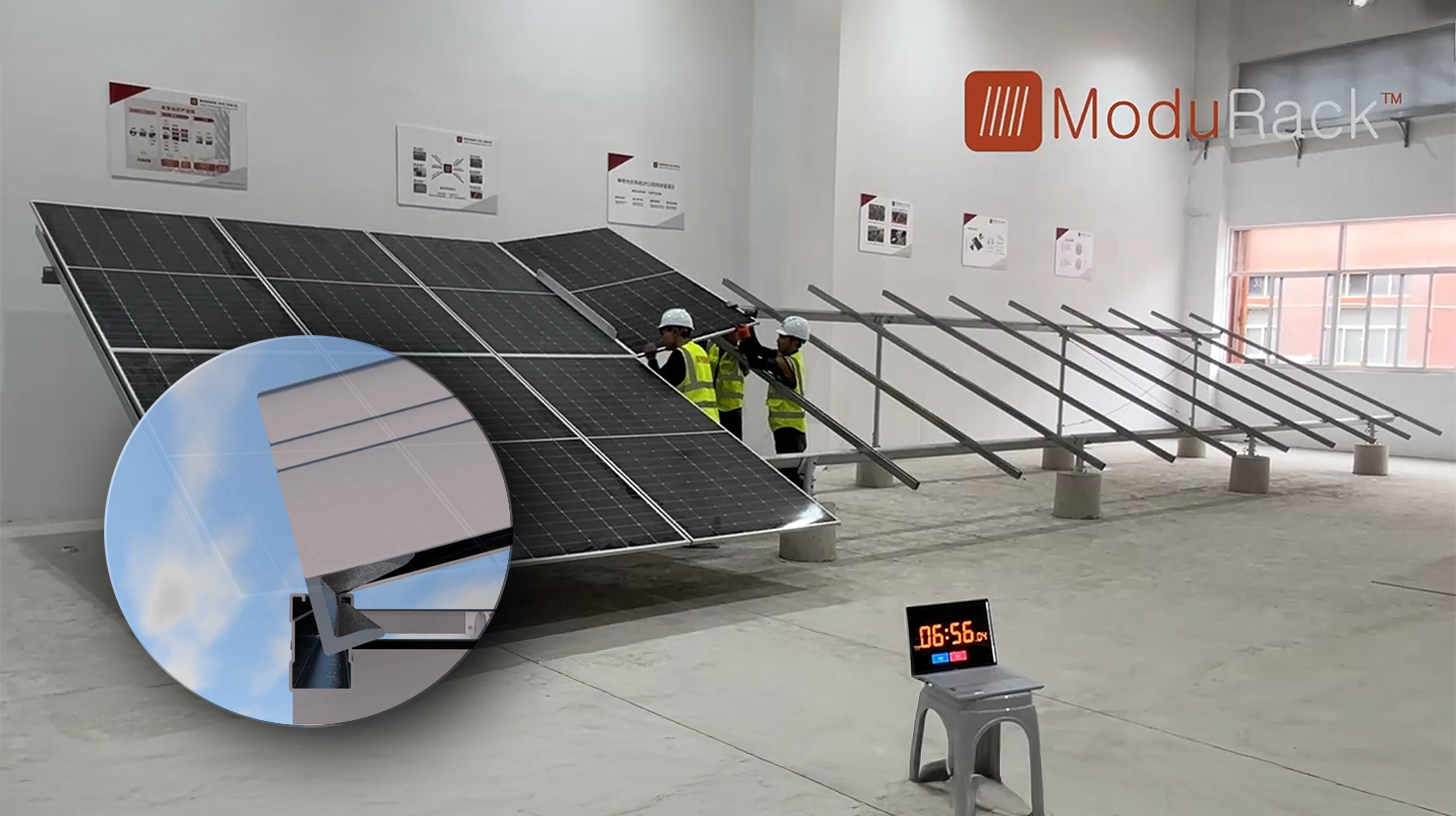
New: Patent from the USA – Install solar parks up to 30% cheaper and 40% faster and easier – with explanatory videos! - Image: Xpert.Digital
The core of this technological advancement is the deliberate departure from conventional clamp mounting, which has been the standard for decades. The new, more time- and cost-effective mounting system addresses this with a fundamentally different, more intelligent concept. Instead of clamping the modules at specific points, they are inserted into a continuous, specially shaped support rail and held securely in place. This design ensures that all forces – whether static loads from snow or dynamic loads from wind – are distributed evenly across the entire length of the module frame.
More information here:
Why new solar parks without huge batteries become an economic risk
Without storage, half the business is lost
As compelling as the location logic is, it only solves half the fundamental problem. While a solar park located close to the point of consumption feeds in electricity closer to demand, it still does so at the wrong time – namely, midday, when there is already a surplus. The crucial second lever is therefore the combination of generation and storage. Battery storage systems can smooth out peak generation at the point of feed-in and reduce the amount of electricity fed into the grid. This is precisely where the future of economic viability lies.
The attractiveness of the energy storage business stems directly from the price volatility inherent in photovoltaics itself. While prices dip into negative territory at midday, they temporarily rose to over €600 per megawatt-hour in the evenings during the second quarter of 2026, because gas-fired power plants then have to step in. A battery storage system that stores electricity when prices are negative or minimal and sells it again during the expensive evening hours transforms precisely this volatility into revenue, the very volatility that threatens the viability of a pure solar park. In practice, in 2026, batteries stored electricity for prices ranging from plus three to minus two cents and sold it again for five to ten cents.
RheinEnergie has long understood this logic and is systematically expanding upon it. In Mecklenburg-Western Pomerania, the company previously commissioned its largest solar park to date, with a capacity of 32 megawatts, complemented by a battery storage system. The real competitive advantage of the future no longer lies in the solar park alone, but in the intelligent integration of generation, storage, and marketing. Those who simply install modules across a landscape sell a raw product at its lowest price. Those who add storage and control systems sell a refined product precisely when the market demands it.
From electricity supplier to system service provider
This sets the framework for what is perhaps RheinEnergie's most important strategic move, one that extends far beyond photovoltaics. The company is systematically expanding its energy services business, known as contracting, into a key growth driver. In the summer of 2026, RheinEnergie agreed to acquire EnBW's nationwide contracting business, which comprises around 200 plants. With this transaction, which is still subject to antitrust approval and is expected to be completed by early 2027, the company will double its installed capacity at a stroke to approximately 1.1 gigawatts and around 800 plants.
Contracting means that the utility company builds and operates generation plants for industrial companies, large housing corporations, municipalities, and public utilities that they themselves do not want to or cannot build or operate. According to RheinEnergie, this makes it one of the three leading providers of complex energy services in Germany and the largest provider with a municipal background. The economic appeal of this business lies in its stability: contracting agreements are long-term, revenues are predictable, and the business is far less exposed to the daily fluctuations of the spot market than simply selling electricity. It is the financial protection against precisely the volatility that photovoltaics introduces into the market.
The connection between photovoltaics and contracting is no coincidence. Large industrial buildings, logistics centers, stadiums, and commercial properties have roofs and surfaces suitable for solar panels and high daytime self-consumption, making the generated electricity usable directly on-site without having to feed it into the grid. This elegantly circumvents the midday problem because the electricity doesn't even need to be fed into the overloaded grid. For the utility company, this creates a self-reinforcing business model: Photovoltaics provides the generation, and contracting provides reliable customers and stable revenue.
Industrial wastelands as the real resource
RheinEnergie's next major step demonstrates its future direction and reinforces its economic message. In Cologne-Niehl, on the industrial site of Deutsche Infineum, a joint venture between ExxonMobil and Shell, an 18-megawatt ground-mounted photovoltaic plant is being built, scheduled to go into operation in 2027. Approximately 25,300 modules will be installed on roughly twelve hectares, with a projected annual output of around 18 million kilowatt-hours, making it one of the largest ground-mounted photovoltaic plants on an inner-city industrial site in Germany. The record set in Rondorf is therefore likely to be short-lived.
The crucial difference lies in the land itself. While Rondorf is being built on former farmland, thus accepting a land-use conflict with agriculture, Niehl is utilizing already sealed or industrially developed land. The use of brownfield sites is gaining importance in minimizing land-use conflicts. Economically, this is doubly attractive: such sites are often easier to develop under planning law, they do not compete with food production, and by definition, they are located where industry, and therefore high electricity consumption, is already present. From the perspective of the new revenue model, the combination of a large industrial direct consumer and an already developed site is almost ideal.
The following comparison illustrates the strategic development of the two Cologne flagship projects.
| feature | Rondorf | Niehl (Infineum) |
|---|---|---|
| Performance | 10.5 MWp | 18 MW |
| Area | approximately 10 hectares | approximately 12 hectares |
| Number of modules | over 17,000 | approximately 25,300 |
| Surface type | former farmland | inner-city industrial area |
| commissioning | Autumn 2026 | 2027 |
| Partner model | RheinEnergie's own project | with industry partner Infineum |
The land conflict as the Achilles' heel
However sound the strategy may be, it should not be adopted uncritically. The Rondorf case also reveals the limitations of the model. The plant is being built on land previously used for agriculture, and while the planned sheep grazing is appealing, it doesn't change the fact that productive farmland is being lost for food production. The expansion of ground-mounted photovoltaics reaches a critical point precisely here: land is finite, and competition for it between energy production, agriculture, housing, and nature conservation will intensify.
The legislature has already responded to this tension. For ground-mounted solar installations on agricultural land, there is an expansion limit of 80 gigawatts; once this limit is exceeded, no further subsidized bids are accepted for such areas. This signals that the seemingly simple route via arable land is not politically unlimited. The increased focus on brownfield sites, such as in Niehl, or on agrivoltaics, which combines agriculture and electricity generation on the same land, is therefore not just a preference, but a necessity. RheinEnergie is already pursuing this complementary approach with its first agrivoltaic plant in Kell am See, which is also scheduled to go into operation in autumn 2026.
The revenue trap in the auction system
A second critical dimension concerns revenue security under the current support system. Plants with a capacity of one megawatt or more must market their electricity through competitive auctions held by the Federal Network Agency, instead of receiving a fixed guaranteed feed-in tariff. For ground-mounted solar installations, the average volume-weighted award price at the bid deadline in July 2026 was only 4.79 cents per kilowatt-hour, compared to a statutory maximum of 5.90 cents. The auction was significantly oversubscribed, with a coverage rate of approximately 148 percent, demonstrating the intense competition and ongoing price pressure.
These figures paint a sobering picture of expected returns. With winning bids for open-field installations between 5.8 and 6.5 cents, returns on equity of only six to eight percent are calculated. This is adequate, but by no means generous, and leaves little room for miscalculations regarding construction costs, interest rates, or yield forecasts. To make matters worse, the guaranteed feed-in tariff is forfeited during periods of negative prices. An operator relying solely on subsidized grid feed-in is therefore walking a tightrope. This explains precisely why pure generation without storage, self-consumption, and contracting is becoming increasingly economically fragile. The solar park of the future will no longer be profitable despite, but only because of, its integration into a larger system of storage, direct marketing, and customer proximity.
A multi-billion dollar program with a safety net
The individual projects are part of an overall strategy whose scale both puts Rondorf's significance into perspective and underscores it. RheinEnergie plans to double its renewable energy plant capacity from its current level of around 300 megawatts to up to 600 megawatts in the coming years. The company is currently developing 50 megawatts of new solar power capacity, of which Rondorf, with 10.5 megawatts, is just one component. This is embedded in a comprehensive energy transition package with a total volume of approximately €3.8 billion, which bundles investments in the electricity grid, district heating network, district heating generation, and, of course, renewable energies and energy services.
These figures reveal the true economic reality behind the solar park on the A555. The 10.5 megawatts in Rondorf, in themselves, are hardly decisive for the balance sheet of a utility of this size. Their value lies in the signal they send and their systemic significance. They are visible proof that the decarbonization of generation, the transformation of the grids, the expansion of storage, and the growth in the service sector are not separate projects, but rather components of a single, integrated bet on an energy system in which value no longer lies in the quantity of electricity generated, but in its intelligent provision at the right time and in the right place.
What the field by the A555 really shows
The Rondorf solar park is therefore far more than just a local success story about supplying 3,000 households. Within ten hectares of farmland, it encapsulates the three major economic shifts of Germany's energy transition. First, generation is moving from remote areas to densely populated urban centers closer to consumption, because grid proximity has become a quantifiable cost advantage. Second, the value of solar power is decoupling from its sheer quantity, because the simultaneous generation at midday leads to oversupply, negative prices, and the loss of feed-in tariffs. Third, generation is increasingly only profitable as part of an integrated system comprising storage, direct marketing, and long-term service contracts.
Anyone who considers these three developments together will realize that the real innovation lies not in the modules gleaming along the highway, but in the architecture of the business model behind them. The traditional electricity seller, producing kilowatt-hours and delivering them at a fixed price, is a thing of the past. In its place comes the system service provider, who combines generation, storage, grid relief, and customer retention into a cohesive whole. The rapid replacement of the Cologne record by the even larger plant in Niehl is therefore not a contradiction to Rondorf, but rather its logical continuation. The field by the A555 marks not the end, but the beginning of a transformation whose economic rules are only just being written.
Your partner for business development in the fields of photovoltaics and construction
From industrial rooftop PV to solar parks and larger solar parking lots
☑️ Our business language is English or German
☑️ NEW: Correspondence in your native language!

Konrad Wolfenstein
I and my team are happy to be available to you as your personal advisor.
You can contact me by filling out the contact form here wolfenstein@xpert.digital:or simply call me at +49 7348 4088 965. My email address is
I'm looking forward to our joint project.