The trend toward growing cities continues unabated worldwide. This is also true for Japan, where Tokyo has become the largest of the global megacities. More than 38 million people now live in the Tokyo metropolitan area – and the number is growing daily.
PDF download for “Megacities – Urbanization – Figures, Data and Facts” can be found below.

Tokyo – Urban Growth – How Japan is setting the course for the future – @shutterstock | mapman
This development presents entirely new challenges for the care and administration of the people living there. However, Japan's government and businesses have long recognized this and have begun to implement appropriate measures to manage this unchecked growth. Automation and digitalization are among the key drivers contributing to the solution.
Not only population experts, but also Japanese politicians and business leaders are aware of the consequences of growing cities. The influx of more and more people is inextricably linked to a significantly increased consumption of energy and supplies. Furthermore, this development places far greater demands on the capacity of both physical and digital infrastructure.
The Tokyo metropolitan area, which includes Japan's capital as well as the cities of Yokohama, Saitama, and Kawasaki, is by far the largest agglomeration in the world with over 38 million inhabitants. Although the region covers a gigantic 13,500 km² (for comparison: Berlin is 891 km²), an average of 2,830 people inhabit each square kilometer. The population density is even higher in Tokyo itself, where the 9.6 million inhabitants are spread across just 628 km², resulting in a density of 15,300 people per km².
However, compared to uncontrolled megacities like Mumbai, Cairo, or Lagos, those in charge in Japan's government agencies and boardrooms know how to respond efficiently to this challenge. One reason for this lies in the development of the last 60 years, during which Tokyo transformed from a city of a million inhabitants into the megacity of our time. This gave planners ample time to perfect their skills in managing the increasing pressures. In doing so, they could always rely on the strong drive for innovation and the high level of problem-solving expertise of Japan's engineers and developers.
Related to this:
- Japan is already working on the future of tomorrow
- Smart Cities – The solution to mega-urbanization?
The efficient answer: Automation and digitalization
The expertise of its workforce also fueled another factor contributing to Japan's pioneering role in technological development: the exceptionally high level of automation that took hold in the Land of the Rising Sun decades ago. This development is now being complemented by digitalization and the increasing prevalence of robots in people's everyday economic and social lives, ensuring that the growing demands on supply and logistics continue to be fully met.
Related to this:
Contactless shopping and convenience stores – local decentralized hubs
One example of this high adaptability is contactless shopping. This has been extremely popular long before the Covid-19 pandemic and the associated fear of infection among consumers. E-commerce and automated shopping have been among the major drivers of shopping development in Japan for years.
Related to this:
However, both of these factors pose major challenges for city logistics. The infrastructure must cope with many times the number of deliveries from parcel and courier services due to the rapidly increasing order volumes.
Japan's international competitiveness is no accident. The country boasts one of the best education systems in the world. It's therefore no surprise that Japanese engineers are among the most innovative developers. The wealth of expertise available in the country is also reflected in the number of patents filed, where Japan has consistently ranked among the top three internationally for years.
To prevent traffic congestion, only intelligent solutions can help. For this reason, intelligent delivery robots have been undergoing trials in Japanese cities for some time now, commissioned by trading and logistics companies like Yamato Transport and Rakuten. The advantage of these networked helpers: they are small, operate automatically, and deliver the desired products directly from local hubs to consumers.
In Tokyo and elsewhere, there are now numerous options for contactless shopping. The solution lies in konbinis, small convenience stores found throughout the country selling everyday items. At the same time, konbinis and other small shops can serve as micro-fulfillment locations. They function as small distribution centers, offering additional services to local residents. For example, in addition to contactless shopping, they can pick up or return goods ordered online.
Especially in metropolitan areas, convenience stores are increasingly operating automatically and without staff. But the Japanese government is already planning further. Last year, representatives from the Ministry of Economy, Trade and Industry approached the five largest providers with an ambitious plan: By 2025, they are to fully automate a large portion of the country's approximately 50,000 convenience stores. Logistics companies will be tasked with ensuring the smooth supply of goods to the decentralized hubs and local stores.
Related to this:
Japan's city of the future is automated and sustainable
Another approach to optimizing urban efficiency is smart grids. Japan is among the world's leading nations in this field as well. This technology relies entirely on networking power generators, storage facilities, distributors, and consumers to optimize energy supply. By integrating high-performance storage power plants, innovative battery solutions, and renewable energy generation, Japan can ensure that even a megacity like Tokyo has a sufficient energy supply at all times.
But the ingenuity of Japanese engineers and IT experts is far from exhausted. Japan's urban planners are already designing for the future. Large corporations like Panasonic and Toyota have taken the lead in developing innovative building and housing concepts. This has demonstrated that Toyota is capable of far more than just being one of the world's most successful car manufacturers. Now, at the foot of Mount Fuji, the industrial conglomerate is planning the city of the future, the so-called Woven City. On 175 hectares, Toyota intends to create a model city characterized by connectivity, automation, and sustainability. Groundbreaking for the project, which in its first phase is expected to provide homes for 2,000 people, is planned for 2021.
Some such forward-looking housing projects have already been implemented in Japan; for example, a project by the Panasonic Group. With the Fujisawa Sustainable Smart Town, the company inaugurated a city for 3,000 residents on the outskirts of Tokyo in 2014 after a construction period of only two years.
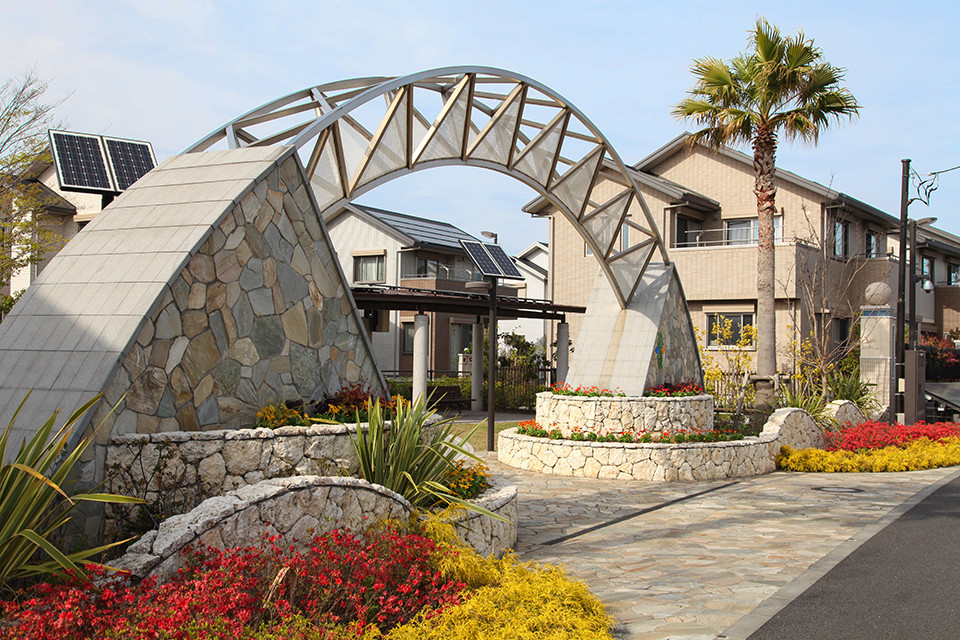
Fujisawa Sustainable Smart Town in Fujisawa City / Japan – @shutterstock | MarinaSkyf
The focus was placed on sustainability, as the planners want the project to operate in an environmentally friendly manner for the next 100 years. Together with other partners, Panasonic invested particularly in environmentally friendly mobility and energy use for all residents. To ensure that Panasonic can benefit from the experience gained from the urban project in the long term and to advance new technologies, development and research laboratories were integrated, further enhancing the innovative capacity of the participating companies.
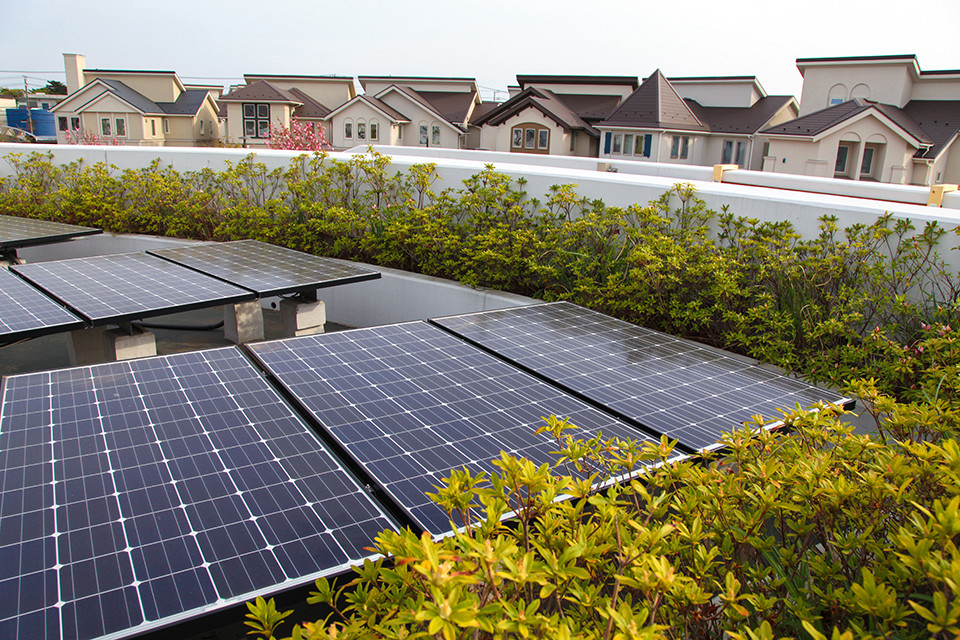
Solar panels on the roofs of buildings in Fujisawa Sustainable Smart Town / Japan – @shutterstock | MarinaSkyf
Looking at Japan shows how the social, economic, and logistical challenges of the future can be overcome. The focus on automation and digitalization, as well as the consistent use of future technologies, forms the basis for an innovative approach that can also lead to increased quality of life and economic strength in both urban and rural areas here in Germany.
Megacities – Urbanization – Facts and Figures
German version – To view the PDF, please click on the image below
.

Megacities – Urbanization – Facts and Figures – PDF Download
► Contact me or join the discussion on LinkedIn
How we secure the infrastructure of our key industries will be crucial for the future!
Three areas are of particular importance here:
- Digital Intelligence (Digital Transformation, Internet Access, Industry 4.0 and Internet of Things)
- Autonomous power supply (CO2 neutrality, planning security, environmental safety)
- Intralogistics/Logistics (Full automation, mobility of goods and people)
Xpert.Digital delivers to you here from the Smart AUDA series.
- Autonomization of energy supply
- urbanization
- Digital Transformation
- Automation of processes
New information is constantly being added and updated regularly.


Keep in touch