


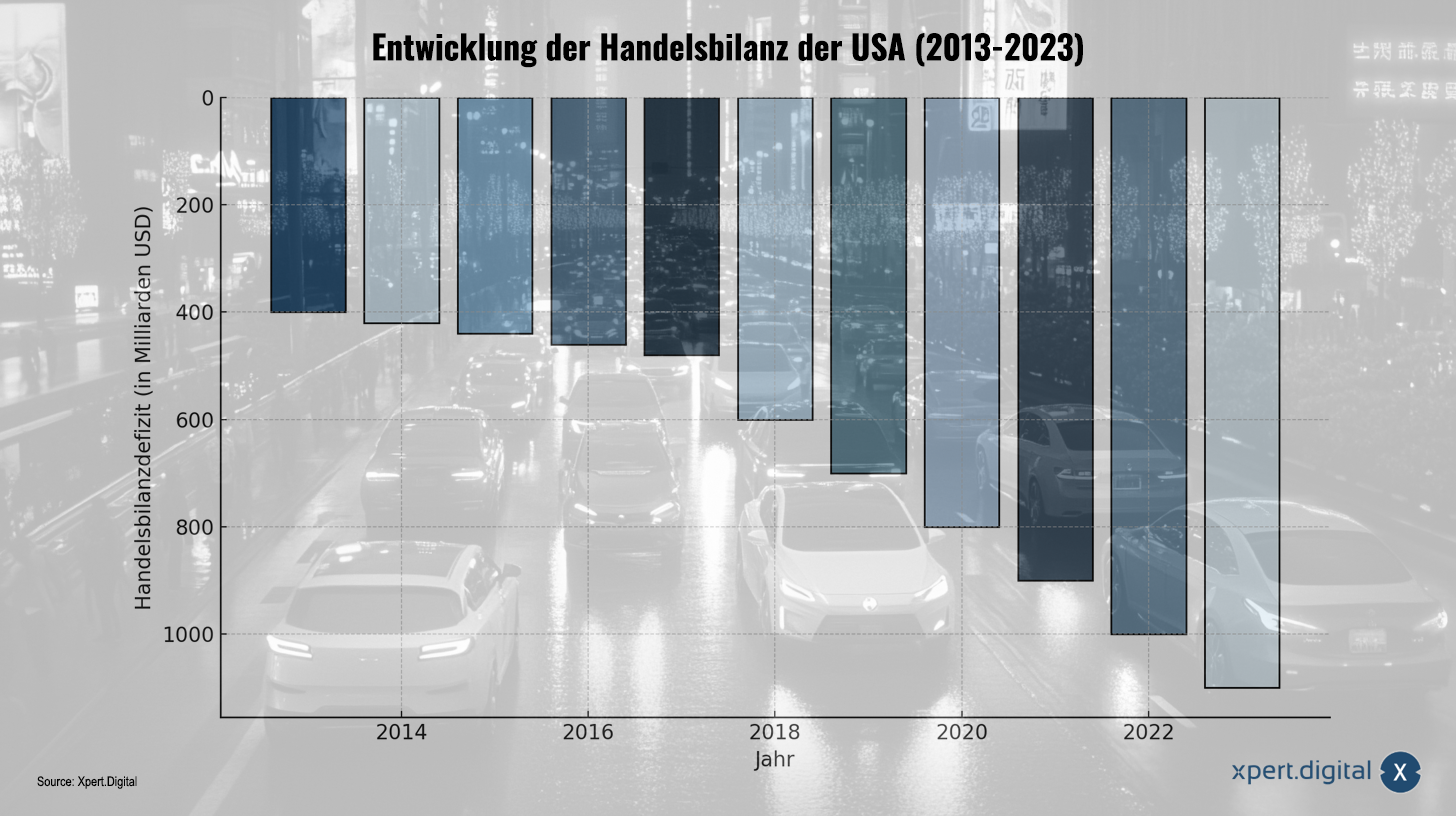
The changing development of the US trade balance (2013-2023) – Image: Xpert.Digital
From surplus to deficit: The dramatic turnaround in the US trade balance
US trade balance: A decades-long transformation and its economic significance
The United States' trade balance has changed significantly over the decades and has become a key indicator of the country's economic development. While the US still recorded trade surpluses in the mid-20th century, the picture has fundamentally changed since the 1970s. Today, the trade balance is characterized by a steadily growing deficit, which has profound effects on the economy and the global standing of the US. The following section describes the development of the trade balance in detail, supplemented by an analysis of its causes and consequences.
Historical development of the trade balance
1950s and 1960s: The era of surpluses
In the postwar decades, the USA was an economic superpower with a strong industrial sector. Exports significantly exceeded imports, resulting in trade surpluses. This period was characterized by global demand for American goods, including machinery, vehicles, and consumer goods. At the same time, competition from other countries, particularly in Europe and Asia, was still limited due to the post-World War II reconstruction efforts.
1970s: The beginning of the deficits
In the 1970s, the trade balance turned negative. This was mainly due to two key factors:
1. Rising oil imports
The oil crises of 1973 and 1979 led to a sharp rise in energy prices. The USA, as a major energy consumer, had to import ever-increasing quantities of oil.
2. Loss of competitiveness
Countries like Japan and Germany gained economic strength and were able to offer high-quality products at lower prices. This led to a decrease in demand for American products on the world market.
1990s: The growing deficit
In the 1990s, the trade deficit continued to increase, reaching an average of approximately US$185 billion per year. Globalization and the relocation of production to countries with lower labor costs contributed significantly to this. Particularly noteworthy was the increasing trade with Asian countries such as China, which developed into a major exporter of consumer goods.
2000s: Record deficits
The 2000s marked a peak in the trade deficit. With an average annual deficit of around US$675 billion, the US reached new record levels. China's accession to the World Trade Organization (WTO) in 2001 significantly increased trade between the two countries, with imports from China far exceeding exports. This was further compounded by rising imports of electronics, vehicles, and other consumer goods.
Developments over the last decade (2013–2023)
Over the past ten years, the trade deficit has worsened further, which can be attributed to several economic developments:
2013–2016
The deficit remained relatively stable at between -450 and -600 billion US dollars per year. During this period, the global economy slowly recovered from the financial crisis of 2008/2009.
2017–2018
A significant increase in the deficit was recorded, reaching -$678 billion in 2018. This increase was primarily due to higher imports, particularly of consumer goods and raw materials.
2020
During the COVID-19 pandemic, the deficit temporarily reduced to -$626 billion. International trade declined due to lockdowns and supply chain disruptions.
2021–2023
During these years, the deficit reached new record highs, particularly in 2023 at -1.15 trillion US dollars. This was due to rising demand for imported consumer goods and weaker export demand resulting from global economic uncertainties.
Reasons for the growing trade deficit
The persistently high US trade deficit can be attributed to a combination of structural and economic factors:
1. High import demand
American consumers often prefer imported goods such as electronics, clothing, and vehicles. These products are frequently cheaper than comparable domestic alternatives.
2. Dependence on raw material imports
Despite progress in energy independence through fracking, the USA continues to import large quantities of oil and other raw materials.
3. Competitiveness of American products
US products are often more expensive than their international counterparts, which limits their appeal on the world market.
4. Trading partners such as China
A significant portion of the deficit stems from trade with China. In 2022, for example, the bilateral deficit amounted to approximately US$422 billion.
5. Strong US dollar
The value of the US dollar is often high compared to other currencies, making imports cheaper and exports more expensive.
Consequences of the trade deficit
The growing deficit has far-reaching consequences for the United States economy:
Increasing foreign debt
To finance the deficit, the US has to borrow capital from abroad, which leads to increasing debt.
Job losses
The relocation of production facilities abroad has led to job losses in many industries, particularly in the manufacturing sector.
Dependence on imports
The high import dependency makes the USA vulnerable to global supply chain problems and geopolitical tensions.
Measures to reduce the deficit
To reduce the trade deficit, various strategies could be pursued:
1. Promotion of exports
Investments in research and development as well as in innovative technologies could help to increase the competitiveness of American products.
2. Trade agreement
Barriers to exports could be reduced through bilateral or multilateral agreements.
3. Strengthening domestic production
Tax incentives or subsidies could encourage companies to establish or relocate production facilities to the USA.
4. Promotion of renewable energies
Greater independence from energy imports could reduce the deficit in the long term.
The trade deficit remains a key economic factor for the USA
The development of the United States' trade balance reflects profound changes in the global economy. While it was characterized by surpluses in the post-war decades, large deficits have dominated the picture since the 1970s. These are a reflection of structural challenges such as heavy import dependency and the limited international competitiveness of American products.
The trade deficit remains a key economic factor for the US, with far-reaching consequences for jobs, debt, and geopolitical dependencies. In the long term, implementing measures to promote exports and strengthen domestic production will be crucial to achieving a more sustainable balance in international trade.
Throughout his presidency and election campaigns, Donald Trump has consistently pursued the goal of reducing the chronic US trade deficit. This deficit arises because the US has imported more goods than it exports for decades. In 2019, the US trade deficit with China alone amounted to $345 billion, making China the primary target of Trump's policies. Countries like Germany and the EU were also targeted due to their trade surpluses.
Reasons and measures for Trump's focus on the trade balance
1. “America First” strategy
Trump views international trade as a zero-sum game in which one country can only win at the expense of another. Following this logic, he sees the long-standing US trade deficits as a sign of weakness and unfair trade practices by partner countries. His "America First" strategy aims to bring jobs and manufacturing back to the US and strengthen domestic industry.
2. Protectionism as a means of strengthening the US economy
Trump relies on protectionist measures such as punitive tariffs to hinder foreign competition and favor US companies. High tariffs on imports – especially from China (up to 60%) and Europe (10–20%) – are intended to boost domestic production and reduce dependence on foreign goods.
3. Criticism of multilateral trade agreements
Trump prefers bilateral negotiations, believing that the US can secure better terms due to its economic strength. He views multilateral agreements like NAFTA or the WTO as disadvantageous to the US and has repeatedly questioned or renegotiated them.
4. Political Rhetoric and Voter Engagement
Reducing the trade deficit is also being used as a political tool to mobilize Trump's base. The prospect of industrial jobs and a return to economic conditions like those of the 1950s to 1980s is a central component of his "Make America Great Again" campaign.
Why tariffs are looming
Trump is expected to reintroduce or increase tariffs, as he sees them as an effective means of achieving the following goals
Reduction of the trade deficit
Higher import tariffs are intended to make foreign goods more expensive, which should reduce imports and at the same time make domestic products more competitive.
Increase negotiating power
Tariffs also serve as leverage in negotiations with trading partners such as China or the EU, in order to force concessions and establish supposedly "fair" trading conditions.
Industrial policy
Tariffs on steel, aluminum, or technology products are intended to protect strategic industries that Trump considers essential for national security.
Criticism and risks
However, economic experts warn of significant negative consequences:
Inflation and higher consumer prices
Tariffs make imported goods more expensive, which in turn fuels inflation. This particularly burdens low-income households.
Economic damage caused by retaliatory measures
Trading partners such as the EU or China could respond with their own tariffs, which would affect global trade and slow economic growth.
Limited effectiveness in reducing the deficit
The causes of the US trade deficit run deeper – for example, in the high level of American consumption and the attractiveness of the US capital market to foreign investors. Tariffs alone cannot resolve these structural factors.
Nevertheless, Trump is expected to continue relying on tariffs to advance his protectionist agenda. However, this strategy is controversial, as while it may bring short-term political success, it is likely to harm both the US and its trading partners economically in the long run.
Related to this: