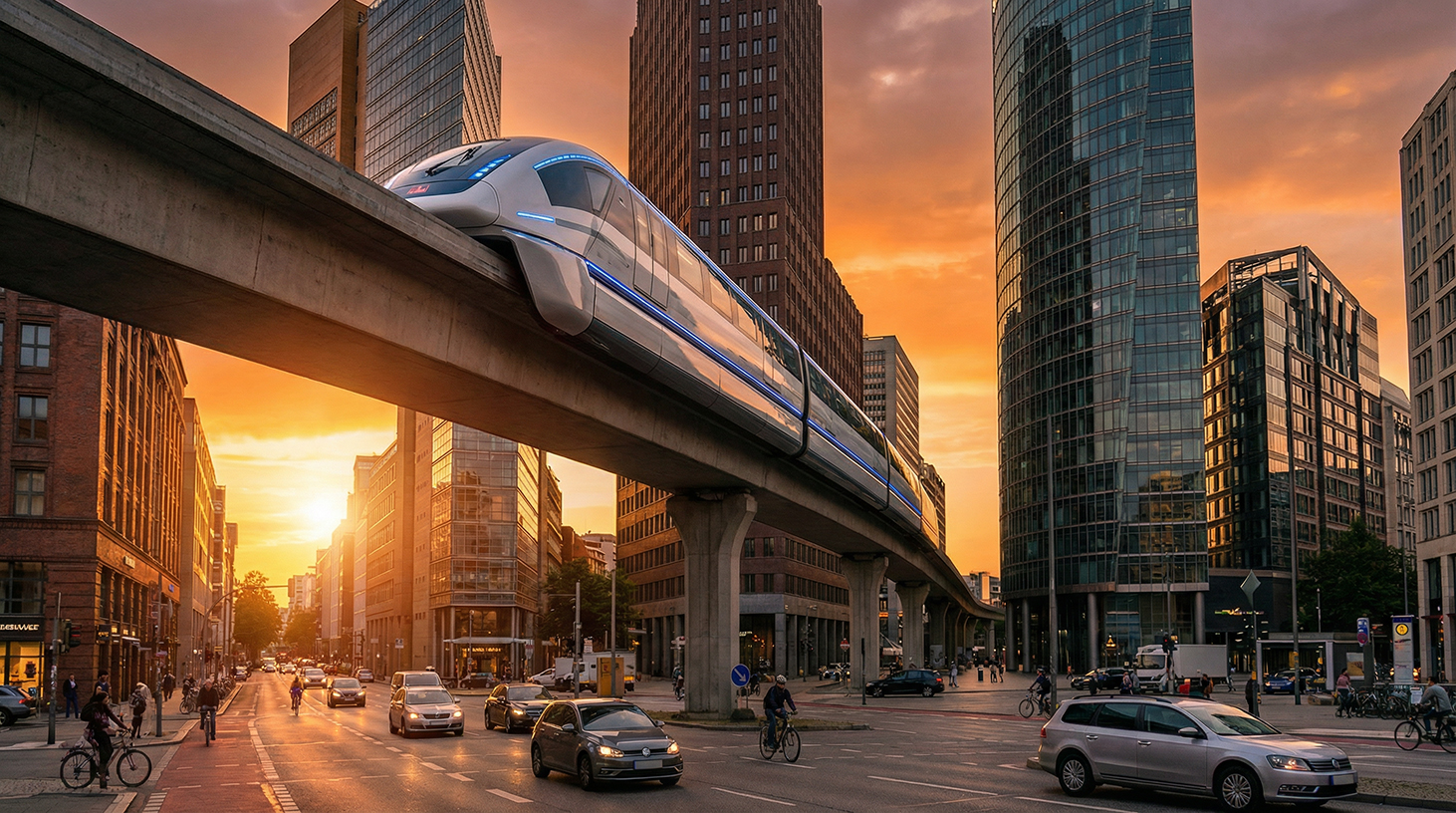
The maglev train and its floating comeback: Why the Transrapid is getting a new chance as a local transport system – Creative image: Xpert.Digital
A comeback for a technology declared dead: Ministry of Transport plans radical restart for the maglev train
Much cheaper than a subway: Is the maglev train experiencing a major comeback in Germany?
The Transrapid was long considered the ultimate symbol of German technological dreams – and of spectacularly failed billion-euro projects. Since Edmund Stoiber's legendary, rambling airport speech, the topic of magnetic levitation trains seemed to have been definitively consigned to the archives in Germany as a political farce. But now a transport policy sensation is brewing: Over two decades later, magnetic levitation technology is poised for a surprising comeback. Driven by new funding plans from the Federal Ministry of Transport, the train of the future is no longer intended to traverse the country as a high-speed long-distance train, but rather to revolutionize urban public transport as a quiet, autonomous, and above all, cost-effective alternative to the subway. With the "Transport System Bögl" (TSB), a production-ready solution from Bavaria is already available, having secured initial regulatory approvals and undergoing serious testing in cities like Nuremberg and Hamburg. But is this system truly the hoped-for savior for cash-strapped municipalities, or is the historical infrastructure trauma about to repeat itself on a smaller scale? A closer look at the technology, the costs, and the concrete criticism from traffic experts reveals what is at stake now.
The story of a German trauma
There are technologies that carry more symbolic weight than function. The Transrapid was one of them. For decades, the magnetic levitation train stood for what Germany could have been: fast, precise, technologically superior. And then it came to represent what Germany sometimes fails at: cost overruns, political vanity, and the inability to realize visionary projects. Edmund Stoiber's legendary speech from 2002, in which he explained the journey from Munich's main train station to the airport in a captivatingly rambling and enthusiastic tone, became a viral symbol of a technology that failed to make it from the test track in Emsland into the reality of German infrastructure.
Now, more than two decades later, Federal Transport Minister Patrick Schnieder (CDU) is bringing the maglev train back from the museum. Not as a long-distance giant speeding across the country at 500 km/h, but in a new, more modest and pragmatic role: as an urban means of local transport, designed completely differently from the classic Transrapid and intended to be a serious alternative to subways and trams.
What Schnieder is planning and why now
In March 2026, it was announced that the Federal Ministry of Transport intends to promote magnetic levitation technology as an alternative form of mobility. The plan is based on a feasibility study from 2021, commissioned by former Transport Minister Andreas Scheuer (CSU), which classifies modern magnetic levitation technology as an available and competitive alternative to conventional, rail-guided transport systems. The Ministry explicitly states that the technology window is open – a spokesperson explained that magnetic levitation technology offers advantages over other systems, particularly under challenging topographical conditions.
The vehicle for implementation is the Municipal Transport Financing Act (GVFG). According to the coalition agreement, this law is intended to explicitly promote innovative approaches such as magnetic levitation trains. Specifically, the law allows for up to 90 percent federal funding of public transport infrastructure projects – approximately two billion euros are available for this purpose this year. This is not a non-binding declaration of intent, but a concrete political and financial framework.
The Bögl transport system: The real star
The Transrapid, which Stoiber once used to make hearts beat faster, is not the same system that Schnieder now wants to establish in cities. The key player is instead the Transport System Bögl, or TSB for short – developed by the Bavarian Max Bögl Group from Sengenthal in the Upper Palatinate. The TSB is a fundamentally different technology than the high-speed Transrapid: quieter, slower, optimized for urban use, and above all, more economical to operate.
The milestones this system has achieved recently are remarkable. In November 2024, the German Federal Railway Authority (EBA) granted TSB Betriebs GmbH official approval to operate public maglev lines in accordance with the General Maglev Act – the first and, to date, only company in Europe to receive this authorization. This official approval is not a symbolic recognition, but a legally binding prerequisite for the actual operation of public lines. Max Bögl has been operating a test track in Sichuan Province, China, for several years – an operational foundation that ultimately enabled the company to obtain approval in Germany.
The system operates autonomously, without a driver, on its own concrete track – the so-called Guideway system. It floats magnetically on a steel rail and is driven by linear motors. With a capacity comparable to a subway, an energy consumption of 3.3 kWh/km (significantly less than a conventional tram at 4.2 kWh/km), and maintenance costs of just €0.27 per kilometer compared to €0.87 for a tram, the TSB boasts impressive specifications.
The decisive cost advantage compared to the subway
The key economic argument for maglev trains in urban areas lies in comparison to the most expensive conventional public transport system: the underground tram. A subway costs between 150 and 200 million euros per kilometer to build – a figure that regularly drives urban planners and local politicians to despair and effectively makes many urgently needed public transport projects impossible. According to the manufacturer, the TSB operates within a cost range of 30 to 50 million euros per kilometer – a radical cost reduction that opens up new possibilities.
This comparison should not be accepted uncritically. The Tagesspiegel Checkpoint investigated and found that different cost estimates exist. While Max Bögl himself indicated a range of 30 to 50 million euros, the Berlin CDU calculated a significantly lower figure for a specific short route, while independent analysts estimated costs for the actual project planning at the higher end of this range. Furthermore, actual feasibility studies show that the total project costs quickly increase due to necessary stops, land acquisition, and connecting infrastructure. For the Nagold-Herrenberg project near Stuttgart, total costs of approximately 290 million euros were determined for a route of roughly 13 to 15 kilometers – including additional stops for local access.
Nevertheless, the structural cost advantage over the subway remains significant, especially since the TSB, as an elevated system on its own track, does not require costly tunnel construction and eliminates the geological uncertainties that regularly increase the cost of subway projects.
Our EU and German expertise in business development, sales and marketing


Our EU and German expertise in business development, sales and marketing - Image: Xpert.Digital
Industry focus areas: B2B, digitalization (from AI to XR), mechanical engineering, logistics, renewable energies and industry
More information here:
A thematic hub offering insights and expertise:
- Knowledge platform covering global and regional economies, innovation and industry-specific trends
- A collection of analyses, insights, and background information from our key areas of focus
- A place for expertise and information on current developments in business and technology
- A hub for companies seeking information on markets, digitalization, and industry innovations
Transrapid trauma overcome? Germany is making a second attempt with the magnetic levitation train
Where the magnetic levitation train is already being tested
Planning activity is underway and extends to several German cities. Nuremberg is currently furthest advanced in the feasibility study. There, a roughly four-kilometer route from the Bauernfeindstraße subway station, across the exhibition grounds, to the Klinikum Süd hospital is being examined. The Free State of Bavaria is covering 90 percent of the costs for the feasibility study, which compares the use of the TSB (Maglev Train) with a planned tramway on the same route. The interim results are both sobering and illuminating: Technically, the construction of a maglev train in Nuremberg is possible, and the construction costs, at around 70 million euros, are similar to those of a tramway – however, according to current analyses, the transport benefits are lower. The findings make it clear that the maglev train is not the superior solution everywhere, but rather has its specific applications.
The situation is different in the Stuttgart region: For the connection between Nagold and Herrenberg – a topographically challenging terrain with steep slopes and narrow valleys where conventional rail construction would be extremely costly – the TSB feasibility study arrives at a benefit-cost ratio of 1.19, which, in principle, makes it eligible for government funding. It is precisely in such terrain configurations that the topographical strengths of magnetic levitation technology become apparent, a fact explicitly emphasized by the Federal Ministry of Transport. Hamburg and other cities are also examining potential deployment scenarios.
The lesson from the failure of the classic Transrapid
To understand the risks of the new maglev project, one must know the history of the old one. The Transrapid didn't fail because of the technology, but because of miscalculations and political overambition. The planned Hamburg-Berlin line, which was considered the centerpiece of the German Transrapid project in the 1990s, was effectively abandoned in 1999 when cost estimates rose from three billion Deutsche Marks to nine billion – without the time advantage over a modernized ICE train being convincing anymore. In the end, the Transrapid would have saved only a good half hour on the Hamburg-Berlin route – too little for a billion-euro project.
The Munich Transrapid debacle of 2008 completed the dismantling of the German Transrapid myth. The 40-kilometer line from the main train station to Erding Airport, Stoiber's pet project, failed due to cost overruns: instead of the planned 1.85 billion euros, the project would have ballooned to over three billion. The world's only commercially operated Transrapid line—a 30-kilometer connection in Shanghai—demonstrates that the technology works. But it also shows that the Transrapid only thrives economically in very specific niche markets.
The new TSB system has learned from this history: It is smaller in scale, designed for shorter distances in urban environments, more cost-effective to build and operate, and avoids the politically toxic long-distance positioning. It attempts to occupy a realistic market niche – where a subway is too expensive and a tram is not feasible due to topographical or planning constraints.
Criticism and counterarguments
Not all experts share this enthusiasm. Transport planners and public transport specialists point out that maglev trains offer the fewest advantages precisely where they are most frequently discussed: in densely populated urban areas. The Nuremberg feasibility study, with its sobering assessment of its benefits, confirms this skepticism. Critics argue that the available funding would be better invested in expanding existing tram and subway networks, for which decades of planning and operational experience have been accumulated.
Particular criticism is directed at the focus on local transport. Experts, such as the operators of the specialist portal magnetbahn.de, believe that the use of maglev trains makes more sense in long-distance transport and complain that Schnieder is promoting precisely the application where the system shows the fewest advantages: in inner-city short-distance public transport, where subways and trams represent fully developed solutions. In long-distance transport, however – from Hamburg to Munich in two hours on a dedicated infrastructure not obstructed by freight or commuter trains – the advantages of magnetic levitation technology would be undeniable and economically sound.
The question of system compatibility is also relevant: Maglev trains cannot run on existing rail networks, require their own infrastructure, and thus create isolated solutions within the public transport network. Transfer connections must be carefully planned to prevent the system from becoming an attractive standalone solution without integration into the overall network.
What now will determine success or failure
The political course set by the Federal Ministry of Transport is a necessary but not sufficient step. Crucial to its actual success will be whether one or two real-world reference projects emerge in the coming years to prove the project's viability in practice. Nuremberg, Hamburg, and the Nagold-Herrenberg line are the candidates for this test case. The test track in Nuremberg could play a key role as an industrial demonstrator and validation project – less because of its impact on traffic on this specific route than because of its signaling effect for subsequent projects.
The crucial variable remains the time horizon. Public transport is a traditional market where innovations require time to gather the necessary evidence and establish the formal framework. In Germany, it regularly takes ten to fifteen years from the feasibility study to the commissioning of a new public transport line. Anyone announcing the Transrapid 2.0 in 2026 will only be able to judge its success or failure well into the 2030s – with the full weight of political headwinds, municipal budget constraints, and technical surprises that reliably plague German infrastructure projects.
Your global marketing and business development partner
☑️ Our business language is English or German
☑️ NEW: Correspondence in your native language!

Konrad Wolfenstein
I and my team are happy to be available to you as your personal advisor.
You can contact me by filling out the contact form here wolfenstein@xpert.digital:or simply call me at +49 7348 4088 965. My email address is
I'm looking forward to our joint project.