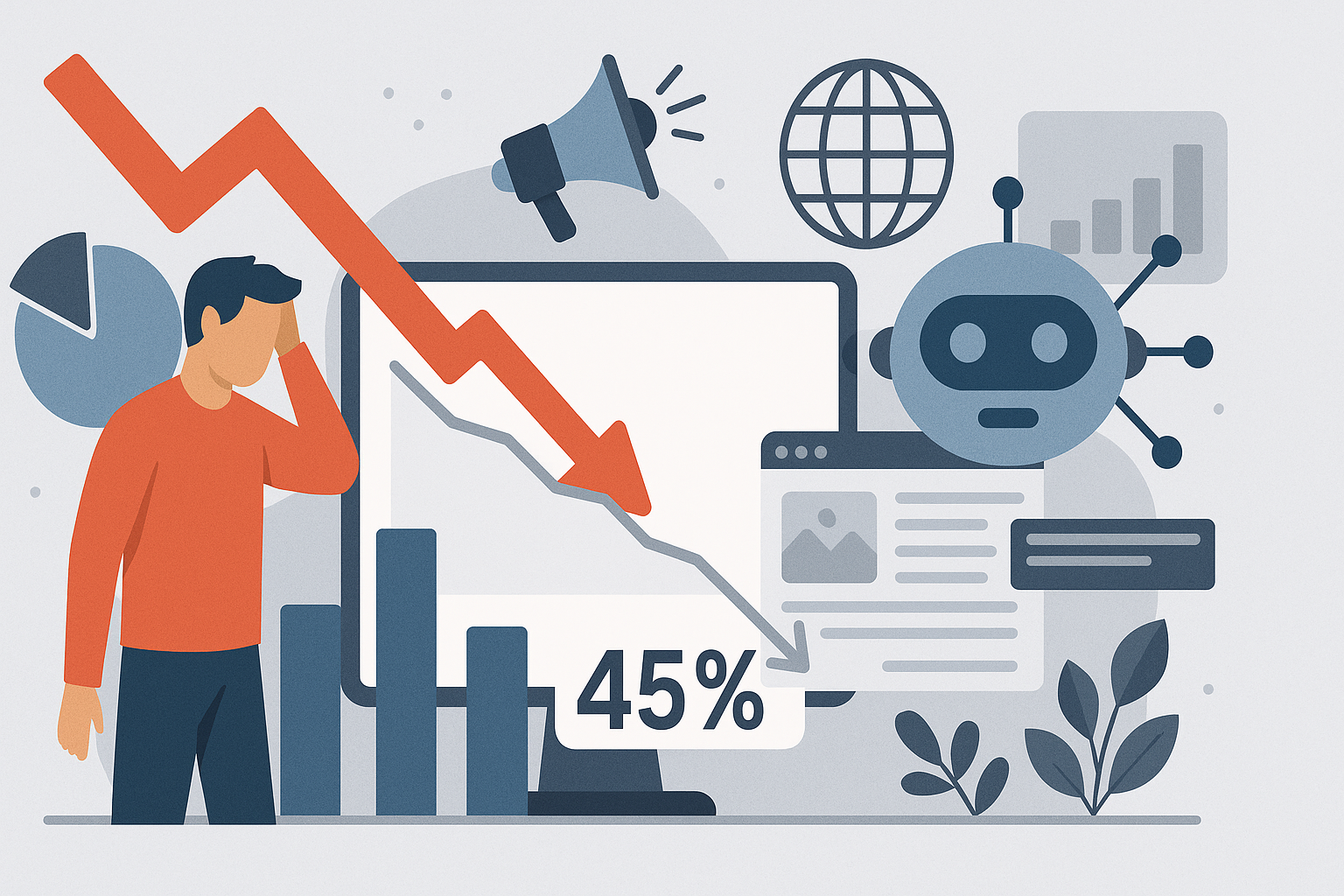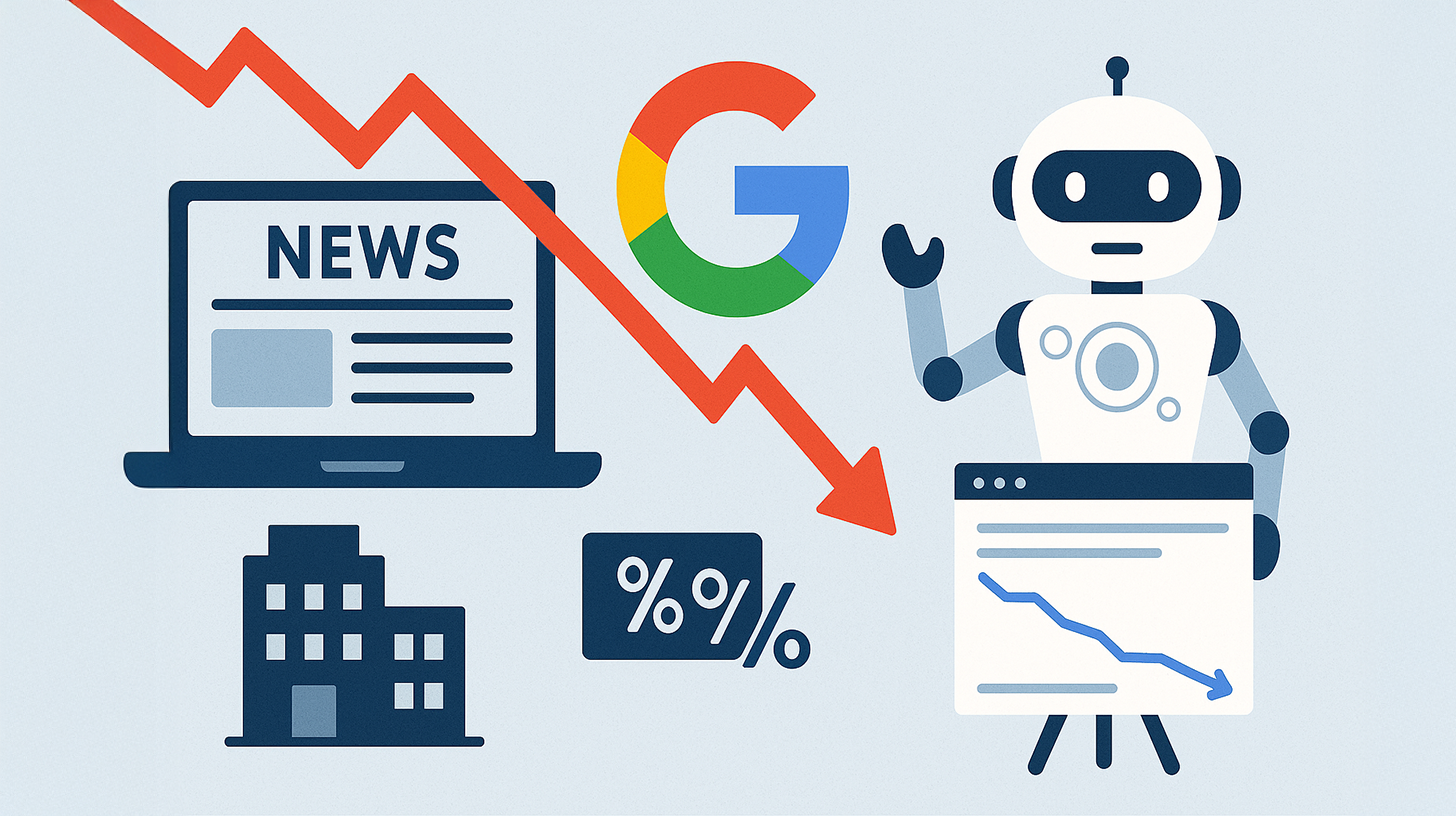
"Traffic-destroying Nightmare" – The SEO industry complex and its complicity – Why the crisis is self-inflicted – Image: Xpert.Digital
Secret documents reveal Google's plan: How the company deliberately lured publishers into a trap
### The Great Website Devastation: Why Millions of Clicks Disappear After Google's AI Update ### Google Isn't the Only Blame: How the SEO Industry Initiated Its Own Downfall ### Your Internet Experience Will Change Forever – and the Question of Blame Is More Complicated Than You Think ###
The traffic nightmare is here: Why the content industry is partly responsible for the current Google crisis
An earthquake is shaking the digital world, and its name is Google AI Overviews. Since the introduction of AI-powered answers in Google Search, website operators, publishers, and media companies worldwide have been experiencing a traffic-destroying nightmare. With dramatic drops in click-through rates of up to 55 percent, a business model that has relied on organic search traffic for decades is being shaken to its core. At the center of the storm is Google, which is employing a perfidious strategy to use publishers' content to keep users on its own platform—without fair compensation and often against the express wishes of the creators.
While outrage over Google's actions is loud and justified, simply assigning blame falls short. This crisis has deeper roots and is largely self-inflicted. For years, a toxic "SEO industry complex" of semi-professional agencies and self-proclaimed experts fostered an ecosystem that prioritized quantity over quality. The web was flooded with superficial content optimized solely for search engines, its only purpose being to generate clicks. Google is now using this self-created quality crisis as the perfect pretext to reshape the system to its advantage. This analysis sheds light on the toxic symbiosis between Google and the content industry, exposes the complicity of the SEO sector, and explains why the demise of the old internet is an inevitable consequence of years of misguided development.
Related to this:

Google's AI revolution and the end of the traditional internet
The discussion surrounding Google's introduction of AI-powered insights and their impact on website operators has reached a new level in recent months. What was initially touted as a technological innovation is increasingly revealing itself as a fundamental systemic shift that is redefining the internet's business model.
The shocking truth behind the numbers
Since the introduction of Google's AI overview in Germany on March 26, 2025, websites have experienced dramatic drops in organic traffic. Initial studies show an average decline in clicks of 17.8 percent, with the click-through rate falling by 14 percent. These figures reflect a global trend already evident in the US, where losses of up to 55 percent were recorded between April 2022 and April 2025.
The situation is particularly dire for large media companies. Traffic from Google to the 500 largest news sites fell by approximately 64 million visits between February 2024 and February 2025. At the same time, visitor numbers from AI-based recommendations increased by only about 5.5 million, which by no means compensates for the enormous losses. Publishers such as HuffPost and the Washington Post suffered declines of over 50 percent.
The impact is so severe that it's now being described as a "traffic-destroying nightmare" for online publishers. Business Insider CEO Barbara Peng had to lay off approximately 21 percent of her staff in May 2025, citing "extreme traffic declines beyond our control" as the reason for the layoffs.
The insidious system behind Google's strategy
What is particularly worrying is the systematic way in which Google has maneuvered publishers into a hopeless situation. Internal documents that surfaced during a US antitrust case reveal that Google deliberately prevented publishers from having granular control over the use of their content in AI features. Instead, publishers were given a choice: either allow their content to be used for AI products or they will disappear completely from Google Search.
A Google vice president confirmed in court that the company can train AI models with web content, even if publishers have explicitly objected to its use for AI training. This practice is carried out under the guise of the "search function," allowing Google to circumvent publishers' opt-out requests.
France has already fined Google €250 million for violating EU copyright laws by scraping online news content to train its Gemini algorithm. However, such fines don't seem to faze Google, as the company continues to pursue its course.
Related to this:
The SEO industry complex and its complicity
What is often overlooked in the discussion about Google's practices is the role of the SEO industry itself. Over the years, a toxic ecosystem has developed in which SEO agencies, web designers, and self-proclaimed experts with questionable know-how have flooded the market. An analysis of 1,653 SEO providers revealed that 88 percent hadn't even properly optimized their own websites for mobile devices.
The problem begins with the lack of professionalization within the industry. Many traditional print agencies and web designers jumped on the SEO bandwagon without possessing the necessary expertise. They sold SEO as an add-on or integrated it into standard packages without understanding the discipline's complexity.
These semi-experts not only flooded the market with substandard services, but also contributed to the emergence of a content culture that prioritized quantity over quality. LinkedIn and other platforms are now overflowing with superficial SEO tips and repeated nonsense posts from self-proclaimed experts.
Related to this:
The quality crisis in content marketing
However, the problems run deeper than just poor SEO. The entire content marketing ecosystem is suffering from a systemic quality crisis. Companies are producing massive amounts of content without a clear strategy or sufficient resources. The focus is often on the rapid production of cheap content rather than on developing valuable, user-centric information.
Andreas Quinkert, an expert in content quality, sums it up perfectly: "The biggest enemy of quality is haste." In the fast-paced world of online marketing, time is considered a scarce commodity, which is directly reflected in the inferior quality of much content. Companies believe they can finance premium quality out of pocket, even though the content competition is now far too fierce for that.
This development has contributed to the internet being flooded with superficial, SEO-optimized content that, while achieving rankings, offered little real value to users. Google is now exploiting precisely this weakness, arguing that AI-generated overviews offer a better user experience than clicking on these low-quality websites.
LinkedIn as a symptom of the problem
A particularly vivid example of these quality problems can be found on LinkedIn. The platform, originally conceived as a professional network, has been increasingly taken over by content marketing experts and SEO gurus who regurgitate the same superficial topics daily. An analysis shows that organic business content has shrunk to just two percent, while sponsored content has risen to 28 percent.
LinkedIn users are clearly critical: too many posts that go beyond the professional context and convey irrelevant information. SEO experts are publicly criticizing absurd claims made by their colleagues, such as the recommendation to completely abandon website SEO and focus solely on YouTube and LinkedIn.
More information here:
This development demonstrates how the SEO industry has discredited itself. Instead of offering sound, strategic advice, the market has been flooded with superficial tricks and short-term tactics. Many agencies sell SEO as a panacea without understanding or implementing the long-term strategic aspects.
Our recommendation: 🌍 Limitless reach 🔗 Connected 🌐 Multilingual 💪 Sales power: 💡 Authentic with strategy 🚀 Innovation meets 🧠 Intuition


From local to global: SMEs conquer the world market with a clever strategy - Image: Xpert.Digital
In an era where a company's digital presence determines its success, the challenge lies in creating an authentic, personalized, and far-reaching presence. Xpert.Digital offers an innovative solution that positions itself as the intersection of an industry hub, a blog, and a brand ambassador. It combines the advantages of communication and sales channels in a single platform and enables publication in 18 different languages. Cooperation with partner portals and the ability to publish articles on Google News and a press distribution list with approximately 8,000 journalists and readers maximize the reach and visibility of the content. This represents a crucial factor in external sales and marketing (SMarketing).
More information here:
Generative Engine Optimization: How publishers secure their visibility without traffic – Why HubSpot represents the wake-up call for content strategies
The toxic relationship between Google and content creators
What is often portrayed in public discourse as a one-sided blame game against Google is, in reality, the result of a toxic relationship between all parties involved that has lasted for years. Google, large media companies, B2C channels, and their SEO consultants have all profited from each other without considering the long-term consequences.
Publishers and websites became dependent on Google traffic for years, without building alternative channels or direct relationships with their users. At the same time, they optimized their content primarily for search engines rather than for human readers. This strategy worked until Google changed the rules of the game.
The HubSpot case exemplifies this problem. The company, long celebrated as an SEO role model, lost approximately 75 percent of its SEO traffic between 2024 and 2025. The number plummeted from 2.8 million visitors per month to 800,000. For years, HubSpot had scaled a "content game" by publishing a large number of how-to articles—13,000 URLs on its blog alone. However, when Google began prioritizing AI-generated answers, this mass-market system collapsed.
Related to this:

The new power dynamics on the internet
With the introduction of AI-generated summaries, Google has fundamentally shifted the balance of power on the internet. While website operators previously hoped to generate traffic and thus revenue through high-quality content, Google now keeps users on its own platform. Although the AI-generated answers sometimes include source citations, studies show that only eight percent of users actually click on these links.
This development leads to a paradoxical effect: AI systems depend on high-quality, up-to-date content, but simultaneously undermine the business models of those who create this content. If content creators can no longer monetize their work, the quality and quantity of new content decreases, which ultimately also negatively impacts AI systems.
Google argues that AI-powered insights have led to a 10 percent increase in search queries. For the company, this is a clear win, as more search queries also mean more advertising opportunities. Advertising revenue remains stable, while the costs of content creation are shifted to others.
Legal recourse and its limits
Legal action against Google's practices is already underway on several fronts. The Independent Publishers Alliance has filed a complaint with the European Commission, accusing Google of abusing its market power and causing publishers significant losses in traffic, readership, and revenue. The allegation is that AI summaries are generated using publisher material without adequately involving the publishers.
In parallel, the European Commission is intensively investigating the impact of Google's AI insights. The focus is on copyright infringements, unfair competition, and the protection of media diversity. The Commission is examining whether Google is violating the Digital Markets Act, the Digital Services Act, and the European Media Freedom Act.
However, legal avenues are reaching their limits. Google can argue that the content is used within the context of its "search function," which is difficult to challenge under existing laws. Furthermore, regulatory processes are lengthy, while Google continues to expand its AI integration.
The future of the internet without traffic-based business models
These developments suggest that traffic-based business models may be nearing their end. Dennis Ballwieser, editor-in-chief of "Apotheken-Umschau," has already stated that reach-oriented business models are dead. This assessment is supported by the latest data.
Successful content providers will have to rely on alternative strategies in the future. These include building direct relationships with users via newsletters and apps, developing paid content models, and licensing content to AI companies. Some publishers are already experimenting with Google's new "Offerwall" feature, which enables direct payments from users.
For SEO professionals, this means a complete realignment of their strategies. Instead of focusing solely on visibility, they must concentrate on brand mentions in AI-generated responses. The goal is no longer the click, but brand mentions in the AI overviews. Companies must learn that they can achieve less traffic but higher visibility in AI systems.
The role of AI visibility in the new era
A new field is already emerging: Generative Engine Optimization (GEO). SEO experts like David Konitzny argue that a good SEO strategy continues to form the foundation for AI visibility. Keyword clustering, website structure, and content depth also contribute to AI visibility, either in the form of brand mentions or as sources.
However, this creates new conflicts of interest. While SEO managers advocate for AI crawlers to capture as much content as possible, CEOs are often critical, as the AI ultimately "steals" content, and the resulting decline in traffic is directly linked to this. Some companies are already blocking GPT bots, which further complicates the situation.
Why the crisis is self-inflicted
The current crisis is not solely Google's fault, but the result of years of poor decisions in the content and SEO industry. Too many players focused on short-term tactics instead of sustainable strategies. Website operators became dependent on a single traffic channel without diversifying.
The SEO industry contributed to the devaluation of its own discipline by spreading misinformation and superficial methods. Content marketing was often misused as a cheap means of generating traffic instead of creating real value for users. These developments provided Google with the perfect pretext to reshape the system to its advantage.
At the same time, publishers and website operators failed to develop alternative business models in time. They remained in the comfort zone of free Google traffic, without recognizing the risks of this dependency. When Google then changed the rules of the game, they were defenseless.
Related to this:

The outlook: An internet in transition
The future of the internet will look different from what we've known for the past two decades. The old model of "free" content, financed by advertising and Google traffic, is no longer viable. It will be replaced by new forms of monetization and user relationships.
Companies that want to survive must quickly rethink their strategies. This means investing in their own channels, building more direct relationships with users, and developing new forms of value creation. SEO won't disappear, but its role will fundamentally change. Instead of traffic generation, the focus will shift to optimizing for AI visibility.
For the SEO industry itself, this means a long overdue professionalization. The era of superficial tricks and quick fixes is over. What's needed are strategic consultants who can support companies in their transition to the new digital reality.
Current developments are painful, but they are forcing the industry to undergo a necessary realignment. Those who recognize the signs of the times and act in a timely manner have the chance to succeed in the new digital landscape. Those who cling to old models, however, will be swept away by these developments.
We are here for you - Consulting - Planning - Implementation - Project Management
☑️ SME support in strategy, consulting, planning and implementation
☑️ Creation or realignment of the digital strategy and digitization
☑️ Expansion and optimization of international sales processes
☑️ Global & Digital B2B trading platforms
☑️ Pioneer Business Development

Konrad Wolfenstein
I would be happy to serve as your personal advisor.
You can contact me by filling out the contact form below or simply call me on +49 7348 4088 965 .
I'm looking forward to our joint project.
Write to me


Xpert.Digital - Konrad Wolfenstein
Xpert.Digital is a hub for industry focusing on digitalization, mechanical engineering, logistics/intralogistics and photovoltaics.
With our 360° Business Development solution, we support renowned companies from new business to after-sales.
Market intelligence, smarketing, marketing automation, content development, PR, mail campaigns, personalized social media and lead nurturing are part of our digital tools.
You can find more information at: www.xpert.digital - www.xpert.solar - www.xpert.plus
Keep in touch