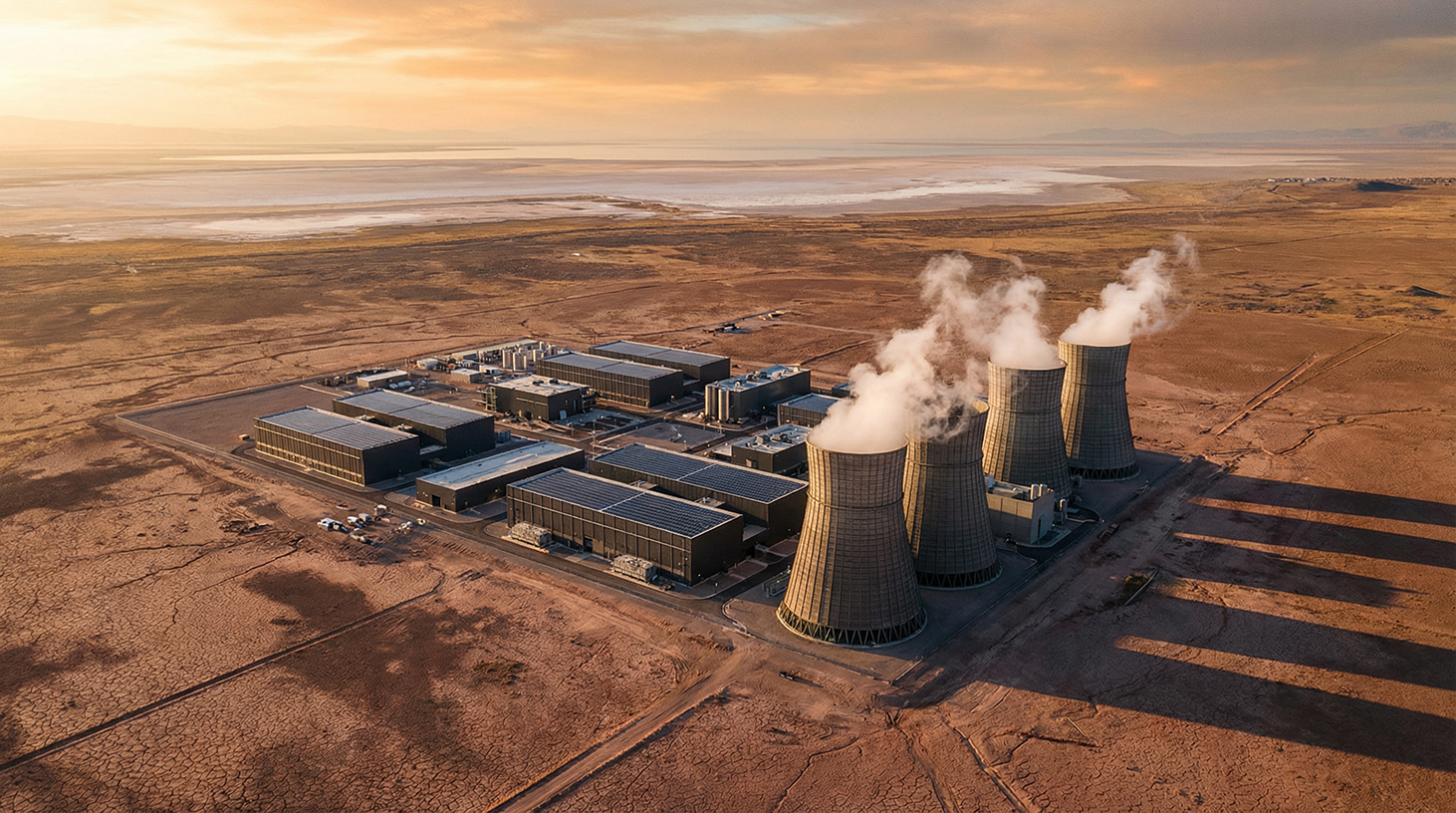
Million-Segen or ecological disaster? The tech giants' secret water theft: How AI is drying up an entire desert region – Image: Xpert.Digital
Thirsty server farms: Why the AI boom threatens water in the western USA
The extremely high price for Utah's new mega data centers: When AI consumes more water than agriculture – Utah's disastrous pact with Big Tech
In places like Eagle Mountain, Utah, massive data centers belonging to tech giants like Meta aresegenunprecedented revenue. But this sudden economic boom comes at an alarming, often invisible price: the server farms, whose energy and cooling needs are currently exploding due to the global AI boom, are in danger of running out of water. In the second driest state in the US, these mega-facilities consume billions of gallons of precious drinking water annually – indirectly subsidized by state tax dollars and a lack of reporting requirements. While local communities celebrate record revenues, vital ecosystems like the Great Salt Lake and the Colorado River are shrinking relentlessly. A fatal conflict of interest is igniting between economic technological progress and ecological survival, one that could escalate into a genuine systemic crisis for the entire American West.
Thirst in the digital age – how AI is drying up Utah
When server farms are worth more than farmland: The silent plundering of the West's water resources
In the city council of Eagle Mountain, a rapidly growing community in the US state of Utah, a meeting revolves around a seemingly innocuous question: Should the city hire its own judge? Just a few years ago, the answer would have been unthinkable. For decades, Eagle Mountain was a dormitory town on the edge of the desert, economically anemic and cut off from any significant investment. Today, the community can afford this luxury—thanks to a massive data center that Meta, the parent company of Facebook and Instagram, built on a greenfield site. The company's municipal energy tax recently brought in six million US dollars for the city—almost the equivalent of the entire annual cost of the city's police force.
A desert city is flourishing: Tax millions from the server rack
Eagle Mountain was founded just 30 years ago and for a long time had barely more than a few thousand residents. Today, it has 75,000 inhabitants, with about 500 new residents moving in every month – a growth rate unparalleled in Utah. The catalyst was the Meta data center. Before Meta even broke ground, the company invested $120 million in local infrastructure: roads, utility lines, and development work. On land that previously generated $35 a year in municipal taxes, there now stands a multi-billion-dollar server complex – and pays property taxes that, according to the city administration, generate as much revenue as 1,000 supermarkets combined.
The model seems coherent, almost flawless: A company establishes itself in an economically disadvantaged region, generating tax revenue and infrastructure without imposing any noticeable burden on residents. Eagle Mountain is planning four more data centers, which are already under construction or in the advanced planning stages. Utah has announced or completed at least 15 new data center buildings or campuses since 2021. The state's economic development agencies are hailing the tech companies as saviors of a region that has waited decades for a major industrial center.
The second driest state has no water to give away
But behind the tax revenues lies a systemic crisis that Utah is only just beginning to grasp. The state is the second driest in the entire United States. The Great Salt Lake, once Utah's geological heart and a habitat for millions of migratory birds, has shrunk dramatically in recent decades. Its water level is now more than two meters below its historical minimum, and environmental scientists estimate that a rise of more than two meters is needed to maintain even minimal ecological health. The Colorado River, the other major watercourse of the American West, is also struggling with chronically low water levels, caused by decades of overuse and exacerbated by climate change.
Into this fragile balance encroaches an industry whose appetite for resources is completely disproportionate to its visible physical presence. Data centers require water on an industrial scale – primarily for evaporative cooling, where water evaporates from cooling towers, dissipating the heat from the server racks. A hyperscale data center with a capacity of 100 megawatts can consume up to 500,000 cubic meters of water annually – and this in a region where every drop counts for agriculture, cities, and ecosystems.
The figures for the water theft: From 5.6 to 17.4 billion gallons
The scale of the problem can be quantified. At the national level, water consumption by American data centers tripled from 5.6 billion gallons in 2014 to 17.4 billion gallons in 2023 – 84 percent of which is attributable to hyperscale facilities, the mega-complexes of Meta, Google, Amazon, and Microsoft. Two-thirds of all data centers planned or built since 2022 are located in water-scarce regions, according to the International Energy Agency.
In the Colorado River basin, water consumption by data centers in five western states—Arizona, Colorado, Nevada, New Mexico, and Utah—could reach a total of 89,700 acre-feet by 2035, when considering both direct cooling and the water used by power plants to generate electricity. For comparison, the federal government spent more than $28.6 million in 2024 on 110 water conservation projects that saved a total of 63,631 acre-feet. The projected data center water consumption would not only negate these savings but significantly exceed them.
Cheap water as a location advantage: The hidden subsidy policy
What makes Utah so attractive to tech companies isn't just the availability of cheap land and a cool climate during the winter months, which reduces operating costs. It's primarily the price of water. Utah has the lowest municipal water rates in the entire United States—and, as a direct consequence of this pricing, the highest per capita water consumption in the country. This isn't by chance, but rather the result of decades of subsidy policies. A portion of property tax revenue from data centers in Utah flows directly to water utilities—as a subsidy for cheap water, which in turn encourages the establishment of other water-intensive industries.
Zach Frankel of the Utah Rivers Council, an environmental organization, describes this mechanism as perverse: The state is financing its own water waste by using taxpayer money from the tech industry to maintain the very price distortions that attract tech companies to Utah in the first place. The fact that data centers rely on water from the Colorado River or the Great Salt Lake watershed—two already chronically polluted systems—makes the situation an ecological tipping point.
A new dimension of digital transformation with 'Managed AI' (Artificial Intelligence) - Platform & B2B solution | Xpert Consulting

A new dimension of digital transformation with 'Managed AI' (Artificial Intelligence) – Platform & B2B solution | Xpert Consulting - Image: Xpert.Digital
Here you will learn how your company can implement customized AI solutions quickly, securely and without high entry barriers.
A managed AI platform is your all-inclusive, worry-free solution for artificial intelligence. Instead of dealing with complex technology, expensive infrastructure, and lengthy development processes, you receive a ready-made solution tailored to your needs from a specialized partner – often within just a few days.
The key advantages at a glance:
⚡ Rapid implementation: From idea to ready-to-use application in days, not months. We deliver practical solutions that create immediate added value.
🔒 Maximum data security: Your sensitive data stays with you. We guarantee secure and compliant processing without sharing data with third parties.
💸 No financial risk: You only pay for results. High upfront investments in hardware, software, or personnel are completely eliminated.
🎯 Focus on your core business: Concentrate on what you do best. We take care of the entire technical implementation, operation, and maintenance of your AI solution.
📈 Future-proof & scalable: Your AI grows with you. We ensure continuous optimization and scalability, and flexibly adapt the models to new requirements.
More information here:
Secret water thieves: Why nobody knows how thirsty AI really is
The transparency problem: Nobody knows how much water is really flowing
To make matters worse, Utah's political leaders simply don't know how much water the data centers actually consume. There is no legal requirement to report, no systematic data collection. Known individual figures offer some insight: The NSA data center near Salt Lake City, according to available data, consumes approximately 128 million gallons of water per year. The Meta data center in Eagle Mountain consumes an estimated 13.5 million gallons annually. An additional 15 data centers in the Great Salt Lake watershed have not yet disclosed their consumption figures.
Republican Representative Jill Koford has therefore launched an initiative that would require data centers to report their water consumption to state authorities. It's a first, modest step toward transparency—nothing more. Koford explicitly emphasizes that she doesn't want to forgo the economic opportunities that data centers bring to Utah. Her aim is oversight, not prevention. But even this minimal move has triggered political resistance because the tech lobby in Utah now wields considerable influence over legislation.
AI triples the thirst of machines
The situation is structurally exacerbated by the AI boom. AI data centers differ from conventional server farms not only in their computing power but also in their physical thermodynamics. The graphics processing units (GPUs) required for AI calculations—primarily Nvidia's H100 and H200 chips—generate extreme heat in a very confined space. While a conventional server rack has a power density of around 20 kilowatts, AI racks require up to 120 kilowatts—and this heat can only be managed by liquid cooling, which is significantly more water-intensive than conventional air cooling.
Forecasts by the Öko-Institut, commissioned by Greenpeace, predict that the global cooling water demand of data centers will rise to 664 billion liters by 2030 – almost four times as much as in 2023. At the same time, the electricity demand of AI data centers is expected to increase elevenfold by 2030 compared to 2023, from 50 billion to around 550 billion kilowatt-hours. The International Energy Agency forecasts that by 2026, data centers could consume as much electricity as the entire country of Japan.
The economic dilemma: taxes yes, consequences no
Utah's political class faces a real dilemma. The tax revenue from the data centers is real and significant—for communities like Eagle Mountain, it's life-changing. The environmental costs, however, are diffuse, delayed, and geographically dispersed. A sinking Great Salt Lake doesn't primarily harm the community hosting the data center—it harms farmers in the watershed, air quality due to dust stirred up from the lakebed, the ecosystem, and, in the long run, tourism around the Winter Olympics that Utah hopes to host in 2034.
Governor Spencer Cox has publicly stated that the majority of data centers use no water—a statement considered factually inaccurate by experts. The reality is more nuanced: Newer facilities increasingly rely on closed-loop cooling systems, which significantly reduce water loss through evaporation. Microsoft announced in December 2024 that it would equip all new AI data centers with such systems, saving approximately 33 million gallons of water per facility annually. Some operators in Utah, such as Novva, are already using waterless cooling. However, the vast majority of existing facilities continue to operate with water-intensive evaporative cooling.
The West is evaporating: Systemic risks for US agriculture
What has so far been perceived as a local environmental problem has the potential to escalate into a national resource crisis. Water policy experts are already warning of the so-called "buy-and-dry" pattern: Tech companies or their energy providers are buying up agricultural water rights to use them for data centers, thereby abandoning farmland. In parts of Arizona and Utah, this is no longer just a theory, but a lived reality. Farmers are selling their water rights because the proceeds far exceed the profits from agriculture.
An estimated 40 percent of the total AI data center capacity in the US is already located in the Colorado River basin. This is not a random concentration, but the result of location decisions that optimize land availability, electricity prices, tax breaks, and water costs—without factoring in the external costs of these decisions. This is a classic example of market failure in public goods, this time on a planetary scale.
Technological alternatives: Ways out of the waterfall
The technical solutions exist. In addition to the aforementioned closed-loop liquid cooling system, waste heat recovery is also gaining increasing attention. Data centers produce immense amounts of heat that could theoretically be fed into district heating networks instead of being wasted through evaporation. In Europe, particularly in the Netherlands, Denmark, and Finland, data centers already contribute to the heating of local cities. In the USA, this practice is still in its infancy.
Another approach is consistent site planning: Data centers in coastal regions that can utilize seawater-based cooling, or in northern climates where outside air is sufficient for cooling year-round, would structurally alleviate the water problem. The fact that so many facilities are nevertheless being built in water-scarce desert regions is a market failure – caused by distorted water prices, generous tax breaks, and a lack of transparency regulations.
The bottom line: wealth built on debt
Eagle Mountain has become richer. Utah's economy has benefited. And yet, the price is high. The Great Salt Lake is slowly dying, the Colorado River is struggling, and mandatory water consumption reporting is still not in place. If AI wants to change the world, it will first deplete the water of the American West. This is not a metaphor. It's hydrology.
Your global marketing and business development partner
☑️ Our business language is English or German
☑️ NEW: Correspondence in your native language!

Konrad Wolfenstein
I and my team are happy to be available to you as your personal advisor.
You can contact me by filling out the contact form here wolfenstein@xpert.digital:or simply call me at +49 7348 4088 965. My email address is
I'm looking forward to our joint project.