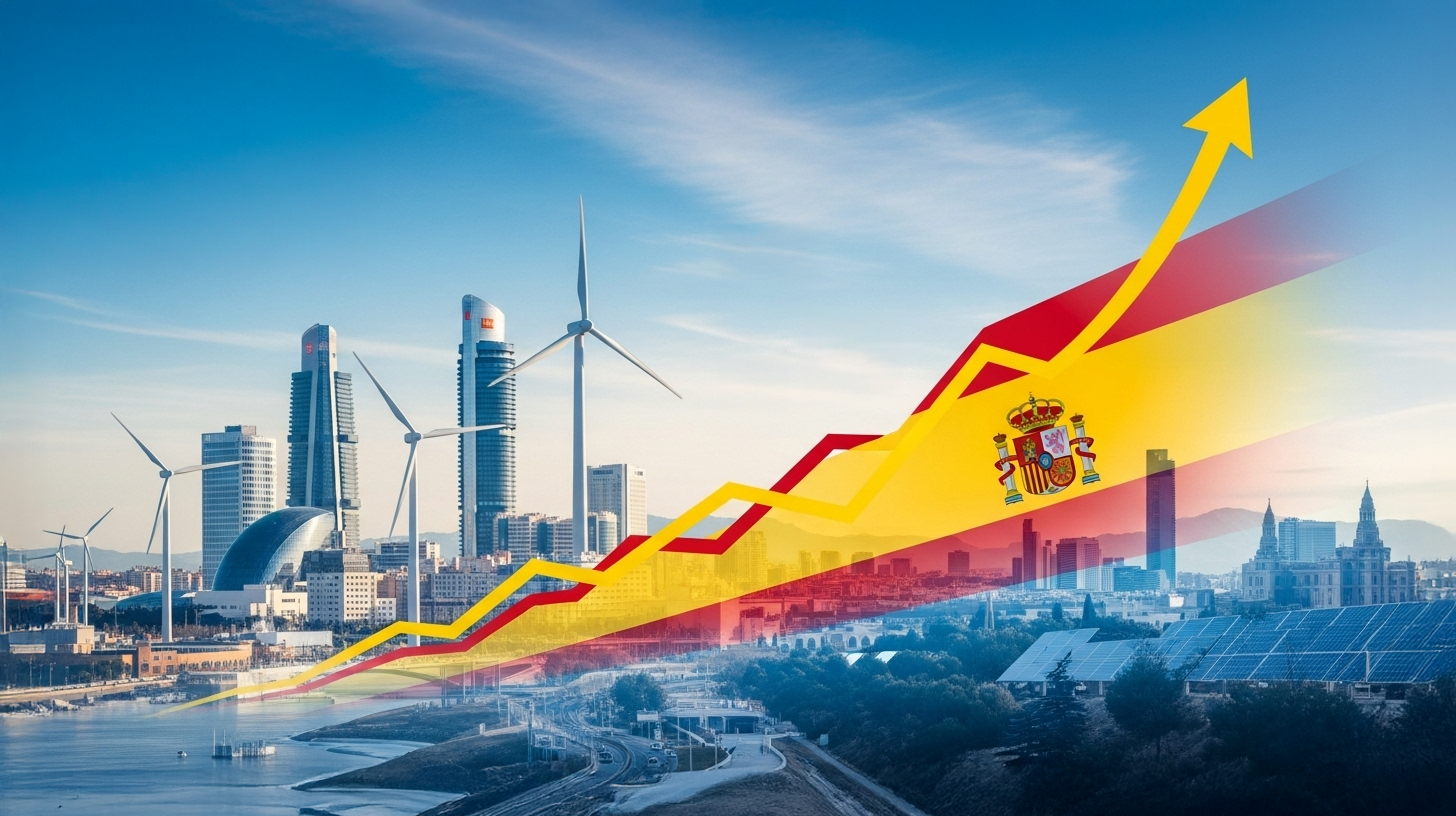
Spain | From problem child to model student: What Germany must now learn from Spain's economic success – Image: Xpert.Digital
The roles are reversed: What Spain is suddenly doing so much better than the German economy
What's actually going on with the Spanish economy?
How is it possible that a country considered one of the biggest losers in the Eurozone crisis just a few years ago has now become Europe's growth champion? This question arises in light of Spain's impressive figures. Its gross domestic product grew by a remarkable 3.2 percent in 2024, while the EU average was a meager 0.8 percent. The European Commission forecasts growth of 2.6 percent for Spain in 2025, putting the country once again significantly above the European average. In the second quarter of 2025, the Spanish economy even grew more strongly than expected, by 0.8 percent compared to the previous quarter.
This development is particularly noteworthy when compared to Germany. While Spain is booming, the German economy has stagnated for three years. In 2024, German GDP shrank by 0.2 percent, and experts expect minimal growth of at best between 0.1 and 0.2 percent for 2025. The OECD even ranks Germany as the laggard among developed industrial nations.
Related to this:

Why is Spain growing so strongly?
The reasons for Spain's impressive growth are multifaceted and mutually reinforcing. A key factor is strong private demand. New jobs and real income increases fuel consumption, while high immigration adds further dynamism to the system. According to the National Statistics Institute (INE), Spain's population increased by 1.7 million to 49.1 million between the beginning of 2021 and the beginning of 2025.
According to the European Commission, private consumption will continue to grow at a rate of 2.9 percent in 2025, matching the previous year's growth. Domestic demand contributed 0.8 percentage points to this growth in the second quarter of 2025. Household spending rose by 0.8 percent, while investment increased by 1.8 percent.
On the supply side, almost all major sectors expanded. Industrial production grew by 0.9 percent, services rose by 1.0 percent, and construction jumped by an impressive 2.3 percent. Only the primary sector contracted, by 6.4 percent.
What role does tourism play?
Tourism is undoubtedly one of the most important drivers of growth in the Spanish economy. Following the COVID-19 pandemic, this sector experienced a resurgence. The Spanish National Statistics Institute (INE) recorded 93.8 million international tourists between 2024 and November – significantly exceeding pre-pandemic figures and representing a 10 percent increase compared to 2023.
The financial impact is considerable. In the first two months of 2025 alone, 16.5 million international tourists visited Spain – an increase of 11.3 percent compared to the same period last year. Tourism revenues rose by 7.6 percent in February to €7.25 billion. For the first two months combined, total revenues amounted to €14.392 billion.
According to forecasts, the Spanish tourism industry will contribute over €260 billion to the national economy by 2025. The sector could create up to 3.2 million jobs and account for approximately 14.4 percent of total employment in Spain. Tourism contributes over 13 percent to Spain's GDP, making its importance to the overall economy virtually undeniable.
How important is immigration for Spain's success?
Immigration plays a crucial role in Spain's economic miracle. Experts attribute the boom largely to the influx of foreign workers. Between 2022 and 2024, Spain took in almost 750,000 migrants, mainly from Colombia, Peru, and Venezuela. The rapid integration of this group is due to their shared language, culture, and history.
According to the Spanish government, almost half of all jobs created in Spain since 2022 have been filled by half a million people from abroad. These new migrants bring valuable skills and a strong work ethic, leading to an increase in the number of workers, particularly in sectors such as tourism, technology, and services.
The Spanish government has recognized the country's urgent need for additional workers. Prime Minister Pedro Sánchez cited studies indicating that Spain needs 250,000 immigrants annually to maintain its prosperity. The government plans to grant residency and work permits to approximately 300,000 undocumented immigrants each year for the next three years.
Related to this:

What makes Spain's service sector so successful?
The service sector is a crucial engine of the Spanish economy. GDP from the service sector rose to €286.739 billion in the second quarter of 2025, reaching an all-time high. Alongside the booming tourism industry, other export-oriented services such as consulting, financial services, and IT are also thriving. Spain is increasingly positioning itself as a major player in the international services market.
This trend is also reflected in the services balance. Spain achieved a positive services balance in 2024, meaning that the country exported more services than it imported. This is an important indicator of the competitiveness of the Spanish services sector in international markets.
What about labor market reforms?
Spain has implemented important labor market reforms in recent years, contributing to its economic dynamism. In 2022, the government introduced the principle of "arraigosroots," granting residency permits to those who have already spent time in Spain and established roots there.
The most recent labor market reform of 2022 aimed to restore workers' rights lost in previous reforms and to strengthen collective bargaining. Its main objective was to reduce unemployment and adapt labor legislation to changing economic conditions.
These reforms have contributed to an employment rate higher than ever before. Although unemployment remains high at 14.1 percent (as of November 2021), the trend is positive. The flexibilization of the labor market and the pragmatic approach to integrating migrants are contributing significantly to economic growth.
What advantages does Spain have in terms of energy costs?
A key competitive advantage for Spain lies in its energy costs. The country has invested heavily in renewable energy and boasts one of the most advanced green energy infrastructures in Europe. In 2024, renewable energy accounted for approximately 59 percent of Spain's total net electricity generation. Onshore wind power represented the largest share of the electricity mix, at around 24 percent.
Spain shines as Europe's leading provider of utility-scale solar energy. The country has more operational utility-scale solar power capacity (29.5 GW) than any other European country. In addition, it has more capacity under construction (7.8 GW) and in early development stages (106.1 GW) than the next three European countries combined.
This massive investment in renewable energies is making electricity in Spain increasingly cheaper overall. Thanks to its extensive renewable energy sources, Spain can even export cheap electricity to France. This gives Spanish industry a significant cost advantage over countries with higher energy prices.
Our EU and German expertise in business development, sales and marketing

Our EU and German expertise in business development, sales and marketing - Image: Xpert.Digital
Industry focus areas: B2B, digitalization (from AI to XR), mechanical engineering, logistics, renewable energies and industry
More information here:
A thematic hub offering insights and expertise:
- Knowledge platform covering global and regional economies, innovation and industry-specific trends
- A collection of analyses, insights, and background information from our key areas of focus
- A place for expertise and information on current developments in business and technology
- A hub for companies seeking information on markets, digitalization, and industry innovations
Why Germany is losing: Bureaucracy, energy and aging
What are Spain's demographic advantages?
While Germany grapples with the consequences of demographic change, Spain is benefiting from population growth driven by immigration. Spain's population increased by 1.13 percent from 48,085,361 to 48,630,010 as of January 1, 2024. The total population for 2024 was estimated at 49.1 million.
In the second quarter of 2024, Spain registered the most regular immigrants from Colombia (36,900), Morocco (25,100), and Venezuela (21,400). The largest population increases were recorded in the provinces of Madrid, the Valencian Community, and the Balearic Islands.
This demographic trend stands in stark contrast to Germany, where the number of citizens aged 20 to 64 will be around eleven percent lower by 2030 than in 2020. Germany is facing a massive demographic problem, while Spain is rejuvenating and expanding its working-age population through targeted immigration policies.
Why is Germany stagnating?
Germany has been struggling with economic stagnation for three years. The German economy shrank by 0.2 percent in 2024, and leading economic institutes expect growth rates of only between 0.1 and 0.2 percent for 2025. The problems are multifaceted and structural in nature.
A major problem is the high cost of energy. German companies have to pay significantly more for electricity than their competitors in other countries. The German electricity price for large industrial customers recently reached 23.3 cents/kWh, placing it in the upper range compared to other EU countries. These high energy prices are hindering companies' investment activities and thus their capacity for innovation.
The OECD identifies weak production as the main cause of Germany's prolonged economic slump. This is primarily due to weak export demand from China, which is particularly impacting German industry. Competition from Chinese products is causing difficulties for German manufacturers, especially in the automotive industry, in other sales markets.
Related to this:
What role does bureaucracy play?
Another serious problem in Germany is its excessive bureaucracy. In 2024, the regulatory burden for businesses, citizens, and public administrations amounted to €27.1 billion. Studies estimate that Germany loses €146 billion in economic output annually due to this high level of bureaucracy.
Growing bureaucracy is increasingly hindering growth and discouraging market entry. Germany is losing its appeal as a business location. A comparative study by the ZEW shows that bureaucracy and regulation are stifling growth and making Germany an unattractive business location.
More and more companies are considering relocating their production abroad, where bureaucratic hurdles are lower. Four out of ten companies are thinking about reducing or relocating their manufacturing abroad due to energy prices and bureaucracy in their home country.
What are the effects of demographic change in Germany?
Germany faces enormous demographic challenges. In 2023, the average age of the population was 44.6 years, while 22.3 percent of the German population was over 65. The fertility rate is only 1.35 – far below the replacement level of 2.1 children per woman.
By 2030, only half as many young people will be entering the labor market as older people will be leaving it. This demographic shift has been apparent for 50 years and is now irreversible. Germany can only try to adapt and mitigate the worst consequences.
The baby boomers are now retiring and there are simply too many of them. Forecasts predict that by 2060, one in three people will be at least 65 years old. Without massive immigration, the German population would continue to shrink.
What are the structural differences?
The structural differences between Spain and Germany are becoming increasingly apparent. While Spain benefits from young, dynamic immigration, Germany is struggling with an aging population and a shortage of skilled workers. Spain has successfully transitioned its energy supply to renewable energies and benefits from lower energy costs, while Germany suffers from high energy prices.
The Spanish government pursues a pragmatic immigration policy and specifically facilitates access to the labor market. Germany, on the other hand, struggles with bureaucratic hurdles and a restrictive migration policy. Spain has recognized and promoted its service sector, particularly tourism, as an engine of growth, while Germany is heavily dependent on its struggling industrial sector.
What lessons can be learned?
The Spanish economic miracle demonstrates that a smart combination of various factors can lead to impressive growth. A pragmatic approach to integrating migrants, massive investments in renewable energy, the promotion of the service sector, and flexible labor market reforms have made Spain Europe's growth champion.
Germany, however, must address its structural problems. Reducing bureaucracy, lowering energy costs, implementing a more proactive immigration policy, and modernizing economic structures are urgently needed. Without these reforms, Germany risks falling further behind while countries like Spain pull ahead.
Is the Spanish model sustainable?
The question of the sustainability of Spain's growth model is justified. The country is heavily dependent on tourism, which makes it vulnerable to external shocks. The high cost of living, especially in major cities, remains a problem. Rents and property prices are climbing to ever new heights.
Nevertheless, forecasts indicate a continued positive trend. The OECD predicts growth of at least 2.3 percent for Spain in 2025 and at least 2 percent in 2026. Spanish GDP is projected to reach approximately US$1.8 trillion in 2025.
Economic diversification is progressing. Alongside tourism, the technology sector is growing, and the number of highly skilled migrants is increasing. Massive investment in renewable energies is positioning Spain as a future energy exporter, particularly for green hydrogen.
What does this mean for the future of Europe?
The Iberian economic miracle is changing the balance of power in Europe. Spain is transforming from a crisis-ridden country into an engine of growth, while Germany, the former engine of the European economy, is faltering. This shift has far-reaching consequences for European integration and the distribution of economic and political power within the EU.
Spain's success demonstrates that it is possible to successfully implement structural reforms and modernize the economy. The country has proven that a combination of pragmatic migration policies, investments in future-proof technologies, and flexible labor market reforms can lead to sustainable growth.
Germany must see this development as a wake-up call. Without fundamental reforms, the country risks losing its status as Europe's economic powerhouse. The time for half-hearted measures is over – Germany needs a comprehensive modernization initiative to remain competitive in Europe and the world.
The Spanish example shows the way: courage to reform, pragmatism in implementation, and a willingness to explore new paths. Only in this way can Germany regain its former strength and maintain its position as Europe's leading economic power.
Related to this:

Your global marketing and business development partner
☑️ Our business language is English or German
☑️ NEW: Correspondence in your native language!

Konrad Wolfenstein
I and my team are happy to be available to you as your personal advisor.
You can contact me by filling out the contact form here wolfenstein@xpert.digital:or simply call me at +49 7348 4088 965. My email address is
I'm looking forward to our joint project.
☑️ SME support in strategy, consulting, planning and implementation
☑️ Creation or realignment of the digital strategy and digitization
☑️ Expansion and optimization of international sales processes
☑️ Global & Digital B2B trading platforms
☑️ Pioneer Business Development / Marketing / PR / Trade Fairs
🔄📈 B2B trading platform support – Strategic planning and support for export and the global economy with Xpert.Digital 💡


B2B trading platforms - Strategic planning and support with Xpert.Digital - Image: Xpert.Digital
Business-to-business (B2B) trading platforms have become a critical component of global trade dynamics and thus a driving force for exports and global economic development. These platforms offer significant advantages to companies of all sizes, especially SMEs—small and medium-sized enterprises—which are often considered the backbone of the German economy. In a world where digital technologies are increasingly prominent, the ability to adapt and integrate is crucial for success in global competition.
More information here: