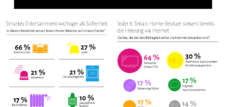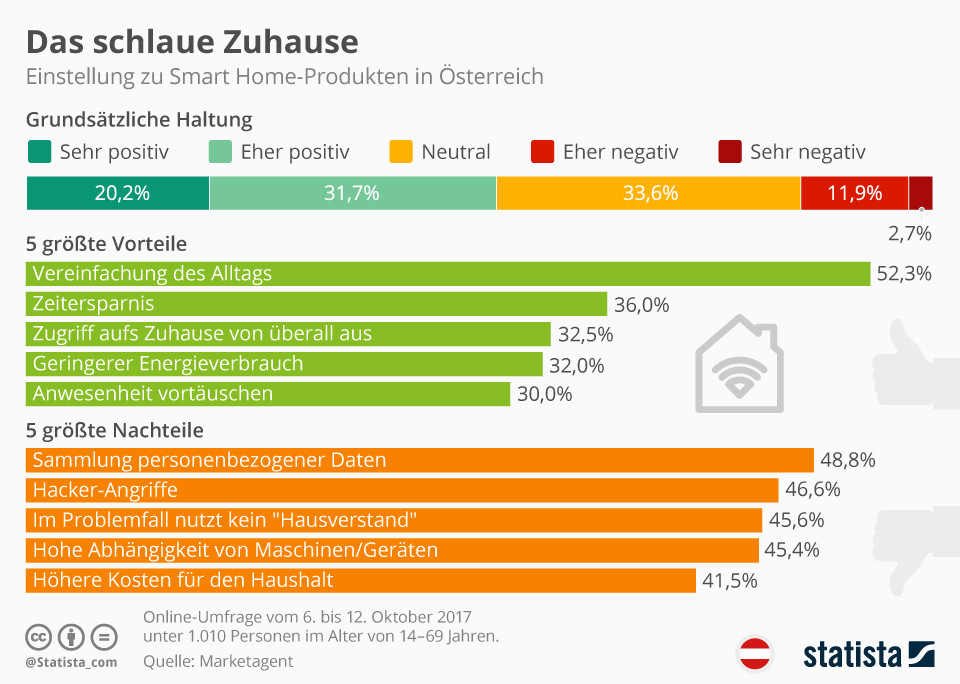
Not only are industrial machines increasingly networked with each other, but automation is also becoming relevant for private homes. The market research institute Marketagent recently investigated Austrians' attitudes toward such "smart home" applications as part of its "Digital Business Trends" event series. The results show a high degree of openness to these technological innovations: More than half (51.9 percent) of respondents view smart home technology positively. Only 14.6 percent reject it, while approximately one-third (33.6 percent) are neutral. Approval is higher among men and younger people than among women and older people.
The greatest advantage of home networking, cited by 52.3 percent of survey participants, is the simplification of everyday life, followed by time savings (36 percent) and the ability to access home technology from anywhere via the internet (32.5 percent). However, the latter also raises concerns: 46.6 percent consider the risk of hacker attacks a disadvantage of such systems, surpassed only by the worry of becoming a "transparent customer" through the collection of personal data (48.8 percent). Furthermore, 45.6 percent fear they will not be able to resolve any problems that arise with the systems themselves.
The most frequently used smart home products are currently smart TVs (36.4 percent) and motion and smoke detectors (29.2 and 27.1 percent, respectively). However, when it comes to planned purchases within the next three years, robotic vacuum cleaners lead the list at 13.6 percent. Smart lighting systems (12.7 percent) and automatic heating controls (10 percent) follow closely behind.


Keep in touch