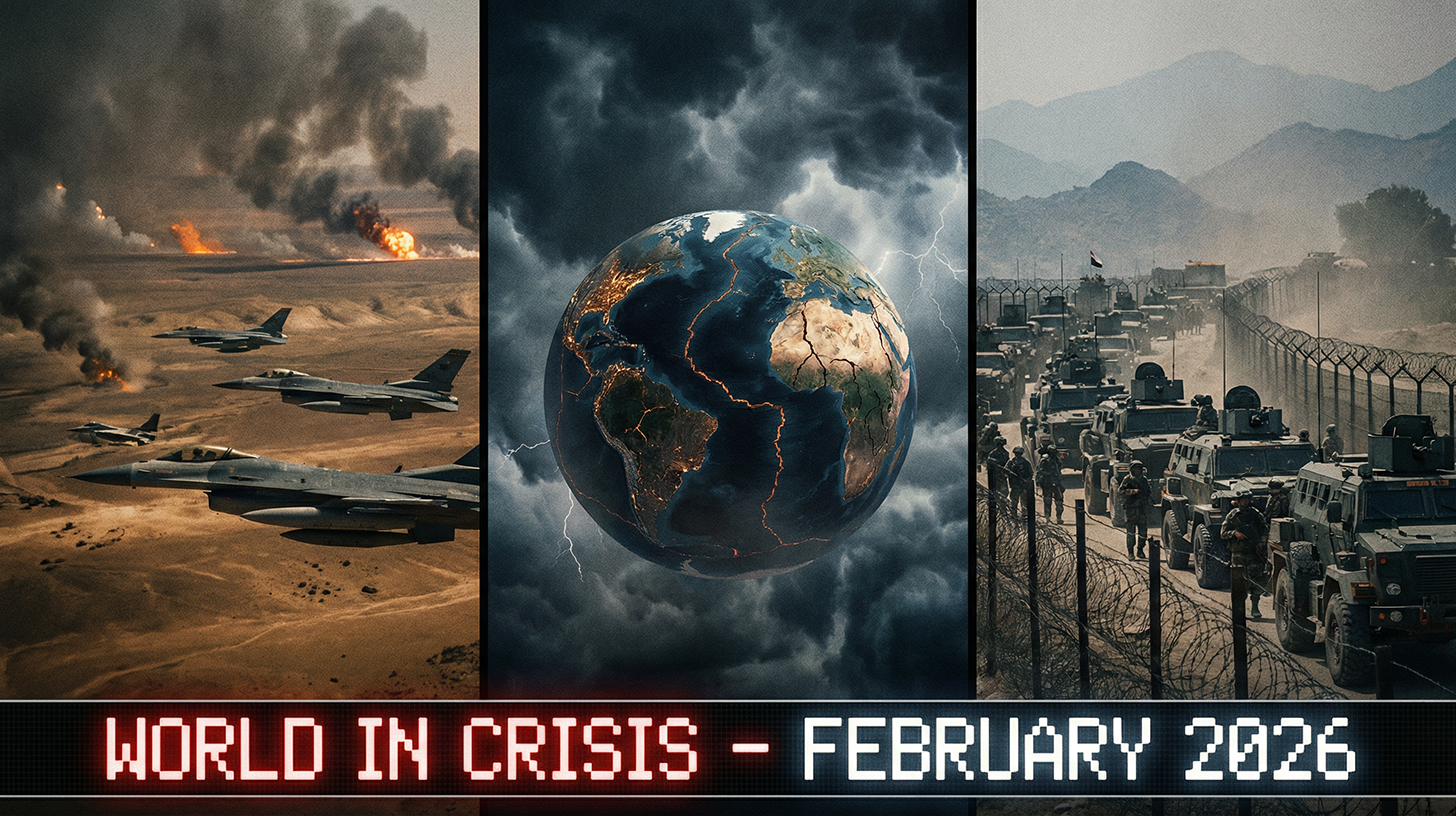
The week of February 22-27, 2026: Trump tariffs halted, escalation in the Middle East: The chronicle of a historic week of crisis – Image: Xpert.Digital
From Kabul to Tehran: When the world stood on the brink at the end of February
Supreme Court, Iran strike and wars: The perfect geopolitical storm in February 2026
There are periods when world history seems to stand still, and there are weeks when it unfolds with unbridled force. The days from February 22nd to 27th, 2026, undoubtedly belong to the latter category. In an extremely narrow window of time, global tensions intensified into an unprecedented stress test for the international order. While in the US, a historic Supreme Court ruling triggered a massive degree of economic uncertainty and declared the Trump administration's tariff policies unconstitutional at a stroke, major military clashes and open war broke out in South Asia between Pakistan and Afghanistan.
In parallel, the war in Ukraine raged unabated into its fifth year, fueled by relentless Russian bombing, and the largely forgotten humanitarian catastrophes in Sudan reached unimaginable proportions. The absolute climax of these geopolitical upheavals, however, was "Operation Epic Fury": an unprecedented, coordinated military strike by the US and Israel against Iran's leadership and infrastructure, which brought the Middle East to the brink of total conflagration. The following report reconstructs the chronology of those six fateful days. It reveals with chilling clarity how quickly seemingly isolated crises can merge into a global conflagration—and just how fragile the foundations of our world order have become.
From Kabul to Tehran: The 6 fateful days that shook the global system
The week of February 22-27, 2026, will go down in history as a period in which several geopolitical crises ignited simultaneously, bringing the fragile international order to the brink of collapse. What would have been perceived as isolated incidents in normal times coalesced during those six days into a perfect storm of military escalation, legal upheaval, and humanitarian disasters that shook the foundations of the global system.
The end of customs arbitrariness: The Supreme Court pulls the emergency brake
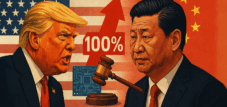
On February 20, 2026, immediately before the start of the week under consideration, the United States Supreme Court delivered a landmark decision. In a 6-3 ruling, the Supreme Court declared that the International Emergency Economic Powers Act (IEEPA) did not authorize the President to impose tariffs. Chief Justice John Roberts, in his majority opinion, stated unequivocally that the power to regulate did not include the power to tax and that the word "regulate" in IEEPA did not constitute an independent authorization to impose tariffs on imports. This ruling effectively declared all reciprocal tariffs imposed under IEEPA since January 2025, including the so-called Liberation Day tariffs of April 2025, unconstitutional in a single judgment.
The Trump administration's immediate reaction was swift. That same day, the president signed a new executive order, based on Section 122 of the Trade Act of 1974, imposing a global tariff of initially ten percent, which was raised to 15 percent the following day and took effect on February 24. For the global economy, this legal earthquake meant a period of massive uncertainty. Companies suddenly faced the question of how the refund process for IEEPA tariffs already paid would work, while at the same time new trade barriers were being erected under a different legal basis. The full extent of the impact on global supply chains and trade relations was difficult to predict, especially since many of the bilateral trade agreements concluded in the preceding months were based on IEEPA authority.
South Asia in open war: Pakistan against Afghanistan
While trade lawyers in Washington were still analyzing the fallout from the Supreme Court ruling, a conflict in South Asia escalated, bringing the region to the brink of full-scale war. On February 21, 2026, the Pakistani Air Force launched airstrikes against the Afghan provinces of Nangarhar, Paktika, and Khost, with the stated aim of destroying seven military camps belonging to the Pakistani Taliban (TTP) and the Islamic State of Khorasan (ISIS-K). Pakistan justified the attacks as retaliation for a series of terrorist attacks, including a devastating suicide bombing at a Shiite mosque in Islamabad.
The Taliban government in Kabul initially condemned the attacks and announced a calculated response. On February 24, hostilities escalated again as both sides opened fire along their borders. The decisive turning point came on February 26, when Afghanistan launched a military retaliatory operation against Pakistan, attacking more than 50 Pakistani border posts. Pakistan's response was devastating. Under the operation name Ghazab Lil Haqq, meaning "Anger for the Truth," the Pakistani air force bombed not only border areas but also the capital, Kabul, with its six million inhabitants, as well as the southern city of Kandahar, the seat of Taliban leader Haibullah Akhundzada. Pakistan's Defense Minister Khawaja Asif openly described it as open war.
The casualty figures on both sides were appalling and highly contradictory. The Taliban reported killing 55 Pakistani fighters, while Pakistani attacks in the provinces of Khost and Paktika claimed the lives of 19 civilians and wounded 26 others. Eyewitnesses in Kabul reported hearing numerous ambulance sirens after loud explosions, and security videos showed bright flashes in the night sky from the border clashes. Only at the end of February 27 did Taliban representatives signal their willingness to negotiate, after the bombing of Kabul and Kandahar had demonstrated the full extent of Pakistani military power.
The Ukraine war in its fifth year: No end in sight
Parallel to the events in South Asia, the week in question also marked the fourth anniversary of Russia's full-scale invasion of Ukraine on February 24. The UN Security Council held a special session on this occasion, during which Under-Secretary-General Rosemary DiCarlo, speaking on behalf of the Secretary-General, emphasized that with each continuation of the war, the suffering and the risks to regional and international peace increase.
The military reality on the ground brutally underscored this warning. On the night of February 25-26, Russia launched another massive missile and drone attack on Ukraine. The Ukrainian Air Force reported the use of 420 drones and 39 missiles that single night, including 11 Iskander-M ballistic missiles, 24 Kh-101 cruise missiles, and approximately 280 Shahed drones. It was the fourth Russian attack involving over 400 projectiles in February 2026 alone. This massive attack primarily targeted Ukrainian energy infrastructure and, significantly, took place on the eve of US-Ukrainian diplomatic talks in Geneva, illustrating Russia's tactic of launching major attacks around key negotiation dates.
An analysis by the International Institute for Strategic Studies reached the sobering conclusion that, despite suffering over 1.2 million casualties combined, Russia remains capable of continuing the war throughout 2026. Moscow is actively using the conflict to test new combat strategies and weapons systems, including a modernized version of the Shahed-136 drone with a range of 2,000 kilometers, theoretically capable of reaching targets across Europe. The Russian military leadership has also deployed fresh units toward Sloviansk and is evidently preparing for planned spring and summer offensives in 2026.
Our global industry and economic expertise in business development, sales and marketing


Our global industry and economic expertise in business development, sales and marketing - Image: Xpert.Digital
Industry focus areas: B2B, digitalization (from AI to XR), mechanical engineering, logistics, renewable energies and industry
More information here:
A thematic hub offering insights and expertise:
- Knowledge platform covering global and regional economies, innovation and industry-specific trends
- A collection of analyses, insights, and background information from our key areas of focus
- A place for expertise and information on current developments in business and technology
- A hub for companies seeking information on markets, digitalization, and industry innovations
The perfect storm: How 3 crises in 6 days brought the world to the brink
Operation Epic Fury: The attack on Iran
The event that overshadowed all others, and whose repercussions will shape the coming months and years, began on the night of February 27-28, 2026. Codenamed Operation Epic Fury, the United States and Israel launched a coordinated air campaign against Iran. In a video address, President Trump announced the commencement of military operations and called upon the Iranian people to rise up against their government. The stated objectives included preventing Iran from developing nuclear weapons capabilities, destroying Iran's missile program, neutralizing Iran's naval forces, and protecting American interests in the Middle East from the so-called Axis of Resistance.
In the first twelve hours of the campaign, the combined American-Israeli force carried out nearly 900 attacks on Iranian targets. The Israeli military alone reported hitting 500 Iranian targets, with attacks observed in 17 Iranian provinces. The combined force conducted a targeted decapitation campaign against the Iranian military and political leadership. Iran's Supreme Leader Ayatollah Ali Khamenei was killed, as confirmed by Iranian state media, as were the commander-in-chief of the Islamic Revolutionary Guard Corps and Ali Shamkhani, the Supreme Leader's representative on the Supreme Defense Council. Israeli operations also targeted several leading figures in Iran's nuclear program.
The Iranian response was swift and targeted not only Israel but also numerous Gulf states. Iran fired missiles at US bases in Bahrain, the United Arab Emirates, Kuwait, Jordan, and Saudi Arabia. Media outlets close to the IRGC reported that Iran attacked a total of 14 American bases. In Abu Dhabi, a drone targeting Zayed International Airport was intercepted, killing one person and injuring seven others. Debris from an interceptor missile also caused a fire at the Burj Al Arab in Dubai, and a fire broke out at the Jebel Ali port after an interception operation. Iranian sources reported at least 201 dead and 747 wounded as a result of the American-Israeli attacks, including students killed in an attack on an elementary school in the southeast of the country.
Forgotten Disasters: Sudan and South Sudan
While the world's attention was focused on the Middle East and South Asia, the world's largest humanitarian catastrophe continued to worsen in Northeast Africa. In Sudan, where the civil war between the Sudanese armed forces and the paramilitary Rapid Support Forces (RSF) began in April 2023, the crisis reached staggering proportions after 1,000 days of war. An estimated 33.7 million people, roughly two-thirds of the population, are expected to require humanitarian assistance in 2026. Over 9.2 million people have been internally displaced, and more than 21 million are suffering from acute food insecurity.
The Rapid Support Forces continued their attacks on the civilian population. In the week under review, at least 22 people were killed in a bombing of a military hospital in South Kordofan. A drone attack on a World Food Programme humanitarian convoy near El-Obeid killed one person and injured three others. In another drone attack on a vehicle carrying displaced families near Er Rahad, at least 24 people were killed, including eight children. The United Nations Security Council warned of indicators of a genocidal trajectory in the region.
In South Sudan, renewed fighting in Jonglei State exacerbated the already dire situation. Nearly 280,000 people have been displaced in just a few weeks, health facilities damaged, and the spread of cholera fueled. The UN Emergency Relief Coordinator warned of a perfect storm of conflict, climate shock, and deprivation. Thirteen health facilities were damaged or looted, and the cholera epidemic, which has been ongoing since September 2024, has already claimed over 98,000 cases and 1,624 lives nationwide.
Diplomatic glimmers of hope in the darkness
Amid the global spiral of crises, there were also some constructive diplomatic developments. US Vice President JD Vance visited Armenia, becoming the highest-ranking American government official ever to visit the country. Vance met with Prime Minister Nikol Pashinyan to discuss the implementation of a peace agreement to end the Nagorno-Karabakh conflict. During this visit, Armenia and the US concluded a nuclear deal that included a Section 123 agreement and nuclear energy exports to Armenia worth up to nine billion US dollars.
Saudi Arabia and Syria signed several agreements, including a joint low-cost airline, a new international airport in Aleppo, and a $1 billion telecommunications project. These investments were part of broader efforts following the lifting of US sanctions against Syria. The United States also announced the deployment of 200 troops to Nigeria to train and provide logistical support to Nigerian armed forces in their fight against Boko Haram and other Islamist terrorist groups.
A week that breaks the rules
The week of February 22-27, 2026, laid bare with chilling clarity just how fragile the international order has become. Armed conflicts escalated simultaneously on at least three continents, while the highest court of the world's leading economic power dismantled its president's trade policy architecture. Humanitarian crises in Africa reached new lows of hopelessness, while diplomatic instruments for containing these crises proved increasingly ineffective. Whether the attack on Iran marked the beginning of a short-lived military intervention or the prelude to a protracted regional conflagration was the dominant question in world politics at the end of that week.
Your global marketing and business development partner
☑️ Our business language is English or German
☑️ NEW: Correspondence in your native language!

Konrad Wolfenstein
I and my team are happy to be available to you as your personal advisor.
You can contact me by filling out the contact form here wolfenstein@xpert.digital:or simply call me at +49 7348 4088 965. My email address is
I'm looking forward to our joint project.