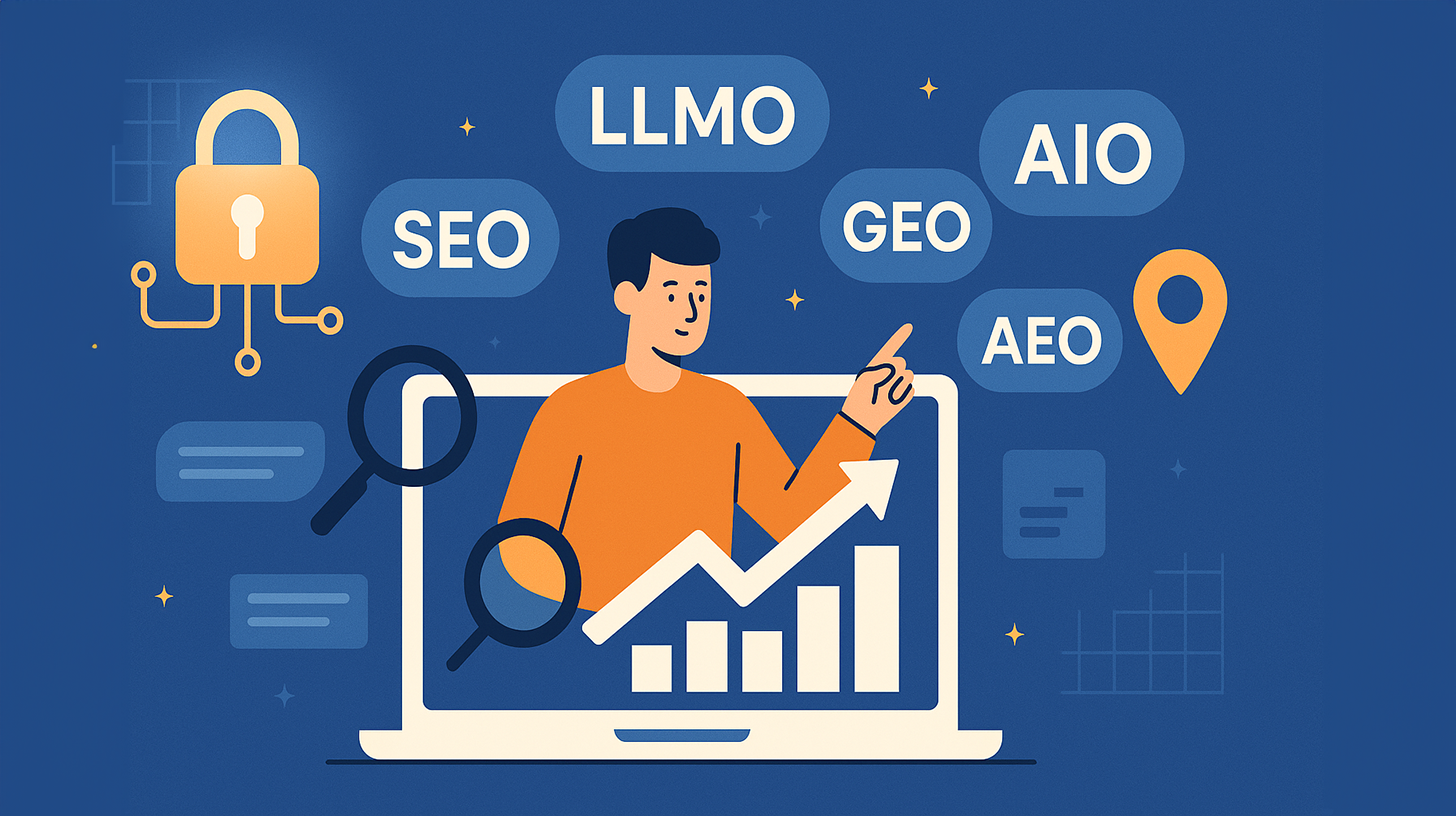
The new digital visibility – A decoding of SEO, LLMO, GEO, AIO and AEO – SEO alone is no longer enough – Image: Xpert.Digital
A strategic guide to Generative Engine Optimization (GEO) and Large Language Model Optimization (LLMO) (Reading time: 30 min / No advertising / No paywall)
The paradigm shift: From search engine optimization to generative engine optimization
Redefining digital visibility in the age of AI
The digital information landscape is currently undergoing its most profound transformation since the introduction of graphical web search. The traditional mechanism, in which search engines present a list of potential answers in the form of blue links and leave it to the user to sift through, compare, and synthesize the relevant information, is increasingly being replaced by a new paradigm. This is being replaced by an "ask-and-receive" model powered by generative AI systems. These systems perform the synthesis work for the user, delivering a direct, curated, and natural-language-language answer to a posed question.
This fundamental shift has far-reaching consequences for the definition of digital visibility. Success no longer simply means appearing on the first page of results; it is increasingly defined by being an integral part of the AI-generated response—whether as a directly cited source, a mentioned brand, or the basis for the synthesized information. This development accelerates the existing trend toward "zero-click searches," where users satisfy their information needs directly on the search results page without having to visit a website. It is therefore essential for businesses and content creators to understand the new rules of the game and adapt their strategies accordingly.
Related to this:


The new vocabulary of optimization: A decoding of SEO, LLMO, GEO, AIO and AEO
With the advent of these new technologies, a complex and often confusing vocabulary has developed. A clear definition of these terms is essential for a targeted strategy.
SEO (Search Engine Optimization): This is the established, fundamental discipline of optimizing web content for traditional search engines like Google and Bing. The main goal is to achieve high rankings in traditional, link-based search engine results pages (SERPs). SEO remains crucial even in the age of AI, as it forms the foundation for all further optimization.
LLMO (Large Language Model Optimization): This precise technical term describes the optimization of content specifically so that it can be effectively understood, processed, and cited by text-based large language models (LLMs) such as OpenAI's ChatGPT or Google's Gemini. The goal is no longer ranking, but rather inclusion as a credible source in the AI-generated responses.
GEO (Generative Engine Optimization): A somewhat broader term, often used synonymously with LLMO. GEO focuses on optimizing the entire generative system or "engine" (e.g., Perplexity, Google AI Overviews) that generates a response, rather than just the language model itself. It's about ensuring that a brand's message is accurately represented and disseminated across these new channels.
AIO (AI Optimization): This is an umbrella term with multiple meanings, which can lead to confusion. In the context of content optimization, AIO refers to the general strategy for adapting content for any type of AI system. However, the term can also refer to the technical optimization of the AI models themselves or to the use of AI to automate business processes. This ambiguity makes it less precise for a specific content strategy.
AEO (Answer Engine Optimization): A specialized sub-area of GEO/LLMO that focuses on optimizing for direct answer features within search systems, such as those found in Google's AI Overviews.
For the purposes of this report, GEO and LLMO are used as the primary terms for the new content optimization strategies, as they most accurately describe the phenomenon and are increasingly becoming the industry standard.
Why traditional SEO is fundamental, but no longer sufficient
A common misconception is that the new optimization disciplines will replace SEO. In fact, LLMO and GEO complement and extend traditional search engine optimization. The relationship is symbiotic: without a solid SEO foundation, effective optimization for generative AI is hardly possible.
SEO as a foundation: Core aspects of technical SEO – such as fast loading times, clean site architecture, and ensuring crawlability – are absolutely essential for AI systems to even find, read, and process a website. Likewise, established quality signals like high-quality content and thematically relevant backlinks remain crucial for being considered a trustworthy source.
The RAG connection: Many generative search engines use a technology called Retrieval-Augmented Generation (RAG) to enrich their answers with current information from the web. They often draw on the top results of traditional search engines. A high ranking in traditional search thus directly increases the likelihood of being used by an AI as a source for a generated answer.
The gap of SEO alone: Despite its fundamental importance, SEO alone is no longer sufficient. A top ranking is no longer a guarantee of visibility or traffic, as the AI-generated answer often overshadows traditional results and directly answers the user query. The new goal is to address and synthesize the relevant information within this AI-generated answer. This requires an additional layer of optimization focused on machine readability, contextual depth, and demonstrable authority—aspects that go beyond traditional keyword optimization.
The fragmentation of terminology is more than a semantic debate; it's a symptom of a paradigm shift in its early stages. The various acronyms reflect different perspectives vying to define the new field—from a technical viewpoint (AIO, LLMO) to a marketing-driven one (GEO, AEO). This ambiguity and the lack of a firmly established standard create a strategic window of opportunity. While larger, more siloed organizations are still debating terminology and strategy, more agile companies can adopt the core principles of machine-readable, authoritative content and secure a significant first-mover advantage. The current uncertainty is not a barrier, but an opportunity.
Comparison of optimization disciplines
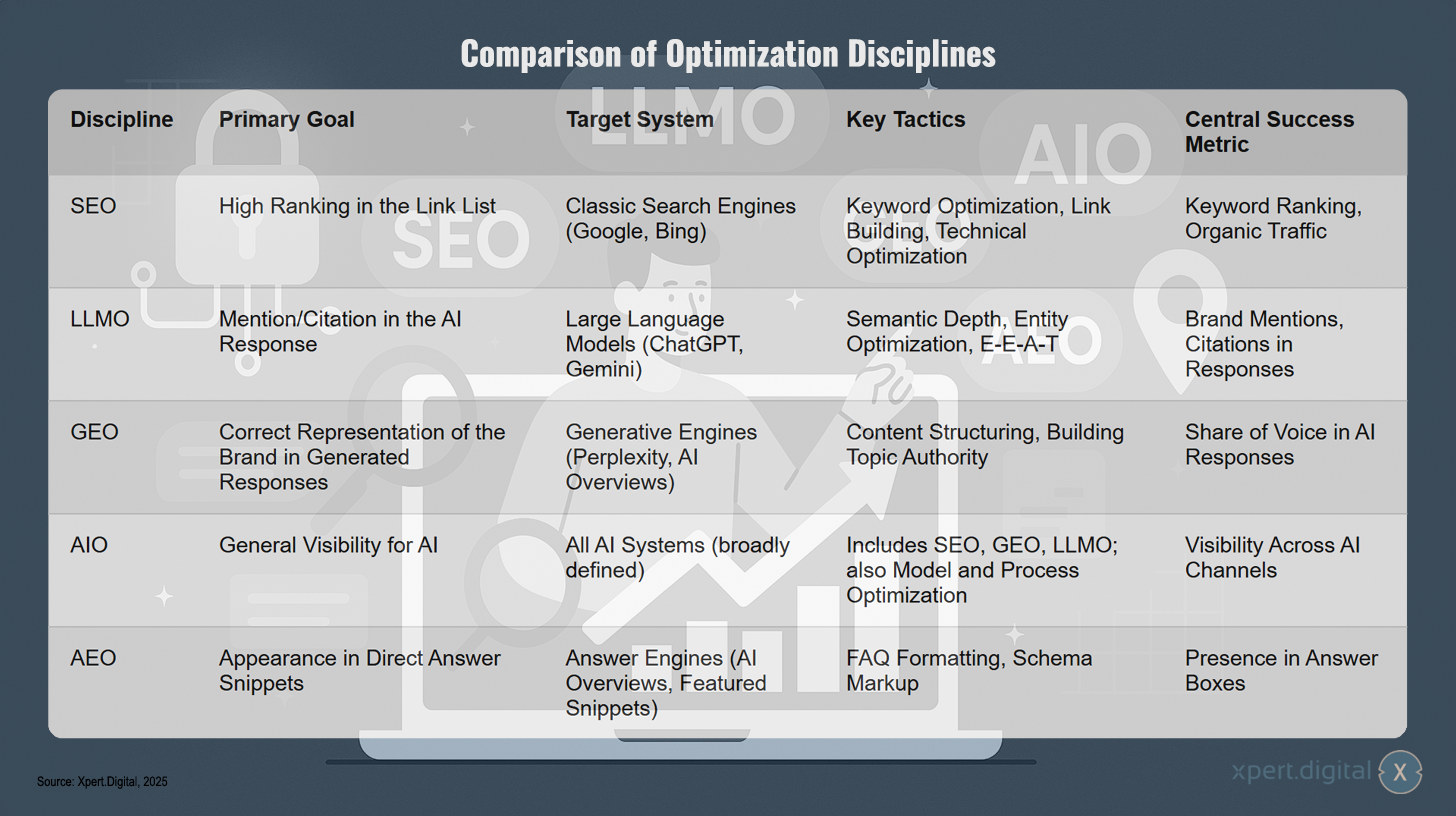
Comparison of optimization disciplines – Image: Xpert.Digital
The various optimization disciplines pursue different goals and strategies. SEO focuses on achieving high rankings in traditional search engines like Google and Bing through keyword optimization, link building, and technical improvements, with success measured by keyword rankings and organic traffic. LLMO, on the other hand, aims to be mentioned or quoted in AI responses from major language models like ChatGPT or Gemini by employing semantic depth, entity optimization, and EEAT factors – success is reflected in brand mentions and citations. GEO strives for the correct representation of the brand in responses generated by engines like Perplexity or AI Overviews, prioritizing content structuring and building topic authority, with share of voice in AI responses serving as a measure of success. AIO pursues the most comprehensive goal: general visibility across all AI systems. It combines SEO, GEO, and LLMO with additional model and process optimization, measured by visibility across various AI channels. AEO ultimately focuses on appearing in direct answer snippets from answer engines through FAQ formatting and schema markup, with presence in answer boxes defining success.
The engine room: Insights into the technology behind AI search
To effectively optimize content for AI systems, a fundamental understanding of the underlying technologies is essential. These systems are not magical black boxes, but are based on specific technical principles that determine their functionality and, consequently, the requirements for the content to be processed.
Large Language Models (LLMs): The core mechanics
Generative AI focuses on large language models (LLMs).
- Pre-training with massive datasets: LLMs are trained on enormous text datasets sourced from sources such as Wikipedia, the entire publicly accessible internet (e.g., via the Common Crawl dataset), and digital book collections. By analyzing trillions of words, these models learn statistical patterns, grammatical structures, factual knowledge, and semantic relationships within human language.
- The knowledge cutoff problem: A crucial limitation of LLMs is that their knowledge is frozen at the level of the training data. They have a so-called "knowledge cutoff date" and cannot access information created after that date. An LLM trained up to 2023 doesn't know what happened yesterday. This is the fundamental problem that needs to be solved for search applications.
- Tokenization and probabilistic generation: LLMs do not process text word by word, but rather break it down into smaller units called "tokens." Their core function is to predict the most probable next token based on the existing context, thus sequentially generating a coherent text. They are highly sophisticated statistical pattern recognizers and do not possess human consciousness or understanding.
Retrieval-Augmented Generation (RAG): The bridge to the live web
Retrieval-Augmented Generation (RAG) is the key technology that enables LLMs to function as modern search engines. It bridges the gap between the static, pre-trained knowledge of the model and the dynamic information of the internet.
The RAG process can be divided into four steps:
- Query: A user asks a question to the system.
- Retrieval: Instead of responding immediately, the system activates a "retriever" component. This component, often a semantic search engine, searches an external knowledge base—typically the index of a major search engine like Google or Bing—for documents relevant to the query. This is where the importance of high traditional SEO rankings becomes apparent: Content that ranks well in classic search results is more likely to be found by the RAG system and selected as a potential source.
- Augmentation: The most relevant information from the retrieved documents is extracted and added to the original user request as additional context. This creates an "enriched prompt".
- Generation: This enriched prompt is forwarded to the LLM. The model now generates its response, which is no longer based solely on its outdated training knowledge, but on the current, retrieved facts.
This process reduces the risk of “hallucinations” (inventing facts), allows for the citation of sources, and ensures that answers are more up-to-date and factually accurate.
Semantic Search & Vector Embeddings: The Language of AI
To understand how the "Retrieval" step works in RAG, one must understand the concept of semantic search.
- From keywords to meaning: Traditional search is based on matching keywords. Semantic search, on the other hand, aims to understand the intent and context of a query. For example, a search for "warm winter gloves" might also return results for "wool mittens" because the system recognizes the semantic relationship between the concepts.
- Vector embeddings as the core mechanism: The technical basis for this is vector embeddings. A special "embedding model" converts text units (words, sentences, entire documents) into a numerical representation – a vector in a high-dimensional space.
- Spatial proximity as semantic similarity: In this vector space, semantically similar concepts are represented as points located close to each other. The vector representing "king" has a similar relationship to the vector for "queen" as the vector for "man" has to the vector for "woman".
- Application in the RAG process: A user's request is also converted into a vector. The RAG system then searches its vector database to find the document vectors that are closest to the request vector. In this way, the most semantically relevant information is retrieved for enriching the prompt.
Thought models & thought processes: The next stage of evolution
At the forefront of LLM development are so-called cognitive models that promise an even more advanced form of information processing.
- Beyond simple answers: While standard LLMs generate an answer in a single pass, thought models break down complex problems into a series of logical intermediate steps, a so-called "chain of thought".
- How it works: These models are trained through reinforcement learning, where successful, multi-stage solution paths are rewarded. They essentially "think out loud" internally, formulating and discarding various approaches before arriving at a final, often more robust and accurate answer.
- Implications for optimization: Although this technology is still in its infancy, it suggests that future search engines will be able to handle far more complex and multifaceted queries. Content that offers clear, logical step-by-step instructions, detailed process descriptions, or well-structured lines of reasoning is ideally positioned to be used by these advanced models as a high-quality source of information.
The technological architecture of modern AI searches—a combination of LLM, RAG, and semantic search—creates a powerful, self-reinforcing feedback loop between the "old web" of ranked pages and the "new web" of AI-generated answers. High-quality, authoritative content that performs well in traditional SEO is prominently indexed and ranked. This high ranking makes it a prime candidate for retrieval by RAG systems. When an AI cites this content, it further strengthens its authority, which can lead to increased user engagement, more backlinks, and ultimately, even stronger traditional SEO signals. This creates a "virtuous circle of authority." Conversely, low-quality content is ignored by both traditional search and RAG systems, becoming increasingly invisible. The gap between digital "haves" and "have-nots" will thus widen exponentially. The strategic implication is that investments in fundamental SEO and building content authority are no longer solely focused on ranking; They secure a permanent place at the table for the AI-driven future of information synthesis.
🎯🎯🎯 Benefit from Xpert.Digital's extensive, five-fold expertise in one comprehensive service package | BD, R&D, XR, PR & Digital Visibility Optimization

Benefit from Xpert.Digital's extensive, five-fold expertise in a comprehensive service package | R&D, XR, PR & Digital Visibility Optimization - Image: Xpert.Digital
Xpert.Digital possesses in-depth knowledge across various industries. This allows us to develop tailored strategies precisely aligned with the requirements and challenges of your specific market segment. By continuously analyzing market trends and monitoring industry developments, we can act proactively and offer innovative solutions. The combination of experience and expertise generates added value and provides our clients with a decisive competitive advantage.
More information here:
Building Digital Authority: Why traditional SEO is no longer sufficient for AI-driven search engines
The three pillars of Generative Engine Optimization
The technical understanding from Part I forms the basis for a concrete, actionable strategic framework. To succeed in the new era of AI search, optimization efforts must rest on three central pillars: strategic content for machine understanding, advanced technical optimization for AI crawlers, and proactive management of digital authority.
Related to this:


Pillar 1: Strategic content for machine understanding
The way content is created and structured needs to fundamentally change. The goal is no longer just to convince a human reader, but also to provide a machine with the best possible basis for extracting and synthesizing information.
Topic authority as a new boundary
The focus of the content strategy is shifting from optimizing individual keywords to building comprehensive topical authority.
- Building knowledge centers: Instead of creating isolated articles for individual keywords, the goal is to create holistic "topic clusters." These consist of a central, comprehensive "pillar content" article covering a broad topic and numerous linked sub-articles addressing specific niche aspects and detailed questions. Such a structure signals to AI systems that a website is an authoritative and exhaustive source for a particular subject area.
- Comprehensive coverage: LLMs process information within semantic contexts. A website that comprehensively covers a topic—including all relevant facets, user questions, and related concepts—increases the likelihood of being used by an AI as a primary source. The system finds all the necessary information in one place and doesn't have to piece it together from multiple, less comprehensive sources.
- Practical application: Keyword research is no longer used to find individual search terms, but to map the entire universe of questions, sub-aspects and related topics that belong to a core competency area.
EEAT as an algorithmic signal
Google's EEAT concept (Experience, Expertise, Authoritativeness, Trustworthiness) is evolving from a mere guideline for human quality assessors to a set of machine-readable signals used to evaluate content sources.
Building trust strategically: Companies must actively implement and make these signals visible on their websites:
- Experience & Expertise: Authors must be clearly identified, ideally with detailed biographies that demonstrate their qualifications and practical experience. Content should offer unique insights from real-world practice that go beyond mere factual knowledge.
- Authority (Authoritativeness): Building contextually relevant backlinks from other reputable websites remains important. However, unlinked brand mentions in authoritative sources are also gaining in importance.
- Trustworthiness: Clear and easily accessible contact information, citing credible sources, publishing original data or studies, and regularly updating and correcting content are crucial trust signals.
Entity-based content strategy: Optimizing for things, not strings
Modern search engines base their understanding of the world on a "knowledge graph." This graph does not consist of words, but of real entities (people, places, brands, concepts) and the relationships between them.
- Elevating your brand to an entity: The strategic goal is to establish your brand as a clearly defined and recognized entity within this graph, one that is unambiguously associated with a specific field. This is achieved through consistent naming, the use of structured data (see section 4), and frequent co-occurrence with other relevant entities.
- Practical application: Content should be structured around clearly defined entities. Important technical terms can be explained in glossaries or definition boxes. Linking to recognized entity sources such as Wikipedia or Wikidata can help Google establish the correct connections and solidify the thematic classification.
The art of the snippet: structuring content for direct extraction
Content must be formatted in such a way that machines can easily disassemble and reuse it.
- Passage-level optimization: AI systems often don't extract entire articles, but rather individual, perfectly formulated "chunks" or sections—a paragraph, a list item, a table row—to answer a specific part of a query. A website should therefore be designed as a collection of such highly extractable information snippets.
- Structural best practices:
- Answer-First Writing: Paragraphs should begin with a concise, direct answer to an implicit question, followed by explanatory details.
- Use of lists and tables: Complex information should be presented in enumerations, numbered lists and tables, as these formats are particularly easy for AI systems to parse.
- Strategic use of headings: Clear, descriptive H2 and H3 headings, often phrased as questions, should logically structure content. Each section should focus on a single, focused idea.
- FAQ sections: Frequently Asked Questions (FAQ) sections are ideal because they directly reflect the conversational question-and-answer format of AI chats.
Multimodality and natural language
- Conversational tone: Content should be written in a natural, human style. AI models are trained on authentic, human language and prefer texts that read like a real conversation.
- Optimizing visual content: Modern AI can also process visual information. Images therefore need meaningful alt text and captions. Videos should be accompanied by transcripts. This makes multimedia content indexable and citable for AI.
The convergence of these content strategies—topic authority, EEAT, entity optimization, and snippet structuring—leads to a profound insight: the most effective content for AI is simultaneously the most helpful, clearest, and most trustworthy content for humans. The era of “writing for the algorithm,” which often resulted in unnatural-sounding texts, is coming to an end. The new algorithm demands human-centered best practices. The strategic implication is that investing in genuine expertise, high-quality writing, clear information design, and transparent source citations is no longer just “good practice”—it is the most direct and sustainable form of technical optimization for the generative age.
Pillar 2: Advanced technical optimization for AI crawlers
While strategic content defines the "what" of optimization, technical optimization ensures the "how"—it guarantees that AI systems can access, interpret, and process this content correctly. Without a solid technical foundation, even the best content remains invisible.
Technical SEO re-examined: The continuing importance of Core Vitals
The fundamentals of technical search engine optimization are not only relevant for GEO, but are becoming even more critical.
- Crawlability and indexability: This is absolutely fundamental. If an AI crawler – be it the well-known Googlebot or specialized bots like ClaudeBot and GPTBot – cannot access or render a page, it doesn't exist for the AI system. It must be ensured that relevant pages return the HTTP status code 200 and are not (unintentionally) blocked by the robots.txt file.
- Page speed and render timeouts: AI crawlers often operate with very short rendering windows for a page, sometimes only 1-5 seconds. Slowly loading pages, especially those with a high JavaScript content, risk being skipped or only partially processed. Optimizing Core Web Vitals and overall page speed is therefore crucial.
- JavaScript rendering: While the Google crawler is now very good at rendering JavaScript-intensive pages, this is not the case for many other AI crawlers. To ensure universal accessibility, critical content should already be included in the initial HTML code of the page and not loaded client-side.
Schema.org's strategic imperative: Create a networked knowledge diagram
Schema.org is a standardized vocabulary for structured data. It allows website operators to explicitly tell search engines what their content is about and how different pieces of information are related. A website marked up with Schema essentially becomes a machine-readable database.
- Why schema is crucial for AI: Structured data eliminates ambiguity. It enables AI systems to extract facts such as prices, dates, locations, ratings, or the steps in a guide with a high degree of certainty. This makes the content a far more reliable source for generating answers than unstructured text.
- Key schema types for GEO:
- Organization and Person: To clearly define one's own brand and the authors as entities.
- FAQPage and HowTo: For structuring content for direct answers and step-by-step instructions that are preferred by AI systems.
- Article: To transmit important metadata such as author and publication date, thereby strengthening EEAT signals.
- Product: Essential for e-commerce to make price, availability and rating data machine-readable.
- Best Practice – Interconnected Entities: Optimization should go beyond simply adding isolated schema blocks. By using the @id attribute, different entities on a page and across the entire website can be linked together (e.g., linking an article to its author and publisher). This creates a coherent, internal knowledge graph that makes the semantic relationships explicit for machines.
The emerging llms.txt standard: A direct communication line to AI models
llms.txt is a proposed new standard that aims to enable direct and efficient communication with AI models.
- Purpose and function: It is a simple text file written in Markdown format, placed in the root directory of a website. It provides a curated "map" of the website's most important content, cleaned of distracting HTML, JavaScript, and advertising banners. This makes it extremely efficient for AI models to find and process the most relevant information.
- Differentiation from robots.txt and sitemap.xml: While robots.txt tells crawlers which areas they should not visit, and sitemap.xml provides an unannotated list of all URLs, llms.txt offers a structured and contextualized guide to the most valuable content resources of a website.
- Specification and format: The file uses simple Markdown syntax. It typically begins with an H1 heading (page title), followed by a short summary in a quote block. H2 headings then group lists of links to important resources such as documentation or guidelines. Variants such as llms-full.txt also exist, which combine all the text content of a website into a single file.
- Implementation and tools: Creation can be done manually or supported by a growing number of generator tools such as FireCrawl, Markdowner, or specialized plugins for content management systems like WordPress and Shopify.
- The debate surrounding its acceptance: Understanding the current controversy surrounding this standard is crucial. Google's official documentation states that such files are not necessary for visibility in AI Overviews. Leading Google experts like John Mueller have expressed skepticism, comparing its usefulness to the outdated keyword meta tag. However, other major AI companies like Anthropic are already actively using the standard on their own websites, and its acceptance within the developer community is growing.
The debate surrounding llms.txt and advanced schema implementations reveals a critical strategic tension: that between optimizing for a single, dominant platform (Google) and optimizing for the broader, heterogeneous AI ecosystem. Relying solely on Google's guidelines ("You don't need it") is a risky strategy that forfeits control and potential visibility on other rapidly growing platforms like ChatGPT, Perplexity, and Claude. A forward-looking, "polygamous" optimization strategy that adheres to Google's core principles while also implementing ecosystem-wide standards like llms.txt and comprehensive schema is the most resilient approach. It treats Google as the primary, but not the only, machine consumer of a company's content. This is a form of strategic diversification and risk mitigation for a company's digital assets.
Pillar 3: Digital Authority Management
The emergence of a new discipline
The third, and perhaps most strategic, pillar of Generative Engine Optimization goes beyond mere content and technical optimization. It focuses on building and managing a brand's overall digital authority. In a world where AI systems attempt to assess the trustworthiness of sources, algorithmically measurable authority becomes a crucial ranking factor.
The concept of "Digital Authority Management" was significantly shaped by industry expert Olaf Kopp and describes a new, necessary discipline in digital marketing.
The bridge between the silos
In the age of EEAT and AI, the signals that build algorithmic trust—such as brand reputation, media mentions, and author credibility—are generated by activities traditionally housed in separate departments like PR, brand marketing, and social media. SEO alone often has limited impact on these areas. Digital authority management bridges this gap by uniting these efforts with SEO under a single strategic umbrella.
The overarching goal is the conscious and proactive development of a digitally recognizable and authoritative brand entity that can be easily identified by algorithms and classified as trustworthy.
Beyond backlinks: The currency of mentions and co-occurrence
- Mentions as a signal: Unlinked brand mentions in authoritative contexts are gaining massive importance. AI systems aggregate these mentions from across the web to assess a brand's awareness and reputation.
- Co-occurrence and context: AI systems analyze which entities (brands, people, topics) are frequently mentioned together. The strategic goal must be to create a strong and consistent association between the brand and its core competency topics across the entire digital space.
Building a digitally recognizable brand entity
- Consistency is key: Absolute consistency in the spelling of the brand name, author names, and company descriptions across all digital touchpoints is essential – from your own website and social media profiles to industry directories. Inconsistencies create ambiguity for the algorithms and weaken the entity.
- Cross-platform authority: Generative engines holistically assess a brand's presence. A unified voice and consistent messaging across all channels (website, LinkedIn, guest posts, forums) strengthen perceived authority. Reusing and adapting successful content for different formats and platforms is a key tactic here.
The role of digital PR and reputation management
- Strategic public relations: Digital PR efforts must focus on achieving mentions in publications that are not only relevant to the target audience but are also classified as authoritative sources by AI models.
- Reputation management: It is crucial to actively promote and monitor positive reviews on reputable platforms. Equally important is active participation in relevant discussions on community platforms like Reddit and Quora, as these are frequently used by AI systems as sources of authentic opinions and experiences.
The new role of SEO
- Digital authority management fundamentally changes the role of SEO within an organization. It elevates SEO from a tactical function focused on optimizing a single channel (the website) to a strategic function responsible for orchestrating a company's entire digital footprint for algorithmic interpretation.
- This implies a significant shift in organizational structure and required skills. The "Digital Authority Manager" is a new hybrid role that combines the analytical rigor of SEO with the narrative and relationship-building skills of a brand strategist and PR professional. Companies that fail to create this integrated function will find that their fragmented digital signals cannot compete with rivals who present a unified, authoritative identity to AI systems.
B2B procurement: Supply chains, trade, marketplaces & AI-powered sourcing

B2B procurement: Supply chains, trade, marketplaces & AI-powered sourcing with ACCIO.com - Image: Xpert.Digital
More information here:
From SEO to GEO: New metrics for measuring success in the AI era
The competitive landscape & performance measurement
Once the strategic pillars of optimization have been defined, the focus shifts to practical application in the current competitive landscape. This requires a data-driven analysis of the most important AI search platforms, as well as the introduction of new methods and tools for performance measurement.
Related to this:

Deconstruction of Source Selection: A Comparative Analysis
The various AI search platforms do not operate identically. They use different data sources and algorithms to generate their results. Understanding these differences is crucial for prioritizing optimization measures. The following analysis is based on a synthesis of leading industry studies, particularly the comprehensive study by SE Ranking, supplemented by qualitative analyses and platform-specific documentation.
Google AI Overviews: The Advantage of the Established System
- Source profile: Google takes a rather conservative approach. The AI Overviews rely heavily on the existing Knowledge Graph, established EEAT signals, and top organic ranking results. Studies show a significant, though not complete, correlation with the top 10 positions of traditional search.
- Data points: Google cites an average of 9.26 links per answer and exhibits high diversity with 2,909 unique domains in the analyzed study. There is a clear preference for older, established domains (49% of the cited domains are over 15 years old), while very young domains are considered less frequently.
- Strategic implication: Success in Google AI Overviews is inextricably linked to strong, traditional SEO authority. It's an ecosystem where success breeds further success.
ChatGPT Search: The challenger with a focus on user-generated content and Bing
- Source profile: ChatGPT uses Microsoft Bing's index for its web search, but applies its own logic for filtering and ordering results. The platform shows a clear preference for user-generated content (UGC), especially from YouTube, which is one of the most frequently cited sources, as well as for community platforms like Reddit.
- Data points: ChatGPT cites the most links (an average of 10.42) and references the largest number of unique domains (4,034). At the same time, the platform exhibits the highest rate of multiple mentions of the same domain within a single answer (71%), suggesting a strategy of in-depth analysis using a single, trusted source.
- Strategic implication: Visibility in ChatGPT requires a multi-platform strategy that includes not only optimization for the Bing index but also actively building a presence on important user-generated content platforms.
Perplexity.ai: The transparent real-time researcher
- Source profile: Perplexity is designed to perform a real-time web search for every query, ensuring the information is up-to-date. The platform is highly transparent and provides clear inline citations in its responses. A unique feature is the "Focus" function, which allows users to limit their search to a predefined selection of sources (e.g., only academic papers, Reddit, or specific websites).
- Data points: Source selection is very consistent; almost all responses contain exactly 5 links. Perplexity's responses show the highest semantic similarity to those of ChatGPT (0.82), suggesting similar content selection preferences.
- Strategic implication: The key to success on Perplexity lies in becoming a "target source"—a website so authoritative that users consciously include it in their focused searches. The platform's real-time nature also rewards particularly current and factually accurate content.
The differing sourcing strategies of the major AI platforms create a new form of "algorithmic arbitrage." A brand struggling to gain a foothold in Google AI Overview's highly competitive, authority-driven ecosystem might find an easier path to visibility via ChatGPT by focusing on Bing SEO and a strong presence on YouTube and Reddit. Similarly, a niche expert can bypass mainstream competition by becoming an essential source for focused searches on Perplexity. The strategic takeaway is not to fight every battle on every front, but rather to analyze the different "barriers to entry" of each AI platform and align content creation and authority-building efforts with the platform that best aligns with the brand's strengths.
Comparative analysis of AI search platforms
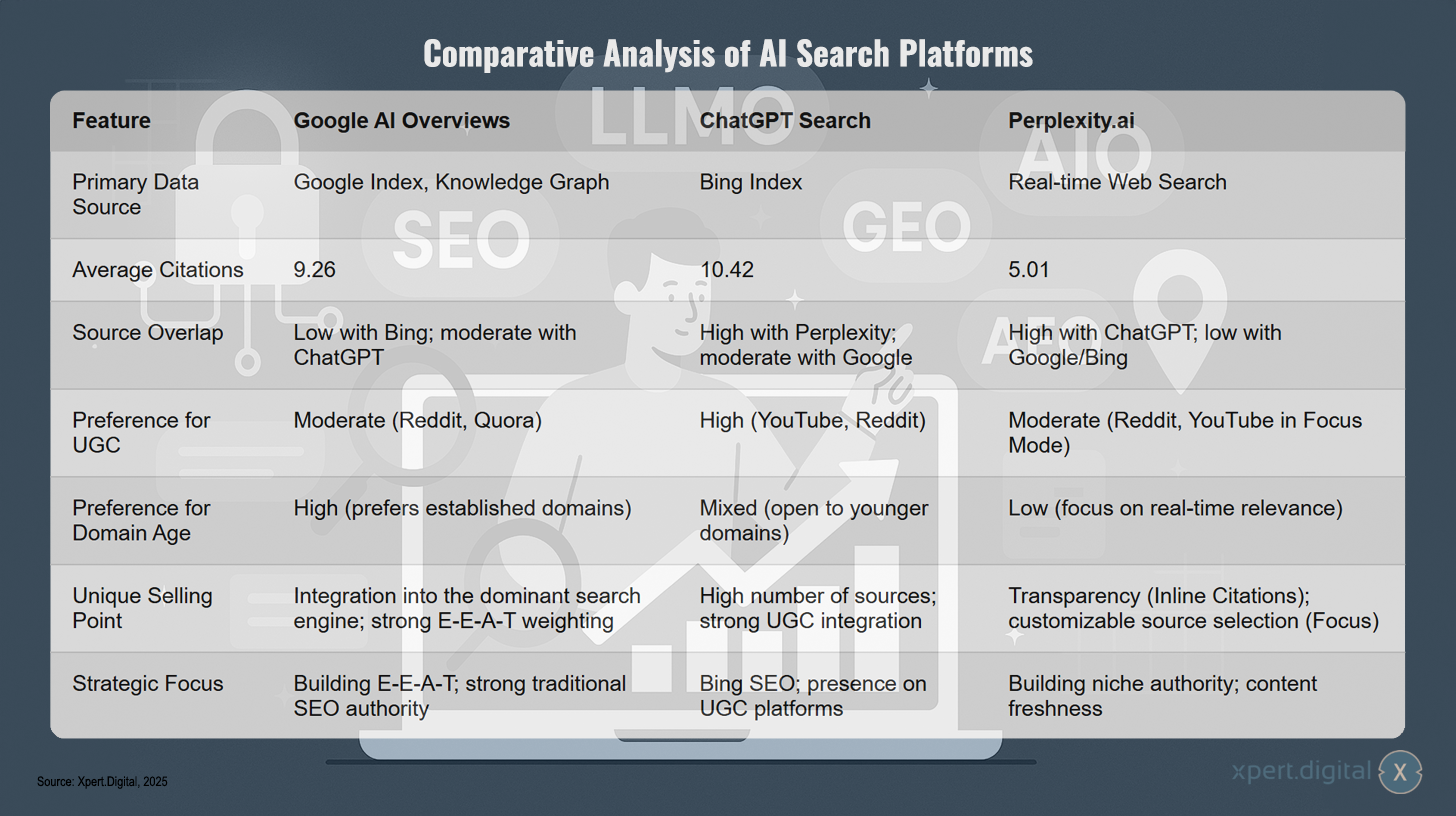
Comparative analysis of AI search platforms – Image: Xpert.Digital
A comparative analysis of AI search platforms reveals significant differences between Google AI Overviews, ChatGPT Search, and Perplexity.ai. Google AI Overviews uses the Google Index and Knowledge Graph as its primary data source, delivers an average of 9.26 citations, and exhibits low source overlap with Bing and moderate overlap with ChatGPT. The platform shows a moderate preference for user-generated content such as Reddit and Quora, but favors well-established, older domains. Its unique selling point lies in its integration with the dominant search engine and its strong emphasis on EEAT (Ever After Appearance) rankings, with a strategic focus on building EEAT and strong traditional SEO authority.
ChatGPT Search uses the Bing Index as its primary data source and generates the most citations, averaging 10.42. The platform shows a high degree of overlap with Perplexity and moderate overlap with Google. Particularly noteworthy is its strong preference for user-generated content, especially from YouTube and Reddit. Its domain age assessment shows mixed results, with a clear preference for younger domains. Its unique selling point lies in the high number of citations and strong UGC integration, while its strategic focus is on Bing SEO and a presence on UGC platforms.
Perplexity.ai distinguishes itself by using real-time web search as its primary data source and delivers the fewest citations, averaging 5.01. Source overlap is high with ChatGPT but low with Google and Bing. The platform shows a moderate preference for user-generated content, favoring Reddit and YouTube in Focus mode. Domain age plays a minor role due to the focus on real-time relevance. Perplexity.ai's unique selling points include transparency through inline citations and customizable source selection via the Focus function. Its strategic focus is on building niche authority and ensuring content is up-to-date.
The new analytics: Measurement and monitoring of LLM visibility
The paradigm shift from search to response necessitates a fundamental adjustment in how success is measured. Traditional SEO metrics lose their relevance when website clicks are no longer the primary goal. New metrics and tools are required to quantify a brand's influence and presence in the generative AI landscape.
The paradigm shift in measurement: From clicks to influence
- Old metrics: The success of traditional SEO is primarily evaluated through directly measurable metrics such as keyword rankings, organic traffic, and click-through rates (CTR).
- New metrics: GEO/LLMO's success will be measured by metrics of influence and presence, which are often indirect in nature:
- LLM Visibility / Brand Mentions: Measures how often a brand is mentioned in relevant AI responses. This is the most fundamental new metric.
- Share of Voice / Share of Model: Quantifies the percentage of one's own brand mentions compared to competitors for a defined group of search queries (prompts).
- Citations: Tracks how often your own website is linked as a source.
- Sentiment and quality of mentions: Analyzes the tone (positive, neutral, negative) and the factual accuracy of the mentions.
The emerging toolkit: Platforms for tracking AI mentions
- How it works: These tools automatically and on a large scale query various AI models with predefined prompts. They log which brands and sources appear in the responses, analyze the sentiment, and track the development over time.
- Leading tools: The market is young and fragmented, but several specialized platforms have already established themselves. These include tools such as Profound, Peec.ai, RankScale, and Otterly.ai, which differ in their range of functions and target audience (from SMEs to large enterprises).
- Adaptation of traditional tools: Established providers of brand monitoring software (e.g. Sprout Social, Mention) and comprehensive SEO suites (e.g. Semrush, Ahrefs) are also beginning to integrate AI visibility analysis features into their products.
Closing the attribution gap: Integrating LLM analytics into reporting
One of the biggest challenges is attributing business results to a mention in an AI response, as this often doesn't lead to a direct click. A multi-stage analysis method is required:
- Tracking Referral Traffic: The first and simplest step is to analyze direct referral traffic from AI platforms using web analytics tools like Google Analytics 4. By creating custom channel groups based on referral sources (e.g., perplexity.ai, bing.com for ChatGPT searches), this traffic can be isolated and evaluated.
- Monitoring indirect signals: The more advanced approach involves correlation analysis. Analysts need to monitor trends in indirect indicators, such as an increase in direct website traffic and a rise in branded search queries in Google Search Console. These trends must then be correlated with the development of LLM visibility, as measured by new monitoring tools.
- Bot log analysis: For technically skilled teams, analyzing server log files offers valuable insights. By identifying and monitoring the activities of AI crawlers (e.g., GPTBot, ClaudeBot), it's possible to determine which pages are being used by AI systems to gather information.
The development of key performance indicators
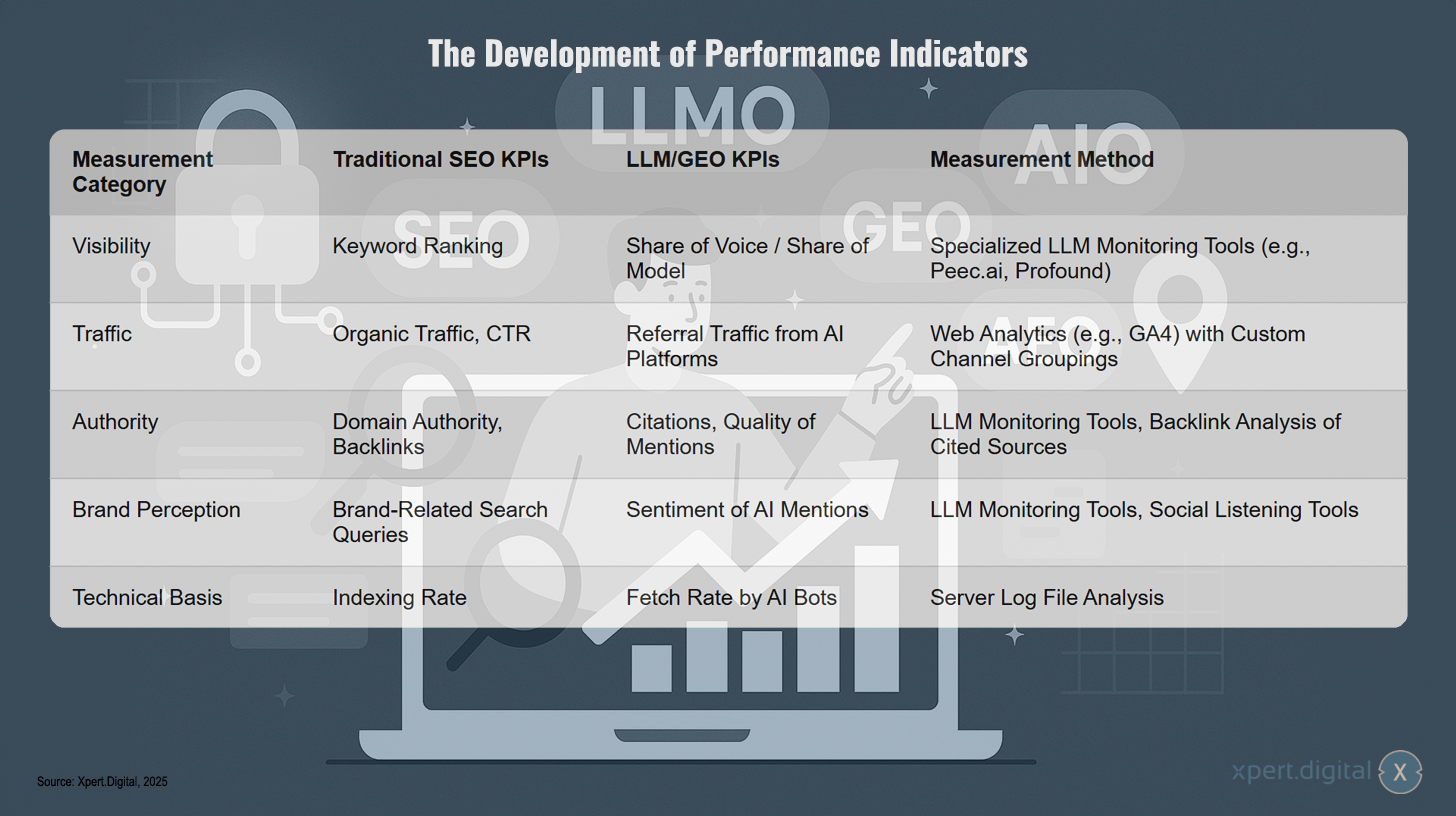
The development of key performance indicators – Image: Xpert.Digital
The evolution of key performance indicators (KPIs) reveals a clear shift from traditional SEO metrics to AI-driven metrics. Visibility is moving away from classic keyword ranking towards Share of Voice and Share of Model, measured by specialized LLM monitoring tools like Peec.ai or Profound. In terms of traffic, referral traffic from AI platforms complements organic traffic and click-through rate, with web analytics tools like Google Analytics 4 (GA4) utilizing custom channel groups. Website authority is no longer solely determined by domain authority and backlinks, but also by citations and the quality of mentions in AI systems, measurable through LLM monitoring tools and backlink analysis of cited sources. Brand perception expands from brand-related search queries to include the sentiment of AI mentions, captured by LLM monitoring and social listening tools. On a technical level, in addition to the traditional indexing rate, there is the retrieval rate by AI bots, which is determined by means of server log file analysis.
Leading GEO/LLMO Monitoring & Analysis Tools
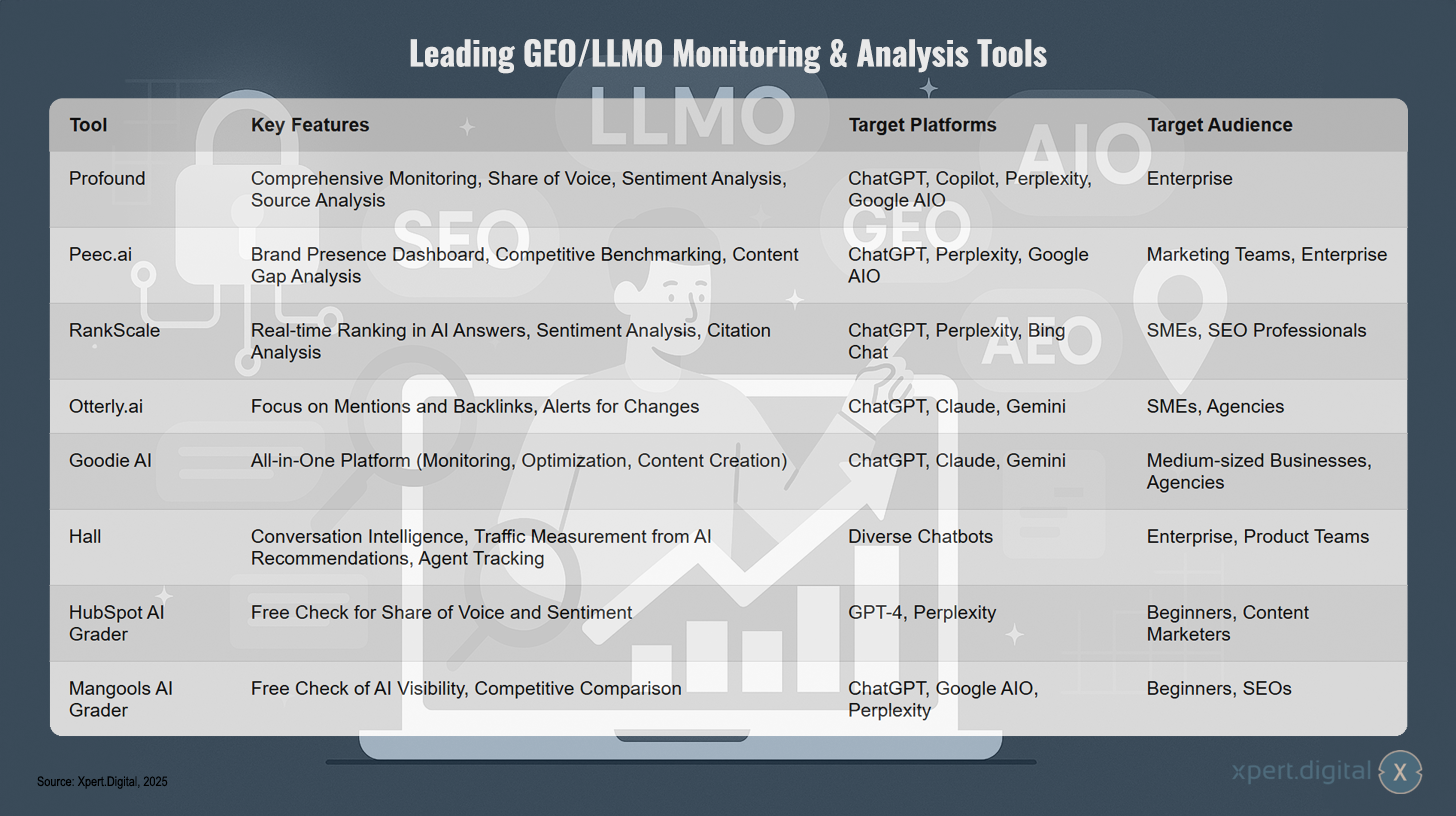
Leading GEO/LLMO monitoring and analysis tools – Image: Xpert.Digital
The landscape of leading GEO/LLMO monitoring and analytics tools offers various specialized solutions for different target groups. Profound represents a comprehensive enterprise solution that provides monitoring, share of voice, sentiment analysis, and source analysis for ChatGPT, Copilot, Perplexity, and Google AIO. Peec.ai also targets marketing teams and enterprise customers, offering a brand presence dashboard, competitor benchmarking, and content gap analysis for ChatGPT, Perplexity, and Google AIO.
For small and medium-sized businesses (SMEs) and SEO professionals, RankScale offers real-time ranking analysis in AI-generated responses, sentiment analysis, and citation analysis on ChatGPT, Perplexity, and Bing Chat. Otterly.ai focuses on mentions and backlinks with alerts for changes and serves SMEs and agencies via ChatGPT, Claude, and Gemini. Goodie AI positions itself as an all-in-one platform for monitoring, optimization, and content creation on the same platforms and targets SMEs and agencies.
Hall offers a specialized solution for enterprise and product teams with conversation intelligence, traffic measurement based on AI recommendations, and agent tracking for various chatbots. Free tools are available for beginners: The HubSpot AI Grader provides a free check for share of voice and sentiment on GPT-4 and Perplexity, while the Mangools AI Grader offers a free check of AI visibility and competitor comparison on ChatGPT, Google AIO, and Perplexity for beginners and SEOs.
The complete GEO action framework: 5 phases to optimal AI visibility
Building authority for the AI future: Why EEAT is the key to success
Following the detailed analysis of the technological foundations, strategic pillars and the competitive landscape, this final part summarizes the findings in a practical framework for action and takes a look at the future development of search.
A workable framework for action
The complexity of Generative Engine Optimization necessitates a structured and iterative approach. The following checklist summarizes the recommendations from the preceding sections into a practical workflow that can serve as a guide for implementation.
Phase 1: Audit & Baseline Assessment
- Conduct a technical SEO audit: Review fundamental technical requirements such as crawlability, indexability, page speed (Core Web Vitals), and mobile optimization. Identify issues that could block AI crawlers (e.g., slow loading times, JavaScript dependencies).
- Check Schema.org markup: Audit the existing structured data markup for completeness, correctness, and the use of networked entities (@id).
- Conduct a content audit: Evaluate existing content with regard to EEAT signals (are authors identified, are sources cited?), semantic depth, and topic authority. Identify gaps in the topic clusters.
- Determine the baseline of LLM visibility: Use specialized monitoring tools or manual queries on the relevant AI platforms (Google AIO, ChatGPT, Perplexity) to capture the status quo of your own brand visibility and that of your main competitors.
Phase 2: Content Strategy & Optimization
- Develop a topic cluster map: Based on keyword and topic research, create a strategic map of the topics and subtopics to be covered, reflecting your own expertise.
- Create and optimize content: Create new content and revise existing content, with a clear focus on optimization for extraction (snippet structure, lists, tables, FAQs) and entity coverage.
- Strengthening EEAT signals: Implementing or improving author pages, adding references and citations, incorporating unique testimonials and original data.
Phase 3: Technical Implementation
- Roll out/update Schema.org markup: Implementation of relevant and interconnected Schema markup on all important pages, especially for products, FAQs, guides and articles.
- Create and provide an llms.txt file: Create an llms.txt file that references the most important and relevant content for AI systems and place it in the website's root directory.
- Resolve performance issues: Eliminate the problems identified in the technical audit regarding loading time and rendering.
Phase 4: Building Authority & Promotion
- Conduct digital PR and outreach: Targeted campaigns to generate high-quality backlinks and, more importantly, unlinked brand mentions in authoritative, topic-relevant publications.
- Engage on community platforms: Actively and helpfully participate in discussions on platforms like Reddit and Quora to position the brand as a helpful and competent source.
Phase 5: Measuring & Iterating
- Setting up analytics: Configuring web analytics tools to track referral traffic from AI sources and to monitor indirect signals such as direct traffic and branded search.
- Continuously monitor LLM visibility: Regularly use monitoring tools to track the development of your own visibility and that of your competitors.
- Adapt strategy: Use the data obtained to continuously refine the content and authority strategy and to react to changes in the AI landscape.
The future of search: From information gathering to knowledge interaction
The integration of generative AI is not a passing trend, but the beginning of a new era of human-computer interaction. This development will extend beyond today's systems and fundamentally change the way we access information.
The development of AI in search
- Hyper-personalization: Future AI systems will tailor responses not only to the explicit request, but also to the user's implicit context – their search history, location, preferences, and even their previous interactions with the system.
- Agent-like workflows: AI will evolve from a mere answer provider to a proactive assistant capable of performing multi-stage tasks on behalf of the user – from research and summarization to booking or purchase.
- The end of the "search" as a metaphor: The concept of actively "searching" is increasingly being replaced by continuous, dialogue-oriented interaction with an omnipresent, intelligent assistant. The search becomes a conversation.
Preparing for the future: Building a resilient, future-proof strategy
The final message is that the principles outlined in this report—building genuine authority, creating high-quality, structured content, and managing a unified digital presence—are not short-term tactics for the current generation of AI. They are the fundamental principles for building a brand that can thrive in any future landscape where information is delivered through intelligent systems.
The focus must be on becoming a source of truth from which both humans and their AI assistants want to learn. Companies that invest in knowledge, empathy, and clarity will not only be visible in today's search results but will also significantly shape the narratives of their industry in tomorrow's AI-driven world.
We are here for you - Consulting - Planning - Implementation - Project Management
☑️ SME support in strategy, consulting, planning and implementation
☑️ Creation or realignment of the digital strategy and digitization
☑️ Expansion and optimization of international sales processes
☑️ Global & Digital B2B trading platforms
☑️ Pioneer Business Development

Konrad Wolfenstein
I would be happy to serve as your personal advisor.
You can contact me by filling out the contact form below or simply call me on +49 7348 4088 965 .
I'm looking forward to our joint project.
Write to me


Xpert.Digital - Konrad Wolfenstein
Xpert.Digital is a hub for industry focusing on digitalization, mechanical engineering, logistics/intralogistics and photovoltaics.
With our 360° Business Development solution, we support renowned companies from new business to after-sales.
Market intelligence, smarketing, marketing automation, content development, PR, mail campaigns, personalized social media and lead nurturing are part of our digital tools.
You can find more information at: www.xpert.digital - www.xpert.solar - www.xpert.plus
Keep in touch