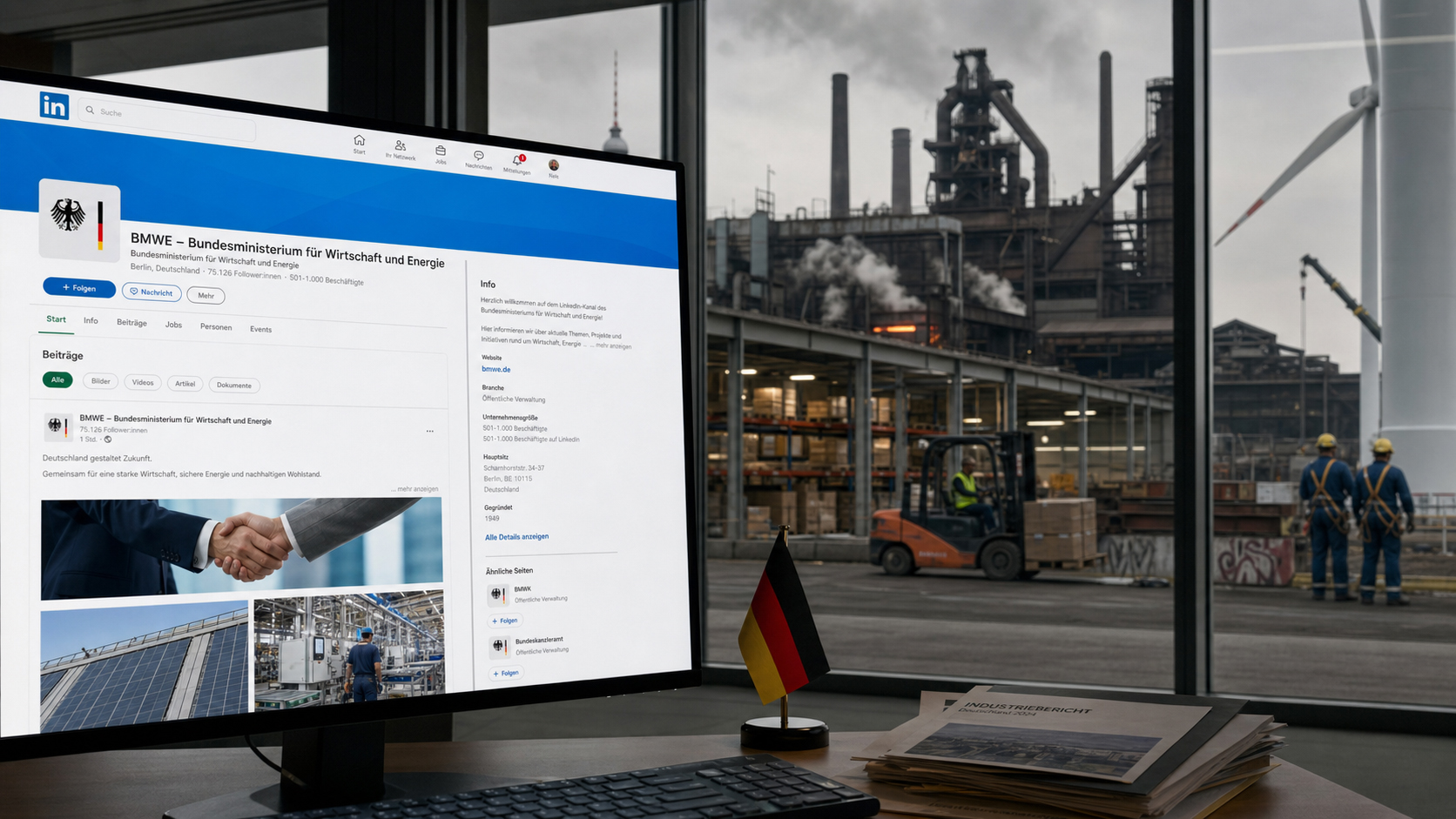
Between high gloss and hollowness – The LinkedIn channel of the Federal Ministry for Economic Affairs and Energy under scrutiny – Creative image: Xpert.Digital
Between PR and the constitution: How the Ministry of Economic Affairs crosses the line on LinkedIn
Gloss instead of facts: The 29 million euro secret behind Habeck's and Reiche's ministry channel
Government communication or propaganda? The LinkedIn presence of the Federal Ministry for Economic Affairs and Energy under scrutiny
The Federal Ministry for Economic Affairs and Energy (BMWE) presents a flawless image on LinkedIn: professional photos, harmonious colors, and boastful success stories reach over 215,000 followers daily. But appearances are deceiving. Behind the perfectly staged, glossy facade lies a profound structural problem. Instead of a critical, fact-based examination of German economic policy, taxpayer-funded self-promotion dominates, often orchestrated by expensive external agencies. The lack of a culture of dialogue and the fine line between the legitimate state obligation to provide information and impermissible PR activities raise a pressing democratic question: Is the state justified in spending tens of millions of euros in taxpayer money to celebrate itself while systematically ignoring inconvenient facts about economic reality? A critical analysis of the government's social media machinery reveals that the way the government communicates with citizens in the digital sphere urgently needs a reorientation.
Government self-promotion with taxpayer money: Who pays for the glossy facade?
The Federal Ministry for Economic Affairs and Energy (BMWE) – as the ministry has been officially known again since May 6, 2025, after CDU Minister Katherina Reiche took office in the Merz cabinet and the word "climate protection" was dropped from the name – maintains a LinkedIn channel with over 215,000 followers. Previously, from 2021 to 2025 under Economics Minister Robert Habeck (Greens), the ministry operated as the Federal Ministry for Economic Affairs and Climate Protection (BMWK). The LinkedIn presence is professionally designed, richly illustrated, and regularly updated. However, a closer look reveals a deeply entrenched structural problem behind the flawless surface: the growing gap between communicative form and economic policy substance. This analysis does not consider the channel as an isolated phenomenon, but rather as a symptom of a much more fundamental question – namely, how a democratic state communicates with itself in the digital age, who pays for it, and what purpose it is actually intended to serve.
A channel that stages itself: aesthetics instead of analysis
The BMWE's LinkedIn profile presents itself to the observer in a perfectly styled manner. Wide header images, warm color palettes, pictures of smiling ministers during company visits, infographics on funding programs, short explanatory videos on energy policy, and occasional interview snippets alternate throughout. The visual consistency is impressive. The content consistency, however, is far less so.
What's missing is what LinkedIn, as a platform for business professionals, should actually distinguish: a substantive examination of the contradictions in German economic policy. Instead, a communicative style dominates, one that always presents its own work in the best possible light. Structural problems such as the chronically weak investment rate, the deindustrialization trends in key industries, or the unresolved issue of economic transformation are, if mentioned at all, only in the context of subsidy programs—as if the ministry already has all the answers before the questions have even been properly asked.
This is no coincidence, but rather a deliberate strategy. A channel managed by a communications department whose primary goal is to project a positive image of the ministry inevitably becomes a tool for self-promotion. The real question – what kind of economic policy does Germany truly need? – remains structurally excluded from this format.
The question behind the facade: Who actually writes these posts?
The crucial question is that of authorship. Is the LinkedIn channel run exclusively by ministry employees, or were external agencies commissioned? This question is not merely academic – it directly touches upon issues of authenticity, taxpayer funding, and the oversight of government communications.
The German Federal Government and its ministries operate over 500 social media accounts in total, with the Federal Ministry for Economic Affairs and Energy (BMWi) and its subordinate agencies alone managing 28 different accounts. Between 2020 and 2022, a total of €29.4 million was spent on advertising and media agencies for social media-based campaigns. The Ministry itself is listed with €365,860 in agency fees for social media campaigns during this period – a seemingly moderate sum, but one that only includes the portion explicitly declared as a "social media campaign".
In addition, there are cross-departmental framework agreements managed by the Federal Press Office for media buying and planning. These are billed separately and do not appear in the figures broken down by department – meaning that the actual costs for operating and professionally managing government social media channels are systematically underestimated. In 2024, the German government put its total expenditure on information measures, advertisements, campaigns, and publicity at €88.66 million, although some expenses are included as lump sums in framework agreements and are not itemized separately.
More than 50 positions across all departments are dedicated solely to social media public relations. This is supplemented by external agencies and professional influencers who are hired for topic-based campaigns. The result: a dense network of internal communications specialists, external creatives, and expensive agency services, the total cost of which is virtually impossible to quantify for the taxpayer.
Follower numbers and genuine engagement: What the metrics really reveal
With over 215,000 followers on LinkedIn, the German Federal Ministry for Economic Affairs and Energy's (BMWi) channel looks impressive at first glance. However, this number needs to be put into perspective. According to current benchmark data from 2026, LinkedIn accounts with over 50,000 followers achieve a median engagement rate of only 1.66 percent. For government organizations, the benchmark on LinkedIn is somewhat higher – around 2.7 percent as the platform average for government accounts and up to 4.21 percent for central government agencies in international comparison.
What does this mean in concrete terms? For a post published by a channel with 200,000 followers, an engagement rate of 2 percent would already be ambitious – that would correspond to approximately 4,000 interactions (likes, comments, shares). Looking at the actual posts of the Federal Ministry for Economic Affairs and Energy (BMWi), it quickly becomes clear that most posts fall far short of this theoretical potential. Informative posts – that is, those with concrete content about funding programs like INNO-KOM – achieve comparatively solid interaction rates, while purely factual posts about ministry meetings hardly generate any noteworthy reactions.
The fundamental problem is structural: a ministry's followers on LinkedIn are often not actively engaged fans, but rather interested parties who have subscribed to the channel out of a sense of professional obligation – management consultants, association staff, journalists, economics students. This target group demands substance, not glossy presentation. And this is precisely where the platform systematically fails. Academic studies on the LinkedIn communication of EU institutions from 2024 confirm: informative posts with genuine analytical depth achieve the highest interaction rates, while missed opportunities for direct dialogue – i.e., not responding to comments, the lack of open-ended questions, and the absence of interactive formats – significantly hinder engagement.
The authenticity problem: Glossy communication as a trust risk
Authenticity on LinkedIn is not a matter of feeling, but a metric of trust. The BMWE's LinkedIn channel suffers from a classic paradox of institutional communication: the more professional and polished a presentation appears, the less credible it seems to a critical professional audience.
The channel's design clearly follows defined communication guidelines aimed at a positive public image. Images are consistently high-quality, texts carefully edited, and topics selectively focused on political success stories. What's missing are moments of genuine vulnerability and openness: a post admitting that industrial transformation is progressing more slowly than hoped; an infographic showing which funding programs have been underutilized; a video in which a minister directly answers uncomfortable questions from readers—without a pre-edited script.
Instead, a communication pattern emerges that communication studies refer to as a "strategic self-presentation mode": Information is selected not according to its relevance to the public, but according to its suitability for cultivating the institutional image. The German Taxpayers Federation has precisely described this pattern: The federal government's public relations efforts often do not serve the public's need for information, but rather improve the image of the incumbent government. The BMWE LinkedIn channel is a prime example of exactly this phenomenon.
The constitutional boundary line: Where information turns into propaganda
The question of whether government social media communication constitutes permissible public relations or impermissible self-promotion is not purely academic. In its landmark 1977 ruling, the Federal Constitutional Court clarified that government public relations ends where electioneering begins. A clear indication of this boundary being crossed is when the informative content is overshadowed by the promotional presentation.
Applying this to the BMWE's LinkedIn channel, a more nuanced assessment emerges. In a recent ruling from December 2025, the Higher Administrative Court of Berlin-Brandenburg decided that the German government's supposedly promotional social media posts do not infringe on freedom of information or freedom of the press, nor do they constitute state indoctrination. Nevertheless, what is legally permissible and what is democratically sensible are not identical.
The real constitutional tension lies elsewhere: When a ministry promotes legislative proposals via social media before they have even gone through the parliamentary process, it conflicts with the principle of the separation of powers and parliament's right to unprepared, public debate. The Federation of German Taxpayers has criticized precisely this practice – government accounts are promoting legislative proposals even before the readings and votes in the Bundestag and Bundesrat. From an economic policy perspective, this is concerning: It blurs the line between government action and opinion leadership.
Our EU and German expertise in business development, sales and marketing

Our EU and German expertise in business development, sales and marketing - Image: Xpert.Digital
Industry focus areas: B2B, digitalization (from AI to XR), mechanical engineering, logistics, renewable energies and industry
More information here:
A thematic hub offering insights and expertise:
- Knowledge platform covering global and regional economies, innovation and industry-specific trends
- A collection of analyses, insights, and background information from our key areas of focus
- A place for expertise and information on current developments in business and technology
- A hub for companies seeking information on markets, digitalization, and industry innovations
The downside of good posts: How the state outsources social media to agencies
The agency model and its consequences: When external service providers shape government communication
The use of external agencies for government communications is not the exception, but the rule. The Federal Press Office issues cross-departmental framework contracts for media buying; individual ministries can also commission their own projects. The implications for a LinkedIn channel like that of the Federal Ministry for Economic Affairs and Energy (BMWi) are fundamental: if the content development and creative implementation are outsourced wholly or partially to agencies, the channel inevitably loses what would legitimize it – the direct, unfiltered voice of the ministry.
An agency naturally optimizes for measurable metrics: reach, follower growth, likes. It follows communication briefs designed to minimize risk. What gets lost in the process is the substantive depth that arises when experienced economists, industry experts, and political decision-makers communicate their unfiltered, genuine assessment of the situation. The result is a channel that creates no accountability internally—to the ministry—because the content doesn't come from those responsible for policy, and it lacks credibility externally because the audience recognizes the stylized perfection for what it is: optimized self-promotion.
The German government's spending on advertising and communications agencies rose from €21.9 million in 2015 to €67.2 million in 2021 – a threefold increase in six years. This development correlates, not coincidentally, with the significant expansion of government institutions' social media presence. It demonstrates that the more the government invests in social media, the more reliant it becomes on commercial communications service providers – with all the structural dependencies that this entails.
Lack of a culture of dialogue: The monologue as a structural failure
LinkedIn is designed as a platform for professional networking and knowledge sharing. Comments are not a bothersome add-on, but rather the heart of the format. A well-managed comment section can transform a post into a vibrant discussion forum – with tangible added value for all participants. This is precisely where one of the most serious weaknesses of government-run LinkedIn channels lies.
Scientific analyses of government and public authority channels on LinkedIn demonstrate that direct responses to user comments, open-ended questions, and the use of interactive formats such as surveys or events are systematically neglected. Users are thus reduced to a passive consumer role instead of being actively involved in shaping public discourse. The consequence is measurable: According to current studies from 2024, channels that proactively respond to comments and offer opportunities for open dialogue demonstrably achieve higher engagement rates.
For a Ministry of Economic Affairs, this is a particularly serious failure. The target audience on LinkedIn – business leaders, association officials, economists, and investors – possesses considerable expertise and is generally willing to contribute it to a dialogue. A ministry that ignores this resource not only wastes communicative potential but also signals: Your input isn't really wanted. This implicit message undermines trust in institutional communication more effectively than any explicit mistake.
Structural deficiencies in the information supply: What's missing speaks louder than what's there
A substantial analysis of the BMWE's LinkedIn channel must also address what is missing. The gaps in the information offered are at least as revealing as the content that is present.
Lack of crisis reflection: Germany has been undergoing a painful economic transformation for several years. Deindustrialization trends in the automotive and chemical industries, the structural weakness of medium-sized companies in the digital transformation, the persistently high energy costs – all these are topics that appear on the channel at best as a side note, usually in the context of funding instruments launched by the ministry. A sober, honest assessment that also acknowledges where politics has failed is nowhere to be found.
Lack of data: LinkedIn users with a business background value data. Actual proof of expenditure of funding, comparisons between program objectives and actual results, impact analyses of economic policy measures – such content is largely absent from the BMWE's channel. Instead, qualitative statements predominate, which are hardly verifiable and therefore hardly open to challenge.
Lack of pluralistic reflection: Economic policy is controversial. Different schools of economic thought reach different conclusions. A LinkedIn channel that exclusively reflects the ministry's perspective without ever addressing dissenting analyses effectively fosters an intellectual monoculture. This not only damages the credibility but also the societal function of a ministry that, by constitutional mandate, is committed to the common good – not to communicative self-affirmation.
The financing paradox: Taxpayers pay for their own influence
There is a fundamental paradox from a democratic theory perspective in government social media communication that is rarely formulated as clearly as it should be: The taxpayer finances a communications apparatus that sells them a sanitized version of government action. They pay for glossy content that suggests everything is going well – while they themselves bear the economic consequences of poor decisions.
The overall scale of these expenditures is considerable. In 2022 alone, the German government's advertising costs for information campaigns amounted to €194.6 million – significantly higher than the pre-pandemic level of €69.1 million in 2019. The reported figure for 2024 is €88.66 million, although this number needs to be adjusted downwards, as agency fees and creative costs are included as a lump sum in framework agreements and cannot be itemized separately.
These expenditures would be justified if they genuinely served to inform the public – that is, if they provided citizens with relevant information about government actions that they would otherwise not receive. But the Federation of Taxpayers rightly doubts this: if campaigns exclusively inform about measures that have already been discussed publicly for months and, moreover, require no action from citizens, then it is not about providing information, but about image cultivation – paid for with public money.
Comparison with best practices: What a ministry channel could achieve
To fairly assess the BMWE channel, it's worth looking at what would be possible. The European Commission operates several LinkedIn channels that, in part, demonstrate how institutional communication can look different: with detailed policy papers summarized in LinkedIn articles, with the direct involvement of experts from civil society in commentary discussions, and with a clear focus on data.
The UK's central government model on LinkedIn achieves an average engagement rate of 4.21 percent – significantly higher than the general benchmark of 1.66 percent for accounts with over 50,000 followers. This demonstrates that government LinkedIn channels can indeed achieve above-average results with the right content and dialogue strategy. According to current research, the key lies in prioritizing detailed content and meaningful stakeholder interaction – precisely what the BMWE channel lacks.
A functioning ministry channel would, for example, regularly give representatives from industry, academia, and civil society a voice in its discussions. It would publish data before drawing conclusions. It would respond to critical comments with substantive debate instead of ignoring them. And it would take the risk of asking uncomfortable questions – because that is the only way to build trust with a critical professional audience.
The official influencer question: Personalization as a way out or as a new problem?
An increasingly discussed alternative to traditional institutional LinkedIn communication is the concept of so-called "official influencers"—civil servants and executives from government institutions who use their personal LinkedIn profiles to promote their employers. This model has a crucial advantage: people follow other people, not institutions. A high-ranking economist from the Federal Ministry for Economic Affairs and Energy (BMWi) who shares a well-founded assessment of current economic developments on their personal profile, openly incorporating their own perspective, generates more engagement than a controlled institutional post with the same content.
However, the model also carries significant risks. What happens if an official's personal appearance contradicts the official ministry line? Who ensures that the communication of government influencers does not exceed the constitutional limits of state public relations? And how can it be guaranteed that this doesn't become another form of optimized self-presentation – this time with the appearance of personality, but just as strategically controlled as the institutional channel?
The question of authenticity cannot be solved by choosing a communication format. It is a question of attitude and institutional culture. As long as the primary goal of government social media communication is the positive portrayal of its own actions—and not the substantive information of a democratic public—every format, whether institutional or personal, will reproduce the same fundamental problem.
Conclusion: Reform instead of relaunch – What true communicative responsibility means
The BMWE's LinkedIn channel isn't the problem – it's the symptom. The real problem is a deep, structural misunderstanding of what government communication should achieve in the digital age. Current practices – costly, agency-driven, focused on image cultivation, and largely immune to criticism from its own target audience – fail to fulfill their democratic purpose.
What is needed instead is a realignment based on three principles: First, radical information – not showing the pleasant, but the relevant, even if it is uncomfortable. Second, genuine willingness to engage in dialogue – not just allowing comments, but actively responding to them, citing counterarguments, and understanding dissent as a resource. Third, complete cost transparency – taxpayers have a right to know what the channel actually costs, including all agency fees, personnel costs, and production budgets.
The Federal Constitutional Court has formulated a clear guideline: government public relations must serve exclusively to inform the public and enable them to form their own free opinion. This standard is not to be understood as a restriction, but rather as an encouragement – for substantive, courageous, and honest communication that meets the demands of a modern democracy. Beautiful images and fine-sounding words alone are not sufficient to meet these demands.