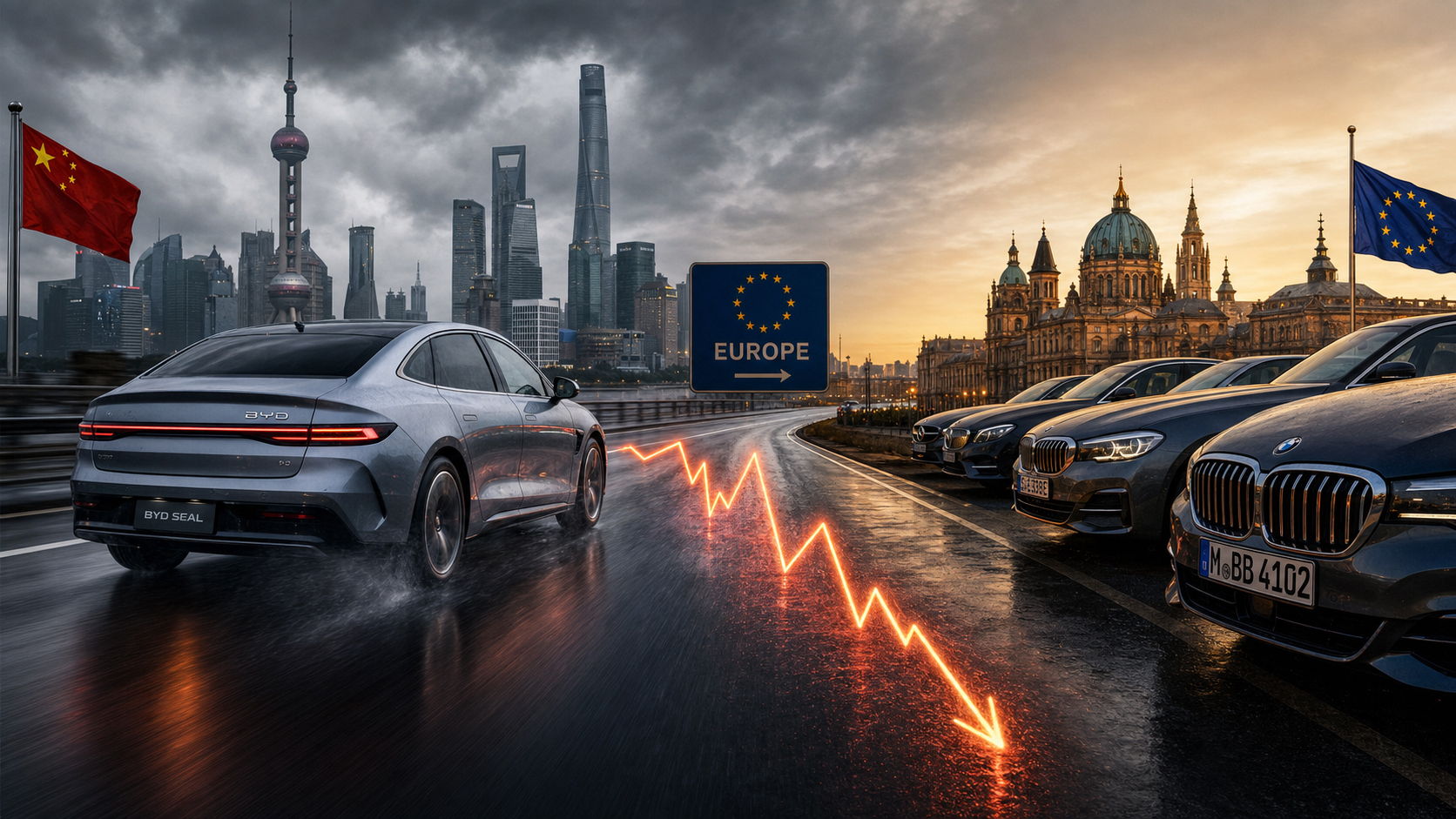
Automotive crisis without perspective: The hype surrounding China's car offensive obscures the fact that Beijing itself is in a dead end – Image: Xpert.Digital
Spare parts and service: The underestimated weakness of the Chinese automotive offensive
The myth of Chinese dominance: Why the hype surrounding BYD and similar companies is misleading
Exports driven by sheer necessity: What's really behind China's electric car boom
The lament for the German and European automotive industry has become a standard feature of public economic debate. Chinese manufacturers are seemingly unstoppable in their advance of the market, while traditional brands like VW, BMW, and Mercedes-Benz are falling behind. But this convenient narrative is incomplete and dangerously simplistic. A sober look behind the scenes reveals a completely different reality: China's automotive industry is struggling with massive overcapacity, ruinous price wars, and a struggling domestic market. The massive exports to Europe stem less from strategic superiority than from sheer economic necessity. At the same time, the behavior of European buyers shows that trust, data privacy, and a reliable service network are far more important than mere price wars. It is time to deconstruct the hype and realistically assess the actual power dynamics in the global automotive market – with all its weaknesses on both sides.
Related to this:


When the narrative overtakes reality
The public discourse surrounding the automotive industry suffers from a structural flaw: it tells a story of the one-sided weakness of European manufacturers and the seemingly unstoppable superiority of China. This narrative is convenient because it sounds clear-cut – and it is dangerous because it only tells half the story. Yes, German automakers are going through difficult years. Yes, the Chinese market is collapsing, taking billions in revenue with it. But anyone who overlooks the fact that Chinese automakers themselves are in a structural crisis that runs deeper than any Western commentary acknowledges is not engaging in analysis – they are engaging in sensationalism.
The figures are clear: Volkswagen sold 2.7 million cars in China in 2025, eight percent fewer than the previous year, and is now only the third-largest manufacturer in the People's Republic, behind BYD and Geely. BMW recorded a 30 percent drop in sales in China in the third quarter of 2024, and the decline totaled 13 percent over the first three quarters of the year. Mercedes-Benz lost around ten percent in the same period, and even 19 percent in the particularly low-margin luxury segment – the adjusted return on sales for its passenger car division plummeted to 4.7 percent, down from 12.7 percent the previous year. Audi, the VW subsidiary with the historically strongest premium footprint in China, lost around 200,000 vehicles in 2024 and recorded an overall sales decline of 11.8 percent.
These losses are real, painful, and structural. The German automotive industry is responsible for more than three-quarters of the overall decline in German exports to China. Compared to the record year of 2022, when cars and car parts brought in almost €30 billion, German motor vehicle exports to China fell to just €13.6 billion by 2025 – a decline of over 54 percent. Such figures call for honest discussion, not panic. But even more urgently, they demand the complete picture.
Related to this:


The crisis on the other side of the wall
The Chinese automotive industry is in a state of emergency, the severity of which is hardly discussed publicly. The domestic market is structurally weak: In times of persistent deflation, an unchecked real estate crisis, and dwindling consumer confidence, Chinese buyers are holding back. Even in the economically powerful metropolises of Shanghai, Beijing, Shenzhen, and Guangzhou, signs of market saturation are increasingly evident. The China Passenger Car Association expects the market to stagnate in 2026, with the weakest growth rate since the first year of the COVID-19 pandemic in 2020.
The situation is even more dramatic than the official growth figures suggest. China's car market collapsed in April 2026, plummeting 21.6 percent year-on-year – marking the seventh consecutive month of decline. Sales also fell by around 16 percent compared to the previous month of March. Behind these figures lies a systemic problem: Over 129 Chinese automakers are struggling to compete in a shrinking market, with a production capacity utilization of a staggering 49.5 percent – half of all production facilities are effectively idle. Great Wall Motor CEO Wei Jianjun issued a stark warning: The Evergrande real estate scenario already exists in the automotive industry; it just hasn't collapsed yet.
The price war resulting from this overcapacity is eroding manufacturers' margins. New models in China no longer need to be more expensive than their predecessors – they need to be up to 30 percent cheaper to attract buyers. BYD, the world's largest electric car manufacturer, recorded its sharpest profit decline in six years in the first quarter of 2026: Net income shrank by 55.4 percent to €510 million, and revenue fell by 11.8 percent to €18.8 billion. Even for the full year 2025, despite record revenue, the group's profit had already plummeted by 19 percent. Other manufacturers are also under extreme financial pressure: Several BYD dealer groups have already filed for bankruptcy. Over 400 smaller providers have already been swept out of the market, and analysts predict the demise of 80 percent of the remaining startups.
Related to this:

Export offensive born of necessity, not strength
Against this backdrop, the logic of China's export offensive to Europe takes on a different light. It is not primarily an expression of technological superiority or strategic expansion – it is a safety valve for gigantic overcapacities that cannot be sold domestically. When half the production facilities are idle and the domestic market is collapsing, exports must at least partially absorb this burden. BYD sold a total of 700,463 vehicles in the first quarter of 2026, with export deliveries exceeding domestic ones for the first time. Cities like Shenzhen are putting together government support packages with 24 individual measures to promote exports, ranging from logistics subsidies and the establishment of export express lanes to improvements in brand presence and customer service abroad.
The actual market success in Europe remains more sobering than the media-generated threat scenario would suggest. In 2023, Chinese car brands achieved total sales of around 147,000 units in Europe, corresponding to a market share of approximately 2.25 percent. This share has since increased: For the first three quarters of 2025, the consulting firm Inovev determined a market share of eight percent – placing the Chinese on par with Korean manufacturers and still five percentage points behind the Japanese. In the first quarter of 2026, Chinese brands accounted for around 3.1 percent of all new car registrations in Germany. Growth – yes. Dominance – far from it. And whether the curve will continue to rise so steeply is anything but certain.
The European market: a historical lesson in overconfidence
The history of the automotive industry is replete with stories of companies that confidently ventured into foreign markets – and failed. The most striking example for Europe is the American automotive industry. Despite its massive industrial power and decades of attempts, US manufacturers never managed to establish a significant presence in the European market. The reason wasn't solely regulatory. Industry expert Stefan Bratzel from the Center of Automotive Management aptly describes it: US manufacturers simply don't appeal to European consumers. Vehicles designed for American roads and habits seem out of place in narrow European city centers – too big, too fuel-thirsty, and simply not adapted.
While nearly 450,000 German cars were exported to the US last year, only 136,000 US vehicles went in the opposite direction to Europe – not primarily due to tariffs, but because of a lack of product compatibility. Even Tesla, the only major US brand that initially made significant strides in Europe, has been struggling with a 13 percent drop in sales in the first quarter since 2025, with reputational issues surrounding its CEO also playing a detrimental role. This story of transatlantic mismatch is not a footnote in economic history – it is a direct blueprint for the challenges facing Chinese manufacturers in Europe.
Our China expertise in business development, sales and marketing

Our China expertise in business development, sales and marketing - Image: Xpert.Digital
Industry focus areas: B2B, digitalization (from AI to XR), mechanical engineering, logistics, renewable energies and industry
More information here:
A thematic hub offering insights and expertise:
- Knowledge platform covering global and regional economies, innovation and industry-specific trends
- A collection of analyses, insights, and background information from our key areas of focus
- A place for expertise and information on current developments in business and technology
- A hub for companies seeking information on markets, digitalization, and industry innovations
After-sales as a stumbling block: Why cheap Chinese models lose customers
Technology alone doesn't sell a car: The underestimated dimension of trust
The central misconception in the discourse surrounding Chinese electric cars is that whoever offers cheap technology wins. This logic overlooks how deeply the automotive business is embedded in social and psychological structures. Cars are not consumer goods like mobile phones or household appliances – they are products of security and trust, where the purchase must be guaranteed for many years. To date, Chinese manufacturers have not offered convincing answers for this dimension of the automotive market.
The DAT Report 2026 provides revealing data on this topic: Although 65 percent of new car buyers in Germany have already noticed Chinese vehicles on the road and almost 80 percent have come into contact with these brands through media and advertising, the actual purchase interest paints a sobering picture – among active new car buyers, only five percent can imagine purchasing a Chinese brand. The perception gap is enormous: Visibility is clearly not a purchase driver when trust is lacking. At the same time, it shows that 56 percent of German new car buyers opt for their previous brand again – driven by positive prior experiences, which 63 percent cite as the decisive reason for their purchase.
According to the DAT Report 2026, the main concerns regarding Chinese vehicles can be specifically identified: data protection and data processing, spare parts availability, the limited network of workshops, uncertain residual value development, and uncertainty surrounding warranty claims. All these concerns are not irrational – they reflect real-world market experiences. The Aiways case exemplifies what happens when a Chinese manufacturer enters the European market with a product but lacks a viable service infrastructure: customers report waiting months, sometimes years, for spare parts, deactivated smartphone apps, and unreachable customer service. Such experiences erode the brand promise before it can even gain traction.
Related to this:

The after-sales deficit: The Achilles heel of Chinese expansion
The automotive business is structured in two parts. The first part comprises the sale of the vehicle – visible, media-driven, and dominated by price comparisons. The second part includes everything that follows: maintenance, repairs, spare parts, warranty processing, roadside assistance, and recall management. This so-called after-sales area is crucial for long-term brand loyalty and accounts for a significant portion of profits in mature markets. European manufacturers dominate this sector with dense networks built up over decades.
Building such a network takes many years, requires significant investment, and demands local partnerships that cannot be substituted by price reductions. A vehicle sold cheaply, but where the customer has to wait weeks for spare parts from China in case of repair, erodes trust more effectively than an expensive vehicle that is reliably maintained. The Chinese government has recognized this weakness and plans to tighten export requirements for vehicle manufacturers: In the future, only companies that can demonstrate local service and repair infrastructure, operate spare parts depots in EU member states, and comply with transparent warranty conditions according to EU standards will be allowed to export. This regulatory self-correction is an admission that the current export model is structurally incomplete.
Some of the larger brands have recognized this and are responding: MG Roewe now has 180 locations in Germany, BYD around 155, and Leapmotor, through a cooperation with the European group Stellantis, has reached approximately 120 locations. Established dealer groups like the Weller Group are integrating BYD and MG into their networks. This is real progress – but it is also only the beginning of a long road. In 2026, Chinese brands still accounted for just 0.2 percent of the German passenger car fleet. There is a gap between media presence and market penetration that cannot be closed in just a few years.
Price pressure as a double-edged sword
The strongest argument of Chinese manufacturers is price. In a market characterized by rising energy costs, high interest rates, and sluggish purchasing power, cheaper vehicles undoubtedly have their appeal. According to the consulting firm Berylls by AlixPartners, the global market share of Chinese manufacturers already stands at 21 percent, and a share of 30 percent is projected for 2030. In Europe, experts anticipate an increase in the Chinese market share from the current four percent to ten percent. These figures deserve attention – but no need to panic.
Price leadership in the automotive business without a corresponding service infrastructure is a dangerous game. Anyone entering the market based on price must expect that customers will apply this same calculation logic to their next purchase – and switch to the next cheapest brand. Customer loyalty, however, is not built on price, but on reliability, a genuine service culture, and the feeling of being well taken care of. While the EBIT margins of the largest European manufacturers fell to just around four percent by mid-2025 – demonstrating the pressure – these established players possess something that cannot be easily bought: decades of brand experience and comprehensive service structures that remain unattainable for most Chinese challengers.
In addition, there are structural market barriers: In response to state-subsidized overcapacity, the EU has imposed punitive tariffs on Chinese electric cars, significantly reducing the price advantages of importers. For the first time in 2025, the EU imported more vehicles and parts from China than it exported there – a former trade surplus has turned into a deficit of several billion euros. This structural change is real and must be taken seriously. However, it does not mean that the Chinese challengers will actually dominate the European market – at least not in the foreseeable future.
The strategic starting point: Who is really under pressure
A sober assessment reveals a more complex picture than media narratives allow. Companies on both sides are under considerable pressure – but the nature of this pressure differs fundamentally. German and European manufacturers are grappling with the loss of a growth market (China), the transition to electric vehicles, and geopolitically induced trade barriers. These challenges are manageable because they are built on a solid operational foundation: well-established service networks, established brands, deep customer knowledge, and decades of presence on their home continent.
Chinese manufacturers, however, face a different, and in some ways more serious, problem. They must simultaneously manage a domestic overcapacity crisis, survive a ruinous price war, build trust in foreign markets, establish service networks from scratch, and overcome the deep mistrust European consumers have regarding the data privacy practices of connected Chinese vehicles. The perception gap in the DAT Report 2026 – high visibility, low willingness to buy – perfectly illustrates this dilemma. Being present in the media and at trade fairs is far from having earned trust. And those who fail to deliver in the after-sales sector risk losing a market they haven't even entered yet.
Only five percent of German new car buyers can imagine purchasing a Chinese vehicle – even though almost 80 percent of this group are aware of Chinese manufacturers in advertising and the media. This statistical finding is the real core problem of Chinese automotive ambitions in Europe. Visibility is not acceptance. Presence is not trust. And low prices do not solve a structural credibility deficit.
Europe's answer: Not defense, but a claim to quality
The real lesson from the current automotive transformation is not that Europe needs to shield its industry. It is that European manufacturers must actively cultivate their strengths: service, reliability, local presence, brand history, and the trust built up over generations. These resources cannot simply be copied structurally – they are the result of decades of investment in customer relationships that cannot be replaced by price reductions or government export subsidies.
The compression of EBIT margins currently being experienced by European manufacturers is a serious signal – but not a death blow. In the first quarter of 2026, VW sold 850,000 vehicles in Western Europe, 4.2 percent more than a year earlier, and even 7.6 percent more in Eastern Europe. The declines in China and North America are significant, but can be partially offset by structurally stronger European businesses. Adjusting model ranges, investing in more affordable electric vehicles, and expanding the digital strategy are not questions of if, but how and when.
The automotive market doesn't reward hype cycles in the long run. It rewards solid performance throughout the entire vehicle lifecycle – from purchase and first inspection to resale value. Those who deliver on this promise retain customers. Those who break it lose them. This applies equally to all manufacturing nations – whether from Wolfsburg, Munich, Stuttgart, or Shenzhen.
Your global marketing and business development partner
☑️ Our business language is English or German
☑️ NEW: Correspondence in your native language!

Konrad Wolfenstein
I and my team are happy to be available to you as your personal advisor.
You can contact me by filling out the contact form here wolfenstein@xpert.digital:or simply call me at +49 7348 4088 965. My email address is
I'm looking forward to our joint project.
☑️ SME support in strategy, consulting, planning and implementation
☑️ Creation or realignment of the digital strategy and digitization
☑️ Expansion and optimization of international sales processes
☑️ Global & Digital B2B trading platforms
☑️ Pioneer Business Development / Marketing / PR / Trade Fairs
🎯🎯🎯 Data-driven B2B industry hub as a quasi-in-house solution


The quasi-in-house solution: How Xpert.Digital closes operational gaps in B2B marketing and sales – Smart Content-Driven Business - Image: Xpert.Digital
Xpert.Digital is a data-driven B2B industry hub led by Konrad Wolfenstein . The company acts as an external, quasi-in-house solution for industrial partners, closing operational gaps in marketing, content, and sales – without requiring additional resources on the client side.
More information here: