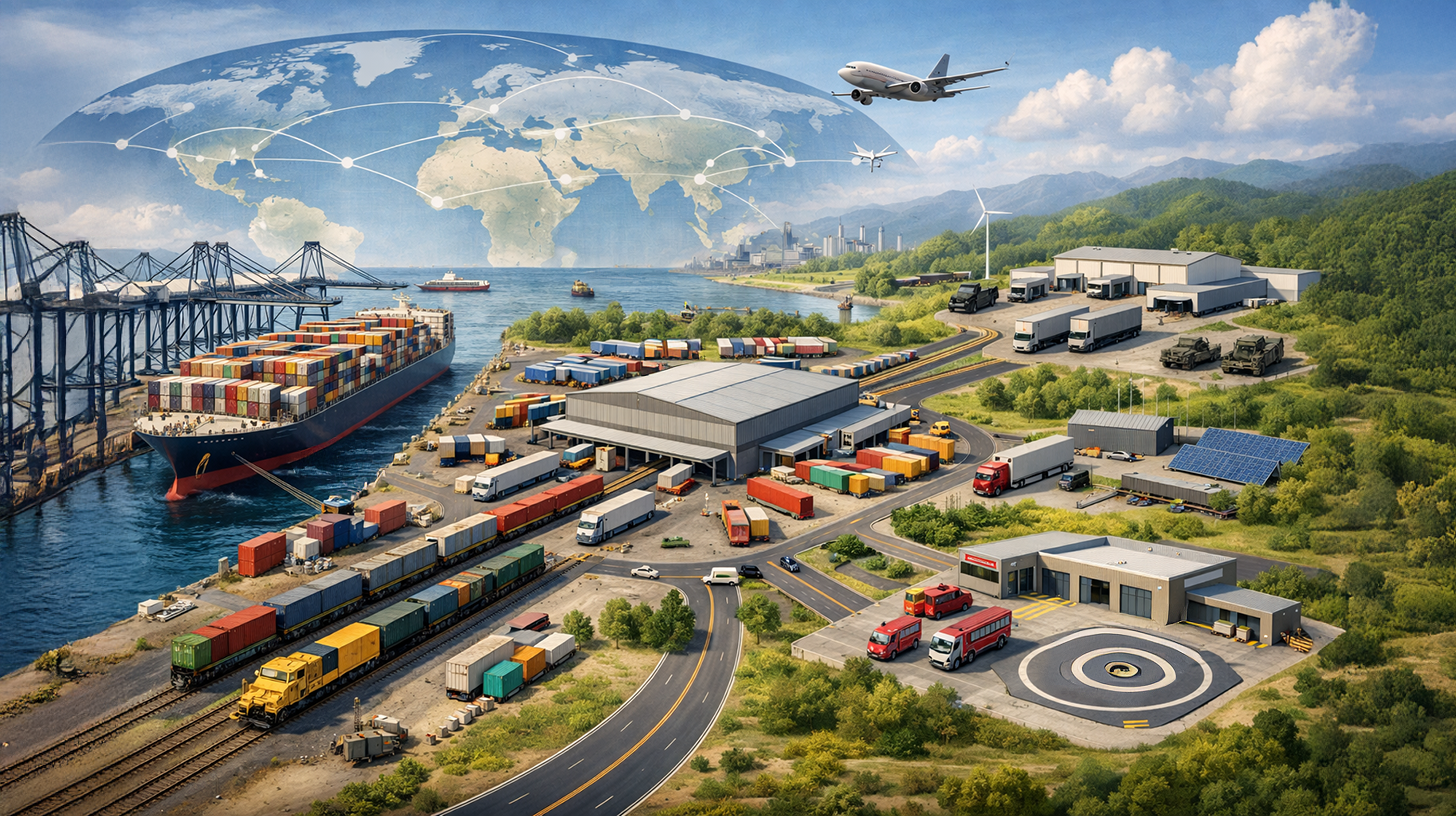
The hub-and-spoke system in logistics: From global container networks to regional dual-use infrastructure – Image: Xpert.Digital
The hub-and-spoke paradigm: How an organizational logic is re-networking the global economy, rail transport, and national defense
From Maersk to the German Armed Forces: The one principle that now determines our security of supply
We are currently witnessing a fundamental reorganization of how goods, commodities, and strategic materials are moved across the globe. On the world's oceans, shipping giants Hapag-Lloyd and Maersk, with their new "Gemini Cooperation," are impressively demonstrating how radical centralization can almost double punctuality. But while maritime mega-hubs are setting new standards, Germany's hinterland is struggling with outdated infrastructure and inefficiency. In northern Hesse, far from the coast, a crucial experiment is now investigating whether the shipping companies' recipe for success can also be the salvation for the ailing regional rail freight sector.
At the same time, a third, long-neglected dimension is forcefully entering civilian logistics: military security. The geopolitical "turning point" is forcing Germany back into the role of Europe's central NATO hub. Suddenly, civilian freight terminals and rail yards are being re-evaluated from a "dual-use" perspective – they no longer just need to be economically viable, but also capable of transporting heavy military equipment in an emergency.
This article analyzes the astonishing convergence of three seemingly separate worlds. It demonstrates how the hub-and-spoke system is becoming the universal answer to the challenges of our time: from increasing efficiency in global container transport and saving regional rail hubs to ensuring the strategic resilience of national defense. It is a journey through a logistics landscape in flux, where economic necessity and national security are inextricably intertwined.
When maritime shipping meets national defense: Why Germany's logistical future lies at the crossroads
Europe's logistics landscape is facing a dual transformation. While global container shipping companies are boosting reliability to over 90 percent with highly automated hub networks, regional rail terminals in northern Hesse are struggling for profitability and capacity utilization. At the same time, a third dimension is emerging: military logistics, which is redefining Germany as a central NATO hub. These three seemingly separate worlds – maritime mega-alliances, regional combined transport, and dual-use defense infrastructure – share a common organizational principle that will determine their future viability: the hub-and-spoke model.
The Maritime Revolution: Gemini Cooperation and the Reorganization of Global Trade Flows
On February 1, 2025, container shipping reached a turning point. With the launch of the Gemini Cooperation between Hapag-Lloyd and Maersk, not only was another shipping alliance created, but also a radically new operating model that addresses the industry's structural weaknesses. The initial situation was sobering: an average on-time delivery rate of around fifty percent made supply chains unpredictable, caused storage costs, and forced companies to maintain expensive buffer stocks. The two shipping companies responded with a radical promise: over ninety percent reliability once the network was fully implemented.
This ambitious goal is based on the consistent application of the hub-and-spoke principle. Gemini Cooperation operates with approximately 340 vessels and a total capacity of 3.7 million standard containers. The network is divided into 29 main lines between strategic hubs and 28 shuttle services connecting smaller ports. The allocation follows a clear capacity logic: Maersk contributes 60 percent, Hapag-Lloyd 40 percent.
The twelve central hubs are spread across Asia, the Middle East, the Mediterranean, Northern Europe, and North and South America. This concentration allows the largest container ships to be deployed on the main routes, while smaller, more flexible feeder vessels handle regional distribution. The result: In its first month of operation, the alliance achieved 92 percent on-time performance – almost 40 percentage points above the industry average.
The economic logic behind this system is compelling. By consolidating freight at central transshipment ports, transport costs per container are significantly reduced. Large ships on the main routes between hubs achieve near-full capacity, while the increased frequency on key routes offers customers greater flexibility. Centralization also allows for better control and faster response to disruptions.
However, the system harbors structural risks. The lengthening of transport routes due to the additional transshipment at the hub can increase transit times. Even more critically, the dependence on a few central hubs creates system vulnerabilities. A failure or overload at a strategic hub can affect the entire network. The Gemini Cooperation addresses this risk by sailing around the Cape of Good Hope as long as the security situation in the Red Sea remains tense.
The sustainability dimension reinforces the strategic importance of the hub model. Both shipping companies have committed to ambitious decarbonization targets: Maersk aims for net-zero emissions by 2040, Hapag-Lloyd by 2045. The hub-and-spoke system supports these goals by enabling larger, more efficient ships on optimized routes with minimized waiting times. Many of the ships deployed are already designed for alternative fuels.
The regional counterpoint: Combined transport in Northern Hesse – between niche and necessity
While the Gemini Cooperation is setting global standards, combined transport in Germany is fighting for its survival. Rail freight will account for approximately nineteen percent of the market share in 2025 – far from the political target of twenty-five percent by 2030. The current forecast is sobering: a decline is expected again in 2025, with only a weak recovery emerging from 2026 onwards.
In this challenging environment, a research project with potentially far-reaching consequences is launching in Northern Hesse. Under the name "KV-Hub Hessen," the Technical University of Darmstadt and the Frankfurt University of Applied Sciences will investigate the feasibility of cargo cooperation between several combined transport operators from May 2025 to spring 2026. The central question: Can a central transshipment terminal in Northern Hesse function as a hub where different operators can exchange goods between their trains?
The economic challenge is evident. As a rule of thumb, a small-scale intermodal terminal requires approximately 25,000 loading units per year for profitable operation. Regional terminals like those in Korbach or Borken fall significantly short of this threshold. The potential analysis for the Black Forest-Baar-Heuberg region reached a similar conclusion: the volume is insufficient to justify a standard terminal eligible for funding.
This is where the cooperation model comes in. Combined transport in Germany is predominantly handled by shuttle trains operated by individual companies, running with fixed train sets between two terminals without intermediate stops. This structure leads to two inefficiencies: peripheral regions do not receive a suitable service, while existing trains are not optimally utilized. Cooperation could address both problems by allowing operators to share their transport resources, reduce empty runs, and distribute fixed costs across a larger volume of goods.
The infrastructure in Northern Hesse exemplifies the gap between ambition and reality. In Korbach, Alfons Brass Logistik operates a site at the former freight depot. The Brass Group employs over 600 people at four locations and handles over 50,000 transport orders annually. With approximately 200,000 square meters of warehouse space, the company is one of the largest transport and logistics service providers in South Westphalia and Northern Hesse.
The Borken Railport, operated by SLF Scherm Logistik und Facilitymanagement, went into operation in November 2021. Its unique feature: a lowered rail siding allows for ground-level loading of goods. Sixteen railcars and overseas containers can be loaded or unloaded daily in the hall, with another ten in the outdoor area. The total area under management covers approximately 65,000 square meters. The company estimates that the Railport will save around 2,000 tons of CO2 compared to transport by truck.
These terminals illustrate the dilemma of regional combined transport: they are technically functional and fulfill important ecological and regional supply functions, but do not reach the critical mass for independent economic operation. The hub concept could be the solution. A central transshipment point in northern Hesse – for example in Bebra or Fulda – could serve as a hub where goods are transferred between trains of different operators. This would allow for higher capacity utilization and more connections, but creates additional logistical complexity due to the second transshipment process.
The challenge is compounded by the investment costs. A gantry crane costs between three and five million euros, depending on the configuration, while a reach stacker costs around five hundred thousand euros. The handling costs of the DUSS (Dual Sector Transshipment System) are approximately twenty-five euros per load unit. Every additional handling operation at the hub increases costs and extends transport time. The model is only economical if the efficiency gains achieved through consolidation more than offset the additional costs.
The current funding landscape sends mixed signals. Germany has secured over €296 million in funding for intermodal projects, out of a total volume of approximately €592 million. Typical funded measures include bridge upgrades, the construction of passing loops, and the expansion of intermodal terminals. However, track access charge subsidies – crucial for the industry's competitiveness – are facing significant cuts.
A combined transport terminal is a special transshipment point where loading units are exchanged between different modes of transport (typically truck and rail, sometimes also ship) in combined transport. It forms the central physical interface in an intermodal transport chain, without the goods themselves being transshipped, but only the container, swap body or semi-trailer changing modes of transport.
A combined transport terminal is always part of a system where the main transport is by rail or ship, and the truck only handles short pre- and post-carriage legs.
Typical structure:
- Preliminary stage: Transport of the loaded loading unit by truck from the sender to the nearest suitable terminal.
- Main leg: Transport of this loading unit between two terminals by train or ship.
- Onward transport: Transport from the receiving terminal by truck to the recipient.
Unlike traditional general cargo transport, the goods are not transferred pallet by pallet; instead, the standardized loading unit remains closed throughout the entire transport chain.
Technical equipment
A combined transport terminal has special infrastructure to efficiently move loading units from one mode of transport to another:
- Handling systems such as gantry cranes or reach stackers for the vertical handling of containers and swap bodies.
- Track systems with sufficient usable length (ideally for unit trains up to about 750 m).
- Truck access roads, parking and maneuvering areas for trailers and containers.
- Terminal IT and interfaces for slot booking, shipment tracking and data exchange with railway companies and freight forwarders.
Depending on the concept, horizontal handling techniques (e.g. CargoBeamer or RoLa systems) can also be used, in which semi-trailers or entire trucks are picked up without a crane.
Function in the transport system
Economically, the terminal is the central "node" in the hub-and-spoke system of combined transport:
- It consolidates shipments from the region onto a few trains (bundling of volumes).
- It enables mass transit by rail (economies of scale, better energy and personnel utilization).
- It acts as a hinge between flexible local distribution by truck and efficient long-distance transport by rail/ship.
Profitability depends heavily on how well the terminal is utilized and whether there is sufficient volume for regular train connections; studies and practical experience often cite a minimum throughput of around 25,000 loading units per year for smaller locations.
The third dimension: Dual-use logistics and Germany's role as a NATO hub
While maritime mega-alliances and regional intermodal terminals address their respective challenges, a third strategic level is emerging: the integration of military requirements into civilian logistics infrastructure. The changed security situation in Europe, particularly since the Russian aggression against Ukraine, has catapulted Germany into a position it has not held since the end of the Cold War: that of NATO's central logistics hub.
The quantitative requirements are immense. Germany must maintain the capability to mobilize 30,000 soldiers, as well as 85 ships and combat aircraft, within 30 days by 2025. The permanent stationing of a 4,000-strong German brigade in Lithuania from 2025 onward has become the flagship project of a new era. In the event of an alliance conflict, potentially up to 800,000 NATO soldiers could have to be transported through Germany within 180 days.
These demands are being met with an infrastructure that has suffered three decades of underinvestment. In 2022, the scientific advisory board of the Federal Ministry for Economic Affairs and Energy estimated the investment backlog for the most urgent infrastructure projects at 165 billion euros – twice as much as would have been necessary in 2009. Eighty-eight billion euros are needed for the most urgent repairs by 2027.
The Host Nation Support (HNS) concept provides the organizational framework for Germany's role as a transit nation. HNS refers to the civilian and military support that Germany provides to allied forces that are stationed on or transiting its territory. This support ranges from escorting transport and providing rest areas to refueling and rationing, as well as medical care and technical assistance. The German Armed Forces (Bundeswehr) process approximately one thousand HNS requests annually.
This brings us back to the hub principle. The dual-use concept aims to finance critical transport infrastructure primarily with defense funds, but to design it in such a way that it can be efficiently shared by civilian users in peacetime. This applies particularly to combined transport facilities, terminals, and transshipment points for rail-road transfer.
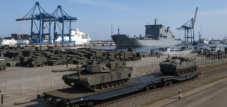
The port infrastructure provides concrete examples. Bremerhaven served as the central hub for 37,000 US soldiers during the large-scale exercise Defender 2020. Recent arms shipments to Ukraine, including 60 Bradley tanks and 90 Stryker armored personnel carriers, were handled via Bremerhaven. The RoRo terminal in Bremerhaven is one of the largest in Europe and has the infrastructure for heavy cargo handling: heavy cranes, self-propelled platform transporters, and large paved storage areas.
The parallel to the civilian offshore wind industry is striking: the handling of massive components such as nacelles and towers requires precisely the same skills and facilities as military project logistics. This civil-military synergy is the core element of the dual-use approach: investments serve both purposes, utilization is smoothed, and capacities are used more efficiently.
The PESCO project "Network of Logistic Hubs in Europe" formalizes this approach at the European level. The network of military logistics centers aims to enable the joint, centralized storage, pre-deployment, preparation, and deployment of equipment, spare parts, and ammunition. A hypothetical example illustrates how it works: A multinational operation in the Baltic states requires spare parts from the Netherlands, equipment from France, and ammunition from Slovenia. These are initially gathered at a German LogHub – for example, in Pfungstadt – and from there, bundled and dispatched for transport to their destination in the Baltic region.
This opens up a strategic perspective for intermodal terminals in Northern Hesse that extends beyond purely civilian operation. Terminals with rail connections, heavy-load capacity, and the ability to handle military vehicles could be integrated into a national or European dual-use network. The requirements are demanding: track lengths of 750 meters for block trains, RoRo capability for rolling military vehicles, and digital interfaces for integration into military logistics systems.
The economic advantages are obvious. While civilian utilization fluctuates and many terminals operate below their break-even point, military co-use would unlock additional demand and funding sources. The government could act as an investor or guarantor, thus ensuring profitability. Conversely, the military would have access to proven, operational infrastructure instead of maintaining its own, often underutilized facilities.
Your container high-bay warehouse and container terminal experts
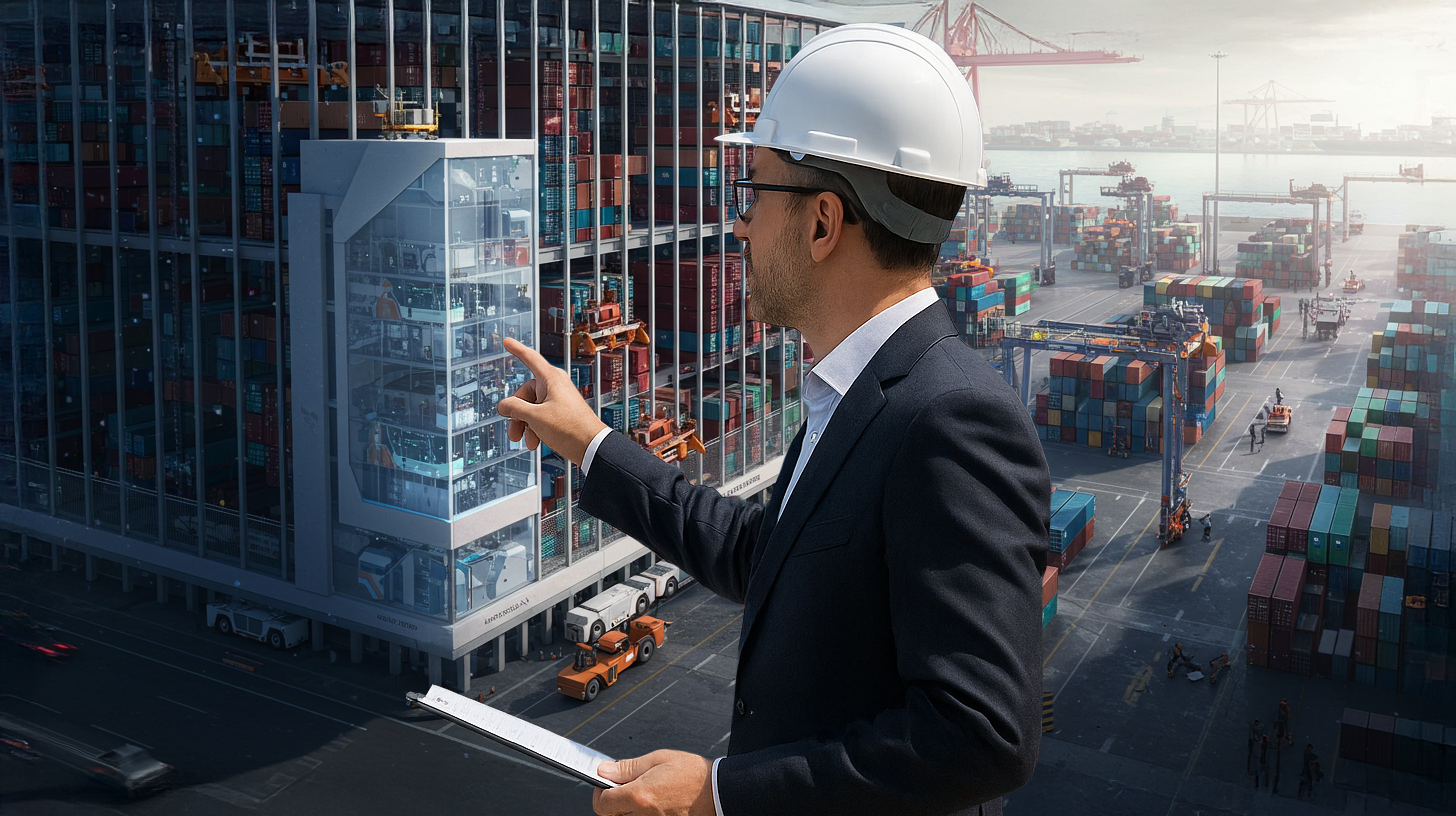
Container high-bay warehouses and container terminals: The logistical interplay – expert advice and solutions - Creative image: Xpert.Digital
This innovative technology promises to fundamentally change container logistics. Instead of stacking containers horizontally as before, they will be stored vertically in multi-story steel racking structures. This not only allows for a drastic increase in storage capacity within the same area, but also revolutionizes all processes at the container terminal.
More information here:
From global trade to national defense: This logistics principle is now changing everything
Systemic commonalities: The hub principle as a universal organizational logic
The analysis of the three levels – global container shipping, regional combined transport, and dual-use defense logistics – reveals a fascinating structural homology. All three systems converge on the hub-and-spoke model as the optimal organizational form for complex, multi-stage transport networks.
The logic is consistent: Centralization at strategic hubs enables economies of scale, consolidation, and efficiency gains. Large transport vehicles – container ships on main routes, long combined freight trains, heavy-load rail transport – operate optimally on highly utilized connections between hubs. Final distribution to the endpoints is handled by smaller, more flexible units: feeder ships, trucks for pre- and post-carriage, and light military vehicles.
The cost structure follows the same pattern. Fixed costs for infrastructure and large transport vehicles are spread over higher volumes. Variable costs per unit decrease through capacity optimization. While the additional handling at the hub increases process costs, this is more than offset by the reduction in transport costs – provided the volume is sufficient.
Flexibility is another shared advantage. New destinations can be integrated into the network via shuttle services or connecting routes without rebuilding the overall system. Disruptions at one spoke point do not affect the entire network, as rerouting via alternative routes is possible. Centralized control at the hub enables a rapid response to fluctuations in demand or capacity bottlenecks.
Differentiation according to scaling and time criticality
However, despite all their structural similarities, the three systems differ fundamentally in scaling, speed and risk profile.
Gemini Corporation operates in the gigawatt-scale realm of globalization. With a capacity of 3.7 million TEU and a fleet of approximately 340 vessels, it handles a significant portion of global trade. Investments run into the billions – modern large container ships cost several hundred million dollars, and major hub terminals require investments in the hundreds of millions. Planning horizons extend over decades, with amortization spread over the lifespan of the ships and terminals.
In contrast, the intermodal terminals in northern Hesse operate on a regional scale. They handle a few tens of thousands of loading units per year, with investments in the single-digit to low double-digit millions, and serve catchment areas of fifty to one hundred kilometers. Their economic sensitivity is higher: losing just a few major customers or experiencing a weak regional economy can push capacity utilization below the break-even point.
Dual-use logistics operates on a scale that combines volume and time-criticality. The projected movement of 800,000 troops within 180 days requires a capacity that far exceeds peacetime utilization. At the same time, the timeframes are tight: NATO's commitment to deploy 30,000 troops in 30 days leaves no room for delays. The risk profile is fundamentally different: while commercial logistics addresses delays with compensation payments, military logistics failures can have strategic consequences.
The following systematic comparison illustrates the differences:
The greatest disparity is evident in the area of scale. Gemini Cooperation, with its 3.7 million TEU capacity and global reach, stands at one end of the spectrum. The intermodal terminals in northern Hesse, handling between 25,000 and 300,000 loading units per year, operate regionally. Dual-use logistics falls between these extremes: national to NATO-wide in geographical scope, but with the capability to move massive volumes at short notice when needed.
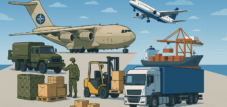
Gemini's transport modes are predominantly the combination of seagoing vessels and feeder ships, supplemented by inland land transport. Combined transport focuses on rail and road with the aim of shifting long-distance freight to rail. Dual-use logistics, on the other hand, must integrate all modes of transport – road, rail, sea, and air – depending on requirements and availability.
The main objectives diverge significantly. Gemini aims for over 90 percent on-time delivery and has already achieved 92 percent in the first month. With this, the alliance is setting new industry standards in a sector that has struggled for years with around 50 percent punctuality. Combined transport primarily aims to shift traffic from road to rail to relieve congestion on highways and reduce CO2 emissions. Dual-use logistics prioritizes rapid troop deployment – speed and reliability under potentially critical conditions.
The investment volumes reflect these different dimensions. Gemini operates a fleet pool worth billions, while hub terminals require hundreds of millions of euros. Intermodal terminals in Northern Hesse, with ten to fifty million euros for terminal infrastructure, are in the moderate range. Dual-use infrastructure modernization, however, is on a completely different scale: the investment backlog in Germany amounts to over one hundred and sixty-five billion euros.
Time horizons also differ fundamentally. Gemini has been operational since February 2025 and is already achieving impressive reliability levels. The combined transport hub project in Northern Hesse is in the planning phase from 2025 to 2026 and is currently investigating its feasibility. The dual-use infrastructure transformation is strategically planned with time horizons extending to 2030 and beyond.
The degree of automation correlates with scale and investment volume. Gemini focuses on highly automated terminals, such as the Altenwerder Container Terminal in Hamburg, which features fully automated gantry cranes and driverless transport vehicles. Intermodal terminals in Northern Hesse operate with conventional gantry cranes and reach stackers at a medium level of automation. Dual-use terminals exhibit a high degree of variability depending on the specific location and equipment.
Convergence and integration: The potential of nested hub systems
The crucial strategic insight lies in the recognition that these three levels do not compete, but rather complement each other. Global maritime hubs like Hamburg or Bremerhaven form the first level of international freight flows. From there, regional intermodal connections branch out to secondary hubs such as the planned intermodal hub in Northern Hesse. These, in turn, supply local terminals like Korbach or Borken, which handle the last mile by truck.
The dual-use concept adds another dimension to this hierarchy. Terminals that function as hubs for civilian purposes can, with appropriate design, simultaneously serve as military logistics nodes. Railport Borken, with its lowered rail connection for ground-level loading, would, for example, be ideally suited for handling military vehicles. Korbach, with its extensive storage areas, could handle the pre-stationing of materials.
The economic viability of such an integrated system would be significantly higher than the sum of its parts. Basic civilian utilization would be supplemented by occasional military use, and government co-financing could enable investments in infrastructure upgrades that would also benefit civilian efficiency. Conversely, the military would rely on robust, proven infrastructure that is maintained during peacetime, instead of maintaining its own parallel structures.
The European dimension amplifies this potential. The PESCO project Network of Logistic Hubs aims to create a networked system of military logistics centers that can also be used for civilian purposes. German regional hubs could be integrated into this network, thereby gaining access to European funding and contract opportunities.
Obstacles and transformation costs
However, the path from conceptual elegance to operational reality is fraught with significant obstacles. The additional handling stage at the hub increases costs and complexity. Each handling step costs approximately twenty-five euros per loading unit. Time is lost, and potential errors multiply. The system only pays off if the savings achieved through consolidation more than offset the additional costs – and that requires critical mass.
Coordination between different operators in combined transport is challenging. Timetables must be synchronized, liability issues clarified, and IT systems integrated. The study by TU Darmstadt will have to demonstrate whether the stakeholders involved in combined transport – shippers, freight forwarders, operators, railway undertakings, and terminal operators – are prepared to abandon their often competitive stance in favor of cooperation.
Military integration adds further layers of complexity. Security requirements, secrecy, special load classes for military vehicles, priority regulations in times of crisis – all of this necessitates additional investments and legal frameworks. Civilian operators must be prepared to maintain or quickly provide capacity in an emergency, potentially at the expense of commercial customers.
Germany's infrastructure deficits are severe. The investment backlog of 165 billion euros affects roads, bridges, the rail network, and waterways. 4500 of the 40,000 bridges are in inadequate or defective condition and cannot bear heavy goods traffic. This affects both commercial and military transport and limits the practical usability of even well-developed hub terminals.
Financing remains the central challenge. While Gemini Cooperation can draw on billions in private sector investments, regional intermodal terminals depend on public funding. The federal government's current austerity plans, with drastic cuts to track access charge subsidies, send a disastrous signal. At the same time, civilian infrastructure investments are competing with the massive funding requirements for defense and military infrastructure.
Strategic imperatives for politics and economics
The analysis leads to clear recommendations for action for the various stakeholders. The German government should consistently prioritize the dual-use concept and enshrine it in a national logistics strategy. An investment program in the tens of billions of euros for dual-use terminals and infrastructure upgrades would be appropriate. Financing could be provided through a special fund analogous to the special fund for the German Armed Forces, given its evident strategic importance for collective defense.
The KV funding guidelines should explicitly incentivize cooperation models. Bonus funding for terminals that provide handling capacity for other operators, funding for digital platforms for capacity sharing, and start-up financing for hub functions during the initial phase – all of this would increase the willingness to cooperate.
For operators like Alfons Brass Logistik or SLF Scherm, a strategic opportunity is opening. Proactively positioning themselves as dual-use sites could unlock access to additional funding sources. Investments in RoRo capability, heavy-duty handling equipment, and IT integration with military logistics systems could pay for themselves in the medium term.
Northern Hesse's role in a future system is ambivalent. Its peripheral location is disadvantageous from a civilian perspective, but potentially advantageous from a military-logistical one: decentralized locations are less vulnerable to targeted disruptions and offer strategic depth. Specializing in dual-use functions could give the region a unique selling point.
The European dimension must not be underestimated. Germany, as a central NATO hub, depends on functioning connections to Dutch and Belgian ports in the west, as well as to Polish and Baltic destinations in the east. The first pilot corridor between the Netherlands, Germany, and Poland points the way. Further corridors with standardized procedures, harmonized legal frameworks, and coordinated investments are urgently needed.
The logistics of the turning point
The parallel development of Gemini Cooperation, North Hessian combined transport cooperation models, and dual-use infrastructure is no coincidence. It reflects a deeper transformation of logistics driven by three megatrends: deglobalization and a focus on resilience in response to supply chain fragility, decarbonization as a response to climate change, and the remilitarization of Europe as a consequence of the changed security situation.
The hub-and-spoke model proves to be a robust organizational form in all three dimensions. It enables economies of scale while maintaining flexibility, central control with decentralized execution, and standardization of core processes with individualized distribution. Its applicability across maritime logistics, land transport, and military applications demonstrates the principle's universality.
Germany has the opportunity to transform its central geographic location in Europe into a strategic advantage. Instead of passively serving as a transit hub, Germany could actively assume hub functions – for European freight transport, transatlantic trade flows, and NATO defense logistics. However, this requires massive investments in infrastructure, digital integration, and institutional coordination.
The projects in northern Hesse will serve as a test case for this vision. If a functioning cargo cooperation between intermodal operators can be established and selected terminals made dual-use capable, this could serve as a blueprint for other regions. If the experiment fails due to a lack of willingness to cooperate, insufficient funding, or infrastructural limitations, this will demonstrate the limitations of the model.
The Gemini Cooperation has demonstrated with impressive speed that ambitious reliability targets are achievable when structure, technology, and incentives are right. The 92 percent on-time delivery rate in the first month sets new standards. Whether Germany and Europe can achieve a similar pace of transformation in rail infrastructure and dual-use integration will be a key factor in the continent's competitiveness and strategic autonomy.
The logistics of this new era is hub-centric, multimodally integrated, and functionally hybrid. It transcends the boundaries between civilian and military, global and regional, and economic efficiency and strategic resilience. The success of this model will not be measured by declarations of intent, but by investment figures, throughput statistics, and the ability to deliver in a crisis. The coming years will show whether Germany and Europe are ready to take the necessary steps.
Consulting - Planning - Implementation

Markus Becker
I would be happy to serve as your personal advisor.
Head of Business Development
Consulting - Planning - Implementation
Konrad Wolfenstein
I would be happy to serve as your personal advisor.
You can contact me at wolfenstein∂xpert.digital or
Just call me on +49 7348 4088 965 .
Hub for Security and Defense - Advice and Information

Hub for Security and Defense - Image: Xpert.Digital
The Security and Defence Hub offers expert advice and up-to-date information to effectively support companies and organizations in strengthening their role in European security and defence policy. Working closely with the SME Connect Defence Working Group, it particularly promotes small and medium-sized enterprises (SMEs) that wish to further develop their innovative capacity and competitiveness in the defence sector. As a central point of contact, the Hub thus creates a crucial bridge between SMEs and European defence strategy.
Related to this: