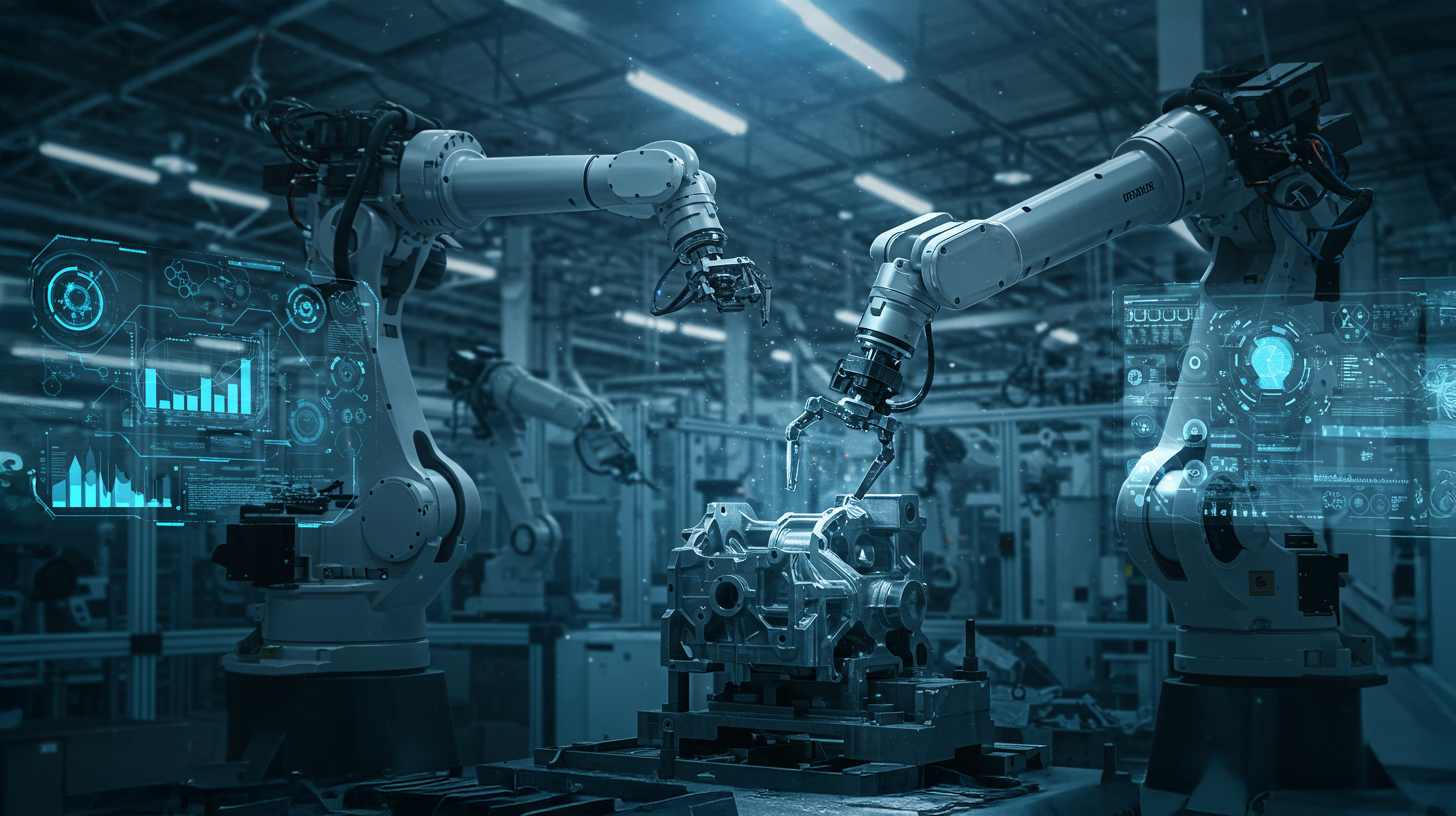
Where do we really stand in the field of robotics and automation? The headlines are full of breakthroughs – Image: Xpert.Digital
Comprehensive analysis of current developments in robotics
Automation decoded: Future technologies between hope and challenge
As someone who closely follows the technological trends of our time, one central question keeps arising: Where do we really stand in the field of robotics and automation? Headlines are full of breakthroughs, investments, and also concerns. To paint a clear picture, it's necessary to systematically examine the individual pieces of the puzzle and recognize the underlying patterns.
1. My first fundamental question is: What are the economic drivers propelling the current wave of robotics innovation? Is it solely about technological progress, or are we seeing a fundamental shift on the capital side?
The answer is multifaceted, but at its core it can be traced back to a powerful symbiosis of capital flow and strategic market consolidation. Technological progress, particularly in the field of artificial intelligence, is undoubtedly the spark, but the fire is kept alive and amplified by massive investments and targeted acquisitions.
When I talk about consolidation, what exactly do I mean by that and what examples support this thesis?
Consolidation is a clear sign of market maturity. It means that large, established companies begin acquiring smaller, innovative startups to secure their technology, talent, and market share. They are not just buying a product, but a future perspective. A prime example that perfectly illustrates this dynamic is the recently announced acquisition of Monogram Technologies by medical technology giant Zimmer Biomet.
Why is this deal so significant? Zimmer Biomet is an established player in the field of orthopedic surgery. Monogram, on the other hand, is an agile company specializing in autonomous surgical robotics. Their technology promises to perform operations not only robotically assisted but also partially autonomously, increasing precision and potentially improving patient outcomes. Instead of investing years and vast sums in developing comparable technology in-house and risking failure, Zimmer Biomet is acquiring the innovation directly. This demonstrates two things: First, autonomous robotics in surgery is no longer science fiction but a strategic asset for which established corporations are willing to pay substantial sums. Second, it signals to other startups in the sector that their developments have a clear "exit path," which in turn encourages early-stage investment. The market isn't simply consolidating; it's restructuring itself as the major players integrate the most promising pioneers.
This leads me to my next question: When established companies make acquisitions, who finances the next generation of innovators? Does the money only flow into already established fields?
Here we are observing a remarkable diversification. Investments are not only high, but also broadly diversified and come from a wide variety of sources. The traditional image of only venture capitalists (VCs) investing in tech startups is long outdated.
First, significant sums are flowing into sectors that were previously considered rather slow to embrace automation. The construction industry is a prime example. Start-ups like Bedrock Robotics, which develop robots for the automated surveying of seabeds for construction projects such as offshore wind farms, are attracting substantial investment. Why? Because the construction industry is under enormous pressure to increase productivity, and automation offers a powerful lever for this. Every process that can be automated—from surveying and welding to operating heavy machinery—promises massive efficiency gains.
Secondly, we are seeing high levels of investment in highly specialized niches such as tactical robotics. A company like XTEND, which develops systems that allow soldiers to intuitively control drones and robots in complex urban environments, receives funding because modern conflicts unequivocally demonstrate the need for such technologies. The goal is to remove people from the immediate danger zone while simultaneously increasing operational capability.
Third, and perhaps most interestingly, investors themselves are diversifying. We're not just seeing venture capitalists. Established industrial companies like Johnson Electric, a global manufacturer of motors and motion systems, are forming joint ventures in the field of humanoid robotics. This isn't purely a financial investment, but a strategic move to participate in the next major paradigm shift in automation and to contribute their core competencies to a new generation of products. Even corporations outside the industry are making targeted investments. When the fashion giant Inditex (parent company of Zara) invests in robotics startups, it's not because they want to build robots, but because they need to optimize their own logistics and supply chain to the utmost. Here, the investment is a means to an end: their own transformation.
Finally, we must not forget state and quasi-state actors. Meta's donation to promote STEM initiatives (science, technology, engineering, and mathematics), which also include robotics, is not a direct investment in a company, but an investment in the future "human capital" that will support this sector. It is an acknowledgment that the strength of a robotics ecosystem depends on the availability of qualified professionals.
In summary, the economic foundation of robotics is broader and more stable than ever before. It is supported by a mix of strategic acquisitions by market leaders, targeted venture capital investments in new fields of application, and strategic investments by corporations both within and outside the industry, complemented by the promotion of fundamental training.
2. If capital is the fuel, what is the engine? My next investigation focuses on the technology itself. What makes today's robots so much more powerful than their predecessors? The answer seems inescapably to be artificial intelligence (AI) and autonomy. But what does that mean in detail?
Exactly. The qualitative leap we are experiencing is inextricably linked to advances in AI. The mere mechanics, the moving of arms or wheels, have been solved for decades. The true revolution is taking place in the machine's "decision-making." This leads us to the heart of the change: the pursuit of autonomy.
What is the difference between an automated and an autonomous system, and why is this trend so crucial?
An automated system performs a predefined, repetitive task. A classic industrial robot on an assembly line is automated. It always welds in the same spot without truly "understanding" its surroundings. If the component isn't positioned precisely, it fails.
An autonomous system, on the other hand, can perceive its environment, interpret the situation, and adapt its actions to unforeseen changes in order to achieve a goal. It requires significantly less, or even no, direct human intervention. This trend is crucial because it exponentially expands the application range of robots—away from the tightly controlled environments of factory floors and into the chaotic, unstructured real world.
The examples we have already seen in the context of investments clearly demonstrate this:
Surgery (Zimmer/Monogram): An autonomous surgical robot not only assists, but also performs certain steps of the operation – such as precisely milling a bone for an implant – independently and with superhuman accuracy after the surgeon has approved the plan. It adapts to the slightest movements of the patient in real time.
Civil engineering (bedrock): An autonomous underwater robot does not map the seabed by rigidly following a route set by a human, but by navigating independently, avoiding obstacles, and optimally aligning its sensors with the conditions.
Underwater maintenance (Remora Robotics): Robots that clean ship hulls of fouling do so autonomously. They attach themselves to the hull, recognize which areas need cleaning, and work through them systematically without the need for a diver or pilot to constantly control them.
Tactical Robotics (XTEND): This is about "Supervised Autonomy". The human sets the goal (e.g., "explore this building"), but the robot navigates independently through doors, around corners, and up and down stairs – tasks that would make manual remote control extremely difficult and slow.
The common denominator is the reduction of the cognitive load for humans. Humans are transformed from "pilots" to "managers" or "commanders" of robotic systems.
How exactly does AI enable this autonomy? Which specific AI technologies are the key enablers here?
AI here is not a monolithic block, but a toolbox of various technologies. The most important are computer vision, sensor fusion, machine learning, and planning algorithms. However, the real breakthrough of recent years lies in two areas: the performance of AI models and the availability of training data.
A key concept here is foundational models for robotics, such as those being developed by Google DeepMind. The idea is to train a massive AI model with a vast amount of data about physical interactions—videos of robots grasping objects, people performing tasks, simulations, and so on. The result is a model that develops a fundamental understanding of physics, causality, and action sequences. This general model can then be fine-tuned for specific tasks with relatively little effort. So, instead of programming a robot from scratch for every new task, this prior knowledge can be leveraged. This dramatically accelerates development.
In parallel, simulation-based data generation is revolutionizing training. Researchers at MIT and elsewhere are creating highly realistic virtual environments. In these simulations, a robot can perform millions of trials in a very short time to learn a skill—for example, grasping differently shaped objects. It can "fail" without damaging expensive hardware. The "policy" (action strategy) learned in the simulation is then transferred to the real robot. This solves one of the biggest bottlenecks in robot AI: the lack of real-world training data.
Another piece of the puzzle is edge AI. What does that mean? Traditionally, complex AI models require massive data centers in the cloud. A robot would therefore have to constantly send sensor data to the cloud, have it processed there, and receive commands back. The resulting delay (latency) makes this impractical for many real-time applications. Edge AI processors are highly specialized, energy-efficient chips that enable sophisticated AI calculations to be performed directly on the robot ("at the edge"). This is essential for autonomous vehicles, drones, and any mobile robot that needs to make fast, reliable decisions without a constant internet connection. It increases autonomy, data security (since sensitive data doesn't have to leave the device), and the system's robustness.
With all this increasing intelligence and autonomy, ethical questions must inevitably come to the fore, right?
Absolutely. This is perhaps the biggest and most difficult challenge to overcome. The more autonomous a system becomes, the more responsibility shifts from the human operator to the developer, the manufacturer, and the system itself. The questions are fundamental:
Liability: Who is liable if an autonomous surgical robot makes a mistake? The surgeon who supervised the procedure? The hospital? The software manufacturer?
Decision-making in dilemmas: How should an autonomous vehicle decide when an accident is unavoidable? How should an autonomous weapons system distinguish between combatants and civilians when the information situation is unclear?
Bias: AI models learn from data. If this data contains historical biases, the robot will reproduce or even reinforce these biases. How do we ensure fairness?
Transparency: Can we even understand the decisions of a complex AI? If a robot performs an unexpected action, we need the ability to use "Explainable AI" (XAI) to understand why it did that.
The development of AI robots is therefore not only a technical task, but also a profoundly ethical and social one. It is about establishing guidelines and standards that ensure these powerful tools are developed and used in accordance with our human values. Adherence to ethical guidelines must become an integral part of the design process – “Ethics by Design”.
🎯🎯🎯 Benefit from Xpert.Digital's extensive, five-fold expertise in one comprehensive service package | BD, R&D, XR, PR & Digital Visibility Optimization


Benefit from Xpert.Digital's extensive, five-fold expertise in a comprehensive service package | R&D, XR, PR & Digital Visibility Optimization - Image: Xpert.Digital
Xpert.Digital possesses in-depth knowledge across various industries. This allows us to develop tailored strategies precisely aligned with the requirements and challenges of your specific market segment. By continuously analyzing market trends and monitoring industry developments, we can act proactively and offer innovative solutions. The combination of experience and expertise generates added value and provides our clients with a decisive competitive advantage.
More information here:
Industry in transition: Robotic innovations are changing everything
3. Having examined the economic and technological foundations, the logical next question is: Where exactly are these waves of change impacting? How exactly is robotics transforming work in the various industries?
The effects are cross-industry, but the nature and depth of the transformation vary greatly. Here, I would like to highlight some of the most important sectors and analyze the specific changes.
Let's start with one of the most traditional industries: construction. How can robotics gain a foothold here?
The construction industry is ripe for disruption. It suffers from low productivity growth, a shortage of skilled workers, and high accident rates. Robotics addresses precisely these issues. We are seeing the automation of entire process chains. Self-driving construction machines—excavators, bulldozers, rollers—that perform highly precise earthworks using GPS and lidar sensors are no longer a thing of the future. They increase efficiency and safety because fewer people need to work in hazardous areas. Specialized robots take over tasks such as bricklaying, welding steel beams, or installing facade elements. The aforementioned use of robots for inspection (as with Bedrock Robotics) also drastically reduces the time and costs associated with preliminary investigations and maintenance. Robotics promises to make the construction process more predictable, faster, and safer.
And in medicine, a high-tech sector par excellence? What is happening beyond the already established systems like the da Vinci robot?
In medicine, the trend is clearly moving towards greater precision, more personalized care, and minimally invasive procedures. Robot-assisted spinal surgery is an excellent example. Here, the robot enables the surgeon to place screws and implants with submillimeter accuracy, significantly reducing the risk of nerve damage. However, the real next wave comes from new approaches. EndoQuest Robotics, for instance, is developing a platform for endoluminal surgery. This means that abdominal surgeries can be performed through natural body openings (such as the mouth) instead of requiring large incisions. The flexible robot navigates through the gastrointestinal tract and can operate from there. This is the epitome of minimally invasive surgery and promises drastically faster recovery for patients. Here, then, we are seeing a development towards entirely new surgical methods that would simply be inconceivable without robotics.
Another sector of strategic importance is defense. What role does robotics play here?
In the defense sector, robotics has become a central element of modernization strategies worldwide. It's no longer just about reconnaissance drones. Tactical ground robot systems (unmanned ground vehicles, UGVs) are being used for logistics, reconnaissance, and even direct support of infantry units. A company like Kraken Robotics is developing autonomous underwater vehicles (AUVs) that can independently search for and identify mines—a dangerous and time-consuming task previously performed by mine clearance divers or remotely operated systems. This autonomy significantly increases the speed and safety of mine countermeasures. The involvement of quantum systems companies in a Ukrainian defense robotics company is particularly revealing. This suggests that the next generation of military robotics could rely not only on AI, but also on quantum sensors for superior navigation and target acquisition, or on quantum communication for eavesdropping-proof control. Robotics is fundamentally changing the battlefield.
What about sectors that are already considered highly automated, such as logistics and retail?
Even here, there are still enormous leaps in innovation. Warehouse automation by companies like Amazon is well-known. Robots bring the shelves to the employees. The next stage is the complete automation of the "pick and pack" process. Amazon is developing robots that can pick and pack individual, diverse items from a container – a task that, due to the variability of the objects, has been extremely difficult to automate until now. Another area is the "last mile." Delivery robots from companies like Pudu Robotics, which are being tested in partnerships with chains like 7-Eleven, aim to automate deliveries in urban areas. In the retail sector itself, robots are appearing for inventory or as mobile information points. Here, robotics is penetrating from the large, invisible logistics centers to the area visible to the customer.
Are there also advances in manufacturing and agriculture?
Yes, absolutely. In manufacturing, we are seeing an increasingly close integration of robotics and additive manufacturing (3D printing). Robot arms are being used as mobile 3D printers to produce large components, or they are handling the post-processing and assembly of printed parts. This enables highly flexible and decentralized production of complex components.
In agriculture, often referred to as "precision agriculture," the impact is also enormous. AI-controlled drones and robots analyze the condition of every single plant in a field. They can apply fertilizer, water, or pesticides precisely where needed. This saves resources, protects the environment, and increases yields. Autonomous tractors and harvesters are also on the rise. Initiatives like the "Moldova Digital Agriculture Incubator" demonstrate that this is not solely a phenomenon of industrialized nations, but is seen as a key technology for securing global food supplies.
4. So far, I've mainly talked about the "inner values"—the software and the applications. But is the external appearance, the physical form of the robots, also changing? Are we moving towards a world like the ones science fiction has been depicting for decades?
This is a perfectly valid question. And the answer is a clear yes. We are witnessing a fascinating diversification of robot forms that goes far beyond the classic robot arm or the mobile chassis.
Perhaps the most iconic form is the humanoid robot. Is this just a gimmick, or are there serious advances and real benefits?
The idea of the humanoid robot is currently experiencing a renaissance, and this time it's driven by pragmatism. The crucial advantage of a humanoid robot is that it's designed for a human-made world. It can climb stairs, open doors, and use tools made for human hands. So instead of adapting the entire environment to the robot (as in a factory), the robot adapts to the environment. This opens up vast fields of application in logistics, maintenance, care, and even industry.
Johnson Electric's investment and the collaborations of Chinese companies demonstrate that a strategic race has begun. A concrete and impressive example is the use of humanoid welding robots at HD Shipbuilding (formerly Hyundai Heavy Industries). These robots can work in confined, hard-to-reach areas of ships where the use of conventional, bulky welding robots would be impossible. They utilize their human-like agility to perform complex welds on curved surfaces. This represents the transition from research lab demonstrations to real-world, value-adding applications.
Is the trend therefore exclusively towards humanoid robots?
Quite the contrary. Parallel to the development of generalists like humanoids, we are seeing an explosion of specialization. Nature has produced a specific solution for every ecological niche, and robotics follows a similar principle.
Inspection in confined spaces: Cleo Robotics is developing a drone that looks like a shrouded propeller. It is extremely compact and collision-resistant, enabling it to fly safely inside tanks, pipes, or ventilation shafts – places that are dangerous or inaccessible to conventional drones or humans.
Underwater maintenance: Sea Teknik Robotics does not develop general-purpose underwater robots, but highly specialized systems that perform, for example, only a single task: cleaning nets in fish farms. They are perfectly adapted to this one task and environment and are unbeatable in their efficiency.
Swarm robotics: Researchers at Harvard University are working on swarms of small, simple robots. Each individual robot is not particularly intelligent, but together they can solve complex tasks, much like an ant colony. They could be used for exploring large areas, in agriculture, or for construction work. The principle is robustness through redundancy and the solution of large problems by many small actors.
What truly futuristic capabilities are on the horizon? What about concepts like self-repair?
Here we enter the realm of basic research, the results of which could shape robotics in ten or twenty years. Research on self-repairing robots is one such area. A particularly fascinating approach is "robotic cannibalism." The idea is that if a robot in a swarm suffers irreparable damage, it is used by the other robots as a "spare parts depot." Functioning robots could thus remove defective parts from a "dead" colleague and install them in themselves. This has immense implications for long-term missions without human maintenance, for example, on Mars, in the deep sea, or in disaster areas. It represents a paradigm shift from disposable electronics to sustainable, resilient systems.
One last question about abilities: We've talked about intelligence, but what about emotions? Why should a robot be able to express emotions?
This is an excellent point that is often misunderstood. Disney Imagineering's work in this area is not about giving robots real feelings. It's about improving human-robot interaction. Emotions are a key means of communication for humans. A smile, a frown, a surprised look—all of these convey a wealth of information about a person's state and intentions in fractions of a second. If a robot is able to express its state (e.g., "I've recognized the object," "I'm unsure," "I need help") through human-readable facial expressions or body language, collaboration becomes more intuitive, fluid, and safer. It builds trust and lowers the barrier to using the technology. So, it's about a more effective interface, not artificial consciousness.
Our recommendation: 🌍 Limitless reach 🔗 Connected 🌐 Multilingual 💪 Sales power: 💡 Authentic with strategy 🚀 Innovation meets 🧠 Intuition


From local to global: SMEs conquer the world market with a clever strategy - Image: Xpert.Digital
In an era where a company's digital presence determines its success, the challenge lies in creating an authentic, personalized, and far-reaching presence. Xpert.Digital offers an innovative solution that positions itself as the intersection of an industry hub, a blog, and a brand ambassador. It combines the advantages of communication and sales channels in a single platform and enables publication in 18 different languages. Cooperation with partner portals and the ability to publish articles on Google News and a press distribution list with approximately 8,000 journalists and readers maximize the reach and visibility of the content. This represents a crucial factor in external sales and marketing (SMarketing).
More information here:
Industry in transition: Robotic innovations are changing everything
5. We now have a detailed picture of the technology and its applications. However, every profound technological change also has far-reaching societal consequences. What economic and social impacts are emerging from the advance of robotics?
This question is of central importance because technology does not exist in a vacuum. It shapes our society, our work, and our lives together.
Perhaps the most frequently asked and feared question is: Will robots take our jobs?
The answer isn't as simple as a yes or no. A profound transformation of the working world is taking place, not a mere elimination of jobs. Gartner's prediction that by 2030 a significant proportion of supply chain managers will be managing robots rather than humans is very insightful in this regard. This doesn't mean that supply chain managers will become unemployed. Rather, their role is changing radically. Their task will be to monitor a fleet of autonomous robots, analyze their performance, make strategic decisions, and manage exceptions or disruptions. Repetitive, manual, and data-processing tasks will be automated, while human work will shift to strategic, creative, and problem-solving tasks.
This also means that qualification requirements are shifting dramatically. New professions will emerge (e.g., robot fleet manager, AI ethicist, robotics maintenance specialist), while others will become less important. The challenge for society is to manage this transition through education, retraining, and lifelong learning to avoid a "lost generation" of workers. It's a transformation, not an apocalypse.
Besides the world of work, are there also potential applications for robotics to address major societal challenges, such as demographic change?
Yes, and this is an enormously important field of application. Many industrialized nations face the problem of an aging population coupled with a shortage of caregivers. Robotics can play a supporting role here, not as a replacement for human care, but as a complement. Robots can assist with physically demanding tasks, such as lifting people. They can act as intelligent assistants, reminding users to take medication, monitoring vital signs, and automatically calling for help in emergencies. Social robots can counteract loneliness through conversations, games, or connecting with loved ones. Research is intensively investigating how such systems can improve the quality of life for older people and enable them to live independently in their familiar surroundings for longer.
What about public acceptance? Do people trust these new machines?
Trust is key to the successful integration of robotics into society. This trust must be actively built. Interesting research shows that subtle design decisions play a significant role here. For example, one study found that robots that establish appropriate eye contact—that is, look at the person before speaking or initiating an action—are perceived as more trustworthy and intelligent. The goal is to make the robots' behavior predictable, safe, and intuitively understandable to humans. Transparency regarding a system's capabilities and limitations is also crucial. Overtrust can be just as dangerous as fundamental distrust.
With all this networking and data collection, there must be significant security concerns, right?
Absolutely. The security concerns are multifaceted and extend beyond pure cybersecurity (protection against hacking). A central issue is data security and national security. The US authorities' testing of drones from manufacturers DJI and Autel is a clear indication of this. The question here is not only whether the drone can be hacked, but also: What data does it collect? Where is this data stored? Who has access to it? When drones inspect critical infrastructure such as power plants, bridges, or ports, the collected data becomes a strategic asset. Dependence on robotics technology from potentially rival states is increasingly viewed as a national security risk. This is leading to efforts to build domestic or allied technology ecosystems.
6. My last major question addresses the foundation of all this: people. Developing, building, maintaining, and managing all these complex systems requires an enormous number of skilled professionals. How do we ensure we have the next generation of talent to shape this revolution?
This question is crucial, because without the right minds, even the best technology remains just a prototype. Developing talent has therefore become a strategic priority for companies and governments.
What role do extracurricular activities such as robotics competitions play here?
They play an immense role that can hardly be overstated. Competitions like the FIRST Robotics Competition or RoboCup are far more than just a game. They are incubators for the next generation of engineers and scientists. Here, school and university students not only learn programming or building, but also acquire practical skills in project management, teamwork, problem-solving under pressure, and strategic thinking in a highly motivating environment. They experience the entire cycle from ideation through design and construction to testing and improvement. Above all, these competitions ignite a passion for technology and demonstrate that STEM subjects lead to tangible, exciting results. Many participants choose to pursue a degree and a career in these fields as a result of these experiences.
And how does the formal education system respond to this need?
The education system is beginning to adapt, often in close collaboration with industry. We are seeing the emergence of new degree programs that explicitly combine robotics, AI, and mechatronics. Universities and universities of applied sciences are partnering with companies to offer practical projects, internships, and dual study programs. This ensures that education doesn't miss the mark when it comes to real market needs. There is also a growing number of programs integrating robotics and programming into school curricula to establish foundational skills early on and reduce any apprehension. The challenge lies in adapting curricula quickly enough to the rapid pace of technological development and training a sufficient number of qualified teachers.
Final synthesis: What overall picture emerges from all these observations?
When I put all these facets together – the capital, the AI, the industry-specific applications, the new forms, and the societal impact – the picture that emerges is of a sector in a phase of exponential growth and profound transformation. Robotics has finally broken out of its niche on factory floors and is becoming a universal key technology that touches every aspect of our lives and our economy.
Growth is driven by a self-reinforcing spiral: Technological breakthroughs, particularly in AI, enable new applications. These new applications attract massive, diversified investments. These investments, in turn, finance the next wave of technological development and the strategic consolidation of the market.
We are seeing a clear movement towards autonomous, intelligent systems that can operate in the unstructured real world. At the same time, the physical forms of robots are diversifying, from highly specialized tools to universally applicable humanoids.
This development, however, is not a purely technological process. It raises fundamental ethical questions, transforms the labor market, creates new geopolitical dependencies, and requires a fundamental adaptation of our education system. Successfully shaping this future depends not only on our ability to build intelligent machines, but also on our wisdom in integrating them responsibly into our society. The robotics revolution is in full swing, and we are only beginning to grasp its true potential and its challenges.
We are here for you - Consulting - Planning - Implementation - Project Management
☑️ SME support in strategy, consulting, planning and implementation
☑️ Creation or realignment of the digital strategy and digitization
☑️ Expansion and optimization of international sales processes
☑️ Global & Digital B2B trading platforms
☑️ Pioneer Business Development

Konrad Wolfenstein
I would be happy to serve as your personal advisor.
You can contact me by filling out the contact form below or simply call me on +49 7348 4088 965 .
I'm looking forward to our joint project.
Write to me



Xpert.Digital - Konrad Wolfenstein
Xpert.Digital is a hub for industry focusing on digitalization, mechanical engineering, logistics/intralogistics and photovoltaics.
With our 360° Business Development solution, we support renowned companies from new business to after-sales.
Market intelligence, smarketing, marketing automation, content development, PR, mail campaigns, personalized social media and lead nurturing are part of our digital tools.
You can find more information at: www.xpert.digital - www.xpert.solar - www.xpert.plus
Keep in touch