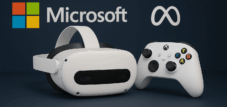
The global VR headset market is undergoing a transformation: An economic assessment – Image: Xpert.Digital
The end of VR headsets? Why tech giants are now radically changing course
Billions burned, visions postponed: Why virtual reality meets harsh reality
Billions in losses and a change of strategy: The great disillusionment in the metaverse
The global virtual reality headset market is undergoing a profound transformation. What was hailed as an unstoppable future technology just a few years ago is showing clear signs of fatigue in 2025. Global shipments of VR headsets fell by 14 percent year-over-year in the first half of 2025, and IDC forecasts a 42.8 percent decline in shipments of VR and mixed reality headsets for the year as a whole. At the same time, the strategic priorities of the world's largest technology companies are shifting from bulky VR headsets to lightweight, AI-powered augmented reality glasses. This development raises fundamental questions about the economic viability of existing investment strategies and is forcing the entire industry to reassess its business model.
Shrinking hardware, growing market valuations: The paradox of forecasts
At first glance, the market research landscape presents a contradictory picture. On the one hand, actual shipment figures show a clear downward trend. In 2024, approximately 9.6 million AR/VR headsets were shipped worldwide, representing growth of about 10 percent compared to the previous year. However, this growth was driven almost exclusively by a single player: Meta, which held a market share of 74.6 percent throughout 2024. In 2025, this trend reversed abruptly. Meta shipped only 1.7 million Quest headsets in the first three quarters, a decrease of 16 percent compared to the same period of the previous year.
On the other hand, various market research institutes continue to predict enormous growth. The global market volume for VR headsets was estimated at around US$9.1 to US$12.5 billion in 2024 and is projected to grow to between US$51.9 and US$261.9 billion by 2034, depending on the analyst firm and the market definition used. Precedence Research estimates the global VR headset market at US$17.68 billion in 2025 and forecasts growth to US$237.45 billion by 2035, representing an annual growth rate of 29.66 percent. This discrepancy between shrinking unit sales and exploding market forecasts is partly explained by the expectation of rising average prices, the inclusion of enterprise solutions, and the increasing convergence of VR, AR, and mixed reality in market definitions.
Meta's $100 billion bet: Between strategic vision and operational reality
No company has invested more in the development of immersive technologies than Meta Platforms. Since acquiring Oculus VR in 2014, the company has invested over $100 billion in its Reality Labs division, according to estimates by Metaverse analyst Matthew Ball, through the third quarter of 2025. Reality Labs' operating losses amounted to $19.19 billion in fiscal year 2025, a deepening from $17.7 billion in 2024. This contrasts with revenues for the division of just $2.21 billion, a marginal increase from $2.15 billion in the previous year.
Reality Labs' financial woes become even clearer when looking at Meta's overall business. While the Reality Labs division racks up billions in losses quarter after quarter, Meta's advertising division generated $59.89 billion in revenue in the fourth quarter of 2025, a 24 percent increase year over year. Profits totaled $22.76 billion. Essentially, Meta's highly profitable advertising business is funding one of the most expensive technology bets in the company's history. The company's CFO has announced that Reality Labs' operating losses are expected to remain at the same level in 2026 as they were in 2025. At the same time, Meta plans to increase its total capital expenditures in 2026 to between $115 billion and $135 billion, nearly double the $72 billion spent the previous year. However, the majority of these investments are no longer flowing into VR, but into the construction of AI data centers and the newly founded Meta Superintelligence Labs.
The strategic U-turn: From virtual reality to smart glasses
Perhaps the most significant development of 2025 was Meta's de facto strategic shift away from VR headsets and towards AR glasses and AI-powered wearables. For the first time in years, Meta did not release a new Quest headset in October 2025, breaking with its previous annual release cycle. Instead, in September 2025, the company unveiled the Ray-Ban Meta Display, an augmented reality headset with a small transparent display in front of the right eye and a novel neural wristband as an input device.
Sales figures for Ray-Ban Meta glasses underscore the dynamism of this segment. EssilorLuxottica, the partner for the Ray-Ban collaboration, reported more than a threefold increase in sales of Meta AI glasses for 2025 compared to the previous year. Regular Ray-Ban Meta Wayfarer glasses had already reached over two million units sold by the end of 2024. The success was so resounding that Meta revised its component orders for the Ray-Ban Meta Display upwards twice within six months. TrendForce forecasts that worldwide shipments of AR glasses will rise to 950,000 units in 2026, a year-over-year increase of 53 percent. According to media reports, Meta is even considering ramping up annual production to 20 million units to meet demand.
This shift follows an economic logic. The smart glasses market grew by 50 percent year-over-year in the first half of 2025, while the AR glasses market in the broader sense expanded by 110 percent. ABI Research expects shipments of consumer AR smart glasses to increase from around 850,000 units in 2024 to nearly 32 million units in 2030, representing an annual growth rate of 82.9 percent. The key driver here is so-called no-display glasses, which, due to their lightweight and portable design, are suitable for everyday use.
The failure of the premium strategy: Apple's Vision Pro as a cautionary tale
No product illustrates the challenges of the VR market more vividly than the Apple Vision Pro. Despite Apple's legendary ability to define new product categories and command premium prices, the $3,499 spatial computing headset proved to be a commercial failure. In the crucial 2025 holiday quarter, Apple shipped only 45,000 units, according to IDC, even after a hardware upgrade to the more powerful M5 chip in October 2025.
In total, only around 390,000 Vision Pro units have been shipped since its launch in 2024. Apple's Chinese manufacturing partner, Luxshare, ceased production in early 2025, and the company slashed its digital advertising budget for the headset by over 95 percent in key markets such as the US and the UK. Morgan Stanley analyst Erik Woodring summed it up: the cost, the form factor, and the lack of VisionOS apps were the reasons why the Vision Pro never achieved widespread adoption.
Significantly, Apple is also shifting its resources. Employees who were working on a successor to the Vision Pro have reportedly been reassigned to developing Apple's own smart glasses strategy. This admission by the world's most valuable technology company that the market for expensive VR headsets is reaching its natural limits sends a clear signal to the entire industry.
🗒️ Xpert.Digital: A pioneer in the field of Extended and Augmented Reality


Finding the right Metaverse agency, planning office, or consulting firm - Image: Xpert.Digital
🗒️ Finding the right Metaverse agency, planning office, or consulting firm – Search and search: Top Ten Tips for Consulting & Planning
More information here:
XR market in flux: Why Meta's dominance is crumbling and new giants are rising
The competitive reorganization: Winners and losers in the XR ecosystem
The competitive landscape of the augmented reality market is undergoing a fundamental shift. While Meta maintained its clear market leadership in VR headsets with approximately 80 percent market share in the first half of 2025, overall sales volumes were declining. Among the top five vendors, only Meta and XREAL recorded growth in 2024, both benefiting from newer products and gaming-focused use cases. In contrast, Sony and ByteDance (Pico) showed declining shipment figures, which IDC interpreted as a waning willingness to continue investing substantially in VR headsets.
At the same time, a new competitive landscape is emerging in the AR segment. Samsung and Google are preparing to launch their own XR devices, with Samsung's Galaxy XR, running Android XR, intended to offer a more open platform alternative to Meta's closed ecosystem. Chinese manufacturers like Xreal and RayNeo are driving innovation in video-centric AR glasses, while Rokid and Even Realities are active in the waveguide-based information glasses segment. The biggest strategic challenge for all competitors lies in scaling their supply chains, particularly for optical components, displays, and assembly.
The enterprise market as an economic lifeline
While the consumer market for VR headsets is stagnating, the enterprise sector is increasingly proving to be a stabilizing factor. It is estimated that by 2030, approximately 60 percent of total VR revenue will come from business applications. Commercial shipments of AR/VR headsets already increased by 14.9 percent in 2024, with Meta's move into the education sector driving growth in this category by 69.4 percent.
The potential is particularly evident in healthcare. The VR market in the healthcare sector is estimated at $5.15 billion in 2025 and is projected to grow significantly by 2031. Surgical simulations hold 32.1 percent of the market share, while rehabilitation is experiencing the fastest growth rate, with studies demonstrating a 20 percent faster recovery rate for stroke patients through immersive VR exercises. The broader AR and VR training market was valued at $18.3 billion in 2025 and is expected to reach $600.5 billion by 2035, driven by sectors such as healthcare, defense, and industry.
Despite these growth prospects, there are also setbacks in this segment. Meta announced the discontinuation of its Quest for Business program by 2030, suggesting that the company itself is more skeptical about the long-term profitability of VR headsets in the enterprise sector. The future likely belongs to lighter, less invasive AR solutions that integrate more seamlessly into everyday work.
Regional differences: Three continents, three strategies
Global market development is not homogeneous, but exhibits pronounced regional differences. North America held a market share of approximately 38 percent of the VR headset market in 2024 and remains the most important single market, driven by consumer and gaming demand. Europe followed with a market share of around 27 percent, with a stronger focus on industrial applications and regulatory frameworks. The Asia-Pacific region, led by China, shows the most dynamic growth, with Precedence Research predicting that the region will account for more than 50 percent of total VR headset sales by 2025.
Particularly noteworthy is the role of China, which dominates the Asia-Pacific market with a share of over 40 percent and is building a self-contained ecosystem through government support programs and local champions like Pico (ByteDance) and RayNeo. However, geopolitical tensions, and especially US tariffs on Chinese products, are introducing considerable uncertainty into market forecasts. Counterpoint Research explicitly warned that without a rapid de-escalation of the trade conflict, forecasts for the XR market would have to be downgraded.
Search trends and consumer behavior: What Google and Amazon reveal
Analysis of Google Trends data for 2025 reveals an insightful pattern in consumer attention. Search interest for MetaQuest products followed a characteristic trajectory: low values in the spring months, a gradual increase throughout the summer, and a significant peak in November 2025, with the search term "MetaQuest 3" reaching a normalized value of 74 on November 29th. This peak clearly correlates with the Black Friday and Christmas season, highlighting the strong seasonality of the consumer market. By February 2026, search queries had fallen back to the low levels seen at the beginning of 2025.
Amazon sales data complements this picture. Search volume for the Meta Quest 3 and high-end VR systems peaked at 1,962.8 in November 2025, while average sales reached their highest point in January 2026 at 1,899 units. This time lag between search peak and sales peak suggests a typical information-driven purchase pattern, where consumers first research and then, often after receiving a product as a gift or taking advantage of discounts, make the purchase. Also noteworthy is the stability of the accessories market, which has developed its own economic dynamic and benefits from the installed base of existing headset owners.
The Content Trap: Why More Engagement Doesn't Mean More Revenue
A particularly revealing economic phenomenon is the decoupling of usage intensity and platform revenue at MetaQuest. While the Quest platform shows increasing usage times and deeper engagement, revenue in the Quest Store has largely stabilized during the Quest 3 and Quest 3S era. Total revenue from content sold on the Quest platform is estimated at just under $3 billion, although Meta itself has been reporting the same figure of $2 billion since September 2023, despite the company stating that it has invested over $2 billion in content development.
This stagnation in platform monetization represents a structural problem. It suggests that while existing users are becoming more satisfied, the acquisition of new users and their willingness to pay for premium content are falling short of expectations. The high barrier to entry, in the form of device costs, form factor, and a lack of practical, everyday use cases beyond gaming, is proving to be a crucial obstacle to mass market penetration.
The tectonic shift: From headset to everyday glasses
The economic analysis of the VR headset market in 2025 leads to one key finding: the industry is not experiencing a cyclical downturn, but rather a structural transformation. Francisco Jeronimo, Vice President of Data Analytics at IDC, put it bluntly: the idea that AR and VR would replace smartphones has not come to pass and never will. This statement, however, refers specifically to the current generation of bulky headsets.
According to industry analysts, the future of immersive technology lies in lightweight, everyday AR glasses that seamlessly integrate AI functionality into daily life. Despite the decline in VR, the global XR market as a whole, including AI glasses, is projected to grow by 41.6 percent to 14.5 million units shipped in 2025. Long-term, the total market for virtual, augmented, and mixed reality is projected to reach $85.56 billion by 2030 and significantly beyond.
For market players, this signifies a fundamental realignment. Companies that succeed in achieving the triad of wearing comfort, affordable prices, and a strong content ecosystem with genuine AI added value will dominate the next phase of industry development. The over $100 billion that Meta has invested to date should be seen less as wasted costs and more as a strategic upfront investment in a platform revolution, the economic benefits of which can only be realized in the second half of the decade at the earliest. Whether this gamble pays off will depend on how quickly the transition from the immersive experience on the head to the intelligent companion on the nose succeeds.
Your global marketing and business development partner
☑️ Our business language is English or German
☑️ NEW: Correspondence in your native language!

Konrad Wolfenstein
I and my team are happy to be available to you as your personal advisor.
You can contact me by filling out the contact form here wolfenstein@xpert.digital:or simply call me at +49 7348 4088 965. My email address is
I'm looking forward to our joint project.