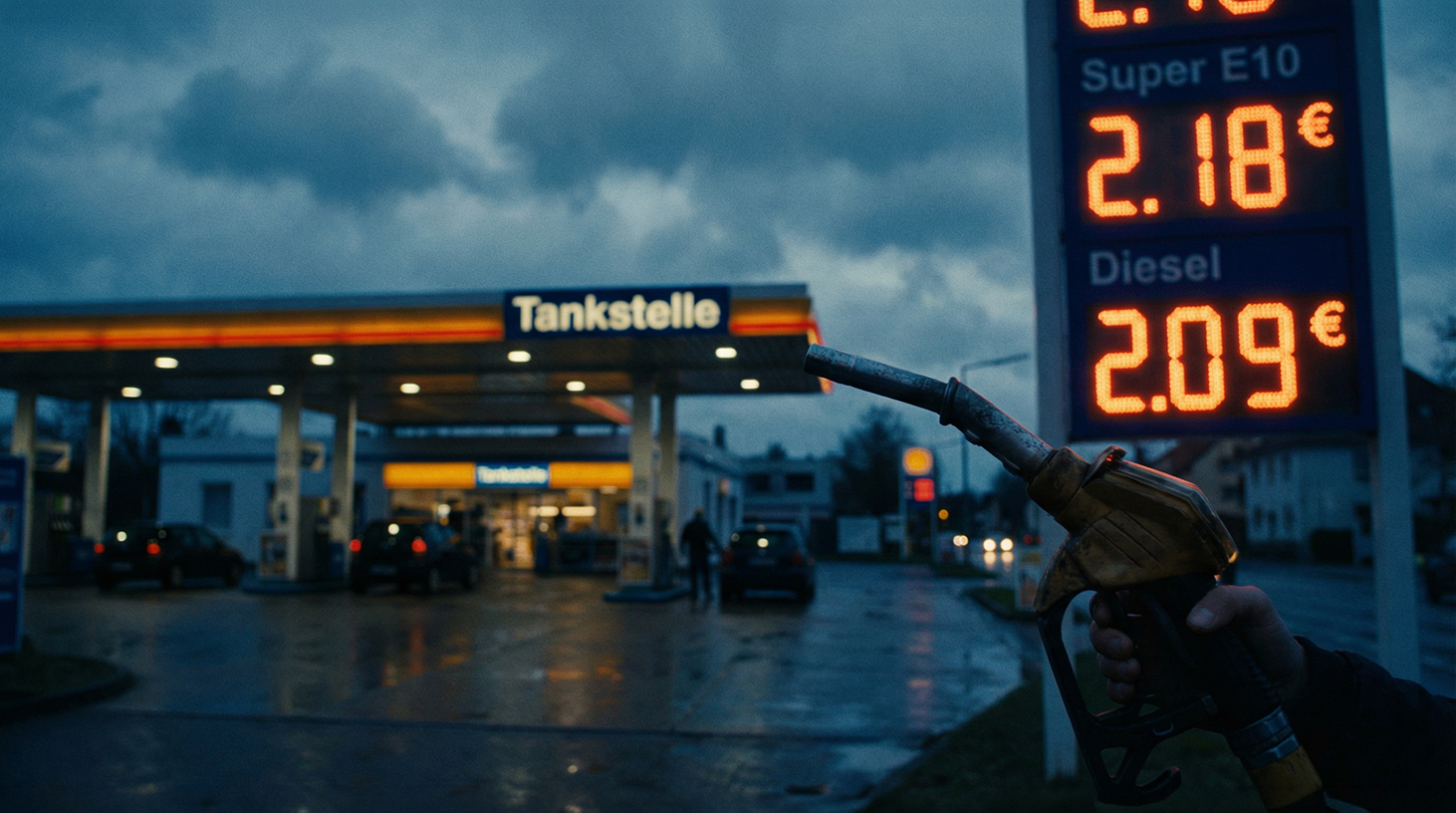
Gas price shock: Diesel over 2 euros – Why the anger over the supposed gas station rip-off is a big mistake – Image: Xpert.Digital
The fuel price illusion: Why the state is actually the biggest beneficiary at the gas pump
Forget the shopping lie: This is how the price at the gas station is really calculated
Economics of outrage: Why high fuel prices right now are not a market failure
When diesel prices break the two-euro mark per liter and the numbers on gas station price boards climb to dizzying heights, the public quickly identifies the culprit: greedy oil companies are ripping off motorists. Politicians loudly demand price caps, associations call for government intervention, and public outrage boils over on social media. But this moral outrage completely misses the economic reality. Anyone who understands the mechanisms of price formation quickly realizes that the current record prices are not a market failure, but rather the flawless functioning of a global information system that reacts to geopolitical crises and acute shortages. To make matters worse, the government—by far the biggest beneficiary of the high prices—likes to portray itself as the savior of consumers. A sober look at the economic facts shows why historical purchase prices are irrelevant to the pump, why political activism like fuel discounts inevitably fails, and why we urgently need more economic expertise in the fuel price debate.
Fuel prices and the economics of outrage
- Why anger at the gas pump is economically pointless and political activism only makes everything worse
When the price of diesel at German gas stations breaks the two-euro mark and gasoline climbs above two euros, the public reaction is as predictable as death and taxes. Politicians of all stripes outdo each other with strong words, social organizations demand government intervention, and public outrage boils over on social media. However, this moral outrage over fuel prices overlooks a fundamental economic principle found in every economics textbook: prices are not receipts for past costs, but rather barometers of future expectations. Anyone who fails to grasp this cannot properly assess the current situation or formulate meaningful countermeasures.
What's really behind the price jumps at the gas pump?
In early March 2026, the war with Iran plunged oil markets into a state reminiscent of the 2022 energy crisis. The price of Brent crude, the European benchmark, rose by around 50 percent within a week, temporarily breaking the $111 per barrel mark, its highest level in four years. The cause was as clear as it was ominous: the Strait of Hormuz, through which about one-fifth of the global oil supply is transported, was effectively closed or at least severely disrupted. Iran threatened a complete blockade, further fueling supply anxieties in international markets. The investment bank Bernstein raised its annual forecast for Brent from $65 to $80, Morgan Stanley revised its quarterly forecast from $62.50 to $80, and in the extreme case of a prolonged conflict, analysts even considered prices of $120 to $150 per barrel possible.
At German gas stations, this development hit with brutal speed. On March 6, 2026, the average price of a liter of diesel across Germany exceeded two euros for the first time, reaching exactly 2.109 euros. Super E10 reached 2.014 euros per liter on the same day. By March 9, prices had risen to 2.07 euros for gasoline and well over 2.20 euros for diesel. A historically unusual phenomenon was that diesel became noticeably more expensive than gasoline for the first time, even though diesel traditionally benefits from a lower energy tax rate.
The logic of replacement value, or why tomorrow's price determines today's price
The central argument fueling public outrage can be summarized as follows: Oil companies purchased their crude oil at significantly lower prices, some of the fuel is already stored in tanks beneath gas stations, and therefore it is unjustified to immediately pass on the increased world market prices to consumers. Herbert Rabl, spokesperson for the gas station industry association, put it bluntly, calling the current pricing a rip-off because the crude oil was purchased and refined at a much lower price.
This argument sounds intuitively plausible, but it reveals a fundamental misunderstanding of how pricing works in a market economy. No company that wants to survive in the long term can base its selling prices on historical purchase prices if the replacement costs for the next delivery are significantly higher. The Fuels and Energy Association (en2x) has made this unequivocally clear: Fuel prices at gas stations are calculated based on current daily purchase prices at the so-called replacement value. This allows for the purchase of fuels that have become significantly more expensive, thus ensuring supply.
In business administration, replacement value refers to the amount required to acquire a new item of the same type and quality on the current market. It is calculated by multiplying the original purchase price by the ratio of the current price index to the price index at the time of acquisition. This principle is not a trick of the oil industry, but a fundamental rule of business accounting applied by every company that wants to preserve its assets. Inflationary trends or sharp price increases typically mean that the amounts accumulated through depreciation are insufficient for a new purchase, which is why depreciation based on the higher replacement value is intended to prevent potential asset loss.
Applied to the fuel market, this means: If a gas station sells its current inventory at the old purchase price, it simply cannot afford the next delivery because it will be calculated at the new, higher world market price. Gas station prices are not based on crude oil prices, but rather on procurement costs, i.e., the world market prices for gasoline and diesel, which are traded on separate exchanges. The pricing formulas used by gas stations to purchase fuel from their suppliers include, as a variable component, the international price quotations on the Rotterdam spot market. If these quotations rise by 30 or 50 percent within a few days, the selling prices at the pump must inevitably follow suit; anything else would be economically irresponsible.
Prices as an information system, or what Friedrich August von Hayek already knew in 1945
Outrage over rising prices is understandable from a human perspective, but economically uninformed. The Austrian-British economist and Nobel laureate Friedrich August von Hayek formulated one of the most profound insights in economics in his groundbreaking 1945 essay: prices are not merely numbers, but condensed information about scarcity and demand. They contain knowledge about what is scarce, what is in demand, and the cost of reallocating resources. No one needs complete knowledge of all markets; it is sufficient to react to price signals so that the actions of market participants coordinate themselves almost automatically.
In a market economy, the price mechanism fulfills four essential functions. The allocation function determines which products are produced and in what quantities. The coordination function ensures that resources are used efficiently. The information function provides all market participants with data on the relative scarcity and value of products. And the incentive function gives producers and consumers impulses for specific behaviors: A high price motivates producers to produce more and consumers to consume less.
When the price of gasoline rises above two euros, it's not a market failure, as Saxony's Minister-President Michael Kretschmer claimed, but quite the opposite: it's a functioning market. The high price signals that oil is becoming scarce, that transport routes are disrupted, and that supply risks exist. This signal has an essential function: it curbs demand, creates incentives to conserve fuel, makes alternative energies and drive systems relatively more attractive, and draws additional capacity into the market on the supply side. High prices signal that a good is scarce, and this signal directly influences the incentives of market participants: producers increase their output, while consumers reduce their demand.
The Anatomy of Fuel Prices, or Why the State Is the Biggest Beneficiary
Before politicians and commentators accuse the oil companies of greed, it's worth taking a sober look at the actual composition of fuel prices. For premium gasoline (E10), taxes and levies accounted for approximately 61.1 percent of the consumer price in 2025. At an average price of €1.74 per liter, this equates to roughly €1.06 flowing directly to the government. For diesel, the tax and levy share was just over 50 percent, with energy tax alone making up 28.5 percent and value-added tax contributing around 16 percent to the gross price.
In addition, there is the CO2 levy, which, since 2026, has been calculated within a corridor of €55 to €65 per ton of CO2 through the auctioning of emissions trading certificates. The Federal Ministry for the Environment forecasts an increase of up to approximately three cents per liter for gasoline and diesel compared to the previous year. In absolute terms, the CO2 tax in 2026 will amount to up to 18.5 cents per liter of gasoline and up to 20.7 cents per liter of diesel, each including the value-added tax (VAT). This levy alone has almost tripled since its introduction in 2021, when it stood at 7 cents per liter of gasoline.
The smallest portion of the fuel price goes toward procurement costs and the companies' profit margins, i.e., transportation, the margins of gas station operators, investments, and distribution. It is therefore a bitter irony that those who collect the largest share of the fuel price—namely, the state and its institutions—portray themselves as protectors of consumers against the alleged greed of corporations. WirtschaftsWoche put it succinctly: it is a more than peculiar idea to artificially inflate fuel prices first and then artificially lower them again when the price rises.
Related to this:

Our EU and German expertise in business development, sales and marketing


Our EU and German expertise in business development, sales and marketing - Image: Xpert.Digital
Industry focus areas: B2B, digitalization (from AI to XR), mechanical engineering, logistics, renewable energies and industry
More information here:
A thematic hub offering insights and expertise:
- Knowledge platform covering global and regional economies, innovation and industry-specific trends
- A collection of analyses, insights, and background information from our key areas of focus
- A place for expertise and information on current developments in business and technology
- A hub for companies seeking information on markets, digitalization, and industry innovations
A victory with an expiration date: Why political triumph becomes an economic trap.
When politicians campaign at the gas pump
The political reactions to the current price crisis follow a pattern well-known from previous episodes. Federal Finance Minister Lars Klingbeil demanded that profiteering be prevented and announced an antitrust review by the Minister of Economic Affairs. The chairman of the Conference of Minister-Presidents, Alexander Schweitzer, stated that there were legal means to combat this profiteering. Saxony's Minister-President Michael Kretschmer declared that the companies had overcharged and spoke of a market failure, because fuel was cheaper in neighboring Poland.
Even before the current price increase, Sahra Wagenknecht called for the abolition of the CO2 price and an end to the oil embargo against Russia. The Left Party leader, Ines Schwerdtner, demanded a price cap for fuels and a profit tax on oil companies, arguing that the companies' crisis profits should be used to provide relief for the population. SPD General Secretary Tim Klüssendorf advocated for stricter regulations, asserting that market movements were not yielding the results that a market economy should be capable of.
When politicians speak of price gouging in general terms, it's either populism, opportunism, cheap vote-grabbing, or simply a lack of economic understanding – in many cases, a mixture of all three. Simon Wolf, climate policy expert at Germanwatch, unequivocally classified the demand for a fuel price cap as pure populism. The demand to use taxpayers' money for a fuel price cap ignores the fundamental fact that money subsidized at the pump is then lacking elsewhere – whether for education, infrastructure, or social security.
Kretschmer's reference to lower prices in Poland is particularly telling. The price differences between European countries result to a considerable extent from differing tax rates and levels of levies, not from differing profit margins of the oil companies, which operate internationally anyway. When a politician speaks of market failure because prices are lower in a neighboring country with lower taxes, he is consciously or unconsciously diverting attention from the fact that it is the government's tax burden that makes the essential difference.
Related to this:


The cautionary tale of fuel discounts, or when the state tampers with the price mechanism
To understand why government intervention in fuel prices regularly fails, one only needs to look back three years. In the summer of 2022, in response to rising fuel prices due to the war in Ukraine, the German government at the time introduced a fuel discount that reduced the energy tax for three months. The experiment cost the government around 3.15 billion euros. Its effect was limited at best and, according to WirtschaftsWoche, was probably only enough for a family-sized pizza at their favorite Italian restaurant for most drivers.
The RWI – Leibniz Institute for Economic Research has scientifically investigated the impact of the fuel discount. The results are sobering: While the discount was passed on to consumers almost entirely in the first month, the pass-through decreased sharply during July and August 2022. In federal states with comparatively high average incomes, particularly Bavaria, the fuel discount was passed on to a significantly lesser extent, while it reached consumers more effectively in eastern German regions. At gas stations with few competitors in the immediate vicinity, the discount was also passed on to a lesser degree: Only about 84 percent of the fuel discount for diesel and 80 percent for Super E10 reached consumers there.
The core problem was a fundamental design flaw, which the Federal Cartel Office itself pointed out: there was and is no legal obligation for oil companies to pass on a tax cut directly to consumers. The then Minister of Economic Affairs, Robert Habeck, finally admitted that it was impossible to permanently offset rising prices for imported oil, the appreciation of the dollar, and refinery shortages with public funds. A rare moment of economic clarity in an otherwise activist debate.
Price caps and their side effects, or how scarcity becomes shortage
Economic theory and historical experience agree: Price controls exacerbate the very problem they are intended to solve. In an open market economy, high prices signal that a good is in very short supply. When prices rise, demand decreases, and new profit opportunities attract more suppliers to the market. The price controls that are being demanded everywhere silence this important signal or at least dim it. The result: Scarcity persists or worsens, and governments have to counteract it with ever more regulations and interventions – a so-called intervention spiral that is almost impossible to stop and is inefficient and therefore expensive for an economy.
Agenda Austria has vividly described the mechanics of a price cap on the energy market: When policymakers impose a limit on prices, scarce goods go to where there is the highest willingness to pay, i.e., to countries without price caps. While a cap does lead to lower prices, it also means there are fewer suppliers actually selling the product. Lower prices simultaneously encourage increased consumption. Thus, the cap transforms price pressure into a supply problem; scarcity becomes a shortage.
Historical examples of failed price controls abound. Venezuela, a country with the world's largest proven oil reserves, has so thoroughly ruined its economy through decades of price subsidies and economic controls that, despite its oil wealth, the population suffers from hyperinflation and shortages. In Germany itself, the rent control law, a related instrument of price control, has, according to the German Property Owners' Association (Haus & Grund), the Council of Economic Experts, and numerous economists, not helped to solve the housing problem but rather exacerbated it, because it destroys investment incentives and reduces supply. The economist Veronika Grimm put it unequivocally: Rent control stifles new construction if it is repeatedly extended.
The oligopoly problem, or where the justified criticism begins
All of this does not mean that the German fuel market is a model of functioning competition. As early as 2011, after three years of intensive market monitoring, the Federal Cartel Office determined that the five major oil companies – namely BP/Aral with 23.5 percent, Shell with 22 percent, Jet with 10 percent, and Esso and Total with 7.5 percent market share each – constitute a dominant oligopoly that dictates fuel prices. The problem: The suspicion of illegal price-fixing could not be confirmed, even though the competition authorities exhausted all investigative avenues.
In a further sector inquiry in 2023, the Federal Cartel Office again examined the markets upstream of petrol stations, namely refineries, trading, transport, and storage of crude oil and petroleum products. The oligopoly structure of the market means that so-called parallel behavior is possible: Companies monitor each other and adjust their prices without the need for explicit agreements. Algorithm-based price adjustments further amplify this effect.
Herein lies the crucial difference to the simplistic narrative of price gouging: The problem is not that prices react to scarcity signals – that is economically correct and necessary. The problem lies in the speed and extent of upward price adjustments compared to the sluggishness of price declines, a phenomenon economists describe as the rocket-spring effect. Prices rise like a rocket when the price of oil increases and fall like a feather when it decreases. Investigating precisely this phenomenon and, if necessary, taking action using existing antitrust instruments is the task of the Federal Cartel Office, not the introduction of price caps or fuel discounts.
Related to this:
What would really help instead of symbolic politics
The current crisis at gas stations is revealing structural problems that cannot be solved with short-term subsidies. Instead, there are economically sound approaches, although these are less likely to attract media attention than calls for a fuel price cap.
The tax burden on fuel could be reviewed without the government subsidizing individual price components. If taxes and levies account for over 60 percent of the gasoline price, then the government's leverage is at least as significant as that of the corporations. Federal Economics Minister Katherina Reiche rightly stated that a government-imposed fuel price cap is not on the agenda and has instead left the assessment to the Federal Cartel Office. The climate policy expert from Germanwatch suggested, as an alternative, a reduction in the electricity tax to relieve the burden on consumers without disrupting the market's scarcity signals.
The Austrian model of a single daily price increase at noon, introduced to the Bundesrat by a motion from the black-green coalition government of Baden-Württemberg, would be a sensible step against rapid price increases without distorting the fundamental pricing mechanisms. It would maintain competition in price reductions while curbing the psychologically and economically problematic practice of multiple daily price increases.
In the long term, reducing dependence on fossil fuels remains the most effective protection against price shocks at the pump. Every euro invested in the electrification of transport, charging infrastructure, and renewable energies is a euro that reduces the vulnerability of the economy to geopolitical crises. The current situation clearly demonstrates the price a society pays for having placed itself in a structural dependence on oil imports from unstable regions for decades.
Economic pragmatism instead of pub talk economics
The debate about fuel prices reveals a profound gap in economic literacy among the German public and many politicians. The confusion between historical purchase prices and replacement values, the misunderstanding of the informational function of prices, the naive notion that government intervention can eliminate scarcity – all this demonstrates a lack of basic economic understanding that is alarming in a country with Germany's economic power.
The Iran war may be an external shock over which Germany has no control. But the way a society reacts to such shocks says a great deal about its economic maturity. As Hayek formulated it over eight decades ago, attempts by the state to overly control or replace prices lead to the loss of parts of the information function. The market is not described as a perfect system, but as a mechanism that, without a central authority, achieves a great deal of coordination—far more than a crisis team in the Ministry of Economic Affairs ever could.
A bit more economic pragmatism would do the heated debate some good. Prices at the pump are high, and they hurt many people. But they are not the result of a conspiracy by greedy corporations; rather, they are the consequence of a geopolitical crisis that is reducing supply on the global market. Those who suppress this signal through government intervention are not eliminating the shortage, but merely removing the incentive to address it through behavioral changes, increased efficiency, or innovation. That would be the real scandal, not the prices at the pump.
Your global marketing and business development partner
☑️ Our business language is English or German
☑️ NEW: Correspondence in your native language!

Konrad Wolfenstein
I and my team are happy to be available to you as your personal advisor.
You can contact me by filling out the contact form here wolfenstein@xpert.digital:or simply call me at +49 7348 4088 965. My email address is
I'm looking forward to our joint project.