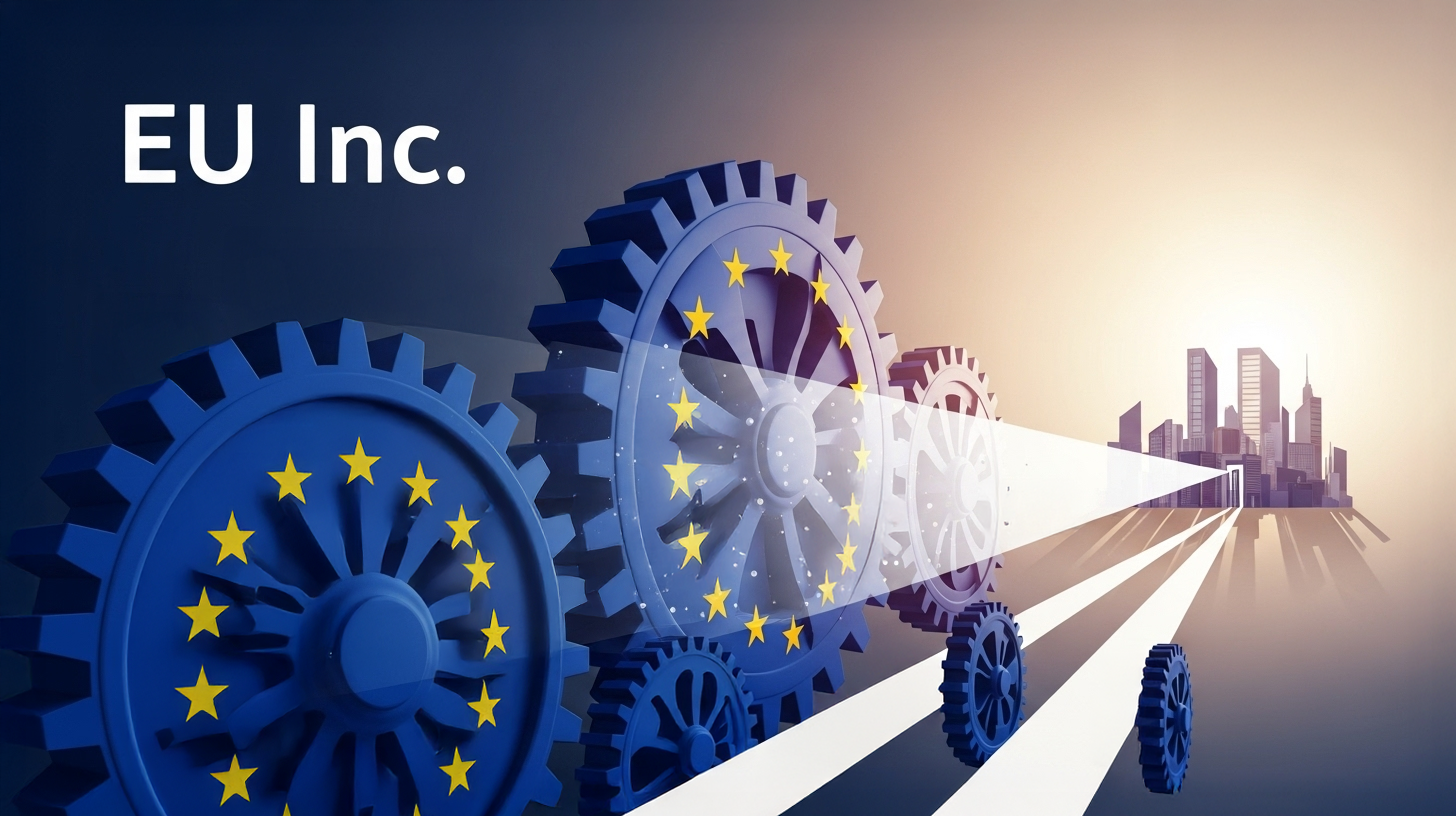
Answers to questions about the future of European start-ups: The EU Inc. – Against bureaucracy and difficulties in raising capital – Image: Xpert.Digital
End the nightmare: How 'EU Inc.' is supposed to replace 27 legal systems and liberate Europe's founders
Europe is falling behind: Shocking figures show why radical start-up reform is now overdue
Only eight percent of the world's growth companies are based in the EU, while around 60 percent are located in North America.
While the US and China dominate the global tech landscape, Europe risks falling behind in the innovation race. The figures are alarming: significantly less venture capital, a lower density of growth companies, and a dramatic lag in patent applications paint a picture of a continent failing to realize its potential. The cause is largely homegrown: a fragmented domestic market that forces founders to navigate the jungle of 27 different national legal systems, unnecessarily complicating and increasing the cost of expansion and investment.
But one ambitious initiative could fundamentally change the game: the “EU Inc.”, also known as the “28th Regime.” The vision is a unified, pan-European legal structure that would allow startups to establish digital companies within 24 hours for under €100 and grow seamlessly across the EU—without having to create a separate subsidiary in each country. Driven by a powerful coalition of prominent founders, including the CEOs of Personio and DeepL, investors, and supported by high-ranking politicians such as Mario Draghi and European Commission President Ursula von der Leyen, the proposal has already been included in the European Commission’s official work program. It is a crucial attempt to dismantle bureaucratic hurdles, mobilize European capital, and safeguard the continent’s technological sovereignty in an increasingly polarized world.
Why is EU Inc. even necessary?
The answer lies in the fragmented structure of the European start-up market. While a California start-up can easily expand and raise capital in all American states, European founders have to familiarize themselves with 27 different legal systems if they want to scale across the EU.
This fragmentation has measurable consequences. Only eight percent of the world's fastest-growing companies are based in the EU, while around 60 percent are located in North America. The figures for venture capital are even more dramatic: On average, venture capitalists invest roughly three times as much capital in the US as in Europe. Between 2019 and 2024, annual venture capital investments in the EU averaged US$68 billion, compared to US$221 billion in the US.
What is the current situation for European start-ups?
The figures paint a worrying picture. Germany, Europe's largest economy, reached a record high of 22,400 corporate insolvencies in 2024 – the highest level since 2015. The increase among young companies is particularly alarming: Start-ups that had been on the market for up to two years saw an increase in insolvencies of almost 40 percent.
The dependence on foreign investors is dramatic: Every second European startup relies on US investors. For every company with a lead investor from Europe, there is one with a US investor. This dependence is less pronounced in other regions – in the US and China, domestic investors play a leading role in eight out of ten funding rounds.
Europe is steadily losing ground. While the EU increased its R&D investments by 32 percent since 2019, the US raised its spending by 69 percent and China by 54 percent. In terms of patent applications in the high-tech sector between 2019 and 2023, China filed 1.7 times more than the US and even 7.6 times more than Europe.
What exactly is EU Inc. and how does it work?
The EU Inc., also known as the "28th Regime," is a planned pan-European legal form specifically for start-ups. It would function as a single European limited liability company (GmbH), existing alongside national legal forms such as GmbH, SARL, and SRL, but with equal recognition throughout Europe.
The fundamental principles comprise four pillars: First, a uniform legal form under EU law that can operate across borders without having to establish a separate subsidiary in each country. Second, a central, digital register for incorporation and administration online via an EU register, ideally in English. Third, standardized investment documents such as term sheets, shareholder agreements, and SAFE notes that are universally recognized. Fourth, an EU-wide employee share ownership scheme with standardized stock options for all of Europe.
The vision is ambitious: A startup should be able to be registered within 24 hours for a fee of less than €100, entirely digitally, without a notary appointment and without minimum capital. Andreas Klinger, one of the main initiators, aptly describes the concept as "Delaware Inc. meets Stripe Atlas meets Y Combinator SAFE".
Who is behind the initiative and what support does it receive?
The EU Inc. initiative was launched in late 2024 by a coalition of prominent founders and investors. Key initiators include Austrian investor Andreas Klinger (Prototype Capital, former CTO of Product Hunt), Philipp Herkelmann, Simon Schaefer, and Vojtech Horna. Andreas Klinger brings extensive experience to the role – he was a founding member of Product Hunt, a VPE at CoinList, Head of Remote at AngelList, and CTO at On Deck.
The support is impressively broad: More than 16,000 people have signed the petition, including prominent founders such as Hanno Renner (Personio), Jarek Kutylowski (DeepL), Verena Pausder (German Startups Association), and the founders of Revolut and Bolt. High-ranking politicians have also signaled their support, including former Central Bank President Mario Draghi and former Italian Prime Minister Enrico Letta.
Particularly noteworthy is the support from established law firms such as Cooley, Orrick, and Osborne Clarke, which are involved in drafting the legal details. EU Commission President Ursula von der Leyen already referred to this as the "28th regime" in Davos in January 2025.
What is the current status and timeline?
The initiative has already achieved concrete political progress. In May 2025, EU Inc. became part of the European Commission's official work program as part of the "EU Startup and Scaleup Strategy." The Commission has established a dedicated working group with which the initiators are in regular contact.
The timeline is ambitious but realistic: The European Commission is expected to publish its legislative proposals in the first quarter of 2026. Following deliberations in the European Council and Parliament, the EU Inc. is slated to come into force in 2027. Andreas Klinger is optimistic: "In the best-case scenario, the first company under the new legal form could be launched as early as 2028.".
A public consultation by the European Commission ran until the end of September 2025, allowing stakeholders to contribute their views on the planned initiative. The initiators are simultaneously working to mobilize political support at the member state level to ensure that the final legislative proposal is sufficiently ambitious.
What role does Mario Draghi's report play in this context?
Mario Draghi's report on the future of European competitiveness, published in September 2024, forms an important policy basis for the EU Inc. initiative. The report identifies closing the innovation gap with the US and China as a key challenge and calls for a new industrial strategy for Europe.
Draghi's analysis dramatically illustrates how Europe is falling behind: Productivity in the EU continues to lag behind the US and is improving more slowly than in Asian markets. The roughly 400-page report contains 170 recommendations and estimates that the digital, social, and sustainable transformation of the EU economy will require approximately €800 billion in investment annually.
Draghi issued a stark warning that European governments had "failed to grasp the gravity of the situation." His report particularly emphasizes the need to dismantle regulatory barriers to innovation and reduce the fragmented structure of the single market as key obstacles to growth. This diagnosis aligns perfectly with the objectives of the EU Inc. initiative.
How is the German start-up scene reacting to the initiative?
The reaction in Germany is predominantly positive. Verena Pausder, who has been Chairwoman of the German Startups Association since December 2023, actively supports the initiative. She emphasizes: "An EU Inc. would remove barriers, enable growth across national borders, and thus multiply the innovative power of our continent.".
The German startup association, which unites 1,200 members, sees EU Inc. as part of a comprehensive innovation agenda. Pausder, who brings diverse experience as an entrepreneur, investor, and co-founder of FC Viktoria Berlin, argues for an "entrepreneurial awakening" for Germany.
Prominent German founders also support the initiative. Hanno Renner, CEO of the Munich-based billion-dollar startup Personio, demands: "We must become independent of the US and China, especially when it comes to technological innovations." He laments that, due to the fragmented European legal landscape, Personio has to maintain seven locations in Europe with a corresponding number of individual subsidiaries.
What specific problems does EU Inc. solve?
EU Inc. addresses several fundamental problems of the European start-up ecosystem. First, the complexity of the founding process: While start-ups in the USA can be founded quickly and digitally, many European countries still require notary appointments, minimum capital, and complex bureaucratic procedures.
Secondly, there are the investment hurdles: Katharina Wilhelm from the international venture capital firm Index Ventures explains: “Many angel investors and international funds are now shying away from countries like Germany – simply because of the high costs and legal complexity.” Investors have to conduct separate legal and tax due diligence for each country.
Thirdly, there are the barriers to scaling: A California-based startup can easily expand to all US states, while European companies have to establish separate subsidiaries in each country. This not only slows growth but also incurs significant costs and administrative burdens.
Fourthly, employee participation: Standardized stock option programs are difficult to implement in Europe due to differing national regulations, making it harder to attract and retain talent.
Our EU and German expertise in business development, sales and marketing

Our EU and German expertise in business development, sales and marketing - Image: Xpert.Digital
Industry focus areas: B2B, digitalization (from AI to XR), mechanical engineering, logistics, renewable energies and industry
More information here:
A thematic hub offering insights and expertise:
- Knowledge platform covering global and regional economies, innovation and industry-specific trends
- A collection of analyses, insights, and background information from our key areas of focus
- A place for expertise and information on current developments in business and technology
- A hub for companies seeking information on markets, digitalization, and industry innovations
EU Inc.: How a unified legal form could reinvent European start-ups
What obstacles and criticisms exist?
Despite broad support, there are also skeptical voices. A major point of criticism concerns the complexity of implementation: Harmonizing company law, insolvency law, labor law, and tax law across 27 member states is an enormous regulatory undertaking.
Some observers fear that the EU Inc. could be watered down in practice through compromises between member states. The history of the European Company (SE) shows that pan-European legal forms do not automatically lead to widespread adoption unless they are substantially simpler than national alternatives.
Tax issues remain complex: While the EU Inc. legal form is to be harmonized, taxation and labor law will generally remain at the national level. This could mean that many of the current problems persist even if the corporate form is standardized.
Time constraints are also a significant factor: Even with successful political implementation, it will take years before the first EU Inc. companies can be established. In the fast-paced startup world, this could be too late to catch up with the US and China.
What is the EU Commission's position on the initiative?
The European Commission has not only adopted the EU Inc. initiative but has positioned it as a central component of its start-up strategy. Stéphane Séjourné, Executive Vice-President for Prosperity and Industrial Strategy, explains: “Companies founded in Europe must grow in Europe.”.
The Commission is planning a comprehensive package of measures in five areas: promoting an innovation-friendly environment, better financing, supporting market acceptance and expansion, attracting and retaining top talent, and easier access to infrastructure and networks.
Of particular interest is the “Blue Carpet” initiative (2025-2026), which focuses on entrepreneurial education, the tax aspects of employee share ownership, and cross-border employment. The Commission also intends to promote fast-track visas for non-EU founders.
The planned "European Business Wallet" aims to enable seamless digital interactions with public administrations across the EU through a unified digital identity. This would complement EU Inc.'s vision of a digital infrastructure.
What role do international investors play?
International investors, particularly from the US, play a crucial role in the European startup ecosystem. However, this dependence is problematic: US investors such as Sequoia, Bessemer Ventures, and Andreessen Horowitz primarily invest in more established European startups that require larger sums of funding for their growth.
The figures illustrate the imbalance: Over a quarter (27 percent) of investments in European startups come from the US, while European investors account for only seven percent of the deal volume in the US. Between 2020 and 2024, around 60 percent of the funding for European startups came from foreign investors.
This dependency carries strategic risks: External investors may have different priorities than European stakeholders. They could relocate successful European startups to their home markets or withdraw their investments in the event of economic tensions.
EU Inc. could provide a solution here: Standardized investment documents and simplified legal structures would make it easier for European investors to invest across borders. This could promote the development of a stronger pan-European VC market.
How does the situation differ in various European countries?
The fragmentation of Europe is clearly evident in the differences between countries. France has overtaken Germany as the second-largest startup market in Europe: in 2024, French startups received around $7.5 billion, while German companies received approximately $6.7 billion. The UK remains unchallenged at the top with $13.1 billion.
These differences reflect differing regulatory environments. France has implemented targeted start-up-friendly reforms in recent years, while Germany struggles with bureaucratic hurdles. Paradoxically, Brexit has not significantly harmed the UK, as London remains attractive to international investors as a financial center.
In Germany, the structural problems are particularly pronounced: European pension funds invest only 0.01 percent of their capital in venture capitalists, significantly less than in the US. In German-speaking countries, this share is even declining and is below the 2016 level.
The German government's planned €12 billion Win initiative is intended to provide new impetus, but it will take years for the ecosystem to benefit. EU Inc. could have a faster impact, as it addresses regulatory rather than just financial hurdles.
What impact would EU Inc. have on competitiveness?
EU Inc. could help Europe avoid falling completely behind the US and China. Currently, the gap is dramatic: the US venture capital market represents 0.7 percent of GDP, while the seven billion euros in German start-up investments amount to only about 0.2 percent of Germany's economic output.
Europe has fundamental strengths that could be leveraged through improved structures: excellent research landscapes, a strong SME sector, and expertise in industrial automation and power semiconductors. The region is also a leader in certain niche technologies and boasts a GDP comparable to that of the USA.
The EU Inc. could offer particular advantages in deep tech and robotics. Andreas Klinger argues that Europe, with its production networks and computer vision expertise, would actually be a better location for robotics companies if legal and financing barriers were removed.
A unified European system could also stem the exodus of European entrepreneurs to the US. The percentage of Europeans starting businesses in the US has risen to around eleven percent in recent years. Daniel Khachab, founder of the restaurant ordering app Choco, urges swift action: "I see EU Inc. as a sign of hope, which we need in these times when everyone is considering leaving the EU.".
What technical and practical challenges need to be solved?
The practical implementation of EU Inc. requires significant technical infrastructure. A central EU register must be created that is compatible with national systems. This is particularly complex because different countries use different IT systems and data standards.
The standardization of investment documents (EUFAST) is legally demanding. These documents must be compatible with different national capital market laws while remaining simple and standardized. International law firms are already working on drafts, but final coordination with 27 national legal systems will be complex.
KYC (Know Your Customer) and AML (Anti-Money Laundering) processes need to be harmonized. Currently, each EU country has its own procedures, which complicates cross-border business. A unified EU Inc. would require standardized, yet legally compliant, procedures.
Integrating with existing banking and employment platforms is also challenging. Start-ups need to be able to work seamlessly with different national banks, payroll providers, and HR systems without the complexity of current multi-country setups.
How could EU Inc. transform the European start-up ecosystem?
The EU Inc. could bring about a fundamental paradigm shift. Instead of 27 fragmented national markets, a unified European startup market with 450 million consumers would emerge. This would offer European startups a critical mass from the outset, comparable to the American market.
The "flywheel effect" could accelerate: simpler business creation processes lead to more startups, which attracts more investors, thus strengthening the ecosystem. Andreas Klinger describes this as a solution to systemic disadvantages that led to Europe losing out on Web 2.0 due to media, language, and investor fragmentation.
Talent mobility would improve dramatically. Standardized stock option programs would make it easier for European startups to attract and retain top talent from different countries. This is particularly important because, while Europe has excellent universities, many graduates migrate to the US.
Capital markets could become more integrated: If investors no longer had to conduct separate due diligence processes for each country, European VC funds could invest more efficiently across borders. This would increase capital flow within Europe and reduce dependence on US investors.
What are the long-term strategic implications of this initiative?
EU Inc. is more than just a regulatory reform – it is part of a broader strategy for European technological sovereignty. At a time when geopolitical tensions between the US, China, and Europe are increasing, the ability to develop domestic technology champions is becoming increasingly strategically important.
This initiative could help Europe create its own "Delaware Inc." equivalent. Delaware attracts a disproportionate number of American companies due to its business-friendly laws. A successful EU Inc. could have a similar effect, drawing international companies to Europe.
This could be particularly relevant in the field of artificial intelligence. While the EU has already approved a three-billion-euro innovation package for AI startups, EU Inc. could offer additional structural advantages. European AI companies could benefit from stricter EU data protection laws if they can simultaneously scale more easily.
Integration into broader EU digital policies is also significant. EU Inc. fits into initiatives such as the Digital Decade, the Digital Services Act, and the planned AI regulation. Together, these regulations could position Europe as an alternative location to the US and China.
The timeframe is critical: If EU Inc. succeeds, it could help Europe avoid missing out on the next wave of technology (Web 3.0, advanced AI, quantum computing). If it fails or comes too late, Europe could permanently lose its role as a technology developer.
The EU Inc. initiative thus represents more than just bureaucratic simplification – it is an attempt to fundamentally strengthen Europe's position in the global innovation landscape and to secure long-term technological sovereignty.
Your global marketing and business development partner
☑️ Our business language is English or German
☑️ NEW: Correspondence in your native language!

Konrad Wolfenstein
I and my team are happy to be available to you as your personal advisor.
You can contact me by filling out the contact form here wolfenstein@xpert.digital:or simply call me at +49 7348 4088 965. My email address is
I'm looking forward to our joint project.
☑️ SME support in strategy, consulting, planning and implementation
☑️ Creation or realignment of the digital strategy and digitization
☑️ Expansion and optimization of international sales processes
☑️ Global & Digital B2B trading platforms
☑️ Pioneer Business Development / Marketing / PR / Trade Fairs
🎯🎯🎯 Benefit from Xpert.Digital's extensive, five-fold expertise in one comprehensive service package | BD, R&D, XR, PR & Digital Visibility Optimization

Benefit from Xpert.Digital's extensive, five-fold expertise in a comprehensive service package | R&D, XR, PR & Digital Visibility Optimization - Image: Xpert.Digital
Xpert.Digital possesses in-depth knowledge across various industries. This allows us to develop tailored strategies precisely aligned with the requirements and challenges of your specific market segment. By continuously analyzing market trends and monitoring industry developments, we can act proactively and offer innovative solutions. The combination of experience and expertise generates added value and provides our clients with a decisive competitive advantage.
More information here: