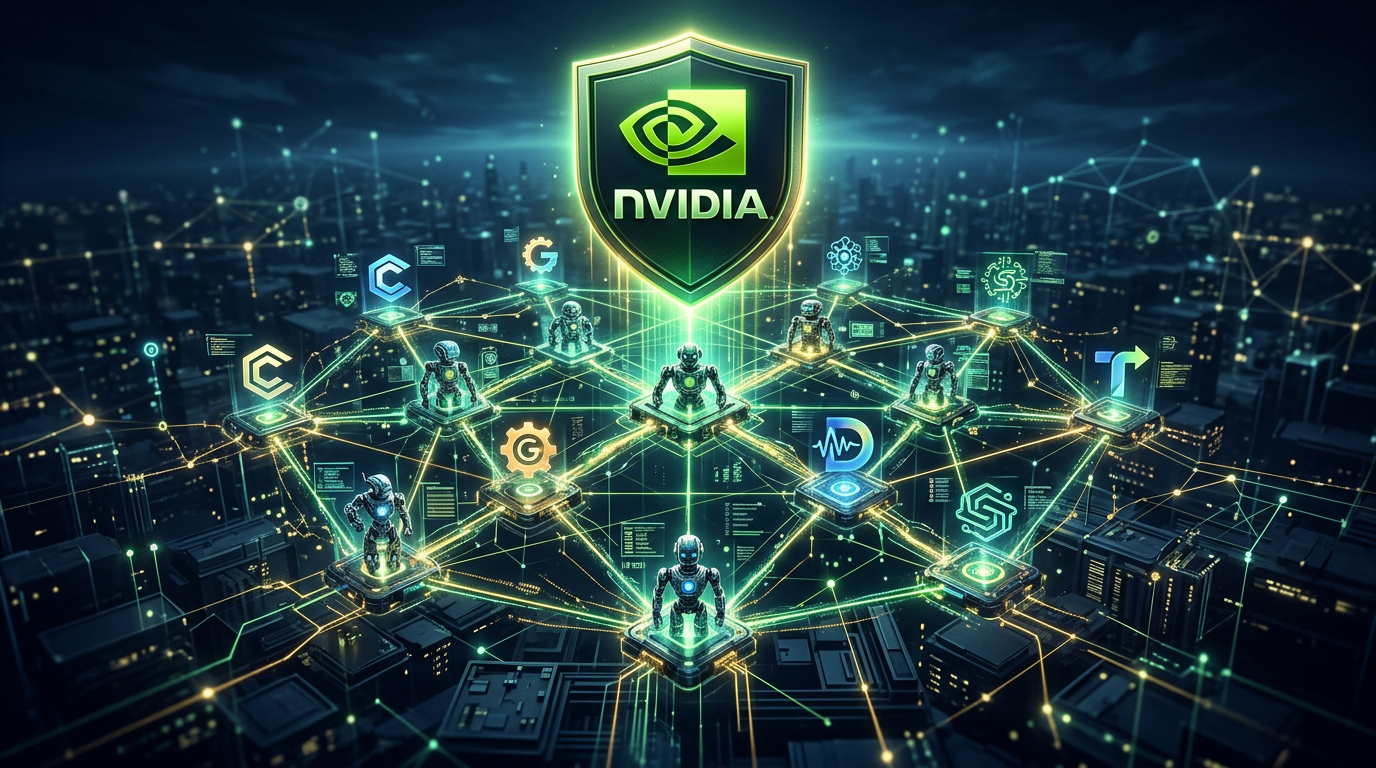
Nvidia attacks OpenAI and Google: How “NemoClaw” is revolutionizing the entire AI industry – Image: Xpert.Digital
More than just chips: Nvidia's brilliant master plan for the AI monopoly of the future
The new “Windows for AI”: Why Nvidia’s agent platform is changing everything
GTC 2026: Nvidia's stealthy move threatens the business model of OpenAI and Google
Nvidia is far more than just the leading chip supplier for artificial intelligence. At GTC 2026, CEO Jensen Huang unveiled a strategic milestone that could fundamentally shift the balance of power in the global tech world. With the OpenClaw and NemoClaw platforms, the company is now targeting the middleware layer – that crucial layer of the future AI agent economy. Instead of leaving the field to proprietary software providers like OpenAI or Google, Nvidia is positioning an open, hardware-agnostic operating system for autonomous AI agents. What seems paradoxical at first glance is a brilliant strategic move to extend its dominance from the hardware to the software layer. The unmistakable message is that whoever controls the infrastructure and standards of the agents determines the future of enterprise AI. For companies, this fundamentally changes the rules of the game.
Related to this:


Nvidia is reaching for the agent layer: Whoever controls the stack controls the AI economy of the future
At GTC 2026 in San Jose, Nvidia CEO Jensen Huang made a strategic move that goes far beyond a product announcement. With the unveiling of NemoClaw as an enterprise-grade AI agent platform and the underlying open-source framework OpenClaw, Nvidia demonstrated that it is no longer content with simply supplying the hardware on which others realize their AI ambitions. The company is now claiming control of the middleware layer – that crucial layer between infrastructure and business processes where the real value creation of the coming agent economy will take place. Whoever controls this layer controls the future of enterprise AI.
From chip supplier to infrastructure operator
To understand the significance of this development, a brief look back is worthwhile. Nvidia was founded in 1993 as a graphics startup, experienced its true strategic transformation with the introduction of CUDA in 2006, and became the dominant infrastructure force of the AI age with the rise of deep learning after 2012. CUDA – short for Compute Unified Device Architecture – was initially a programming interface that allowed developers to leverage the parallel computing power of graphics processors for general-purpose computing. Jensen Huang described the platform at its 20th anniversary at GTC 2026 as a true flywheel: The technological advancements enabled by CUDA attracted new users, who implemented new ideas, and this cycle reinforced itself over two decades.
What began as a tool for computer graphics and scientific simulation laid the foundation for Nvidia's current near-monopoly in AI hardware. More than 85 percent of the systems in the TOP100 list of the world's most powerful supercomputers now use GPUs, and a significant portion of these run on Nvidia architectures. The CUDA ecosystem now comprises more than 400 libraries, allowing developers to build, optimize, and scale applications across PCs, cloud systems, workstations, and supercomputers. This deep-rooted developer loyalty is Nvidia's crucial competitive advantage – and it is precisely this model that the company is now transferring to the agent level.
NemoClaw: The enterprise-grade agent stack
What Jensen Huang presented at GTC 2026 as OpenClaw and NemoClaw is more than just a software platform – it's an attempt to become for the era of autonomous AI agents what Windows was for the personal computer. The analogy was explicitly drawn at GTC: Just as Windows gave personal computers a standardized environment for running software, OpenClaw aims to give AI agents a standardized environment for operating. Agents based on this framework can navigate file systems, spawn sub-agents, execute scheduled tasks, step-by-step decompose complex problems, integrate external tools, send messages, and work overnight without human oversight.
NemoClaw is the enterprise-hardened version of the open-source framework – bridging the gap between the experimental world of developer communities and the requirements of large corporations. Developed in collaboration with OpenClaw creator Peter Steinberger, NemoClaw adds critical enterprise features to the open framework: the NVIDIA OpenShell runtime for secure agent execution, policy enforcement and network barriers, privacy routing that keeps sensitive data local, and seamless integration with NVIDIA's own NeMo and NemoTron models. Crucial to its market penetration is its explicitly hardware-agnostic approach: NemoClaw runs on any GPU, not just NVIDIA chips. This may sound paradoxical, but it's strategically brilliant – an open-source ecosystem that works on third-party hardware attracts more developers, strengthens the standard, and ultimately increases switching costs for companies deeply integrated into the NVIDIA stack.
Strategic partnerships as a multiplier
Even before Jensen Huang took the stage at the SAP Center in San Jose, Nvidia had already positioned NemoClaw in discussions with some of the most influential companies in the enterprise technology world. Salesforce, Cisco, Google, and CrowdStrike were identified as potential partners with whom Nvidia was in talks about the agent stack, according to reports from Wired and CNBC. This partnership approach is indicative of Nvidia's new strategy: instead of selling licenses, Nvidia offers early access in exchange for code contributions to the project. This model makes the ecosystem more valuable through the active participation of its enterprise partners and deeply integrates Nvidia's architecture into the product development cycles of the world's largest software companies.
At GTC, the Nemotron Coalition was also unveiled – a global collaboration for open-frontier models, with founding partners such as Mistral, Perplexity, and Cursor. This initiative underscores the ambition to be not merely a platform for AI models, but to become the center of an open, yet Nvidia-centric, AI model ecosystem. With six model families encompassing speech, image, robotics, driving, biology, and weather models, Nvidia is positioning itself as a full-range provider in the AI modeling business – a direct challenge to the proprietary offerings of OpenAI, Anthropic, and Google.
A new dimension of digital transformation with 'Managed AI' (Artificial Intelligence) - Platform & B2B solution | Xpert Consulting


A new dimension of digital transformation with 'Managed AI' (Artificial Intelligence) – Platform & B2B solution | Xpert Consulting - Image: Xpert.Digital
Here you will learn how your company can implement customized AI solutions quickly, securely and without high entry barriers.
A managed AI platform is your all-inclusive, worry-free solution for artificial intelligence. Instead of dealing with complex technology, expensive infrastructure, and lengthy development processes, you receive a ready-made solution tailored to your needs from a specialized partner – often within just a few days.
The key advantages at a glance:
⚡ Rapid implementation: From idea to ready-to-use application in days, not months. We deliver practical solutions that create immediate added value.
🔒 Maximum data security: Your sensitive data stays with you. We guarantee secure and compliant processing without sharing data with third parties.
💸 No financial risk: You only pay for results. High upfront investments in hardware, software, or personnel are completely eliminated.
🎯 Focus on your core business: Concentrate on what you do best. We take care of the entire technical implementation, operation, and maintenance of your AI solution.
📈 Future-proof & scalable: Your AI grows with you. We ensure continuous optimization and scalability, and flexibly adapt the models to new requirements.
More information here:
Nvidia's master plan: How the chip giant is secretly reshaping the AI world
The strategic break with the old business model
The truly remarkable aspect of Nvidia's agent offensive is not the technology itself, but the underlying paradigm shift in its business model. Nvidia has always been primarily a hardware company – its market capitalization, which at times exceeded $4.5 trillion, is essentially based on the promise that AI training and inference will require ever more GPUs. This remains true: the demand for Blackwell GPUs is massive, as evidenced by projects like the announced delivery of over one million Nvidia GPUs to Amazon Web Services. Infrastructure demand remains Nvidia's foundation.
But with NemoClaw and its agent platform, Nvidia is now entering the software layer. And this is where the real strategic impact lies: As AI agents become the primary interface between human work and AI systems, the balance of power shifts. Large language models – LLMs – become interchangeable components in the background, a kind of commodity engine that can be swapped out as needed. The real differentiation then lies at the agent layer: Whoever defines the environment in which agents operate, sets the security standards, formulates the governance rules, and provides the interfaces to business processes, holds the key position in the new economic architecture.
Related to this:


The ambivalent relationship with OpenAI
Nvidia's agent offensive gains particular strategic significance due to its impact on its relationship with OpenAI. The relationship between the two companies is characterized by a peculiar ambivalence: Nvidia is by far the most important hardware partner for OpenAI's ambitious compute plans – the planned provision of computing capacity for OpenAI reaches into the double-digit gigawatt range, making the company an indispensable infrastructure partner. At the same time, Nvidia is building an open agent ecosystem with NemoClaw, which directly competes with OpenAI's own agent approach.
The crucial difference lies in the marketing strategy: While OpenAI positions agents as proprietary products for which companies pay subscriptions, Nvidia's approach is modular and open. NemoClaw is a building block that Salesforce, Cisco, Adobe, and other technology providers can integrate into their own products—without dependence on a proprietary model stack and without being locked into specific hardware. For enterprise customers, this translates into a highly attractive offering: full control over their own data, no external dependencies, maximum flexibility in model selection, and government compliance.
This fundamentally changes the nature of competition in the AI industry. For a long time, the most important question in the tech world was: Which language model is more powerful – OpenAI's GPT, Google's Gemini, or Anthropic's Claude? This question becomes less important as soon as the agent platform becomes the crucial layer. Then, the differentiating factor is no longer the model itself, but rather the quality of the orchestration environment, the governance features, the security architecture, and the depth of integration into existing business processes.
Open Source as a Trojan Horse
Nvidia's open-source strategy with NemoClaw, upon closer inspection, is a highly sophisticated market development strategy. Traditional platform players like Microsoft with Windows or Google with Android have demonstrated how open or freely available platforms can achieve enormous market penetration, provided the ecosystem is designed in such a way that the platform architecture itself fosters long-term customer loyalty. Nvidia replicates this model at the agent layer.
By being hardware-agnostic but deeply integrated with Nvidia's NeMo models, the NIM service layer, and the DGX hardware line, NemoClaw creates a pull dynamic: Companies adopt the open platform, benefit from rapid deployment – NemoClaw promises production-ready agent deployments in under an hour – and naturally migrate to Nvidia's own hardware ecosystems for high-performance workloads. The result is a platform effect that, much like CUDA two decades ago, reinforces itself.
The Enterprise AI world according to NemoClaw
For companies pursuing an AI strategy, the NemoClaw announcement significantly alters the planning horizon. The integration of security and privacy guardrails from the outset addresses the biggest adoption barriers in the enterprise sector to date: regulatory uncertainty, data privacy concerns, and compliance requirements. European companies operating under the GDPR and the EU AI Act, in particular, will consider this architecture highly relevant – because the ability to process sensitive corporate data entirely on-premises without consulting external model APIs is not an optional convenience feature for many regulated industries, but a mandatory requirement.
At the same time, it is becoming clear that the agent platform will change the organizational structure of companies in the medium term. If AI agents can autonomously handle complex, multi-stage tasks—from email management and file analysis to workflow orchestration and scheduling—then the role of human employees will fundamentally change. They will spend less time executing processes and more time configuring and monitoring agents and evaluating the quality of their output. In this vision, the corporate organization of the future is not a structure of people and systems, but a network of agent hierarchies in which humans assume strategic control.
Competitors under pressure
Nvidia's entry into the agent layer presents established players in this market with fundamental challenges. Microsoft with its Copilot stack, OpenAI with its enterprise agent products, and Google with its Workspace assistants have thus far operated in a market without a clear infrastructure standard. Nvidia is now offering a powerful counterpoint: an open, security-oriented, hardware-flexible standard backed by the weight of by far the most influential semiconductor company of the AI era.
Nvidia's strategic decision not to replace existing application layers, but rather to position itself as an infrastructure layer beneath them, is astute. It reduces friction with potential partners who would integrate NemoClaw into their own products and prevents the political backlash that direct competition with established applications would trigger. The message is clear: We are the infrastructure on which you build your agents – much like you use AWS to host your applications. The real battle for the enterprise agent layer has only just begun.
Your global marketing and business development partner
☑️ Our business language is English or German
☑️ NEW: Correspondence in your native language!

Konrad Wolfenstein
I and my team are happy to be available to you as your personal advisor.
You can contact me by filling out the contact form here wolfenstein@xpert.digital:or simply call me at +49 7348 4088 965. My email address is
I'm looking forward to our joint project.