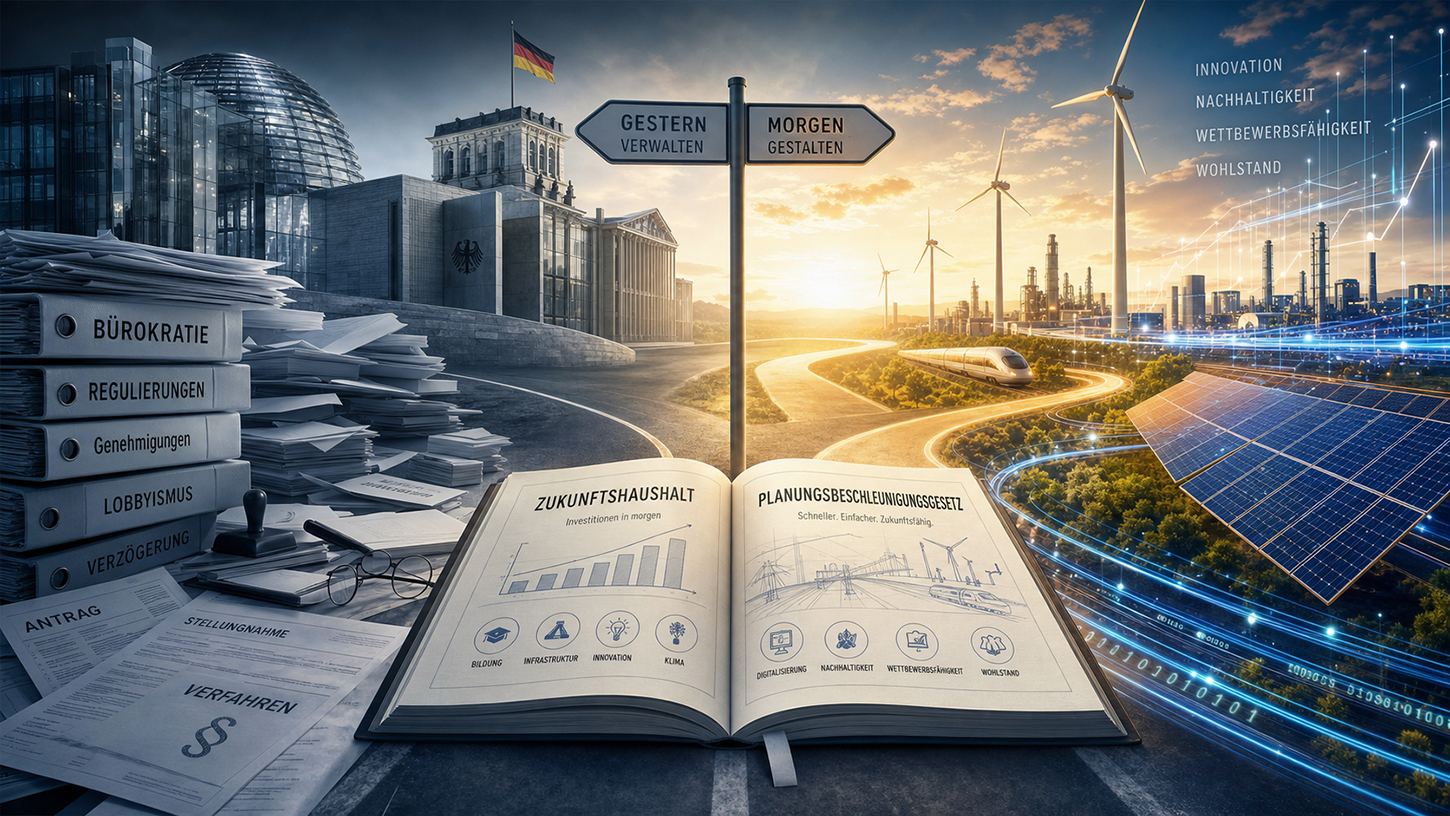
Identifying the causes and understanding the economic crisis: An economy in the stranglehold of opportunism and obstructionist policies – Image: Xpert.Digital
The crisis behind the crisis: Why the German economy is no longer growing
Trapped in a web of interests: Why Germany urgently needs a new economic model
Permanent stagnation: How politics and lobbying are paralyzing Germany's economy
Germany, once celebrated as an export world champion and the growth engine of Europe, is stuck. For years, its economic development has resembled a debilitating stagnation – a state that far exceeds the usual cycles of a classic recession. While official forecasts speak only of a "baby-step recovery," awareness of a profound, structural crisis is growing in society and among businesses. Crumbling infrastructure, a lack of investment, a crippling shortage of skilled workers, and weak productivity growth are the obvious symptoms. But the true cause lies deeper: German economic policy is trapped in a web of political opportunism, partisan blockades, and overpowering lobbying.
Instead of pursuing a future-proof, coherent basic model, politics is getting lost in fragmented individual measures and ad-hoc programs that often serve the particular interests of well-connected groups more than the long-term common good. The following analysis ruthlessly exposes the mechanisms of this systemic gridlock. It shows how the lack of strategic transparency stifles investment, why our economic renewal urgently requires a separation of lobbying and government, and how the media and civil society can help to finally refocus attention on genuine problem-solving instead of mere self-promotion.
Related to this:


Initial situation: An economy under constant stress
The German economy has been in a state of stagnation for several years, a situation that can be described neither as a classic recession nor as a robust recovery. After a significant slump in 2023 and a further decline in gross domestic product (GDP) in 2024, growth in 2025 was very weak, amounting to only a few tenths of a percentage point. Official statistics show that economic output is stagnating, while at the same time the feeling of a structural crisis is growing.
Economic forecasts from major institutions paint a picture of a "baby-step recovery": a decline in 2024, stagnation or minimal growth in 2025, and at most a moderate increase of just over one percent in 2026. Unemployment has risen noticeably compared to the pre-pandemic boom, while at the same time, many sectors are experiencing a shortage of skilled workers. Although the inflation rate has normalized towards the target value of around two percent, the real wage losses of recent years have only been partially offset.
Germany thus exemplifies a pattern familiar to many mature industrialized nations: weak productivity growth, reluctance to invest, demographic pressure, geopolitical uncertainty – and increasing political fragmentation that undermines the state's ability to act. The economic problems are therefore not purely technical or cyclical phenomena, but are deeply intertwined with the structures of the political system, the incentive mechanisms of political parties, and the influence of organized interests.
The central idea behind this analysis is that sustainable economic renewal is hardly conceivable without a systematic disentanglement of opportunism, party politics, and lobbying. The crisis is not just one of numbers, but one of priorities and transparency.
Economic situation: Stagnation with structural causes
Growth dynamics: From export miracle to slow track
For a long time, Germany was considered the growth and export engine of Europe. In the 2000s and early 2010s, the economy benefited from globalization, high industrial expertise, and moderate unit labor costs. However, this model has come under pressure. In recent years, there have been a series of economic downturns and weak recoveries.
The data show that real GDP declined significantly in 2023 and contracted again in 2024. While slight positive growth was achieved again in 2025, there was no sign of a strong recovery. Forecasts indicate growth of just over one percent for 2026 – sufficient to avoid a deep recession, but insufficient to decisively finance investment, innovation, and tackling major transformation challenges such as decarbonization and digitalization.
The diagnosis of economic policy advisory bodies is relatively uniform: Potential growth – that is, the long-term growth rate determined by structural factors – has declined in Germany. This is due to structural problems: insufficient investment in productive capital, sluggish digitalization, inadequate innovation across large sectors of the economy, and significant deficiencies in public infrastructure.
Labor market: High employment, but growing instability
At first glance, the labor market appears stable, but closer inspection reveals cracks. While the number of employed people is high, the unemployment rate has risen to around six percent, after being significantly lower in previous boom years. At the same time, companies in many sectors are complaining about a shortage of skilled workers, particularly in technical professions, nursing, skilled trades, and IT.
This paradoxical situation – rising unemployment and simultaneous shortages – indicates that the labor market has structural matching problems: qualification profiles do not match demand, regional disparities are significant, and further training and retraining systems are reacting too slowly. Furthermore, jobs are being cut in crisis-stricken sectors such as parts of the energy-intensive industry, while growth segments are not scaling quickly enough.
Wage development presents a mixed picture: Years of high inflation led to real losses in purchasing power, which are only being gradually offset. Consumer price inflation rates are expected to remain at around two percent in 2025 and 2026, which will have a stabilizing effect but will not automatically compensate for the existing real wage losses. For domestic demand, this means that consumption will remain subdued, especially given the uncertainty surrounding the economic future and the tax and social security burden.
Public finances and state investments
The public sector is in a liminal state: The deficit ratio is in the range of two to three percent of GDP, significantly below typical crisis levels, but also far from a balanced budget. The government's financing balance shows a persistently negative position of well over 100 billion euros per year, which limits its room for maneuver, but seemed justifiable for a long time given historically low interest rates.
At the same time, it has been pointed out for years that the state's investment needs are considerable: dilapidated bridges, overloaded railways, inadequate digital infrastructure, and investment backlogs in schools, universities, and public administration. Studies emphasize that the quality of public infrastructure is a key location factor and directly influences private investment. Many companies report that infrastructure deficiencies impair their business operations and negatively affect investment decisions.
At this point, it already becomes apparent how the entanglement of politics and interests has an influence: Instead of pursuing clear, long-term investment strategies based on a consistent setting of priorities, ad-hoc special funds, temporary programs and politically motivated priorities often emerge, which serve short-term profiling interests rather than a long-term location strategy.
Foreign trade: Dependencies and location attractiveness
Germany is a strongly export-oriented economy that benefited for many years from large current account surpluses. While these surpluses have declined recently, they remain high, signaling continued external demand for German products. At the same time, geopolitical tensions, strategic competition between major economic regions, and trade disputes are exacerbating the situation.
The high dependence on certain export markets and energy-intensive value chains makes the economy vulnerable to external shocks. The necessary transformation towards climate-neutral production, more resilient supply chains, and greater diversification of sales markets generates high investment needs. If these are not accompanied by a coherent interplay of government regulations, private investment, and credible industrial policy, a gradual erosion of the country's attractiveness as a business location is imminent.
Productivity, investments and the gradual decline
Productivity slump as the core problem
The primary driver of long-term prosperity is productivity growth – the ability to produce more or better goods and services with a given amount of labor. In Germany, productivity growth has been significantly weaker for years than in previous decades. The reasons lie in a complex interplay of insufficient investment, inadequate digitalization, the slow diffusion of innovations, and institutional inertia.
Reports from the Council of Economic Experts and other institutes emphasize that two dimensions are particularly important: investments in physical capital stock and technological progress, supplemented by human capital and the quality of public institutions. Investments in machinery, equipment, software, and infrastructure increase the capital stock, which can be used more productively. Technological progress—for example, through digitalization, automation, and artificial intelligence—amplifies this effect.
If these investments fail to materialize or are implemented too slowly, potential growth declines. This is precisely what we are observing: Germany is failing to transform its structure towards a highly innovative, digitally competent, and resource-efficient economy, even though it does not fundamentally lack know-how, capital, and technological capabilities. The problem lies less in the "what" but in the "how" and "who implements it.".
Investment weakness: Private and public
Both private and public investment are lagging behind what would be sensible and necessary. Companies are hesitant to initiate large projects because of political uncertainty, regulatory complexity, slow approval processes, and unclear long-term frameworks. Reported infrastructure deficiencies—from transportation and energy to digitalization—exacerbate this reluctance.
While governments talk a lot about investment initiatives, implementation often fails due to budgetary rules, jurisdictional disputes between different levels of government, capacity limitations in public administration and the construction industry, and a frequently reactive, project-oriented rather than strategic planning approach. Special funds and temporary programs create additional complexity instead of establishing a reliable, long-term investment strategy.
This creates a vicious cycle: weak productivity slows growth, weak growth makes it politically difficult to justify new debt or tax reforms, a lack of investment prevents productivity leaps, and so on. This cycle is reinforced by political incentive structures that reward short-term gains while long-term measures with diffuse, difficult-to-explain effects are hardly rewarded.
Human capital and institutions as underestimated levers
In addition to physical capital and technology, human capital plays a central role: educational attainment, professional qualifications, management skills, and a culture of innovation. Expert reports indicate that investments in human capital are just as important as those in machinery and infrastructure. For Germany, this means that a forward-looking education policy that focuses on digital skills, STEM subjects, professional development, and lifelong learning is a crucial factor for economic competitiveness.
Equally important are public institutions. Their quality determines how efficiently resources are used, how reliable regulations are, and whether economic actors have confidence in politics and administration. Slow planning and approval processes, unclear responsibilities, frequently changing funding policies, and a generally risk-averse administration act like sand in the gears of modernization.
This reveals a close connection to the issue of lobbying: When institutional processes are opaque, the importance of informal influence, direct contacts, and specialized associations that know how to shape regulations to favor specific interests increases. This distorts resource allocation because priorities are not given to the most productive projects, but rather to those with the best access to decision-makers.
Lobbying, party politics and opportunism as a systemic blockage
How lobbying works in economic policy
Lobbying is nothing unusual in modern democracies; it is, in itself, a normal expression of organized interest representation. Associations and companies provide information, contribute expertise to legislative processes, and represent the legitimate concerns of their members. Problems arise when the balance between the general interest and particular interests is lost.
Analyses of lobbying in Germany show that interest groups exert influence on political decisions in a variety of ways: through direct contacts with members of parliament and ministries, participation in hearings, statements on draft legislation, expert panels, reports, and media campaigns. Their influence is largely based on an informational advantage and the ability to selectively present complex issues.
Studies emphasize that lobbying can help shape economic policy frameworks in line with specific objectives, such as favorable competitive conditions, a relaxation of government regulations, or better chances in public procurement. This potentially shifts the focus of economic policy from a balanced consideration of objectives to a selective favoring of those sectors that are particularly well-organized.
Information dominance and regulation in favor of individuals
A critical dimension is the so-called informational influence strategy: associations are increasingly permeating legislative processes with their analyses, drafts, and proposed wording. Particularly in complex policy areas such as energy, finance, digitalization, or health, ministries and parliaments often lack the capacity to work out all the details themselves. This increases their dependence on external expertise, which, however, is not neutral but rather driven by vested interests.
Political science analyses show that this dependency is structurally embedded in two ways: First, economic policy is under pressure to strengthen national competitiveness and reduce production costs, which makes it susceptible to arguments that threaten a country's economic competitiveness. Second, close cooperation with private sector actors is increasingly portrayed as normatively desirable, in the sense of "partnership" and "co-governance".
The consequence can be that public resources – for example, through subsidies, tax breaks, or regulatory exemptions – are largely made available to private interests without transparent discussion or consideration of alternative uses. This shifts the allocation of tax revenue and regulatory attention in favor of well-organized groups, while long-term, society-wide investment needs remain underfunded.
Public perception and loss of trust
Empirical studies on the perception of lobbying show that a large portion of the population considers the influence of lobbyists on German politics to be extensive and rather problematic. A significant proportion of those surveyed even believe that this influence is stronger at the national level than at the EU level. This perception contributes to a growing distrust in the ability of politicians to represent the public interest.
When citizens get the impression that political decisions are primarily shaped by associations, large corporations, or well-connected NGOs, their willingness to support unpopular but necessary reforms decreases. As a result, politicians become more cautious, shy away from clear decisions, and try to please everyone – a classic pattern of opportunistic decision-avoidance. This creates a double paralysis: economic policy is susceptible to special influence, while at the same time, the fear of voter backlash blocks fundamental course corrections.
Opportunism and party politics as amplifiers
Party politics is unavoidable in a parliamentary democracy. It becomes problematic when short-term self-promotion and differentiation take precedence over the search for viable solutions. In economic policy practice, this manifests itself on several levels:
- Parties develop their own “signature projects”, which primarily serve internal mobilization and media profile, rather than a coherent overall economic strategy.
- Opposition parties focus on scandalizing the government's weaknesses instead of constructively contributing to cross-party reform consensus.
- Coalition partners block each other by tactically delaying, watering down, or linking key concerns of the other side to unrelated compromises.
These mechanisms are not the result of individual malice, but rather the expression of an opportunistic incentive system: Short-term advantages in elections, internal party positioning, or media presence are weighted more highly than long-term problem-solving success. Consequently, numerous individual measures, special rules, exceptions, and program fragments emerge, which are rarely embedded in a consistent basic economic policy model.
Instead of relying on a shared basic model supported by a broad range of political and social actors, competing narratives dominate: Every party, every NGO, every association emphasizes the weaknesses of the other side, instead of identifying common ground – both positive and negative – and building viable compromises on that basis. This not only limits economic governance but also confuses the public, who are presented with a multitude of unconnected guiding principles.
Our EU and German expertise in business development, sales and marketing

Our EU and German expertise in business development, sales and marketing - Image: Xpert.Digital
Industry focus areas: B2B, digitalization (from AI to XR), mechanical engineering, logistics, renewable energies and industry
More information here:
A thematic hub offering insights and expertise:
- Knowledge platform covering global and regional economies, innovation and industry-specific trends
- A collection of analyses, insights, and background information from our key areas of focus
- A place for expertise and information on current developments in business and technology
- A hub for companies seeking information on markets, digitalization, and industry innovations
Existing buildings as a stumbling block: How the energy transition can still succeed
The missing base model: Why a common reference is so important
Fragmented guiding principles instead of a consistent strategy
A key weakness of German economic policy is the lack of a widely accepted, simple, yet viable basic model that defines the major goals and priorities. Instead, many competing models exist: growth-oriented versus distribution-oriented, industrially controlling versus market-oriented, and maximally ambitious climate policy versus cost-oriented restraint.
Numerous NGOs, political parties, business associations, and expert networks each present their own "master plans," which are heavily focused on specific problem areas—climate protection, social justice, competitiveness, debt brakes, digitalization, and so on. These plans often aim to highlight the weaknesses of other approaches instead of identifying common ground and openly addressing contradictions. As a result, instead of creating a clear framework, there is a glut of particular concepts.
A viable basic model would have to do precisely the opposite: It wouldn't regulate everything down to the last detail, but would define in a binding way which economic policy goals are prioritized and in what order, what role the state and the market should each play, how many resources are mobilized for future investments, and how distributional conflicts are fairly balanced. Individual measures could then be evaluated on this basis, instead of existing in a vacuum.
Key economic questions that a basic model must answer
An effective basic economic policy model for Germany would have to clearly address at least four key questions:
1. Growth target and potential
What medium-term economic growth should be targeted, and what productivity increases are required to achieve it? How much investment in infrastructure, digitalization, and the energy and transport transitions is needed to reach this goal?
2. Role of the State
Which tasks does the state directly undertake (infrastructure, education, security, basic services) and where does it limit itself to setting the framework for private actors? How are state investments financed, and how is it ensured that short-term cost-cutting measures do not destroy long-term profitability?
3. Distribution issues and social security
How can we prevent growth strategies from deepening social divisions while simultaneously preserving incentives for performance and individual responsibility? What role do tax policy, wage policy, and transfer systems play in the social acceptance of reforms?
4. Innovation, competition and location quality
How can an environment be created in which innovations can quickly take hold, new companies emerge, and existing companies invest instead of waiting for subsidies? What role do competition policy, deregulation, and the education system play in this?
As long as these questions remain unanswered, at least in broad terms, by a widespread consensus, economic policy will remain a patchwork of short-lived initiatives. Lobbying and party politics fill this void by negotiating isolated advantages and pushing through symbolic decisions that are only partially embedded in a long-term strategy.
Related to this:

Transparency regarding positive and negative similarities
A key shortcoming of the current debate culture is that common ground is often only identified where it is relatively conflict-free – for example, in the abstract commitment to "growth and sustainability" or "prosperity and social justice." The truly relevant areas of overlap, that is, the concrete positive and negative shared positions, remain vague.
These transparent areas of overlap would be crucial:
- Positive commonalities: Measures that are generally supported by different political camps and interest groups, such as investments in education, digitalization, infrastructure or faster planning procedures.
- Negative commonalities: measures that are considered problematic by almost everyone, such as inefficient subsidies without targets, excessive special regulations, and opaque lobby structures.
If these common ground were clearly communicated, a minimum consensus could be established, upon which concrete reform packages could be based. Anyone wishing to deviate from this would have to disclose their reasons and submit to an objective analysis of their motives and the consequences. This would not prevent opportunism and mere self-promotion, but it would make it more difficult.
Media, public opinion and “calling a spade a spade”
Structural blind spots in reporting
The media play a central role in communicating economic and political issues. In practice, however, reporting often focuses on short-term controversies, personnel matters, scandals, and symbolic individual measures. The complex interplay of lobbying, party politics, and structural economic problems is rarely systematically revealed.
Instead of addressing structural opportunity costs—for example, which infrastructure projects are not implemented because funds are channeled into ineffective subsidies—many contributions focus on superficial conflicts: disputes over individual laws, partisan maneuvers, and pointed quotations. This avoids addressing the core issue, instead shrouding it in a fog of slogans and stereotypical roles.
A nuanced, data-driven analysis of economic relationships, which simultaneously exposes political and institutional incentives, is complex and harder to communicate than a sensationalist commentary. For a mass news format with limited attention spans, this presents an inherently difficult format problem. Nevertheless, precisely this kind of reporting is necessary to reveal the mechanisms behind stalled economic policy.
Disclosure of conflicts of interest as a journalistic task
One approach to effectively addressing opportunism and lobbying would be the systematic disclosure of conflicts of interest and channels of influence. This includes not only traditional lobbying meetings, but also the role of external expert opinions, associations in expert panels, drafting assistance for legislation, and the intertwining of political and economic careers.
Some media outlets already engage in investigative reporting in these areas, but these reports often remain episodic and person-centered. For structural improvement, it would be helpful if media outlets established regular, standardized formats that analyze legislative proposals and major economic policy projects by addressing the following questions:
- Which interest groups are actively involved?
- What specific financial or regulatory advantages are being discussed?
- Which alternatives were considered and rejected?
- What long-term costs and benefits are foreseeable, and for whom?
Such transparency would not automatically lead to better political decisions, but it would increase the cost of opportunistic strategies. Anyone opposing a broadly accepted grassroots approach would have to provide a plausible explanation instead of hiding behind rhetorical platitudes or short-term sentiments.
Shifting narratives: From blame to problem-solving logic
The public debate is heavily influenced by blame-shifting – governing parties blame the opposition and external shocks, the opposition blames the government, associations blame the framework conditions, NGOs blame industry, and so on. This logic of constant shifting of responsibility is deeply intertwined with partisan competition and media sensationalism.
For an economically sound crisis management strategy, the debate needs to shift more towards a problem-solving approach: Which measures are empirically proven to increase productivity and investment? Which reforms actually and measurably improve the quality of education, infrastructure, and administration? Where are short-term cuts necessary to ensure long-term stability?
The media's task would be to foreground these questions and measure political actors by the consistency of their answers. This does not mean abandoning criticism and pointed commentary, but rather focusing it on the discrepancy between the basic model and actual actions, instead of mere partisan squabbles.
Profiling and solution: A question of the correct sequence
Profiling as a legitimate, but secondary, incentive
Profiling – that is, the desire of political actors, parties, associations, or even companies to be publicly visible and to receive recognition – is not inherently a negative phenomenon. It is a key driving force in democratic competition and can foster motivation, engagement, and a willingness to innovate.
Publicity becomes economically and politically problematic when it doesn't serve the solution but overshadows it. When measures are judged primarily on their short-term attention-grabbing power rather than their long-term effectiveness, the focus shifts from rational problem-solving to symbolic politics. The result is measures that sound good but achieve little, or projects that garner maximum attention but have minimal structural impact.
The logical sequence should therefore be: First, a viable solution is sought based on a fundamental model; then, this solution is communicated and used for profiling. However, in practice, the order is often reversed: First, the question is how a party or actor can position itself, and then a suitable substantive proposal is sought.
Recognition for those who contribute to the solution
One possible answer to this dilemma is not to demonize self-promotion, but to link it to problem-solving. Public and media recognition should be more strongly oriented towards demonstrable contributions to effective reforms. Those who show the courage to make unpopular but necessary decisions should benefit in the long run in terms of reputation, instead of being politically ostracized in the short term.
In practice, this could be supported, for example, by making policy success measurements more systematic. Instead of simply counting the number of laws passed or the size of individual programs, impacts need to be evaluated: Have investments in education actually and measurably improved skills? Have infrastructure projects increased productivity? Have reforms to planning procedures reduced approval times?
Such a focus on impact would not eliminate profiling, but rather redirect it: away from mere announcement-based communication, towards a culture in which visible, demonstrable problem-solving is considered the most important source of political reputation. This would better align the motivation of political actors with the long-term interests of the economy.
Sanctioning opportunistic deviations through transparency
Those who deviate from a jointly defined basic model should not be automatically sanctioned, but should be required to provide justification. In a pluralistic democracy, there will always be legitimate deviations, minority positions, and alternative solutions. The crucial point is that these are made transparent and their consequences analyzed.
An institutionalized "deviation reporting" system could be helpful here: If political actors, associations, or NGOs oppose jointly accepted objectives—for example, regarding investment priorities, structural reforms, or institutional improvements—they should be required to disclose their arguments. Independent bodies, scientific advisory boards, or media fact-checking formats could then verify the plausibility of these justifications.
The key is not to prohibit dissenting opinions, but to expose opportunistic motives. When it becomes clear that a particular blockade primarily serves self-promotion or pandering to a specific clientele, public pressure increases to provide a substantive explanation. This transforms self-promotion from a free-for-all into a risky undertaking that only pays off if it is also justifiable on substantive grounds.
Perspectives for economic renewal
Strategic priorities for growth and resilience
Germany's economic renewal requires a clear prioritization of measures that demonstrably increase growth potential, productivity, and resilience. These include, in particular:
- Massive, but targeted investments in public infrastructure – transport, energy, digitalization – to eliminate bottlenecks and stimulate private investment.
- A consistent strengthening of the education system, further education and research, in order to increase human capital and innovative capacity.
- Accelerating planning and approval processes to implement projects quickly and reduce investment risks.
- A modernization of the tax and contribution system with a view to investment incentives, work incentives and competitiveness.
- An industrial policy framework to support the transformation process towards climate neutrality, setting clear target paths but avoiding technology-specific rigidities.
These measures are largely undisputed in the scientific debate; the differences lie in the details of their design and the order of implementation. The problem, therefore, is less a lack of solutions than a lack of coordination and resolve.
Institutional reforms to curb opportunism
To limit opportunism and excessive lobbying without preventing legitimate interest representation, several institutional reforms are possible:
- Transparency rules: Expansion and tightening of lobby registers, disclosure obligations for contacts between politics and interest groups, publication of statements on draft legislation.
- Evidence-based legislation: Mandatory impact analyses of major economic policy measures, systematic evaluation after implementation, public reports on the achievement of objectives.
- Strengthening independent expertise: Expanding independent scientific advisory bodies with clearly defined mandates to reduce informational dependence on individual associations.
- Reform of parliamentary procedures: Structures that promote cross-party consensus on long-term projects, for example through "future councils" or qualified majorities for certain investment programs.
These reforms would not solve all problems, but they would change the incentive structure: the benefits of purely opportunistic strategies would decrease, while the value of credible, substantively based policies would increase.
The role of civil society and the economy itself
Not only politics and the media, but also businesses and civil society organizations influence the direction of economic development. Companies can choose whether to focus on short-term subsidies and special regulations or on long-term innovation, competitiveness, and constructive cooperation with the state.
Civil society actors, including NGOs and associations, can shift their focus from simply criticizing opponents to constructively shaping a shared basic model. This includes a willingness to relativize their own positions, acknowledge priorities, and make compromises if these lead to better economic outcomes overall.
From this perspective, economic renewal would not only be a technical process, but a societal learning process: away from the logic of maximum self-profiling, towards a cooperative problem-solving logic in which profiling arises from visibly successful participation, not from obstruction.