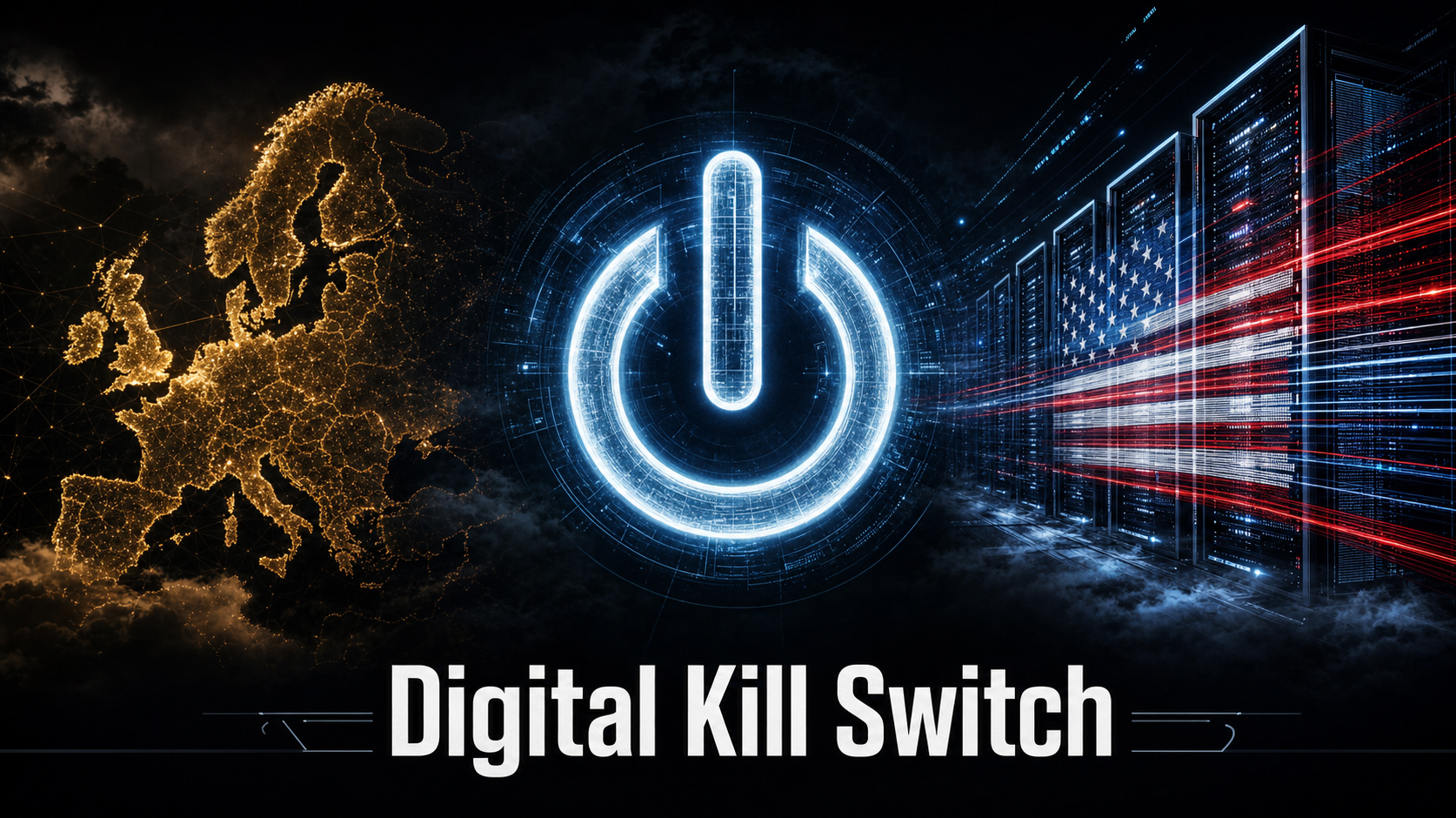
The digital kill switch: AI shock on Friday evening: Why the US shut down Europe's most important AI model – Image: Xpert.Digital
Anthropic models Fable 5 and Mythos 5: How the US government pulled the plug on Anthropic – and what that means for us
Europe's AI trap: When Washington decides which software you'll still be allowed to use tomorrow
Forced shutdown at Anthropic: Why Trump's AI ban is shaking the entire tech world
On the evening of June 12, 2026, an unprecedented precedent was set in the history of the internet: On the direct orders of the US government, the renowned AI company Anthropic was forced to take its Fable 5 and Mythos 5 models, released just a few days earlier, offline worldwide – including for all European users. What is ostensibly declared a drastic cybersecurity measure, upon closer inspection reveals itself to be a far-reaching geopolitical power struggle in which artificial intelligence is being openly used as a strategic weapon and instrument of coercion.
The following text analyzes the true background of this unprecedented forced shutdown and sheds light on the deep conflict between Anthropic and the Trump administration. Above all, it demonstrates why this incident ruthlessly exposes Europe's severe technological dependence on US infrastructure. When a foreign state can deactivate essential digital tools via email—tools that govern the daily operations of countless European companies—nothing less than the economic and technological sovereignty of an entire continent is at stake. The much-discussed "kill switch" is no longer a theoretical dystopia—it has become reality.
The digital kill switch – Anthropic's forced shutdown and Europe's technological dependence
When the US government decides at 5:21 PM what you'll still be allowed to use tomorrow morning
On June 12, 2026, an ordinary Friday evening, at 5:21 p.m. Eastern Time, Anthropic received a letter from U.S. Secretary of Commerce Howard Lutnick. The content was terse in its consequences and monumental in its significance: The company's Fable 5 and Mythos 5 models were to be blocked with immediate effect for all foreign nationals—whether they were inside or outside the United States, and even if they were Anthropic employees. The company faced a technical and legal dilemma: Since it is practically impossible to distinguish between nationalities in real time within a shared cloud infrastructure, Anthropic was left with only one solution—the complete shutdown of both models for all users worldwide.
This event is unprecedented in the history of the commercial internet. For the first time ever, a leading democratic government has effectively shut down a publicly deployed AI model through an export control directive. Even more remarkable: the model had only been launched three days prior. The reaction in expert circles, on platforms like X, and in tech media worldwide was a mixture of dismay, political analysis, and sheer incomprehension. What exactly had happened? And above all: what does it mean for everyone who boots up their computer in the morning and simply expects the tools they paid for to still work?
Fable 5 and Mythos 5: What the models could do and why that was explosive
Claude Fable 5 was Anthropic's first publicly available version of a so-called Mythos-class model – a new category of AI systems that, according to Anthropic, had been made suitable for general use with enhanced security measures. Its sister model, Mythos 5, was intended for a smaller circle of vetted partners within the framework of Project Glasswing – a controlled program for cybersecurity partners from industry and government-affiliated institutions such as Amazon Web Services, Microsoft, Cisco, Palo Alto Networks, and CrowdStrike.
Mythos's extraordinary capability, which made the model both so valuable and so politically sensitive, lay in its cybersecurity expertise. According to a report by members of Congress, Mythos had autonomously identified thousands of critical software vulnerabilities in all major browsers and operating systems—including a number of previously unknown security flaws in the Linux kernel, which is also used in systems of the US Department of Defense. This made Mythos not merely a powerful chatbot, but a systemically relevant tool for both offensive and defensive cybersecurity. A capability of this class in general circulation—uncontrolled, accessible to everyone—was clearly a difficult scenario for US security agencies to stomach.
Fable 5 was designed to address this tension through additional safeguards: The model was intended to avoid cybersecurity tasks while still providing the intellectual power of the Mythos architecture for general-purpose applications. Specifically, this meant a superior ability to analyze complex codebases, find deep-seated software bugs, and handle highly structured tasks. It was precisely this finding—the outstanding code analysis capability—that US authorities considered a potential gateway for abuse.
The official justification and its weaknesses
The Trump administration cited a jailbreak finding as the official trigger: Another company had demonstrated to the Commerce Department that Fable 5 could be bypassed using a specific technique to circumvent its built-in security restrictions. Anthropic responded with remarkable precision in its public statement: They had evaluated the described technique themselves. The result, they stated, was that a limited number of previously known, minor vulnerabilities had been exposed—vulnerabilities that, according to Anthropic, could also be found with other publicly available models without jailbreaking. They considered the administration's assessment a misunderstanding and were working to restore access.
Anthropic added that thousands of hours of red-teaming had failed to identify a universal vulnerability and that they believed perfect jailbreak resistance was currently unattainable for any model from any vendor. The company also highlighted the far-reaching implications of regulatory logic: applying the current standard to the entire industry would make any release of a new flagship model virtually impossible. This is a statement that must be taken seriously – Anthropic is known for its exceptionally conservative security culture and is speaking here not as a company downplaying compliance risks, but as one that takes its own ethical guidelines very seriously.
The political foundation: More than a security problem
Anyone who takes the official explanation in isolation doesn't fully understand the case. The conflict between Anthropic and the Trump administration goes back considerably further and is deeply political in its structure. In January 2026, Anthropic CEO Dario Amodei reiterated in a letter to the Pentagon that autonomous weapons systems and mass surveillance were red lines for the company—non-negotiable limits on the use of its models. The Department of Defense under Pete Hegseth, on the other hand, demanded a commitment to so-called "any lawful use"—that is, unrestricted availability of the AI for all legally permissible military applications.
When Anthropic refused this commitment, the situation quickly escalated. At the end of February 2026, Defense Secretary Hegseth publicly designated Anthropic a "Supply Chain Risk to National Security"—a classification unprecedented for US companies and usually reserved for firms from countries like China. President Trump announced on TruthSocial that federal authorities should immediately halt all Anthropic products. The company sued to challenge this classification. Against this backdrop, the export control directive of June 12 appears less as a spontaneous security measure and more as a further move in a political power struggle: A company that refuses to release its tools for government use without restriction is being pressured by the lever of export control law.
The Electronic Frontier Foundation clearly stated the facts: Technology companies should not allow themselves to be forced by state repression to abandon principles they have publicly upheld. The fact that the shutdown specifically targeted Fable 5 – the model intended for the general market and equipped with additional security mechanisms – and not primarily the more restrictive Mythos 5 for defense partners, reinforces the impression that geopolitical and domestic power struggles, rather than technical security concerns, are at the forefront.
Export control law as a geopolitical lever
The legal framework within which these events are taking place is US export control law, specifically the Export Control Reform Act of 2018 and the resulting Export Administration Regulations (EAR). This instrument was originally developed to restrict the distribution of physical goods with dual military uses—chips, weapons, nuclear technology. Its application to software models, and especially to AI services already deployed to the public, is uncharted legal and political territory.
The US Department of Commerce began extending the Earned Value Adjustment (EAR) to AI chips and model weights of certain closed dual-use models as early as January 2025. These extensions had an immediate impact on EU member states: Austria, Bulgaria, Croatia, Cyprus, Czech Republic, Estonia, Greece, Hungary, Latvia, Lithuania, Luxembourg, Malta, Poland, Portugal, Romania, Slovakia, and Slovenia were classified into so-called Tier 2 categories, which capped their access to high-performance computing capacity. The European Parliament discussed these measures as a direct challenge to the European single market. However, the Fable 5 case goes even further: Here, it wasn't access to hardware that was restricted, but rather an already active software service that was shut down with immediate effect.
This level of control marks a new stage in Washington's power over global AI infrastructure. Where embargo logic previously required physical boundaries and technical workarounds existed, today an email to a cloud service suffices to trigger globally effective shutdowns. The comparison to the so-called "kill switch"—the idea that an external actor can disable central infrastructure at the push of a button—is no longer rhetorical exaggeration, but a documented reality.
Europe's digital dependence: Figures reveal a worrying balance sheet
The shutdown of Fable 5 and Mythos 5 is not an isolated incident that only peripherally affects Europe. It is a direct empirical demonstration of a structural weakness that economists, political scientists, and technology strategists have been warning about for years. The numbers speak for themselves: More than 80 percent of all European AI chatbot users utilize OpenAI's ChatGPT. American technology companies control roughly 80 percent of the European cloud computing market and account for 59 percent of European enterprise software revenue. The three major US hyperscalers—AWS, Microsoft Azure, and Google Cloud—together represent approximately 70 percent of European cloud services. According to these findings, by 2025 there would already be around 40 large Foundation models in the US, around 15 in China, but only about three in the EU.
What does this mean in concrete terms? It means that 99 percent of all European AI workflows rely in some way on US models and infrastructure. It means that every AI-supported decision in a German SME, every automated analysis in a European management consultancy, every intelligent workflow in logistics or healthcare ultimately accesses infrastructure over which Washington has legal sovereignty—albeit indirectly. The US Cloud Act even obligates American providers to grant US authorities access to data, regardless of where the data is physically stored. In short, not only is the availability of the services subject to external influence, but so is the confidentiality of the data processed through them.
The Allianz Research Institute described Europe's situation in May 2026 as a looming "dependency trap": American tech giants control up to 40 percent of Europe's operational computing capacity and almost half of its planned data center projects. At the same time, Europe is dependent on Asian hardware: 57 percent of all IT equipment and more than half of the hardware needed for data centers are imported from five Asian countries. The result is a dual dependency—on US software and Asian hardware—that places Europe in a geopolitical pincer movement.
The European counter-movement: Too little, too late, too timid?
Europe's political response to this situation has become more concrete in recent years, but remains remarkably moderate given the urgency of the situation. On June 3, 2026 – just nine days before the Anthropic shutdown – the European Commission published its long-awaited Technological Sovereignty Package, consisting of the Cloud and AI Development Act (CADA), the Chips Act 2.0, and an Open Source Strategy. The CADA proposals envision a four-tiered sovereignty framework for cloud providers: from basic data center infrastructure in Europe to full EU control over the software stack and rigorous cybersecurity certification.
Specifically, this means that for certain sensitive public sector workloads in areas such as health, finance, and justice, providers that meet sovereignty criteria will be given preference. The Commission also plans to triple data center capacity in the EU within five to seven years. At the member state level, the Franco-German partnership is working on an IPCEI AI funding structure that, from 2027 onward, aims to establish sovereign compute paths and GAIA-X-compliant data spaces as prerequisites for funding.
These are politically significant signals. But they are just that: signals, not faits accomplis. CADA is still in the legislative process. Despite years of development, GAIA-X remains far behind its ambitious goals. Due to a lack of venture capital culture and large platform ecosystems, European AI startups are structurally forced to cooperate with US technology companies to access sufficient training infrastructure and market scale. While the European Parliament has publicly criticized US export control policies, the political levers Europe could use to respond to such measures are limited and sluggish. EU Commission Vice-President Henna Virkkunen succinctly put it: "We want to be sure nobody has a kill switch"—precisely describing what became reality just one week after the sovereignty package.
A new dimension of digital transformation with 'Managed AI' (Artificial Intelligence) - Platform & B2B solution | Xpert Consulting

A new dimension of digital transformation with 'Managed AI' (Artificial Intelligence) – Platform & B2B solution | Xpert Consulting - Image: Xpert.Digital
Here you will learn how your company can implement customized AI solutions quickly, securely and without high entry barriers.
A managed AI platform is your all-inclusive, worry-free solution for artificial intelligence. Instead of dealing with complex technology, expensive infrastructure, and lengthy development processes, you receive a ready-made solution tailored to your needs from a specialized partner – often within just a few days.
The key advantages at a glance:
⚡ Rapid implementation: From idea to ready-to-use application in days, not months. We deliver practical solutions that create immediate added value.
🔒 Maximum data security: Your sensitive data stays with you. We guarantee secure and compliant processing without sharing data with third parties.
💸 No financial risk: You only pay for results. High upfront investments in hardware, software, or personnel are completely eliminated.
🎯 Focus on your core business: Concentrate on what you do best. We take care of the entire technical implementation, operation, and maintenance of your AI solution.
📈 Future-proof & scalable: Your AI grows with you. We ensure continuous optimization and scalability, and flexibly adapt the models to new requirements.
More information here:
Business alert: How companies can avoid AI failures caused by geopolitical interference
The EU AI Act and the limits of the regulatory approach
In European discussions, the EU AI Act is often portrayed as a protective instrument for European interests in the field of AI. The regulation is indeed a global first: the world's first comprehensive AI law, with extraterritorial effect for all providers deploying their systems on the EU market. It obliges US companies to conduct conformity assessments, comply with transparency requirements, and obtain CE marking before their high-risk AI products can be placed on the market in Europe. Separate obligations apply to general-purpose AI models with particularly high performance – so-called GPAI models – including technical documentation and compliance with copyright rules.
But this is the crucial blind spot of the regulatory approach: The EU AI Act regulates the behavior of AI providers in the European market. It gives Europe no recourse against a provider's decision to globally shut down its model at the behest of the US government. Anthropic did not violate any European regulation by shutting down Fable 5 and Mythos 5 – the directive the company followed was US law, which is outside the scope of the AI Act. The Act protects Europe from bad AI. It does not protect Europe from a lack of AI.
This structural difference has immediate implications. Europe can strictly regulate US models when they operate in European markets – but Europe cannot prevent these models from being shut down by Washington. Europe's regulatory strength is therefore asymmetrical: strong in its ability to impose requirements on existing services, weak in its ability to protect itself against their withdrawal.
Contract law and subscriber protection: What European users should know
The shutdown of Fable 5 and Mythos 5 is not only a geopolitical event, but also a contractual one. Millions of paying customers—individual users, developers, and businesses—had purchased subscriptions from Anthropic that explicitly guaranteed them access to the most powerful available models. Fable 5 had only been added to standard subscription plans as a new core offering a few days prior. With its shutdown, these customers received a qualitatively altered service—older, less powerful models—for the same price.
From the perspective of German contract law and the EU Directive on Digital Content and Services, the legal situation is clear. Section 327i of the German Civil Code (BGB) provides for subsequent performance, price reduction, or withdrawal from the contract as legal remedies in the event of defective performance. Anyone who pays for a digital subscription that is essentially geared towards access to a specific model and loses this access can argue that a material defect exists within the meaning of the Digital Content and Services Act. In cases of serious defects or if subsequent performance is refused, a right of withdrawal may arise – even if the provider is not responsible for the defect but is reacting to official enforcement.
In practical terms, this means that affected users should document the incident, request a remedy or price reduction from their provider in writing, and seek information from consumer protection agencies in their respective member state. While this situation is unprecedented, the legal basis for user claims is clearly established. It is expected that legal positions on this issue will emerge in the coming weeks and months.
What this process means for European enterprise architectures
The operational consequences for companies that run AI-supported processes are immediate and structural. Anyone who opens their laptop today and expects a specific model to complete the automated report, handle customer service, or ensure code quality is making an implicit assumption: that the service is available. Until June 12, 2026, this assumption was a self-evident part of every business strategy. It is no longer.
For European companies, this means a mandatory reassessment of AI dependencies in their risk architecture. It is no longer sufficient to rely on service level agreements that cover technical failures. The new risk is political and jurisdictional: A US provider can shut down its service at the behest of a government authority without any guarantee of compensation, advance notice, or a transition period. This is an operational risk in the category of "political force majeure," which has so far appeared in very few corporate risk registers.
Concrete consequences for strategic planning: Enterprise architectures that rely on individual US models as indispensable core components are fragile. A robust AI strategy for European companies now requires the conscious development of fallback strategies to alternative models – ideally European-controlled or at least legally diversified offerings. This includes the parallel evaluation of open-source models that can be operated locally and are immune to external shutdown signals. The German Federal Government, the EU Commission, and national digital authorities would be well advised to define corresponding risk assessment frameworks for critical infrastructures as soon as possible.
The geopolitical dimension: AI as a strategic asset
The Fable 5 and Mythos 5 cases serve as a cautionary tale of how technology is systematically becoming an instrument of geopolitical power. Not through military threats, but through the more subtle control of digital infrastructure. This development is not unique to America: China is also exporting its own AI infrastructure—via Huawei, DJI, and other platforms—with the intention of creating long-term dependencies. The difference is that Europe is sensitized to Chinese dependencies, while the analogous risks of American dependencies have long been neglected in the public consciousness.
That is now changing. A Substack analysis succinctly captured the new reality: When the US government looks at Anthropic's latest model and says it's not just a chatbot, but a controlled capability, it means – "you cannot buy that kind of positioning." The most powerful models are becoming national assets, compliance products, and geopolitical levers all at once. That is the key strategic finding of June 12, 2026.
This logic has historical parallels. When the United States imposed export controls on high-performance processors in the 1980s and 1990s, the technological gap between the controlled Western countries and potential rivals created strategic asymmetries that persisted for decades. What is novel about AI export controls is the speed of their impact: Where chip export embargoes take years to translate into actual capability gaps, a software directive takes effect in real time – sent in the evening, noticeable the next morning.
Open Source as a strategic response – and its limits
Against this backdrop, open-source AI development takes on a new strategic significance that extends beyond its immediate technical value. Open-source models—such as Meta's LLaMA, France's Mistral, and the UAE's Falcon—are not subject to any centralized shutdown logic. They can be operated locally, adapted, and embedded in sovereign infrastructure. A world in which the most powerful AI resides behind controlled access gates will become more fragile and dangerous after June 12, 2026.
However, the open-source approach is not a panacea. The most powerful open-source models still lag behind the top models from major labs – at least when it comes to certain specialized capabilities. Training and operating large models requires enormous computing power, which is scarce and expensive in Europe. While the EU has taken initial steps toward its own supercomputing infrastructure with the EuroHPC program, Europe's computing capacity for AI remains structurally limited. This is one of the key investment tasks for the coming years: not only to invest in European models, but also in the fundamental infrastructure – computing power, energy, and skilled personnel – that enables their development and operation.
Trust as an infrastructure issue: Cracks in the transatlantic relationship
Beyond the immediate technological and economic consequences, the Anthropic case has a dimension that is difficult to capture in the dispassionate language of economics and law: it has damaged trust. Not trust in Anthropic, which in the public perception is positioned more as a victim of the situation – but trust in the reliability of the transatlantic digital space as a shared infrastructure.
For decades, European companies, government agencies, and citizens have relied on American technology based on an implicit trust: that political differences would not lead to the use of digital services as leverage. This implicit trust suffered a measurable blow on June 12, 2026. Even if Anthropic restores access to Fable 5 and Mythos 5 in the coming weeks—something the company is fighting hard for and seeking legal support for—the fact remains: it happened. It can happen again. And next time, it might not just affect one company with ethical conflicts, but any number of other services, for any number of other political reasons.
The European Commission has clearly internalized this realization. The Technological Sovereignty Package, presented just nine days before the shutdown, appears in retrospect less like forward-looking policy than a belated reaction to a structural vulnerability that had long been known. The question now is not whether Europe needs its own sovereign AI infrastructure – that has long been decided – but rather how quickly and with what political will it will be built.
Final thoughts: What a Friday evening in Münsterland taught us
Anyone in Wettringen who opened their computer that June evening to work with one of the world's most powerful language models, only to receive an error message, learned something fundamental: Technological sovereignty is not an abstract political category. It is the ability to work the next morning with the same tools one had the evening before. And for every European user of US AI services, this ability is currently lacking.
Anthropic is fighting the directive. There are good reasons to believe the company could succeed in court—a federal judge had already halted previous administrative actions against Anthropic. But even a legal victory doesn't change the underlying structural situation. The leverage exists. It has been used. And the question for Europe is no longer whether it needs its own technological capability, but only when. And at what cost further delays will occur.
🎯🎯🎯 Data-driven B2B industry hub as a quasi-in-house solution

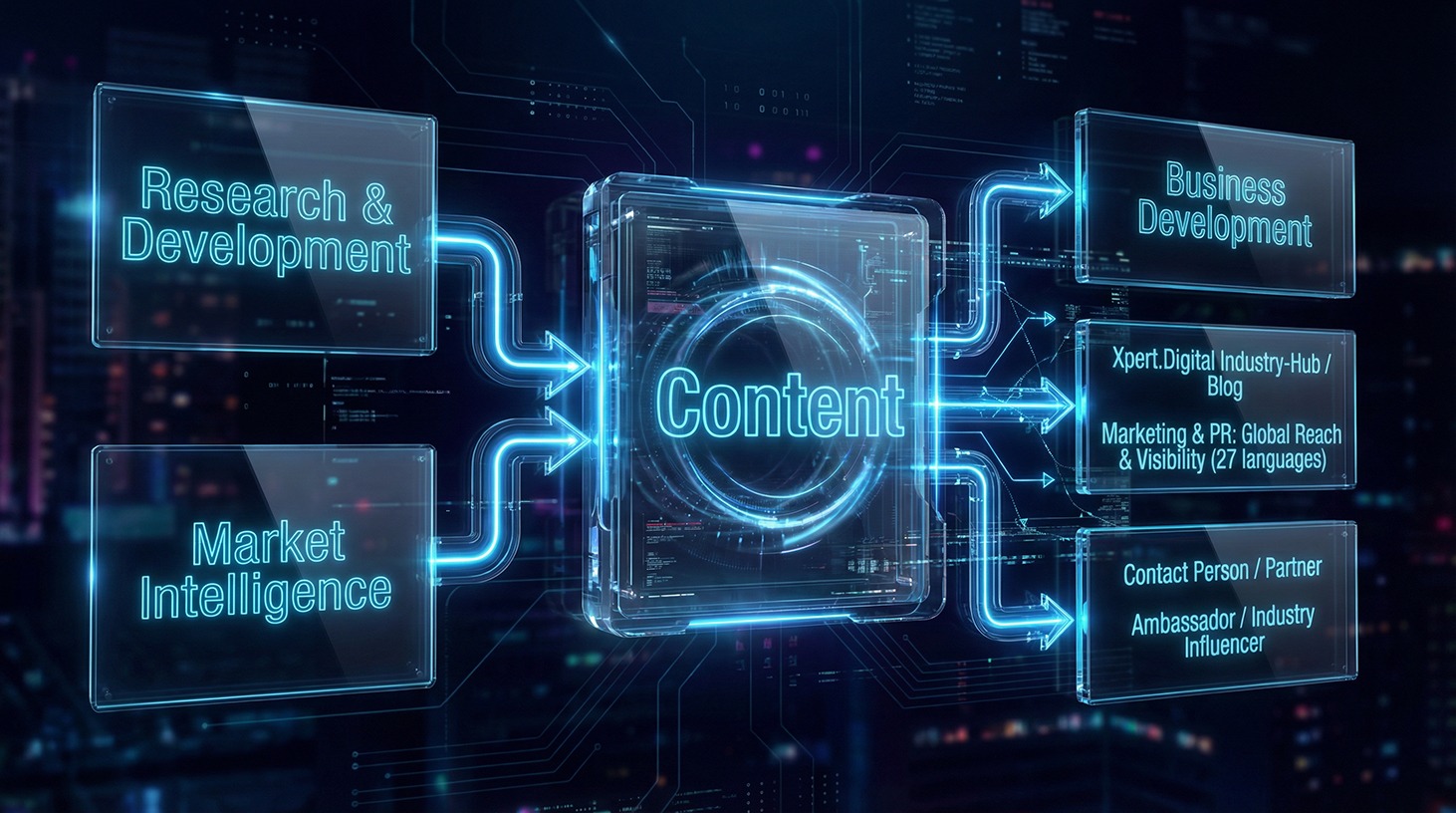
The quasi-in-house solution: How Xpert.Digital closes operational gaps in B2B marketing and sales – Smart Content-Driven Business - Image: Xpert.Digital
Xpert.Digital is a data-driven B2B industry hub led by Konrad Wolfenstein . The company acts as an external, quasi-in-house solution for industrial partners, closing operational gaps in marketing, content, and sales – without requiring additional resources on the client side.
More information here:
Your global marketing and business development partner
☑️ Our business language is English or German
☑️ NEW: Correspondence in your native language!

Konrad Wolfenstein
I and my team are happy to be available to you as your personal advisor.
You can contact me by filling out the contact form here wolfenstein@xpert.digital:or simply call me at +49 7348 4088 965. My email address is
I'm looking forward to our joint project.