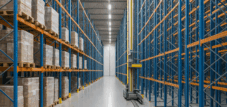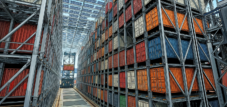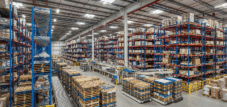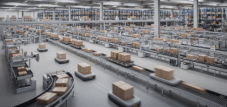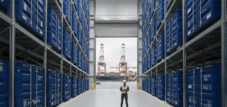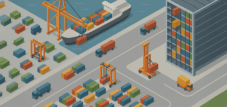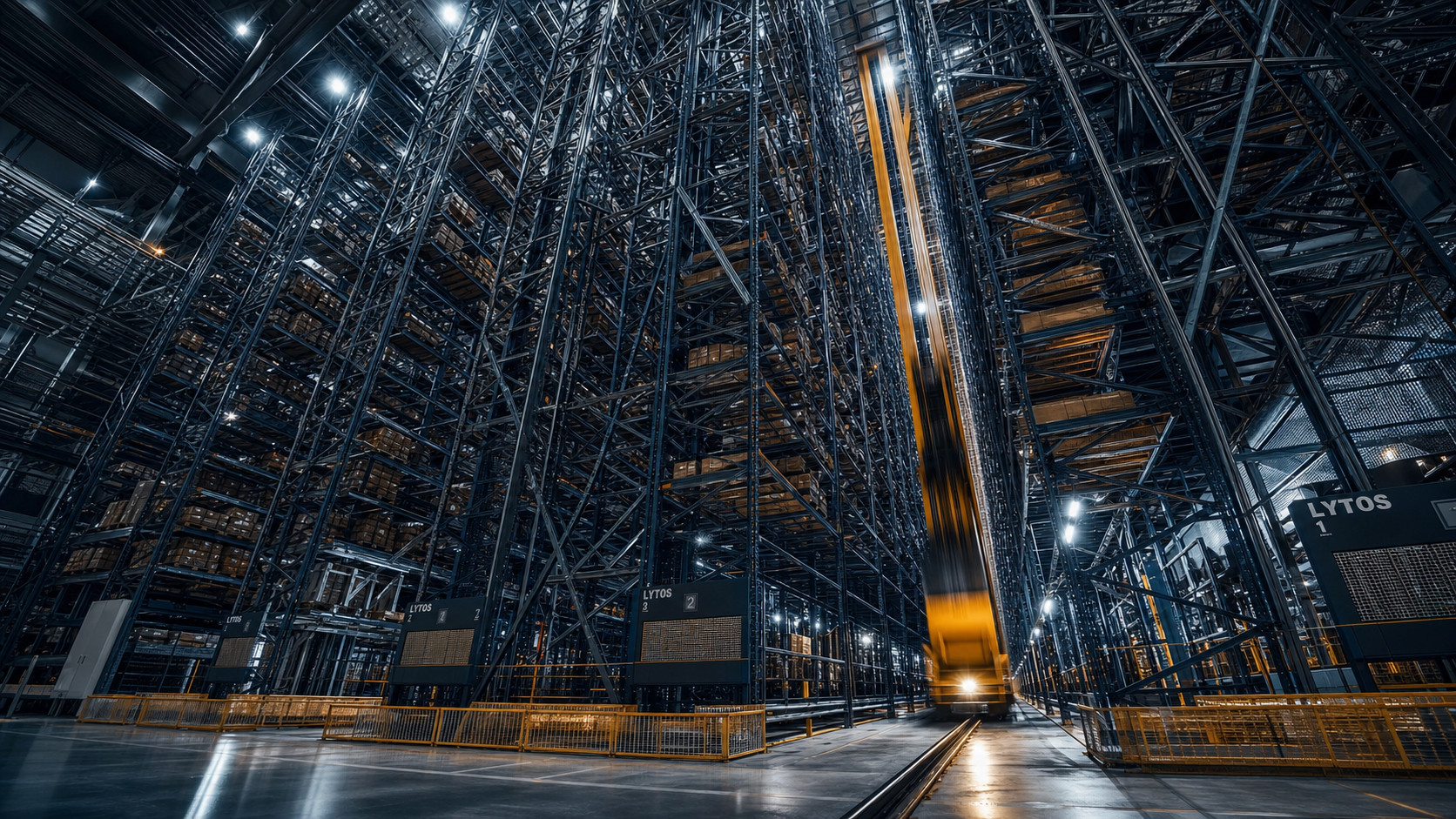
The development of high-bay warehouses: How a German book club secretly revolutionized the global economy – Image: Xpert.Digital
Without this technology, global e-commerce would collapse immediately
50 meters high, fully automated: The hidden giants of our supply chains
High-bay warehouses are the invisible cathedrals of modern consumption. Without them, there would be no e-commerce, no just-in-time production, and no functioning global supply chains. But these gigantic steel towers, often up to 50 meters high, in which autonomous robots silently navigate endless aisles, are not merely the result of technology-obsessed engineering. Their evolution is a direct reflection of the global economy. From the first simple storage and retrieval machine in Gütersloh in the 1960s to AI-controlled swarms of robots in today's fulfillment centers: every historical era has forced logistics to undergo radical innovations. Whether it was the lack of space in Europe, the turmoil of the oil crisis, the explosive rise of Amazon, or the pressing need for greater sustainability – the driving forces have always been economic. This article examines how a once inconspicuous niche product rose to become the digital nerve center of our economy and why the future of warehousing extends far beyond simply stacking boxes.
From steel skeleton to digital nerve center – How a niche technical product reshaped the global economy
Warehouses as a reflection of their time: Why high-bay warehouses are no accident
The history of high-bay warehouses is not a story of engineers tinkering away in quiet laboratories. It is a story of economic constraints, geopolitical shocks, demographic shifts, and technological leaps that mutually influence and reinforce each other. Anyone who wants to understand why high-bay warehouses have the form they do today—fully automated, software-controlled, up to 50 meters high, and globally widespread—must understand the economic conditions under which they arose.
Warehousing is as old as humanity itself. Even in early civilizations, grain and goods were systematically stored, distributed, and managed. But what we know today as high-bay warehouses is a child of the post-war modern era – a product of the economic miracle, the oil crisis, globalization, and finally, the digital age. Its development can be divided into five major phases, each characterized by a dominant economic or technological driver. Each phase created the conditions for the next and made regression virtually impossible.
The starting point: Production management without inventory logic
In the 1950s, warehousing was still a world of ground-level operations. Forklifts and reach trucks dominated the landscape; heavier items had to be stored at ground level, as no reliable technology existed to safely lift them to higher floors. Warehouses were sprawling, low-rise structures that occupied large areas and required a disproportionate number of personnel. The focus of the post-war economy was on production: the main thing was that the goods were manufactured – how they were subsequently stored and distributed was a secondary concern.
The economic miracle in Germany and similar booms in other Western industrialized nations initially created sufficient capital and labor to maintain this inefficient form of warehousing. The importance of intralogistics and material flow systems was viewed as a classic component of overall logistics, consisting of transport, handling, and storage – without any independent strategic value. This view was to fundamentally change within a decade.
The birth in Gütersloh: When a book club reinvented logistics
The year 1962 marked a turning point that would permanently change global logistics. At Bertelsmann in Gütersloh, the first fully automated high-bay warehouse went into operation – developed by Demag's predecessor, Stöhr, which had been working on a fundamentally new concept since the late 1950s. Engineers Friedhelm Podswyna, Horst-Werner Ruttkamp, and Werner Kühn had literally turned the basic principle of rack operation on its head.
The revolutionary principle was to place rotating and mobile masts in each racking aisle, allowing load-handling elements to be moved up and down along them. Initially, these masts were connected to the ceiling and guided by rails at the top of the racking – a design intended to dampen vibrations but limiting speed and flexibility. However, it was soon realized that floor-based systems were far more stable and, at the same time, faster at controlling multiple aisles. The first unit could still be manually operated from a cabin on the mast, but it already featured automated control via punch cards.
What motivated Bertelsmann to take this step? In the early 1960s, the book club market demanded a previously unknown combination of high throughput, a wide selection, and rapid delivery. Competition for subscribers created immediate pressure on logistics. According to contemporary calculations, the new system could process up to 15,000 orders daily—a figure that would simply have been unattainable with conventional floor storage and manual order picking. The innovation thus struck a chord at a time when mass consumption, rising wages, and increasing space constraints in urban and industrial centers demanded effective cost savings and more efficient technologies.
Europe's space problem as a driver of innovation: The structural advantage of high-bay warehouses
One factor often underestimated in explaining early European dominance in high-bay warehouse development is simply geography. Unlike the USA, where industrial land was comparatively cheap and plentiful, the relative scarcity of land in Europe – especially near urban industrial centers – provided a structural incentive from the outset to grow vertically rather than horizontally.
The automated high-bay warehouse made it possible, for the first time, to utilize the entire height of a warehouse for storage and retrieval. While a forklift truck practically reached its limits at a usable height of four to five meters, the new stacker cranes could access heights that were previously simply inaccessible. This vertical densification made significantly more storage volume available on the same footprint. In an economic environment of rising land prices in industrial zones, this was a compelling economic argument that required no discussion of subsidies – it simply made financial sense.
The first generation of high-bay warehouses was therefore not primarily a product of engineering curiosity, but rather an economically motivated response to resource scarcity. This fundamental logic – more storage volume with the same or less land use – would remain the central economic argument for high-bay warehouses throughout all technological changes.
The oil crisis as a catalyst: pressure to rationalize and the high-bay warehouse boom of the 1970s
By the mid-1960s, high-bay warehouses had established themselves as a technical concept, but widespread implementation was still pending. In Germany and other Western European industrialized nations, the number of such systems remained manageable. The 1970s dramatically changed the situation. The 1973 oil crisis was not only an energy policy event, but also a profound economic shock that forced companies to fundamentally rethink their cost structure.
With exploding energy prices, rising labor costs, and declining growth rates, rationalization was on the agenda of every industrial company. Logistics, previously a neglected area, suddenly came into focus. The high-bay warehouse offered several rationalization arguments at once: it replaced human labor in one of the company's most labor-intensive areas, it optimized space utilization, and, through the automation of storage and retrieval, it enabled 24/7 operation without a proportional increase in personnel costs. Large, automated high-bay warehouses were systematically built in industrialized countries during this decade; the technology found its way into the automotive, chemical, food retail, and pharmaceutical industries.
In parallel, a significant technological improvement took place during this period: the storage and retrieval machines were guided by rails from the floor, which considerably improved their stability and dynamics. Multiple aisles could now be accessed faster, more frequently, and with greater precision. This opened the door to mass throughput capability. Japan also began building automated warehouses in the mid-1960s and quickly developed its own solutions, while the USA set its own standards, particularly through computer-aided control concepts.
The computer age reaches for the shelf: Control technology as a key technology of the 1980s
High-bay warehouses sprang up everywhere in the 1980s. At the same time, these facilities reached their current maximum height limit of approximately 45 meters. This phase, however, was not just a quantitative leap, but above all a qualitative transformation: the integration of computer and information technology into warehouse control systems.
The programmable logic controller (PLC), the first generation of which came onto the market as early as 1970, enabled, for the first time, the digital control and regulation of machines and systems. Combined with early warehouse management software systems, which had emerged in the 1970s as simple warehousing systems, the PLC made it possible not only to physically automate high-bay warehouses but also to network them with information systems. The warehouse became a controlled system: every storage and retrieval operation was logged, and storage locations were dynamically assigned – the principle of so-called chaotic storage, in which the system independently selects the optimal available space, originated in this era.
Sensors, magnetic and laser technology now enable precise distance measurements and positioning that were simply impossible before. Continuously variable drive systems reduced energy consumption and increased the dynamics of the storage and retrieval machines. New load handling elements made it possible to reach deeper into the aisles and operate various container and pallet systems. The combined operating strategy – in which a storage and retrieval machine stores and retrieves goods in a single operation, instead of performing only one of the two processes – became standard practice and increased throughput by around 40 percent compared to individual operations.
Mannesmann, the then-owner of the Stöhr company, set another milestone in 1973: The world's first fully automated high-bay warehouse in the modern sense – with integrated computer-aided control – revolutionized the construction of distribution centers. This development made it clear that the high-bay warehouse was not merely a building product, but a complex system product in which mechanics, electrical engineering, and computer science were inextricably linked.
Lean, Just-in-Time and the Paradox of Inventory Reduction
The 1990s brought with them an apparent paradox. The just-in-time concept, originally developed by Toyota and now widely adopted in Western industry, promoted the minimization of inventory. Surely, those who practice just-in-time don't need high-bay warehouses – right? This conclusion was wrong, and reality emphatically refuted it.
Just-in-time and lean production changed how inventory was managed, but not the need for high-performance storage systems. On the contrary, the very necessity of just-in-time delivery placed the highest demands on the precision, speed, and reliability of storage technology. Those who eliminated inventory had to ensure availability through superior logistics processes. The high-bay warehouse transformed from a storage facility to a flow-through system – less inventory, but significantly more throughput per unit of time.
At the same time, the consolidation process in distribution led to larger individual warehouses. Regional warehouses became national central warehouses; national central warehouses became European distribution centers after the EU single market largely eliminated customs formalities. This consolidation created critical masses that made automation more economical than manual alternatives. The paradoxical consequence: Decreasing inventory levels and growing high-bay warehouses were perfectly compatible, because the warehouses didn't get bigger because more was being stored, but because more volume had to be managed by fewer individual warehouses.
The average number of pallet spaces in high-bay warehouses therefore increased from around 4,000 in the early years to up to 12,000 in the late 1990s – not because more was stored, but because consolidation and centralization required larger units.
Silo construction: When the shelf itself becomes the building
A groundbreaking innovation in construction technology that fundamentally changed the economics of high-bay warehouse construction was silo construction, or self-supporting construction. In this method, the racking structures themselves take on the function of the load-bearing structure: they not only support their own weight and the stored goods, but also form the supporting framework for side walls, roof structure, ventilation ducts, and lighting systems.
This construction method has far-reaching economic consequences. It eliminates the costly hall structure as a separate component and integrates storage and building functions into a single unit. For companies planning a new building from scratch, this can result in significant investment cost savings. At the same time, silo construction places the highest demands on structural design, as the structure must withstand wind and seismic loads. It thus represents a particularly radical form of optimization: every material used fulfills multiple structural functions simultaneously.
Silo construction became increasingly popular from the 1980s onwards and is now widespread in large distribution centers in the food, automotive, and chemical industries. Heights of 40 to 50 meters are achievable with this construction method. It exemplifies how engineering innovation can transform not only the performance but also the entire economic logic of a storage system.
LTW Intralogistics Solutions

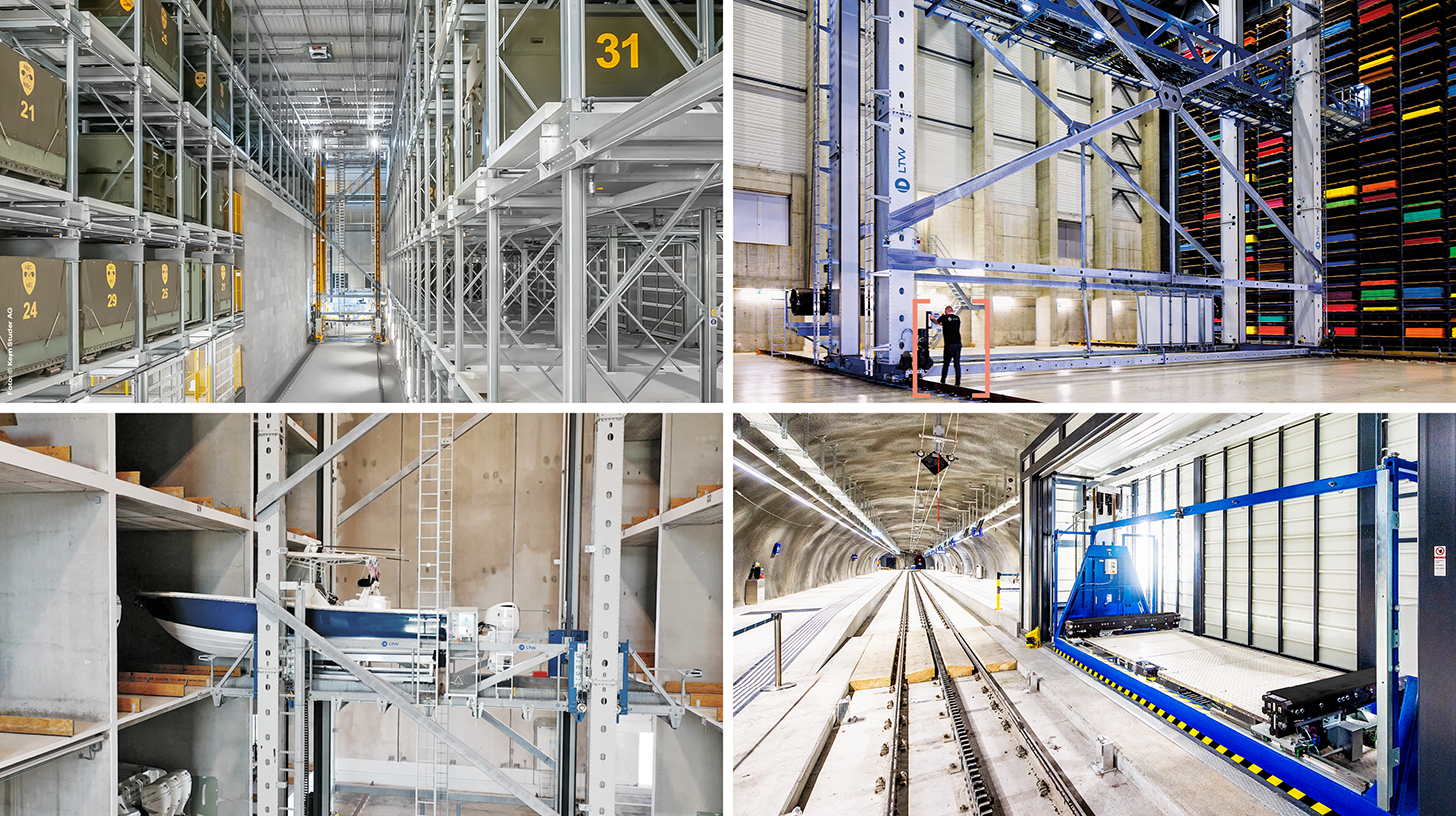
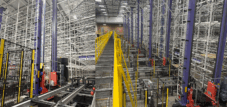
LTW Intralogistics – Engineers of Flow - Image: LTW Intralogistics GmbH
LTW offers its customers not individual components, but integrated complete solutions. Consulting, planning, mechanical and electrotechnical components, control and automation technology, as well as software and service – everything is networked and precisely coordinated.
In-house production of key components is particularly advantageous. This allows for optimal control of quality, supply chains, and interfaces.
LTW stands for reliability, transparency, and collaborative partnership. Loyalty and honesty are firmly anchored in the company's philosophy – a handshake still means something here.
Related to this:
How Amazon reinvented the high-bay warehouse – and what that means for your warehouse
The e-commerce shock: Amazon is changing the rules of the game
Perhaps the single most profound influencing factor on the recent development of high-bay warehouses was the rise of e-commerce. When Amazon was founded in 1994 and, in the following decades, changed consumer behavior in a way that no planning scenario of the 1980s had foreseen, a completely new set of requirements for warehouse technology emerged: an extremely wide product range combined with high order throughput, short delivery windows, and massive seasonal volatility.
The classic high-bay warehouse, originally designed for homogeneous pallets and large-volume units, had to adapt. The industry responded by differentiating its system concepts: In addition to the classic pallet high-bay warehouse, automated small parts warehouses (AS/RS) for containers and cartons, specialized picking systems, and – perhaps the most consequential new development – shuttle-based storage systems emerged, enabling significantly higher throughput rates while simultaneously offering flexible scalability.
The Multishuttle, jointly developed by the Fraunhofer Institute for Material Flow and Logistics (IML) and Siemens Dematic and launched in 2006, represented a paradigm shift. Rail-bound, autonomously driving vehicles took over the tasks of traditional stacker cranes, level by level. The decisive advantage: throughput could be scaled almost arbitrarily by increasing the number of shuttle vehicles without altering the basic structure of the racking. In an era where e-commerce companies had to cope with sharp order peaks, this flexibility was a crucial competitive advantage.
Amazon itself has become a symbol of this new era of warehouse automation. Following its acquisition of robotics manufacturer Kiva Systems in 2012, Amazon has been relying on mobile storage robots that use autonomous vehicles to navigate beneath storage units and transport them to the picking station – a principle that doesn't replace stationary high-bay warehouses but rather complements them, offering superior flexibility in certain applications. Today, Amazon operates more than 750,000 autonomous mobile robots in its fulfillment centers – a 25-fold increase since 2015.
Digital transformation: When software overtakes mechanics
Technically, the basic principle of high-bay warehouses has remained unchanged since the 1960s: a storage and retrieval machine travels in an aisle, picks up goods, and stores or retrieves them. What has fundamentally changed is the intelligence with which this principle is controlled, optimized, and integrated into higher-level systems. Warehouse management software (WMS) has evolved from simple inventory tracking tools of the 1970s to complex, real-time control systems that anticipate material flows, optimize storage location decisions, and are integrated with ERP systems.
The ABC strategy – storing frequently needed items near the storage/retrieval location and less frequently needed items further away – has been replaced by dynamic algorithms that continuously reassess and optimize storage locations. Modern systems use machine learning to predict order patterns and proactively position the storage and retrieval machines. Barcode scanning, RFID, and now camera-based recognition systems provide seamless tracking of every unit in the system.
The integration of warehouse management systems into broader platforms creates new levels of value creation: A modern high-bay warehouse is no longer just a storage location, but a central hub in the information flow of the entire supply chain. The availability information that a distribution center transmits to trading partners, the demand forecasts that inform production planning, the delivery status information that end customers receive in real time – all of this is fed by the data from the networked high-bay warehouse. The warehouse has thus transformed from a cost center into a data producer and a strategic asset.
Energy efficiency and sustainability: The new economic dimension
High-bay warehouses are energy-intensive systems. Storage and retrieval machines with peak power requirements of 60 to 70 kilowatts per unit, multiplied across many parallel aisles and long operating times, generate significant energy costs. In an economic environment of rising energy prices and increasing ESG requirements, energy efficiency has become a competitive factor in its own right.
The industry's response was multifaceted. Lightweight construction in storage and retrieval machines reduced the masses to be moved; continuously variable drive systems minimized energy losses; and recuperation systems stored braking energy and made it available for subsequent acceleration. A concrete example: The Hawle Austria Group reduced the peak power requirement of five storage and retrieval machines from 60 to 70 kilowatts to 7 to 10 kilowatts per machine by using Powercap energy storage systems, thereby saving around 230,000 kilowatt-hours per year – comparable to the annual consumption of 52 average households.
Furthermore, the spatial efficiency of high-bay warehouses takes on a new dimension: Because high-bay warehouses require significantly less floor space than space-efficient alternative warehouses for the same storage volume, they conserve land that can be used for other purposes or not sealed at all. In a time of increasing societal sensitivity to land sealing, this is a sustainability argument that is increasingly being incorporated into permitting processes and site selection decisions. Logistics buildings also account for around 13 percent of global greenhouse gas emissions released by logistics, indicating considerable potential for savings.
The global market and its drivers: figures and perspectives
The global market for high-bay racking systems reached a volume of US$13.2 billion in 2024. It is expected to increase to US$28.7 billion by 2033, driven by a compound annual growth rate (CAGR) of 8.9 percent. The market for automated storage and retrieval systems (AS/RS) is expanding in parallel: from US$9.86 billion in 2025 to a projected US$14.80 billion by 2030.
These growth figures reflect the interplay of several structural forces. E-commerce remains a key driver: More than 40 percent of e-commerce companies now use automated high-bay warehouses, and Walmart alone plans to invest $14 billion in warehouse automation, having already automated over 50 percent of its fulfillment volume. The ongoing labor shortage in Western industrialized nations is intensifying the pressure to automate: Human labor is not only more expensive, but simply no longer available in sufficient numbers.
Interesting regional differences emerge. North America dominates with a market share of around 35 percent, followed by Asia-Pacific with 30 percent and Europe with 25 percent. With an annual growth rate of 15.5 percent, China is developing into the most dynamic single market worldwide in the logistics automation market; the Chinese market volume for logistics automation was valued at US$25.5 billion in 2024 and is projected to grow to US$80.7 billion by 2032. According to forecasts, Europe is the fastest-growing region in the warehouse racking market.
The trend toward extra-large warehouses with more than 40,000 square meters remains strong: In 2023, this segment accounted for 25 percent of total warehouse market activity in Europe. Companies like Henkel are actively investing in new capacity: The new high-bay warehouse in Düsseldorf, measuring 50 meters high, 34 meters wide, and 121 meters long, exemplifies the continued investment momentum in German industry.
Reshoring, geopolitical risks and the renaissance of the local supply warehouse
The COVID-19 pandemic and the subsequent geopolitical tensions – trade conflicts, energy crisis, war in Europe – have accelerated a trend reversal in global logistics strategy, which has far-reaching consequences for high-bay warehouse development: reshoring, the relocation of production and warehousing functions back to home markets or near these markets.
For years, globalization led to the relocation of warehousing functions to lower-cost locations in low-wage countries or outsourcing to extensive overseas warehouses. The fragility of global supply chains—impressively demonstrated by empty supermarket shelves, chip shortages, and Suez Canal congestion—has shifted this perspective. Safety stocks are being increased again; companies are building buffer capacities near their sales markets. The result is increased demand for high-bay warehouses in Europe and North America, which, due to their space efficiency, are particularly advantageous in high-cost regions.
This trend is also changing the required specifications: Maximum pallet capacity is no longer the primary requirement; instead, flexibility, responsiveness, and the ability to manage a wider product range within shorter timeframes are paramount. Accordingly, high-bay warehouse technology is evolving towards modular, rapidly reconfigurable systems that can adapt to changing demand patterns without requiring complete rebuilds.
Autonomy, AI and the next development horizon
The line between traditional rail-guided high-bay warehouses and the new generation of autonomous robotic systems is becoming increasingly blurred. Amazon's robot Vulcan, the first of its kind with tactile sense and physical AI, is already in operation at a logistics center in Winsen near Hamburg, performing complex gripping and lifting tasks that previously required human hands. The integration of AI-supported image processing, tactile sensors, and dynamic path planning overcomes the last remaining limitations of complete automation—the unstructured grasping of unknown or irregularly shaped objects.
Fraunhofer IML and other research institutions are working on cellular transport systems that completely replace the stationary storage and retrieval machine principle with swarms of communicating autonomous vehicles. While manual order picking takes an average of two to three minutes per item, automated systems accomplish the same task in 30 to 60 seconds – and AI-supported systems aim for even further acceleration. This speed advantage is not merely academic, but directly relevant to business: Same-day and next-day delivery have become the expected standard in e-commerce and cannot be achieved economically at the necessary scale without warehouse automation.
At the same time, energy flexibility is becoming a key focus of further development. Since energy costs on the electricity exchange fluctuate significantly from day to day, researchers at the University of Stuttgart are developing methods to make the energy demand of high-bay warehouses tradable: The warehouse itself is used as a storage facility for potential energy by storing heavy loads at greater heights during periods of favorable electricity exchange prices, and this height difference can then be used as an energy resource when the loads are removed. The high-bay warehouse as an active participant in the electricity market – a concept that takes the integration of logistics and the energy industry to a new level.
A structural assessment: Why high-bay warehouses developed the way they did
In retrospect, the development of high-bay warehouses did not follow a random technical logic, but rather a very coherent economic one. Each phase was a response to a specific economic pressure or a structural shift.
The first phase of development in the 1960s was a response to land scarcity and rising labor costs during the economic boom. The expansion of the 1970s and early 1980s was a response to the oil crisis and general pressure to rationalize. The computerization of the late 1980s and 1990s was a response to the need to manage more heterogeneous product ranges with higher throughput. The shuttle and robotization revolution of the 2000s and 2010s was a response to the e-commerce boom. And the current phase of highly intelligent, AI-powered, and energy-flexible systems is a response to labor shortages, sustainability pressures, and geopolitical supply chain fragility.
The high-bay warehouse is thus a particularly clear example of how technology does not emerge from within itself, but is shaped by the interplay of economic, social, and political forces. The next transformation of these systems is already underway – and it will again be determined less by technological possibilities than by the economic and social demands to which it must respond.
Consulting - Planning - Implementation

Konrad Wolfenstein
I would be happy to serve as your personal advisor.
You can contact me at wolfenstein∂xpert.digital or
Just call me on +49 7348 4088 965 .
Your intralogistics experts
Consulting, planning and implementation of complete solutions for high-bay warehouses and automated storage systems - Image: Xpert.Digital
More information here: