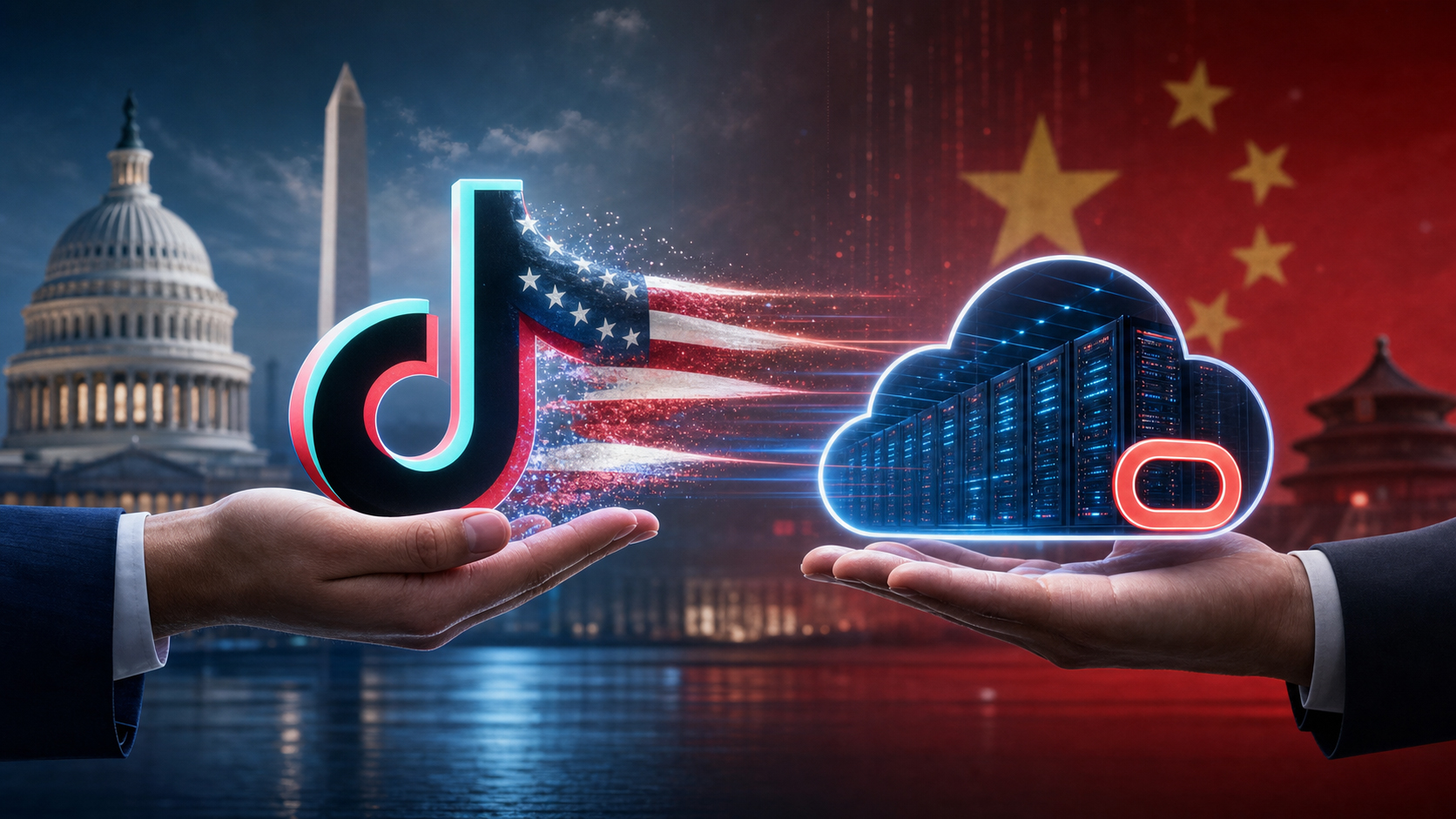
Oracle, Silver Lake and the TikTok ban: $14 billion instead of $60 billion – The dark secret behind the new TikTok deal – Image: Xpert.Digital
A dangerous bluff? Why the TikTok sale is now going to court in the US
A billion-dollar deal for Trump's friends: The questionable details of the TikTok deal
Secret algorithm: Does TikTok still actually belong to China?
The months-long, politically charged dispute over TikTok's future in the US seemed to have been finally resolved with its spectacular sale to an American consortium led by Oracle and Silver Lake. But what initially appeared to be a historic move in the name of national security is increasingly revealing itself behind the scenes as a legal and political powder keg. From a conspicuously low valuation in the billions and the new owners' close ties to the Trump administration to the crucial—and unresolved—question of who truly controls the app's powerful algorithm: the mega-deal now raises more questions than it answers. Is the spin-off from its Chinese parent company, ByteDance, a genuine strategic victory for Washington—or merely an unprecedented, multi-million-dollar facade that could soon crumble in court?
TikTok, Oracle, and the end of a stalemate
After years of political wrangling over TikTok, something that had long seemed unlikely actually happened in January 2026: The Chinese parent company ByteDance relinquished its majority stake in the short-video app's US operations. A consortium led by Oracle, Silver Lake, and the Abu Dhabi sovereign wealth fund MGX took control of the newly formed TikTok USDS Joint Venture LLC, while ByteDance remained just below the legally required 20 percent threshold. What at first glance appears to be a smooth conclusion to a years-long legal battle, on closer inspection reveals itself to be a highly complex, politically charged, and legally vulnerable construct whose future is anything but secure.
One law, three presidential years, and a constantly postponed ultimatum
The origin of the entire dispute lies in April 2024, when then-President Joe Biden signed a law requiring ByteDance to divest its US operations or face a nationwide ban on the app. The official justification was national security: the concern that the Chinese government could gain access to the data of more than 200 million American users through ByteDance or misuse the recommendation algorithm to spread propaganda was central to the legislative debate. The Supreme Court upheld the legality of this law in a unanimous decision in January 2025, with Justice Neil Gorsuch explicitly stating that any cooperation between a new American ownership structure and ByteDance regarding the operation of the recommendation algorithm was prohibited.
Donald Trump, who himself experienced a brief suspension of the app on his inauguration day in January 2025, repeatedly postponed the mandatory enforcement of the ban by executive order. What was originally a January 2025 deadline was extended several times, ultimately stretching to an additional twelve months, until a framework agreement with China was announced in September 2025 during trade talks in Madrid. Interestingly, the Chinese delegation reportedly softened its demands for lower tariffs in exchange for its concessions on TikTok, demonstrating how closely the app deal was intertwined with the broader geopolitical economic negotiations between Washington and Beijing.
Who will actually be sitting at the table in the end?
On January 22, 2026, TikTok finally announced the completion of the transaction. The new TikTok USDS joint venture is led by a seven-member, predominantly American board of directors, which includes TikTok CEO Shou Zi Chew, Oracle executive Kenneth Glueck, and representatives from Silver Lake, Susquehanna, DXC Technology, and MGX. Adam Presser, who previously served as TikTok's head of operations and trust and security, was appointed chief operating officer.
The ownership structure reveals a network closely intertwined with Trump's political circle. Oracle, Silver Lake, and MGX each hold 15 percent, collectively controlling 45 percent of the shares. Larry Ellison, Oracle co-founder and one of the world's richest people, has been considered a close confidant of Trump for years. The remaining 35 percent includes, among others, Michael Dell's family office, Susquehanna subsidiary Vastmere, Alpha Wave Partners, and investor Steve Case. This constellation has raised concerns among critics that the platform could no longer operate in a politically neutral manner, but rather be influenced by individuals with direct ties to the current administration.
The following overview summarizes the key data of the new ownership structure:
| Participants | Portion | role |
|---|---|---|
| Oracle | 15 percent | Security partner, cloud and algorithm management |
| Silver Lake | 15 percent | Investor, Board of Directors |
| MGX (Abu Dhabi) | 15 percent | Investor, Board of Directors |
| ByteDance | 19.9 percent | Former majority shareholder, remaining minority stake |
| Other investors (Dell Family Office, Susquehanna subsidiary Vastmere, Alpha Wave, etc.) | approximately 35 percent | Investors without operational leadership roles |
Why a supposed evaluation gap raises questions
One detail that received remarkably little attention in the public debate is the valuation of the deal. Vice President JD Vance put the value of the US division at approximately $14 billion, a sum that seems strikingly low compared to ByteDance's global valuation of around $480 billion. Given that the US user base alone, with over 200 million people, represents an enormous advertising market, and that other reports prior to the deal suggested valuations as high as $60 billion, it remains unclear on what basis this figure was arrived at. This discrepancy fuels the suspicion that political, rather than purely market-driven, considerations may have played a role in determining the price.
The algorithm as the actual core of the conflict
The most technically and politically sensitive aspect of the entire agreement concerns the recommendation algorithm, the core component responsible for TikTok's commercial success for years. Officially, the new American entity will retrain the algorithm using data from American users, with Oracle assuming technical control over this process within its own cloud infrastructure. Vice President Vance explicitly emphasized during the signing of the executive order in September 2025 that the American owners would retain control over how the algorithm delivers content to users, as this was essential from a national security perspective.
However, doubts about this account have been growing ever since. Analyses by the Foundation for Defense of Democracies indicate that, despite the formal change in ownership, ByteDance retains control over the underlying source code, which could theoretically still allow for influencing the content. This assessment is reinforced by a lawsuit filed in March 2026, which focuses precisely on this point: the new structure is essentially a mere facade, while the actual technical control over the algorithm remains with ByteDance in Beijing. Should this claim prove true, the entire transaction would circumvent the legal requirement, upheld by the Supreme Court, that any form of cooperation in algorithm control between ByteDance and the new American entity must be excluded.
A bumpy start with technical glitches and new data privacy issues
The official transition on January 23, 2026, was anything but smooth. During the very first weekend under the new ownership structure, numerous media outlets reported technical outages: users complained of problems logging in and uploading videos, with many clips stuck in review for hours. TikTok USDS officially attributed these disruptions to a power outage at an American data center, but simultaneously, speculation circulated on social media about possible censorship related to ongoing protests in Minneapolis. It was also noteworthy that international users outside the United States appeared to be completely unaffected by these problems, which at least underscores the technical independence of the new US infrastructure.
In parallel, the new entity significantly tightened its data protection regulations. While the app previously only collected approximate location data, it now gathers precise, GPS-based location information with the user's consent. Furthermore, data collection for personalized advertising was considerably expanded and now includes activities outside the app itself. Particularly noteworthy is a new clause that explicitly mandates the systematic recording and analysis of all interactions with generative AI tools within the platform, including input requests and generated responses. A little less than three months later, the operational chaos proved to be temporary: observers from the first few weeks in February described it as a false start without the initially feared mass user exodus.
🎯🎯🎯 Data-driven B2B industry hub as a quasi-in-house solution


The quasi-in-house solution: How Xpert.Digital closes operational gaps in B2B marketing and sales – Smart Content-Driven Business - Image: Xpert.Digital
Xpert.Digital is a data-driven B2B industry hub led by Konrad Wolfenstein . The company acts as an external, quasi-in-house solution for industrial partners, closing operational gaps in marketing, content, and sales – without requiring additional resources on the client side.
More information here:
TikTok deal under pressure: Why the US solution is far from secure
The political front against the deal is forming
From the outset, there was resistance from Congress. Democratic Senator Ed Markey called for a parliamentary inquiry into the agreement just one day after its official announcement, criticizing the White House for disclosing so few concrete details, particularly regarding the crucial question of whether the algorithm was truly free from Chinese influence. This lack of transparency is a recurring theme throughout the reporting: Neither the Treasury Department nor the White House, Oracle, nor Silver Lake responded directly to inquiries regarding the precise details of the contract.
In March 2026, legal resistance reached a new level of escalation. Two California minority shareholders of Alphabet and Meta, supported by the Public Integrity Project, filed a lawsuit against Trump and Attorney General Pam Bondi. The plaintiffs argued that approving the deal violated the provisions of the 2024 law because ByteDance would de facto retain control over all essential aspects of TikTok, thereby undermining the very purpose of the law and giving individuals with close ties to Trump a position from which they could influence the political discourse on one of the world's most influential media platforms. A second, separate lawsuit, filed on March 5, 2026, explicitly accused the new structure of being a mere shell company lacking genuine technical independence.
States remain suspicious despite change of ownership
The legal battle continues at the state level as well, albeit with differing outcomes. While a judge in Montana declared the state's TikTok ban invalid due to the recent change of ownership, the Iowa Attorney General's Office significantly intensified its ongoing lawsuit against TikTok in April 2026. The new, revised complaint now explicitly lists the TikTok USDS Joint Venture as a co-defendant and expands the allegations to include three additional categories: deliberately addictive design features such as endless scrolling and variable notification stimuli; misleading assurances regarding the inapplicability of Chinese law to user data, despite Beijing's continued legal access rights; and erroneous age ratings in the Apple App Store. This development demonstrates that the mere change of ownership by no means completely eliminates the fundamental legal and societal concerns surrounding the platform.
Oracle as a major economic winner with manageable risk
For Oracle itself, the deal initially appears to be an extremely favorable opportunity. The company, which has been acting as a cloud service provider for TikTok's US data since 2022 and generates an estimated 5 percent of its Oracle Cloud Infrastructure revenue from this, saw its shares rise by more than 6 percent upon the announcement in September 2025. In its quarterly report for the fiscal quarter ending in February 2026, Oracle quantified its investment in the new joint venture at approximately $2.2 billion in non-marketable equity instruments, the vast majority of which was for the TikTok stake. Compared to the total valuation of $14 billion for the entire US division, as cited by Vance, this investment appears financially manageable for a company of Oracle's size, while the strategic gain in influence over one of the world's most widely used communication platforms is substantial.
At the same time, the operational vulnerability of this new dependency became apparent in March 2026: A technical outage at Oracle led to temporary delays for content uploaders before the service was fully restored after a few days. Such incidents illustrate that shifting the entire technical infrastructure to a single provider creates new concentration risks that did not exist in this form under the previous, more distributed infrastructure.
China's calculation between loss of face and strategic retreat
From a Chinese perspective, the deal appears considerably more ambivalent. Beijing never publicly expressed enthusiasm for the agreement, but merely emphasized its respect for the decisions of the companies involved, as long as these decisions comply with Chinese law. This restrained phrasing suggests that the Chinese leadership views the deal as a concession within the broader framework of trade negotiations with Washington, not as an independent, voluntary corporate decision. Analysts at the New York Times also point out that TikTok's fragmented outcome serves as a case study for other Chinese technology companies with global ambitions, as they must expect to be forced into similar concessions under comparable political pressure in the future.
At the same time, ByteDance, with its remaining 19.9 percent stake, deliberately kept just below the legal 20 percent threshold, retains both a financial share in the success of the US division and a seat on the board of directors through Shou Zi Chew. This arrangement can certainly be interpreted as a clever compromise that allows Beijing to save face and formally comply with American law, while in reality preserving a certain degree of influence and economic stake.
Between political staging and unresolved core question
A comprehensive review of the facts reveals a remarkable pattern: The political staging of the deal as the definitive solution to a national security problem stands in stark contrast to the fact that the central technical question of actual control over the algorithm remains unresolved. Trump publicly celebrated the agreement as his personal victory and explicitly thanked Chinese President Xi Jinping for his approval, while at the same time independent institutions such as the Information Technology and Innovation Foundation interpreted the deal as proof that targeted structural security measures can address privacy risks without completely banning a foreign app. These two interpretations are not necessarily mutually exclusive, but they obscure the fact that the real point of contention—namely, the complete technical and operational separation of ByteDance—has not yet been convincingly demonstrated.
From an economic perspective, the deal can be described as a hybrid construct, neither a true full acquisition nor a mere licensing agreement, but somewhere in between. This interim solution may appear politically pragmatic, but it creates considerable legal uncertainty for all investors involved, as multiple parallel lawsuits could potentially unravel the entire structure. For Oracle, Silver Lake, and MGX, this means their multi-billion-dollar investments rest on a foundation that is not yet fully legally sound, while for the more than two hundred million American users, the question remains how significantly the newly trained algorithm will actually differ from the previous one.
The unresolved fractures
The coming months will be crucial in determining whether the current structure proves resilient in the long term or whether one of the ongoing lawsuits will actually lead to a court-ordered retrial. The lawsuit from March 2026, in particular, which accuses the new joint venture of insufficient technical autonomy in operating the algorithm, could prove to be the Achilles' heel of the entire structure should a court believe the allegation that it is merely a facade. At the same time, the intensified lawsuit from Iowa demonstrates that fundamental allegations regarding the platform's addictive design and inadequate protection of minors persist regardless of the change in ownership and will continue to put the platform under regulatory pressure.
From an economic perspective, the question remains whether the comparatively low company valuation of $14 billion will withstand future independent scrutiny, or whether, in retrospect, evidence of politically motivated undervaluation favoring the investor group involved will emerge. Should the suspicion be confirmed that close ties between the new owners and the current administration influenced the terms of the deal in favor of this group, it is likely to further inflame the already heated debate about favoritism surrounding the Trump administration and significantly shorten the political lifespan of this supposedly final solution.
Your global marketing and business development partner
☑️ Our business language is English or German
☑️ NEW: Correspondence in your native language!

Konrad Wolfenstein
I and my team are happy to be available to you as your personal advisor.
You can contact me by filling out the contact form here wolfenstein@xpert.digital:or simply call me at +49 7348 4088 965. My email address is
I'm looking forward to our joint project.
☑️ SME support in strategy, consulting, planning and implementation
☑️ Creation or realignment of the digital strategy and digitization
☑️ Expansion and optimization of international sales processes
☑️ Global & Digital B2B trading platforms
☑️ Pioneer Business Development / Marketing / PR / Trade Fairs
📈🚀 From visibility to trust 👀🤝 Your scalable path with Xpert.Digital


From visibility to trust: Your scalable path with Xpert.Digital - Image: Xpert.Digital
In industrial B2B, sustainable business relationships rarely emerge overnight. They develop step by step – through visibility, professional relevance, recurring touchpoints, and growing trust. Xpert.Digital's 4-stage model addresses precisely this: It offers a structured path that begins with a manageable entry point and can evolve into deeper collaboration in business development if needed.
Instead of relying on loud marketing promises, this model puts the relationship at the forefront. Companies start with clearly defined, easily calculable measures and then decide, based on their own experience, how far they want to expand the collaboration. A key factor for this undisturbed trust-building process: The platform completely avoids annoying advertising ads, so the editorial focus remains solely on the companies' expertise.
More information here: