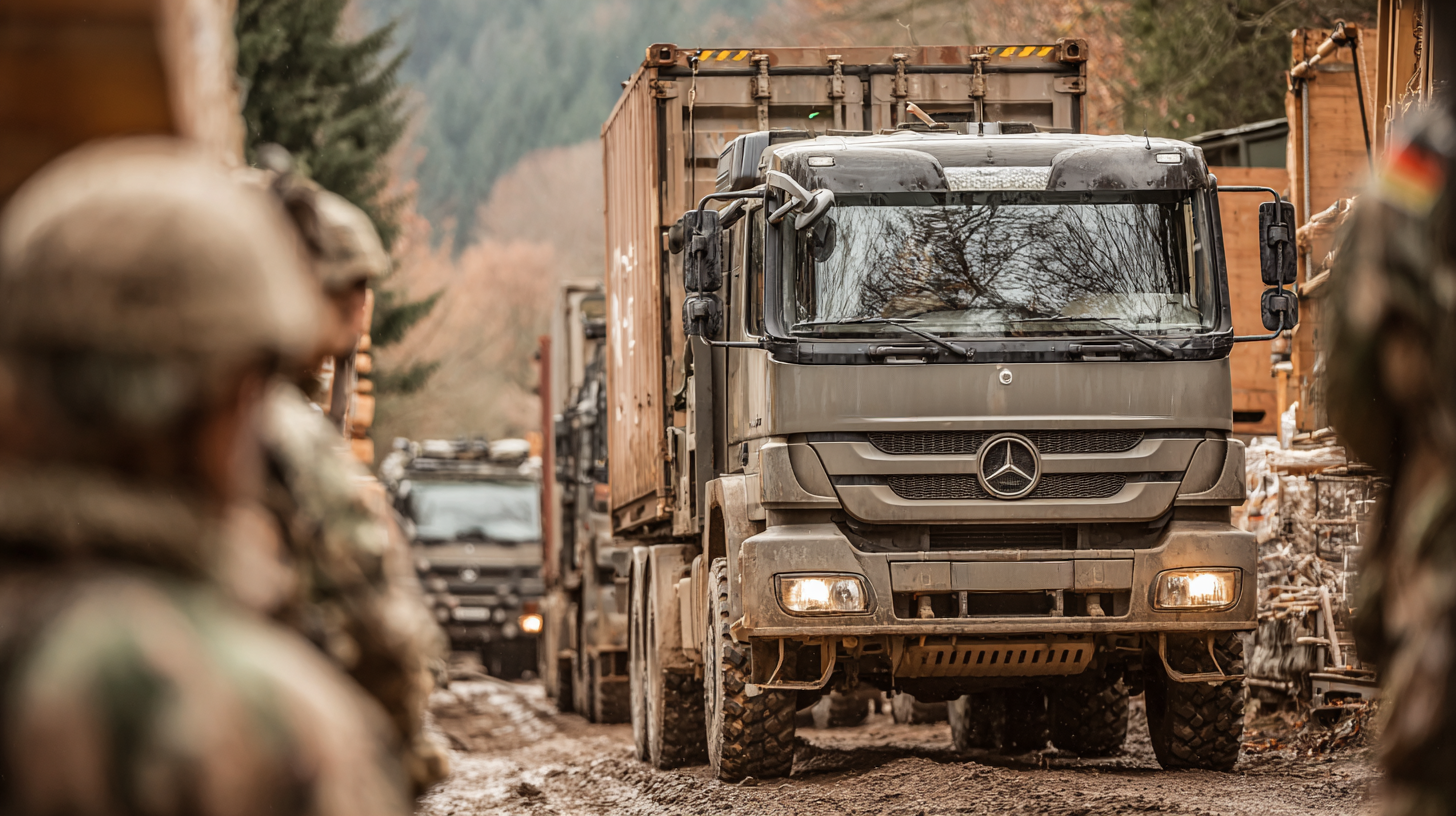
20,000 rounds lost: The dangerous security leak in the German Armed Forces' logistics – Analysis by dual-use logistics & rapid deployment experts – Symbolic image: Xpert.Digital
Outsourcing tension: Business incentives versus security needs
Systemic risk of civilian logistics: The vulnerability of the military supply chain
The theft of approximately 20,000 rounds of ammunition from a civilian truck near Burg in Saxony-Anhalt is far more than an isolated crime; it marks a turning point in the understanding of military logistics chains. The fact that lethal cargo—including 10,000 rounds of live ammunition and thousands of training rounds—could be stolen overnight from an unguarded parking lot reveals a shocking discrepancy between military security requirements and business realities. The incident starkly highlights the risks of privatization in defense logistics: where cost-efficiency clashes with security relevance, dangerous gaps emerge.
The following analysis deconstructs the event not only as a forensic fact, but also as a symptom of a deeper structural problem. It sheds light on the "principal-agent problem" between the German Armed Forces and private transport companies, where economic pressure leads to fatal security compromises. We examine the failure of technical control mechanisms in the digital age, the sources of human error in an industry suffering from staff shortages, and the serious strategic implications for NATO's ability to function as an alliance. For if the supply chain fails even in peacetime due to an unsecured parking lot, the credibility of military mobility in a crisis is fundamentally called into question. What began as theft must now be understood as a wake-up call for a reassessment of the national security architecture.
Related to this:


Between cost efficiency and security policy negligence – A wake-up call for procurement strategy
The security incident in Saxony-Anhalt represents far more than a mere theft; it is a symptomatic event that exposes deeper structural deficiencies in the interaction between military necessity and civilian service. The theft of approximately 20,000 rounds of ammunition—specifically, 10,000 rounds of live ammunition for small arms, 9,900 rounds of blank ammunition for assault rifles, and pyrotechnic smoke grenades—marks a significant loss of control over lethal assets. While the loss of blank ammunition primarily represents an economic loss in terms of training capacity, the loss of the 9x19mm live ammunition poses a considerable threat to internal security. This type of ammunition is compatible with a wide variety of civilian and illegal weapons systems and is highly fungible on the black market.
The forensic reconstruction of the incident near Burg, close to Magdeburg, reveals a shocking discrepancy between the German Armed Forces' theoretical security concepts and the reality of the civilian transport industry. The fact that the theft was only noticed the following day upon delivery to the barracks by the reception staff there, and not by the freight forwarder itself, starkly highlights the lack of integrity in the chain of surveillance. It reveals that the physical integrity of the cargo area was neither electronically nor visually verified for several hours. This is particularly alarming given that modern logistics chains are typically equipped with tamper-proof seals and real-time tracking systems that immediately report any unauthorized access.
The ammunition was located in a trailer of a civilian transport vehicle. MDR and several other sources report that the ammunition was "stolen from the trailer of a transport vehicle belonging to a civilian freight forwarder.".
It was a tractor unit with a trailer – not a box truck or a container. The trailer was parked overnight in front of the hotel in an industrial park in Burg, while the driver slept inside.
The term "loading area," used in some reports, suggests that it was likely a curtainsider or an open trailer with a tarpaulin cover—not a closed container. This would also explain why the perpetrators were able to access the cargo relatively easily: with a curtainsider, the side tarpaulin can be cut open or the rear wall opened without the need for the elaborate tools required to break into a container.
The break-in to the trailer was only discovered upon delivery to the guardhouse at the Clausewitz Barracks in Burg. This also suggests external tampering, which might not have been immediately apparent during a cursory visual inspection by the driver the following morning.
So, while the driver slept, only millimeters of tarpaulin separated national security from organized crime. It's a scenario straight out of a bad thriller, but one that became a bitter reality: It didn't take a highly complex cyberattack or an enemy special forces unit to steal from the German armed forces. A simple, rusty utility knife was enough to slash the military supply chain at its most vulnerable point. In the darkness of this unguarded rest stop, every strategist's nightmare manifested itself – the moment when deadly cargo becomes easy prey, as simple as stealing a pallet of cigarettes.
The sensitive cargo vanished silently into the no-man's-land of civilian logistics. The fact that the theft wasn't noticed until hours later at the destination is the real scandal: the truck became a Trojan horse, carrying its emptiness undetected all the way to the barracks. This incident is a silent indictment of the "outsourcing" doctrine. It mercilessly exposes that while we invest billions in weapons systems, we fail at the grassroots level: if we treat the transport of military equipment like Amazon packages, we're delivering ammunition for the black market and terrorism right to their doorstep. "Systemic risk" is no longer an abstract concept here—it's the gaping hole in a slashed tarpaulin.
Economic efficiency of outsourcing: The principal-agent problem in defense logistics
To put the incident into economic perspective, one must understand the underlying motivation of the armed forces for outsourcing sensitive transport to civilian entities. From a business management standpoint, the Bundeswehr is following the trend toward reducing vertical integration. Maintaining its own military heavy-haulage fleet, capable of handling peak loads during peacetime, involves enormous fixed costs for personnel, maintenance, and capital commitment. Outsourcing to civilian freight forwarders transforms these fixed costs into variable costs, resulting in a significant increase in efficiency on paper.
However, this illustrates a classic principal-agent problem. The German Armed Forces (principal) commissions a freight forwarding company (agent) to carry out a security-critical task. While the Armed Forces' goal is the absolute security of the cargo, the civilian freight forwarder operates under the primacy of profit maximization in an extremely low-margin market environment. Security measures such as the two-driver rule, secured rest areas, or special security escorts incur direct costs that reduce the already meager profits of the freight forwarding company. If the contractual penalties for security violations or the probability of their detection are lower than the costs saved by not complying with the rules, an economic incentive for moral hazard—that is, risky behavior—arises. In this sense, a driver who spontaneously chooses an unsecured parking space and a hotel is acting rationally within a system that prioritizes efficiency over resilience, provided he is not under strict surveillance.
Systemic weaknesses: Rule violations and staff shortages as a security risk
Procedural erosion and human error in security architecture
The investigation suggests that the driver deviated from the planned route without authorization and disregarded basic safety regulations. However, this is rarely the failure of an individual, but often the result of a systemic erosion of standards. Rigorous regulations exist in the area of dangerous goods transport (ADR), and especially in the transport of weapons of war and ammunition. The fact that a Class 1 (explosive) transport was left unattended in an unguarded, publicly accessible parking lot in an industrial area is a blatant breach of due diligence.
The violation of the four-eyes principle is particularly critical. The contractual obligation to have two drivers is not only for driver rotation, but primarily for the continuous monitoring of the vehicle during unavoidable stops. The fact that this fundamental requirement was not met suggests either that the freight forwarder's scheduling failed or that cost pressures were so high that personnel were deliberately cut. This is a well-known phenomenon in the logistics sector, which is suffering from an acute driver shortage. For the German Armed Forces, this means that its security architecture rests on the foundation of an extremely fragile civilian labor market. If driver security clearances (Ü1/Ü2) are expedited due to personnel shortages, or if the control mechanisms of freight forwarding companies are not rigorously audited, civilian logistics becomes the Achilles' heel of national defense.
Hub for Security and Defense - Advice and Information


Hub for Security and Defense - Image: Xpert.Digital
The Security and Defence Hub offers expert advice and up-to-date information to effectively support companies and organizations in strengthening their role in European security and defence policy. Working closely with the SME Connect Defence Working Group, it particularly promotes small and medium-sized enterprises (SMEs) that wish to further develop their innovative capacity and competitiveness in the defence sector. As a central point of contact, the Hub thus creates a crucial bridge between SMEs and European defence strategy.
Related to this:
The end of carefree logistics: How genuine dual-use logistics must become the new requirement for ammunition transports
Technological discrepancy: Dual-use logistics in the digital age
The digital deficit: Lack of transparency on the "last mile"
This incident is particularly paradoxical given the increasing digitalization of logistics. In modern dual-use logistics, i.e., the use of civilian infrastructure for military purposes, warehouse management systems (WMS) and telematics solutions have long been standard. In an ideal scenario, every ammunition container is digitally recorded, and the truck itself is a networked asset whose position, door status, and technical condition are transmitted to a control center in real time. Multi-client capable software allows freight forwarders to efficiently separate civilian and military cargo and handle it differently.
The theft in Burg, however, highlights the drastic gap between digital theory and analog reality. While highly complex algorithms manage inventory and automatically segregate hazardous materials in warehouses (intralogistics), the security chain often breaks down on the "last mile" or in long-distance transport. It's of little use if the WMS knows that the ammunition has left the warehouse if the transport vehicle itself becomes a "black box" as soon as the driver removes the ignition key. Geofencing monitoring technology—which triggers an alarm as soon as a truck leaves a defined security route or makes an unscheduled stop—is commercially available. The fact that such an unplanned overnight stop went unnoticed suggests that either no corresponding telematics systems were contractually required or that these systems were not actively monitored at the freight forwarder's control center or by the military client. This reveals a shortcoming in the cyber-physical convergence of the logistics chain.
Related to this:


Strategic consequences for military mobility and alliance capability
Implications for Rapid Deployment Capacity and Military Mobility
This incident must be viewed within the context of the current security policy realignment, the "turning point." NATO and the EU are pushing the concept of "military mobility" and the development of a "rapid deployment capacity." The strategic goal is to move troops and equipment across Europe to the eastern flank within the shortest possible time. This is impossible without the massive involvement of civilian logistics capacities (rail, road, port).
However, if 20,000 rounds of ammunition go missing during a routine inland transport even in peacetime, this raises fundamental questions about the wartime capability of these logistics concepts. In a real-world scenario, these transports would not only be vulnerable to criminals but would also be prime targets for enemy special forces, sabotage, and hybrid warfare. An unsecured truck would then no longer be an insurance claim but an operational gap that jeopardizes supplies at the front. The reliance on civilian service providers, who clearly lack the necessary security mindset, thus represents a strategic risk for collective defense. The German Armed Forces must evaluate whether the "just-in-time" logistics model, adapted from the civilian automotive industry, is even viable for military goods, or whether a return to more robust, redundant, and militarily self-managed logistics structures ("just-in-case") is necessary.
Criminological assessment and hybrid threat situation
Criminological findings: Insider knowledge and the scenario of hybrid threats
Finally, a dispassionate analysis of the perpetrators is necessary. The German Armed Forces assume that a chance discovery is unlikely. This assessment is valid. The targeted break-in of an inconspicuous civilian flatbed or box truck in a remote parking lot, precisely during the time when the driver is asleep, suggests inside knowledge or targeted surveillance. Criminal gangs specializing in cargo theft (so-called "truck slashers") usually look for easily resalable consumer electronics. Ammunition is "hot property," highly sought after in criminal circles but also extremely risky, as it triggers intense investigative pressure from law enforcement.
Therefore, the hypothesis of a hybrid threat should not be dismissed prematurely. In times of geopolitical tension, the destabilization of rear services is a classic tactic of asymmetric warfare. The theft may serve less as a means of personal gain than as a demonstration of vulnerability, a sowing of public anxiety, and a diversion of investigative resources. Should it emerge that information about the route and contents was leaked from the logistics company or even the German Armed Forces, we would be dealing not merely with theft, but with a massive counterintelligence problem. The fact that 10,000 rounds of live ammunition are now in uncontrolled hands poses an immediate threat to public safety that extends far beyond the material damage.
Action required: Return to robust security logistics
In summary, the incident at Burg demonstrates that the economization of military logistics reaches its limits where market forces undermine security standards. The cost savings achieved through outsourcing are more than offset by the risk of strategic materiel losses and reputational damage. An immediate revision of the contract standards for ammunition transports is necessary. This includes the mandatory implementation of real-time telematics connected to a military operations center, a drastic increase in penalties for security violations, and the reinstatement of military escorts for transports above a certain sensitivity level. Security is not a cost factor that can be optimized away, but rather the fundamental operational prerequisite of any armed force.
Consulting - Planning - Implementation

Markus Becker
I would be happy to serve as your personal advisor.
Head of Business Development
Chairman SME Connect Defense Working Group
Consulting - Planning - Implementation
Konrad Wolfenstein
I would be happy to serve as your personal advisor.
You can contact me at wolfenstein∂xpert.digital or
Just call me on +49 7348 4088 965 .
Your dual-use logistics experts

Dual-use logistics experts - Image: Xpert.Digital
The global economy is currently undergoing a fundamental transformation, a watershed moment that is shaking the foundations of global logistics. The era of hyper-globalization, characterized by the relentless pursuit of maximum efficiency and the "just-in-time" principle, is giving way to a new reality. This new reality is marked by profound structural breaks, geopolitical power shifts, and increasing fragmentation of economic policy. The once taken-for-granted predictability of international markets and supply chains is dissolving and being replaced by a period of growing uncertainty.
Related to this:
Our EU and German expertise in business development, sales and marketing

Our EU and German expertise in business development, sales and marketing - Image: Xpert.Digital
Industry focus areas: B2B, digitalization (from AI to XR), mechanical engineering, logistics, renewable energies and industry
More information here:
A thematic hub offering insights and expertise:
- Knowledge platform covering global and regional economies, innovation and industry-specific trends
- A collection of analyses, insights, and background information from our key areas of focus
- A place for expertise and information on current developments in business and technology
- A hub for companies seeking information on markets, digitalization, and industry innovations