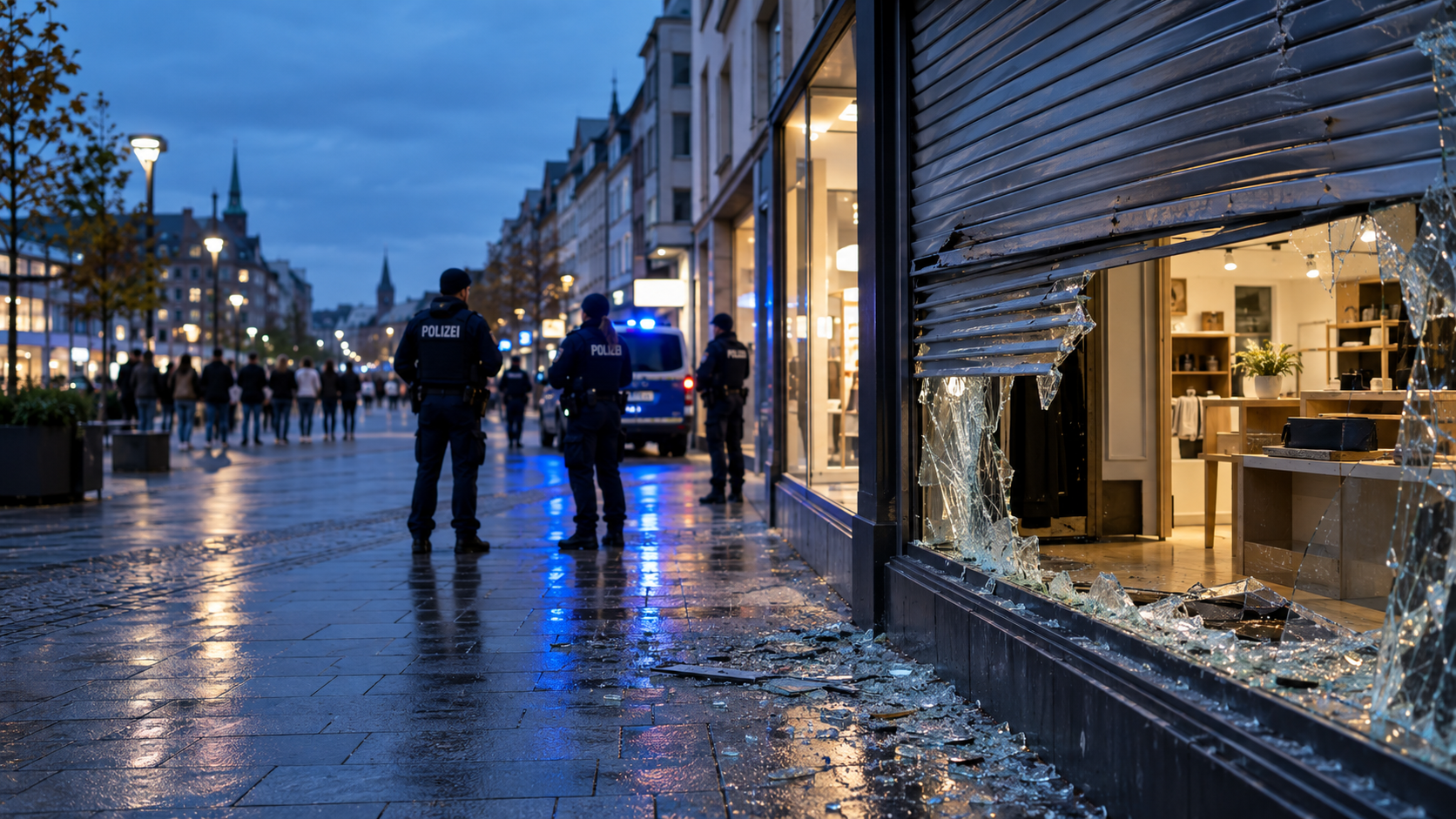
The riots following the largely peaceful Gen Z protests: violence, migration, and the costs of political uncertainty – a creative image on the topic, created with AI: Xpert.Digital
Violence after protests: Why clear perpetrator analyses are crucial for security
Security, migration and political language: Where the debate loses precision – overrepresentation is not a perpetrator profile, but an important indicator of the need for action
After the riots: How political uncertainty is damaging trust and the economy
The riots following the largely peaceful Gen Z protests raise a fundamental question: How can the state consistently prosecute violence without implicating peaceful demonstrators or casting blanket suspicion on entire population groups? In Frankfurt am Main, according to initial reports, more than 100 police officers were injured and at least 20 businesses were damaged or looted. The consequences extend beyond the immediate damage: Acts of violence tie up police and the judiciary, burden businesses, and can undermine confidence in the safety of public spaces.
The political debate surrounding this issue also touches upon migration and crime statistics. Nationwide, non-German suspects were significantly overrepresented in violent crime cases in 2025; at the same time, the number of registered offenses decreased compared to the previous year. Both of these points are essential for a factual assessment. The statistics reveal a striking distribution, but they explain neither its causes nor who was involved in specific acts of violence. Therefore, it is crucial to clearly identify those responsible, await reliable findings, and derive comprehensible consequences from them. This allows necessary investigations to be combined with the protection of peaceful protests – without downplaying violence or equating origin with guilt.
Those who downplay problems make security more expensive – as do those who use origin as an explanation
The debate surrounding the violence following the largely peaceful Gen Z protests touches upon a fundamental question of the state's capacity to act: Can a government clearly define violence, investigate potential perpetrator structures, and enforce consequences without resorting to either linguistic evasions or sweeping generalizations? The economic significance of this question extends far beyond damaged shop windows. Public safety protects economic activity, limits private insurance costs, and fosters trust in the reliability of state institutions.
Three levels must be distinguished: responsibility for specific crimes, the statistical distribution of crime, and the explanation of its causes. Mixing these levels produces not clarity, but political obfuscation. A conspicuous overrepresentation of certain groups in crime statistics should not be ignored. However, it proves neither the composition of a specific group of perpetrators nor a direct causal link between origin and propensity for violence.
A viable perspective therefore begins with responsibility: violence must be prosecuted regardless of origin or political self-definition. Where reliable evidence points to specific milieus prone to violence, these must be precisely identified. At the same time, the necessary differentiation must not serve to obscure the fundamental question of perpetrators, networks, and state consequences. It is precisely at this juncture that it is decided whether political communication contributes to solving the problem or itself incurs additional societal costs.
Peaceful protest does not imply responsibility for subsequent violence
The starting point was youth protests, which were largely peaceful. These were followed by riots in several cities. The events in Frankfurt am Main were particularly serious. According to initial reports, more than 100 police officers were injured and at least 20 shops were damaged or looted. These figures describe considerable damage, but do not replace a final assessment or the individual investigation of the crimes.
The distinction between demonstrations and subsequent violence is not a mere linguistic point. It concerns the correct allocation of responsibility. People who peacefully demonstrate for better education, affordable living, or other political causes are not automatically responsible for later attacks by others. The organizers distanced themselves from violent acts and emphasized that these were not part of their demonstrations.
From an economic perspective, this creates a problem of harm to others: violent actors can exploit the public attention garnered by a demonstration, while the political and social consequences also affect those who protested peacefully. Their concerns lose visibility, organizers come under pressure to justify themselves, and future demonstrations become more difficult to organize.
A state that ignores these distinctions creates perverse incentives. It burdens legitimate protest with the consequences of others' crimes. Conversely, a state that downplays subsequent violence out of consideration for peaceful demonstrators also fails in its duty. It must guarantee both simultaneously: the protection of democratic participation and the effective prosecution of violence.
The government dispute also concerns the standard of proof and political language
Karin Prien categorized the riots as a problem in which, in addition to left-wing radical groups, individuals from migrant backgrounds may also have been involved. From this, she deduced the need for a more thorough examination of integration problems. Alexander Dobrindt identified violence-prone left-wing groups and migrant perpetrators of violence much more explicitly as those responsible. Boris Pistorius objected primarily to the vagueness of the terminology, pointing out that he lacked the factual basis for such a classification. At the same time, he explicitly demanded the punishment of those responsible for attacks on police officers and serious property damage.
These differences are politically relevant. Prien formulated a preliminary assessment, Dobrindt a more decisive attribution of perpetrators, and Pistorius an objection to the scope and basis of the category used. It cannot be readily inferred from this that Pistorius relativized the violence or ruled out migrant involvement. Neither of these conclusions corresponds to the documented content of his statements.
Nevertheless, a legitimate political question remains: When is pointing to differentiation helpful, and when does it overshadow the necessary engagement with a problem? The answer depends on whether the conceptual critique is followed by a verifiable mandate for clarification. Anyone who considers a category imprecise should explain what information is needed instead and when it should be available.
Differentiation is productive when it clarifies investigations. It becomes unproductive when it merely prolongs the debate without improving our understanding. The same applies, conversely, to assertive language: it is helpful when it summarizes verifiable facts in an understandable way. It becomes harmful when it creates a false sense of certainty before the evidence is available.
Crime statistics reveal a real problem, but not a complete offender profile
Nationwide crime trends provide important context. In 2025, 212,335 cases of violent crime were registered. This was 2.3 percent fewer than in 2024, when 217,277 cases were recorded. Compared to 2019, however, the number was still 17.3 percent higher. Thus, a short-term decline and a longer-term increase in crime rates exist simultaneously.
A differentiated picture also emerges regarding the suspects. In the area of violent crime, a total of 192,239 people were recorded in 2025. Of these, 109,674 were German citizens and 82,565 were non-German citizens. The proportion of non-German suspects was 42.9 percent. The Federal Criminal Police Office explicitly describes this group as significantly overrepresented.
These figures justify a serious discussion on security policy. A conspicuous distribution does not become meaningless simply because its explanation is complex. Conversely, a statistical anomaly does not lead to a generalization about all members of a population group.
Equally important is the recent development within these groups. The number of non-German suspects in violent crimes fell by 2.9 percent in 2025 compared to the previous year, while the number of German suspects fell by 2.4 percent. Among immigrants included in the stricter statistical definition, the decline was 7.2 percent. Therefore, anyone who relies solely on rising figures from the previous year, despite the availability of more recent data, paints an incomplete picture.
The objective conclusion is neither an all-clear nor a blanket diagnosis of escalation. Germany has a significant problem with violence, which remains at an elevated level. Non-German suspects are significantly overrepresented. At the same time, key indicators have recently improved. A sound analysis must reconcile all three points.
Why nationality and migrant background are different things
A major weakness in the public debate lies in the conflation of different categories. Police crime statistics distinguish between German and non-German suspects based on their nationality. They do not, however, include a potential migration background as a corresponding, comprehensive comparative category. Statistically, German citizens with a family history of immigration are classified as belonging to the German group.
The term "migrant milieu," on the other hand, denotes neither a clearly defined legal status nor a uniform social structure. It can refer to family origin, specific neighborhoods, circles of friends, cultural orientation, or social isolation. Without further clarification, it remains unclear which of these characteristics is relevant for the specific analysis.
The statistical term "immigrant" also has a narrower meaning than in general usage. In this context, it encompasses specific categories of residency status, including asylum seekers, those granted protection, those with tolerated stay status, and persons residing illegally. It does not represent all people who have immigrated to Germany at any time.
For an economically rational security policy, this conceptual precision is indispensable. Measures must target modifiable and verifiable risk factors. A specific circle of friends prone to violence, a repeatedly conspicuous meeting place, or an identified network can be investigated. A very large and heterogeneous category of origin, on the other hand, offers little guidance for the targeted allocation of scarce resources.
This does not mean that origin-related factors should be ignored altogether. They can be relevant, for example, if they play a role in the structure of a network or in specific immigration-related issues. However, their significance must be demonstrated. Simply stating a characteristic does not replace the requirement to prove its explanatory power.
Overrepresentation warrants an investigation, but not a guarantee of causality
The claim of a direct, established causal link between migrant background and violence goes beyond what aggregated police data can demonstrate. Statistics can show that a group is more frequently represented among suspects. However, they do not answer the question of which characteristics and circumstances produce this difference.
A causal analysis would require considering factors such as age, gender, social status, residency conditions, geographical concentration, and prior criminal record. Differences between individual offenses and between various groups within the non-German population are equally relevant. This examination is not intended to excuse the situation, but rather to refine the explanation.
Even comparing crime statistics with population proportions requires careful consideration. Not every person recorded as a suspect is a permanent resident of Germany. Comparing a broad group of suspects with a more narrowly defined resident population can lead to distorted comparisons of crime burdens. Furthermore, police crime statistics only reflect reported and processed crimes. Reporting behavior and the frequency of police checks can influence the recorded data.
None of these limitations automatically negates the observed overrepresentation. However, they do restrict the conclusions that may be drawn from it. Methodological objections are therefore neither a license to downplay the issue nor proof that the observed differences would disappear completely.
The appropriate approach is more demanding: A conspicuous finding must be acknowledged, investigated more closely, and translated into effective measures. Replacing this final step with a blanket declaration of origin can be just as misguided as refusing to take the first step altogether.
Images document violence, but they do not measure a population group
News images can reveal significant violence. They show attacks, destruction, looting, and the strain on emergency services. While these images can provide important clues for reconstructing individual acts, they are insufficient as a basis for a reliable statistical classification of those involved.
Nationality, family immigration history, residency status, and specific social background cannot be reliably determined from outward appearance. Furthermore, published photographs do not represent a randomly selected cross-section of all those involved. Particularly spectacular scenes receive more attention than unspectacular events.
Economically, this is an information problem. People have to make judgments with limited attention spans and therefore often rely on particularly memorable observations. Political communication can either supplement these observations with verifiable data or elevate them to the level of comprehensive certainties.
The appropriate response is not to downplay visible violence. It is to distinguish between observation and conclusion. A documented attack can prove a specific act. However, it does not, in itself, prove the composition of all those involved, nor the cause of their propensity for violence.
Therefore, the demand for transparent investigation results is far stronger than the reliance on a supposedly clear visual impression. Those who demand clarity should require reliable information about identified individuals, their involvement in the crime, prior convictions, and possible connections. This transforms outrage into a verifiable security policy demand.
The immediate damage affects people and economic assets
The first economic level concerns the immediate damage. Damaged storefronts, stolen goods, and destroyed fixtures must be replaced. Added to this are cleaning, security, organizational costs, and potentially temporary business closures. Furthermore, injuries cause medical and personal consequences that cannot be reduced to repair bills alone.
The information available here does not provide a reliable total figure for the damage caused by the current riots. Therefore, any specific figure in the millions would be speculative. The number of damaged businesses and injured emergency personnel cannot be reliably converted into an overall economic damage figure without additional information.
Crucially, it is also important to distinguish between operational and macroeconomic damage. If a business remains closed and customers shop elsewhere, the affected business loses revenue. For the overall economy, some of this demand can simply be shifted. In contrast, damaged goods, additional repair work, and injury-related absences represent real resource losses or additional resource commitments.
Insurance payments don't eliminate the damage. They distribute the financial burden according to the specific terms of the policy. Whether a particular case is covered and what the remaining out-of-pocket expenses are must be examined on a case-by-case basis. From an economic perspective, the destroyed assets and the necessary restoration costs remain.
These distinctions are important because a dispassionate damage analysis should neither dramatize nor downplay the situation. It must capture what was actually lost, what additional costs are incurred, and what burdens are merely shifted between different stakeholders.
Small businesses often bear the brunt of uncertainty more directly than large organizations
The economic consequences are not evenly distributed. A larger chain store may be able to absorb a local outage within its network of locations. An owner-operated business may not have this option. There, repair costs, organizational strain, and lost revenue directly impact the company's liquidity.
Even if material damages are compensated, the time investment remains. Business owners have to coordinate tradespeople, take inventory, compile documents, and reorganize operations. These tasks displace productive work. The damage, therefore, consists not only of what was visibly destroyed, but also of the time and attention consumed.
A second channel concerns the formation of expectations. Repeated uncertainty can play an additional role in location decisions. Companies then consider not only rent, accessibility, and customer base, but also how reliably employees, goods, and business premises are protected.
However, a single violent incident does not necessarily imply a lasting economic decline in a city center. This would require examining trends in visitor numbers, vacancy rates, investments, and revenues over a longer period. A sound analysis describes the potential mechanism without predicting its actual extent.
This leads directly to a municipal policy mandate: After serious riots, damage and operational impacts should be systematically recorded. Only in this way can it be determined whether short-term aid is sufficient or whether longer-term problems for the location will arise.
Police operations cause opportunity costs throughout the state
Large-scale police operations tie up personnel, equipment, and command resources. Injured officers may also be unavailable for duty. Subsequent investigations require further resources. The strain, therefore, does not end the moment a street is cleared.
The decisive economic factor is the opportunity cost. Every additional working hour tied up is not simultaneously available for other tasks. This can affect patrol duty, investigations in other cases, or preparatory work for future operations. Which specific tasks are displaced depends on staffing levels and organizational structure.
It would be wrong to automatically classify all regular personnel costs of an operation as additional damages. Some of the employees would have been on duty anyway. A distinction must be made between additional expenses, such as certain overtime or material costs, and the lost opportunity to use existing resources elsewhere.
The judiciary must also be included in this analysis. Good police work loses its effectiveness if evidence cannot be evaluated in a timely manner or if cases cannot be processed adequately. Security policy is therefore a continuous chain of services: from local protection and the identification of suspects to judicial decision-making.
A policy focused solely on visible police presence falls short. It must examine where additional resources can make the greatest contribution to solving crimes, ensuring lawful prosecution, and preventing further offenses.
Uncertainty acts like an additional price for using public spaces
Public safety has economic value, even if no entrance fee is charged. A safe public space facilitates commerce, mobility, leisure, and social interaction. Those who feel unsafe may use these services differently or less frequently.
The results of the victim survey, published alongside the crime statistics, paint a more nuanced picture. The feeling of safety at night in one's own neighborhood was 74 percent, slightly higher than in the comparative survey from 2020. At the same time, around 45 percent felt unsafe using public transport at night. Therefore, a blanket description of Germany as universally unsafe would be just as inaccurate as claiming that there is no significant security problem.
Economically, uncertainty can be understood as an additional cost of use. Besides travel costs and time, people may also have to consider fear, precautions, or detours. Those who have alternatives can change course. Those who are dependent on working late or using specific transport connections have less flexibility.
Therefore, security policy also has a distributional dimension. A withdrawal of the state does not automatically burden everyone equally. Private protection options, alternative mobility, and the freedom to choose one's place of residence are unequally distributed.
This does not justify unlimited surveillance. Rather, it necessitates tailoring measures to specific threats and verifiable effects. Sound security policy reduces the actual burden on public spaces without unnecessarily restricting their free character.
Precise perpetrator analysis also protects peaceful people with a migration background
Sweeping generalizations also incur economic and social costs. When a large group of people with a particular background is associated with a propensity for violence, mistrust can be directed at people who have nothing to do with the acts. This shifts the focus from verifiable behavior to a vague group characteristic.
This shift is problematic for an economy based on the division of labor. Collaboration relies on assessing individuals according to relevant characteristics: qualifications, reliability, performance, and actual behavior. Blanket suspicion can obscure this information.
The available information does not allow us to quantify the potential consequential costs in this specific context. The analytical point is more narrowly defined: an imprecise category can worsen both security decisions and societal judgments. Simply by using politically charged language, it does not generate any additional precision.
Conversely, peaceful residents of affected neighborhoods benefit from effective law enforcement. Origin and victimhood are not mutually exclusive. Policies that, out of fear of stigmatization, fail to clearly investigate violent networks do not automatically protect the people in whose communities these networks operate.
The most convincing alternative is therefore not linguistic silence, but rather individual and structural precision. Specific perpetrators, supporters, and connections must be made visible. The more reliably this attribution can be established, the less room remains for suspecting an entire population group.
Political tunnel vision is a testable hypothesis, not a substitute for analysis
The accusation that political actors left of center opportunistically downplay integration-related security problems is a debatable political hypothesis. However, it is not proven simply because an SPD minister criticizes an unclear group designation. In this specific case, Pistorius explicitly demanded the punishment of the perpetrators of the violence.
A sound critique would therefore need to be more precise. Are existing findings being withheld? Are conspicuous developments not being investigated despite reliable data? Are demands for a better data basis going unanswered? Or are measures being blocked whose benefits are sufficiently proven? Such questions can be examined by looking at decisions and results.
Political incentive problems can, in principle, work in both directions. One side may deflect unpleasant findings because it fears stigmatization or wants to protect its own understanding of integration. The other side may prematurely claim certainty because a simple narrative of perpetrators can politically mobilize support. Both are potential perverse incentives, not automatically proven motives of individuals.
The economic parallel lies in organizational failure: institutions learn poorly when information is primarily evaluated based on whether it fits their own position. In such cases, the most effective measure is not sought, but rather the most politically convenient explanation.
A demanding benchmark, therefore, is to measure political leaders by their willingness to make corrections. Those who become more precise based on new insights demonstrate strength. Those who use every uncertainty as an excuse or treat every clarification as a retreat hinder informed decision-making.
Investigating the causes must not remove responsibility from the agenda
It is legitimate to want to discuss perpetrators, protective measures, and prosecution after a violent incident. Discussions about education, social conditions, or long-term integration policies must not replace the immediate question of responsibility. There is a fundamental difference between an explanation and a justification.
The operational sequence is clear: avert danger, provide care for the injured, secure evidence, identify suspects, and conduct legal proceedings. Possible social motives do not need to be definitively determined before an attack can be prosecuted.
For long-term resource planning, understanding the causes remains crucial. Different mechanisms that lead to violence require different countermeasures. An ideologically motivated group, a spontaneously escalating group, and a group of perpetrators with a history of repeat offenses are not the same problem.
This does not mean that every act of violence should be attributed to a lack of prospects. Nor is a lack of prospects proof of a lack of personal responsibility. Rather, an economic analysis asks which measures can actually prevent further harm under given circumstances.
Separating these time horizons thus resolves a perceived contradiction. Short-term consequences and long-term prevention are not necessarily in competition. They only become opposites when one is used as a pretext for neglecting the other. A functioning state must organize both without linguistically equating their respective tasks.
Reliable consequences and a functioning process chain are crucial
It's easy to announce political toughness. It's more difficult to turn an act of violence into a provable and legally sanctioned crime. This requires reliable documentation, attributable contributions to the crime, and sufficient processing resources.
From an economic perspective, therefore, the nominal amount of potential penalties should not be the only factor considered. Equally crucial for assessing the state's ability to act is whether suspects are identified, whether evidence is sound, and whether proceedings can be concluded within a reasonable timeframe.
This leads to a practical mandate for reviewing political measures. Additional powers are not automatically effective if existing information cannot be evaluated. Increased police presence does not solve every problem if subsequent case processing becomes bogged down. Conversely, a well-equipped justice system is insufficient if crimes are barely documented on the ground.
Immigration-related consequences must also be distinguished from the criminal assessment. Which additional measures are legally possible depends on the individual's status and the legal requirements. For German citizens with an immigration history, treatment under immigration law as a foreigner is not an appropriate category.
A credible state therefore does not promise indiscriminate automatic responses. It ensures that the permissible consequences in each case are actually examined and implemented. Equal treatment does not mean equating legally different situations, but rather handling comparable cases according to comprehensible standards.
Good data must close the gap between suspicion and result
A policy that relies on data cannot be satisfied with the number of arrests alone. Arrests primarily document police action. They do not yet answer how many allegations will later be confirmed or which proceedings will lead to which outcomes.
For a serious investigation, several interrelated pieces of information would therefore be necessary: the number of identified individuals, their alleged involvement in the crime, relevant prior convictions, identifiable connections, and the subsequent outcome of the proceedings. Where origin or residency status is publicly discussed, this information should also be legally permissible, methodologically sound, and clearly limited in scope.
The presumption of innocence remains central. Suspects are not convicted offenders. Police crime statistics reflect the state of knowledge after the police investigation has concluded; subsequent assessments by public prosecutors and courts may differ.
Economically, such a data foundation improves the monitoring of success. Resources should not be allocated solely based on which measure is most visible, but rather on its contribution to reducing violence and improving public awareness. For this to happen, effort and results must be comparable.
Transparency also requires a temporal structure. An initial assessment of the situation may be preliminary. However, it should be supplemented by further findings and corrected if necessary. Those who openly acknowledge uncertainty and then demonstrably address it create more trust than those who immediately claim certainty or remain stuck in general reservations.
The economically sound approach combines clarity with limitation
The central challenge is not choosing between consistent prosecution and nuanced language. Both belong together. Precision directs state action toward those truly responsible. Consistency ensures that this precision does not go unpunished.
The available data justify a thorough examination of the overrepresentation of non-German suspects in violent crimes. It also justifies the observation that the most recent nationwide figures in this area have declined. However, for specific incidents of violence, the respective investigations must reveal which individuals and structures were responsible. Nationwide statistics cannot preempt this work.
Karin Prien's reference to possible integration-related connections is therefore a legitimate approach to the investigation, but not yet a conclusive explanation. Alexander Dobrindt's specific classification must be measured against concrete findings. Boris Pistorius's demand for conceptual precision is objectively justifiable, but it does not absolve political leaders from following up reliable findings with concrete answers.
Ultimately, the decisive factor for economic evaluation is whether the state limits damage, reliably protects public spaces, and uses its scarce resources effectively. This includes acknowledging unpleasant findings. It also includes rejecting unsubstantiated generalizations.
Political clarity doesn't arise from the harshest formulation. It arises when it's stated what is certain, what still needs to be examined, and what the consequences will be. Such an approach protects businesses, emergency services, and peaceful citizens, as well as the credibility of the rule of law. Precisely for this reason, it is neither weak nor evasive, but rather the more demanding form of decisive government action.