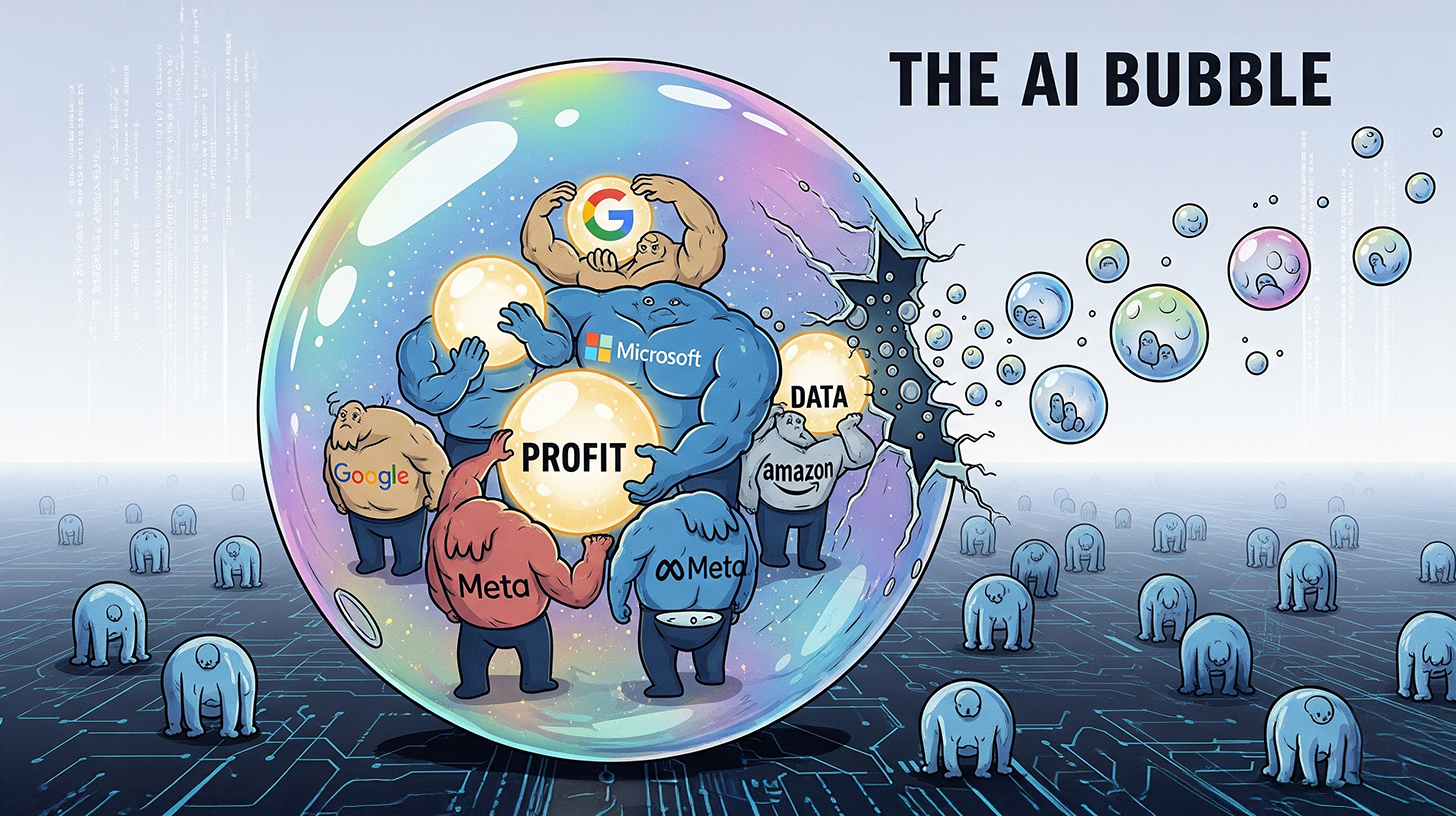
The great AI bubble is bursting: Why the hype is over and only the big players are winning
Billions invested, zero profit? What's really behind the great AI disillusionment?
### Of all people, the ChatGPT CEO is sounding the alarm: Is the AI industry on the verge of collapse? ### The great AI extinction: Why small startups are now running out of money en masse ### The AI gold rush is over: Only a few are now raking in the billions ###
From hype to cold shower: Why the initial AI euphoria has now faded
The party's over: After a period of boundless euphoria and seemingly endless investments, a palpable sense of disillusionment is setting in for the AI sector. The once broad flow of venture capital that fueled countless startups is now channeling into a few massive deals with established players. This paradigm shift from a gold rush mentality to strategic consolidation marks a turning point for the entire industry.
The signs are unmistakable: While small, innovative AI startups are increasingly struggling for funding and fearing a "great extinction," even presentations from tech giants like OpenAI no longer elicit unanimous enthusiasm, but also significant criticism. When even key figures like Sam Altman, who played a major role in shaping the hype, publicly warn of a bubble, it's more than just a faint warning signal. At the heart of this shift lies a fundamental discrepancy: Astronomical valuations and investment sums exceeding $100 billion are juxtaposed with a reality in which, according to studies, the majority of AI projects have yet to generate any measurable profit. The following text analyzes the reasons for this disillusionment and reveals the consequences of this shift for investors, tech giants, and the entire startup ecosystem.
What is meant by the current paradigm shift in the AI investment sector?
The AI investment market is currently undergoing a fundamental transformation. After years of widespread euphoria and numerous smaller bets on various AI startups, a clear strategic shift is taking place towards selective large-scale investments. This development is characterized by several distinctive features that will have a lasting impact on investment behavior.
Investors are increasingly focusing on established companies with proven business models or concentrating on a few promising large-scale projects. Instead of spreading available capital across numerous smaller AI startups, they are pooling their resources for strategic large-scale investments that promise a higher chance of success. This development reflects a realistic reassessment of the AI industry, where initial enthusiasm is giving way to a sober analysis of actual market potential.
The figures clearly confirm this trend: While AI investments more than doubled in 2024 to over $100 billion and now account for 37 percent of the global venture capital market, these sums are concentrated on fewer and fewer companies. At the same time, the total number of funding rounds declined, suggesting that investors are using their resources more strategically.
What specific signs point to growing disillusionment?
This disillusionment manifests itself on various levels and is made visible by several concrete developments. A particularly striking example was the introduction of OpenAI's GPT-5, which, instead of the expected enthusiasm, triggered a wave of criticism. Experts such as Gary Marcus, an emeritus professor of psychology and neuroscience at New York University, described the new model as "overdue, overrated, and disappointing.".
User reactions were even more drastic. Just a few hours after the presentation, resistance to the new model formed on social media. Criticisms included shorter and inadequate answers, a more intrusive AI style, and the lack of the "personality" of earlier models. Many users found it particularly problematic that GPT-5 was marketed as an "upgrade" but, in practice, brought limitations.
The scientific assessment was equally sobering. An MIT study showed that 95 percent of the AI projects examined in companies have so far failed to deliver any measurable profit contribution. Steve Sosnick, chief strategist at Interactive Brokers, called these results a "slap in the face," thus highlighting the discrepancy between the enormous investments and the actual returns achieved.
How does this development affect small AI startups?
The situation is becoming dramatically worse for small AI startups. The focus on large investments means that less capital is available for early-stage financing. This trend is already reflected in concrete figures: In Germany, for example, the number of small deals under one million euros fell significantly by more than a fifth compared to the previous quarter.
The situation is particularly worrying for newly founded AI startups. While companies founded in 2021 have received a total of approximately $535 million so far, startups from 2022 and 2023 have received only about $93 million combined. Dr. Philip Hutchinson, Senior AI Expert at the appliedAI Institute, is concerned about this trend: "It has become increasingly difficult for AI startups founded in 2022 or later to raise capital.".
The high costs of training AI models and the expensive AI specialists further exacerbate this problem. Small startups often cannot raise the enormous resources required to develop competitive AI solutions. This creates a vicious cycle: without sufficient funding, they cannot develop competitive products, and without compelling products, they cannot obtain funding.
EU/DE Data Security | Integration of an independent and cross-data-source AI platform for all business needs

Independent AI platforms as a strategic alternative for European companies - Image: Xpert.Digital
AI Game Changer: The most flexible AI platform - Tailor-made solutions that reduce costs, improve your decisions and increase efficiency
Independent AI platform: Integrates all relevant company data sources
- Rapid AI integration: Tailor-made AI solutions for businesses in hours or days, instead of months
- Flexible infrastructure: Cloud-based or hosting in your own data center (Germany, Europe, free choice of location)
- Maximum data security: its use in law firms is irrefutable proof
- Deployment across a wide variety of enterprise data sources
- Choice of own or different AI models (DE, EU, USA, CN)
More information here:
AI Investments: The Great Showdown of the Giants
Why is Sam Altman of all people warning about an AI bubble?
Sam Altman's warnings about a potential AI bubble are particularly surprising, given that, as CEO of OpenAI, he played a key role in fueling the current AI boom. His critical remarks suggest several possible motivations, all of which could be strategic in nature.
First, investor pressure is mounting dramatically. The era of blind faith and unlimited funding for every AI approach is drawing to a close. Smart money investors are increasingly demanding robust business models and tangible results. Altman's warning could be a clever preemptive move – being the first to warn of a bubble positions oneself as a far-sighted voice of caution, not as an unwitting follower.
Secondly, it could be an attempt to force weaker competitors out of the market before the mass die-off begins. Altman's public statement that "some investors are going to lose a lot of money" could encourage investors to focus their funds more on established players like OpenAI.
The financial realities support this interpretation. Although OpenAI tripled its revenue to approximately $3.7 billion in 2024, the company reportedly posted a loss of around $5 billion. Added to this is a dangerous cost spiral: OpenAI's o3 model was roughly 100 times more expensive than its predecessor.
What exactly does the term "large-scale investment trend" mean?
The trend toward large-scale investments is characterized by a fundamental shift in investment strategies. Instead of distributing many smaller sums across various startups, investors are concentrating on a few, but very large, funding rounds. This development can be illustrated by several concrete examples.
Databricks secured one of the largest funding rounds of 2024 with a $10 billion Series J funding round. Led by Thrive Capital, the round raised the company's valuation to $62 billion, surpassing even giants like OpenAI, xAI, and Waymo.
The trend is equally evident in Germany. Munich-based Helsing, which specializes in artificial intelligence for the defense industry, raised €450 million. Cologne-based translation service DeepL received €277 million, and Aachen-based Black Semiconductor secured €254 million. These three deals alone accounted for a significant portion of the total German AI investment volume.
The statistics illustrate the scale of this shift: In 2024, there were 29 major investments in Germany, each with a financing volume of at least 50 million euros – eight more than in the previous year. At the same time, the total number of financing rounds fell by twelve percent, showing that fewer companies received funding, but those that did received significantly larger sums.
What role do the tech giants play in this development?
The major technology companies play a crucial role in concentrating AI investments on a few large-scale projects. Companies like Meta, Amazon, Microsoft, and Alphabet have fundamentally changed their investment strategies and are pumping billions into expanding their AI infrastructure.
Meta doubled its investments in 2025, Amazon is building gigantic AWS campuses, and Microsoft is constructing new data centers en masse. These massive infrastructure investments are swallowing up billions and leading to a paradoxical situation: While profits are rising, free cash flow is collapsing. For the four major US tech companies, it has fallen by around 30 percent since 2023.
The tech giants are pursuing a clear strategy: they want to divide the AI market among themselves and control or acquire potential competitors as they emerge. Large funding rounds and acquisitions by these corporations are increasingly shaping the market landscape. This is creating a kind of oligopoly structure in which only a few large players determine developments.
This development also has geographical implications. While the US dominates with a 62 percent market share of global VC investments, Europe has overtaken Asia for the first time to become the second-largest VC region. Nevertheless, the absolute differences remain enormous: startups in the US received €41.4 billion in venture capital commitments in the second quarter of 2024, compared to only €1.8 billion in Germany.
How is the valuation of AI companies developing?
Valuations in the AI sector have reached grotesque proportions in some cases, justified only if profits increase dramatically in the long term. Tesla is currently trading at a price-to-earnings ratio of around 200, while Nvidia is at about 60. These levels reflect extreme future expectations, which raise skepticism among many experts.
The discrepancy between valuations and actual earnings is particularly problematic. Although AI companies achieve astronomical valuations, most remain far from profitable. OpenAI, valued at around $300 billion, is estimated to continue posting massive losses.
The valuation bubble is also evident in the extreme market concentration. Nvidia and Microsoft now represent around 15 percent of the S&P 500 – a weighting that is unprecedented even in the technology-obsessed US market. This concentration makes the entire market vulnerable to corrections, as even minor setbacks for these companies can have a significant impact.
The warning signs are mounting: Nvidia lost 3.6 percent in three days, Microsoft 3 percent, and for other companies like Palantir, the setback was even more severe at minus 14 percent. This volatility suggests that the markets are becoming increasingly nervous.
Which industries and application areas are particularly affected?
The transformation in AI investment is impacting different industries and application areas in varying ways. Consumer-oriented AI applications and traditional Software-as-a-Service solutions are particularly affected, struggling with declining valuations.
In contrast, specialized sectors benefit from the focus on large-scale investments. The healthcare sector dominates the financing volume with 1.039 billion Swiss francs, representing 45 percent of the funds invested in Swiss startups. Biotech startups alone received 703 million Swiss francs.
The defense sector is experiencing a particular boom. German AI companies like Helsing, which specializes in artificial intelligence for the defense industry, are attracting massive investments. This development reflects societal changes and geopolitical tensions that are increasingly bringing military applications of AI into focus.
The situation is particularly dramatic for traditional e-commerce and online retail companies. Berlin, which has traditionally been strong in this sector, has had to accept significant declines in funding, while Bavaria, with its focus on technology and AI, has overtaken the capital in terms of funding amount for the first time.
🎯🎯🎯 Benefit from Xpert.Digital's extensive, five-fold expertise in one comprehensive service package | BD, R&D, XR, PR & Digital Visibility Optimization

Benefit from Xpert.Digital's extensive, five-fold expertise in a comprehensive service package | R&D, XR, PR & Digital Visibility Optimization - Image: Xpert.Digital
Xpert.Digital possesses in-depth knowledge across various industries. This allows us to develop tailored strategies precisely aligned with the requirements and challenges of your specific market segment. By continuously analyzing market trends and monitoring industry developments, we can act proactively and offer innovative solutions. The combination of experience and expertise generates added value and provides our clients with a decisive competitive advantage.
More information here:
AI bubble or reboot? Why only true problem solvers will survive
What are the long-term implications for the start-up ecosystem?
The long-term effects of current developments will fundamentally change the entire startup ecosystem. The focus on large investments is leading to polarization: a few companies receive substantial capital, while the majority of startups struggle with significant funding difficulties.
This development exacerbates the existing problem of unequal survival chances. While established startups with solid business models continue to have access to capital, it is becoming increasingly difficult for innovative but still unproven business ideas to obtain the necessary seed funding.
The figures speak for themselves: In 2024, 336 startups in Germany filed for insolvency, representing a 17 percent increase compared to the previous year. Around eleven percent of the surveyed startups expect to become insolvent within twelve months – a dramatic increase compared to the previous year.
The trend in early-stage financing is particularly problematic. The decline in small investments under one million euros primarily affects young companies, which are often still in the development phase. This funding gap could weaken the innovative capacity of the entire ecosystem in the long term.
What regional differences are evident in this development?
Regional differences in the AI investment landscape are becoming increasingly pronounced and reflect different strategic approaches. The US continues to dominate unchallenged with 62 percent of global VC investments, while different patterns are developing in Europe and Germany.
A remarkable geographical shift is taking place in Germany. In 2024, Bavaria overtook Berlin for the first time in terms of funding, raising €2.33 billion – a good €600 million more than in 2023. Berlin, on the other hand, received only €2.17 billion, a decrease of €200 million. This development is mainly attributable to the tech and AI boom, in which Bavaria has traditionally been stronger.
North Rhine-Westphalia also saw strong growth, reaching €951 million, an increase of €620 million. This regional redistribution shows that investment priorities are shifting from traditional online retailers, Berlin's traditional strength, to technology-oriented sectors.
Across Europe, the picture is mixed. While Europe has overtaken Asia as a region to become the second-largest VC region, the absolute figures remain modest. In France, startups received €2.1 billion in VC commitments in the second quarter of 2024, and in the UK, the figure was €5.1 billion – still far from the €41.4 billion in the US.
How are investors reacting to the changed market situation?
Investors have fundamentally adjusted their strategies and are demonstrating a significantly more selective approach. The expected internal rate of return (IRR) has decreased overall: For early-stage investments, it fell from 36 to 31 percent, and for growth financing, from 32 to 25 percent. Only for late-stage investments did the IRR rise, from 24 to 28 percent, reflecting the preference for later, lower-risk investment phases.
This shift in risk appetite is leading to longer holding periods and an increase in secondary deals. With trade sales and IPOs becoming increasingly rare, investors are seeking alternative exit strategies. VC secondary deals offer the opportunity to generate liquidity without having to wait for a full exit.
Due diligence processes have become more stringent. Investors are scrutinizing companies more closely and placing higher demands on business models and profitability pathways. While in the boom years, ideas and teams were often financed, investors today require concrete evidence of market potential and competitiveness.
The role of foreign investors in large deals is particularly noteworthy. Almost half of all venture capital deals exceeding €50 million in Germany are conducted solely by foreign investors. This suggests a form of valuation arbitrage: foreign investors invest at more favorable European valuations with the aim of later exiting in the US at higher valuations.
What conclusions can be drawn for the future of the AI sector?
Current developments in the AI sector point to a fundamental market consolidation, which presents both opportunities and risks. The focus on large investments will likely lead to oligopolization, with a few large players dominating the market. This development could stifle innovation, as disruptive ideas from smaller companies will have less chance of securing funding.
At the same time, a more selective investment strategy could lead to more sustainable business models. The pressure to develop profitable and scalable solutions is forcing companies to adopt a more realistic approach to AI applications. The MIT study, which showed that 95 percent of AI projects do not deliver a measurable return on investment, underscores the need for this correction.
The geographical shifts are likely to intensify. Regions with strong technical universities and established tech ecosystems, such as Bavaria or Baden-Württemberg, could gain further importance, while traditional startup centers focused on consumer applications could decline.
This presents important areas for policymakers to take action. The proposed AI vouchers and increased support for collaboration between SMEs and startups could help close the funding gap. Without targeted support for smaller innovators, there is a risk that Germany and Europe will fall further behind in the global AI race.
Sam Altman's warning about an AI bubble should be taken seriously, even if it might be strategically motivated. The parallels to the dot-com bubble are undeniable: inflated valuations, a lack of viable business models, and blind faith in technology. A controlled decline in valuations could be beneficial and lead to more sustainable development in the AI sector.
Ultimately, the AI sector faces a crucial test. The era of unlimited funding without concrete results is coming to an end. Only companies that solve real problems and create demonstrable value will be successful in the long run. This development may be painful, but it could lead to a more mature and sustainable AI industry that actually delivers societal and economic benefits.
We are here for you - Consulting - Planning - Implementation - Project Management
☑️ SME support in strategy, consulting, planning and implementation
☑️ Creation or realignment of the AI strategy
☑️ Pioneer Business Development

Konrad Wolfenstein
I would be happy to serve as your personal advisor.
You can contact me by filling out the contact form below or simply call me on +49 7348 4088 965 .
I'm looking forward to our joint project.
Write to me


Xpert.Digital - Konrad Wolfenstein
Xpert.Digital is a hub for industry focusing on digitalization, mechanical engineering, logistics/intralogistics and photovoltaics.
With our 360° Business Development solution, we support renowned companies from new business to after-sales.
Market intelligence, smarketing, marketing automation, content development, PR, mail campaigns, personalized social media and lead nurturing are part of our digital tools.
You can find more information at: www.xpert.digital - www.xpert.solar - www.xpert.plus
Keep in touch