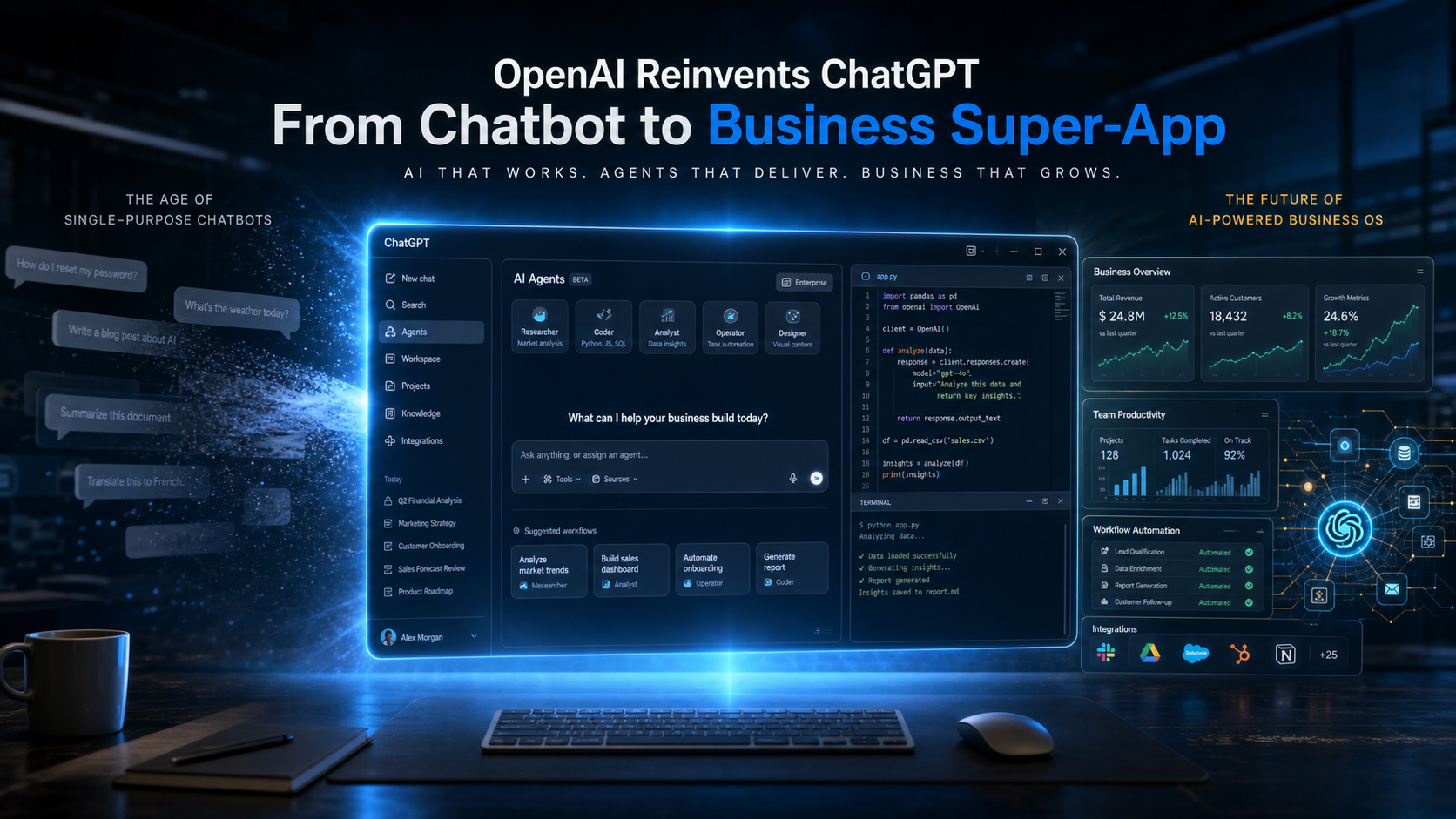
“AI chat is dead”: Why OpenAI is now sacrificing its greatest success – Image: Xpert.Digital
$25 billion loss: OpenAI's risky bet on the AI super app
Panic over Anthropic: How a newcomer is forcing the ChatGPT creator to radically restructure
The End of Prompts: Why OpenAI Wants to Change the Way We Work Forever
OpenAI revolutionized the technology world with ChatGPT – but now the most valuable private AI company faces the most radical upheaval in its history. Behind closed doors, the verdict has already been delivered: "Chat is dead." Confronted with immense financial pressure, exploding infrastructure costs, and the rapid rise of its B2B competitor Anthropic, OpenAI is forced to abandon its greatest success. The new strategy targets the very heart of the global economy: a comprehensive enterprise super-app and autonomous AI agents are intended to make prompts obsolete and replace the traditional software industry. But while the startup burns through billions to prepare for a historic IPO, the question remains: can the pioneer of the AI era win the trust of major corporations, or will OpenAI stumble over its own ambition? An in-depth analysis of the new power dynamics in Silicon Valley.
From chatbot to the operating system of the AI era: OpenAI's strategic reinvention
Admittance of a market shock: OpenAI under pressure
It is rarely the loud announcements that signal the most profound change in a company, but rather the quiet admissions. When a senior OpenAI employee told the Financial Times, "Chat is dead," it sounded less like a triumphant gesture than the sober assessment of an internal crisis meeting. The fact that the company, which essentially invented chatbots as a mass phenomenon with ChatGPT, is now declaring the death of that very format is not just a strategic realignment. It is the clearest indication that a fundamental power shift has taken place in the AI market, and the winners are yet to be determined.
In 2026, OpenAI finds itself in a peculiar predicament: With a valuation of $850 billion, it is one of the most valuable private technology companies in history, planning one of the largest IPOs ever, yet internally it has missed several of its own revenue and user targets. Its most popular product, ChatGPT, has reached 900 million weekly active users, but it narrowly missed its self-imposed goal of one billion by the end of 2025. CFO Sarah Friar has raised concerns internally about whether future computing contracts can even be financed if revenue growth doesn't pick up significantly. Meanwhile, its main competitor, Anthropic, is growing at a rate that is surprising even seasoned industry analysts.
In this tension between gigantic valuation and real growth pressure, ChatGPT's announced transformation into a "super app" reveals far more than just an interface redesign. It is the result of a strategic realization that reached OpenAI late, but not too late: consumer chatbots may shape the public image, but enterprise customers ensure survival.
Two million corporate customers as a new core pillar of the business model
To understand why OpenAI is now calling its most famous chatbot obsolete, one must take a closer look at the company's revenue structure. Two million companies currently use OpenAI products and are responsible for around 40 percent of total revenue. OpenAI expects this share to rise to 50 percent by the end of 2026. This means that half of all revenue will come from a customer group that represents only a fraction of the user base.
This calculation is essential from a business perspective. A corporate customer who pays for API integration, developer access, or professional Codex subscriptions generates, on average, many times the revenue of a private ChatGPT Plus subscriber paying $20 per month. At the same time, corporate customers are significantly less price-elastic, switch providers more slowly, and have a greater need for customized solutions that foster vendor loyalty. The majority of Codex users already pay for the service, demonstrating this target group's willingness to monetize.
This revenue profile is crucial for a planned IPO. Capital markets value recurring corporate revenues significantly higher than volatile consumer sales. A company that derives 50 percent of its revenue from stable B2B contracts is valued by investors at different multiples than a pure consumer player. The transformation into an enterprise platform is therefore not only a reaction to competitive pressure, but also a targeted preparation for the capital market narratives that are intended to justify an IPO at a trillion-dollar valuation.
The Codex model as a blueprint for a more profitable future
At the heart of this strategic realignment is a product that is far less well-known to the public than ChatGPT, but is treated internally as a lifeline: Codex, OpenAI's AI-powered programming product. Since the launch of a desktop application in February 2026, Codex's weekly user base has increased sixfold and now exceeds five million active users per week.
Codex is the most precise example of what differentiates OpenAI from chatbot logic. It solves concrete, monetizable problems for developers and businesses: it writes code, debugs errors, generates tests, and navigates existing codebases. Thibault Sottiaux, who was previously responsible for Codex and now heads the entire product division at OpenAI, describes the underlying system as a personal agent that can provide support in all areas of life and work contexts—via smartphone, desktop, and in the car. The shift is paradigmatic: away from the reactive chatbot that answers questions, toward the proactive agent that independently solves tasks.
The acquisition of the startup Astral has significantly strengthened the technical capabilities of the Codex platform and enables deeper integrations into development environments. In the new super-app architecture, Codex is designed to work seamlessly with ChatGPT and the proprietary Atlas browser: Atlas searches documentation, Codex writes and debugs the code, and ChatGPT explains the process in real time. This is not a gradual improvement, but a qualitative leap in product logic.
The Anthropic Dilemma: How a newcomer is giving the market leader a run for its money
The most immediate trigger for OpenAI's strategic shift is a company founded in 2021 by former OpenAI employees: Anthropic. Since its inception, Anthropic has consciously focused on enterprise customers, security architecture, and API integration, while OpenAI long dominated the consumer market. The consequences of these diverging strategies are now clearly visible in the market.
Anthropic claims to serve around 300,000 enterprise customers with its Claude model. User studies paint a clear picture: ChatGPT is primarily used for private purposes, while Claude dominates in professional application areas such as programming, research, and business analysis. The Menlo Ventures Report confirms Anthropic's leading position in the enterprise segment. And while OpenAI still leads in B2C revenue from ChatGPT subscriptions, Anthropic has caught up in the API business—its structurally more valuable and stable revenue stream—or is already leading in some segments.
Anthropic's rapid growth is the truly alarming signal for OpenAI. At the end of 2025, Anthropic's annualized revenue was around €8.3 billion; by the beginning of March 2026, it had risen to €17.5 billion – a doubling in just a few months. Epoch AI forecasts predicted that Anthropic could overtake OpenAI in revenue by mid-2026. OpenAI had missed several monthly revenue targets in the preceding months, having lost significant market share to Anthropic in the coding and enterprise software sectors.
This makes the situation particularly interesting for OpenAI: The company isn't being copied by Anthropic, it's copying itself. The planned super-app, focused on enterprise, code, and agents, is essentially the model Anthropic has been pursuing for years. The difference is that Anthropic has worked with fewer resources, less product fragmentation, and a more stringent security profile – all attributes that enterprise customers value.
When Prompts Disappear: The Architecture of the Next Generation of AI
Beyond the immediate realities of competition, OpenAI is pursuing a technological vision with its super app that goes far beyond a simple user interface overhaul. Alex Embiricos, head of the enterprise product division, puts it succinctly: once a general artificial intelligence is available, there will no longer be a multitude of different brands, but likely a single point of contact that meets all requirements.
The implications of this statement can hardly be overstated. It describes a world in which the entire ecosystem of search engines, CRMs, project management tools, communication platforms, and development environments is replaced by a single AI agent—or at least coordinated by a single interface layer. OpenAI has already internally outlined the goal that AI models should automatically recognize user intent as soon as they open the app, even before a single prompt has been formulated. Prompts would thus no longer be the interface, but rather an outdated form of interaction.
The new user interface, which will initially be rolled out as an update for the website and mobile apps in the coming weeks, will guide users directly to programming tools, image generation, and integrated partner services such as Canva and Booking.com. In the long term, these explicit navigation aids are expected to become obsolete. OpenAI managers anticipate that users will interact with a single AI assistant in the future, rather than using a multitude of separate applications, and that the boundaries between chatbots, programming tools, search services, and other software categories will blur.
Technically, this means the transition from reactive to agentic AI systems that autonomously execute complex, multi-stage tasks. The architecture of the super-app will merge ChatGPT, Codex, and the Atlas browser into a common codebase, enabling seamless transitions between natural language processing, software development, and web research. Greg Brockman, OpenAI's president, is personally overseeing the technical integration of the previously separate development teams.
The price of the vision: billions burned on the road to profitability
Behind the strategic ambitions lies a sobering financial reality. OpenAI expects revenue of $30 billion in 2026, coupled with a loss of $25 billion. This results in a loss rate unparalleled even in the cost-intensive AI sector. In 2025, revenue was $13 billion, with a loss of $8 billion. The company is thus scaling its losses faster than its revenue.
The root cause lies in the astronomical infrastructure costs. AI models at the level of GPT-5 and its successors require a computing infrastructure that must be continuously expanded. OpenAI has accumulated total commitments exceeding $1.4 trillion over eight years. In 2026 alone, over $80 billion in commitments are due. The multi-billion-dollar partnership with Amazon Web Services, in which Amazon invests an additional $35 billion in OpenAI and provides its cloud infrastructure, is a crucial pillar, but simultaneously creates a strategic dependency.
To broaden its capital raising for these ambitions, OpenAI is partnering with private equity firms, offering them guaranteed minimum returns of 17.5 percent and early access to new AI models – in exchange for their willingness to bear high customization costs for corporate clients. At the same time, the workforce is set to nearly double from 4,500 to 8,000 employees. This spending trend makes the pressure on revenue growth, particularly in the higher-margin B2B segment, even more pressing.
A new dimension of digital transformation with 'Managed AI' (Artificial Intelligence) - Platform & B2B solution | Xpert Consulting


A new dimension of digital transformation with 'Managed AI' (Artificial Intelligence) – Platform & B2B solution | Xpert Consulting - Image: Xpert.Digital
Here you will learn how your company can implement customized AI solutions quickly, securely and without high entry barriers.
A managed AI platform is your all-inclusive, worry-free solution for artificial intelligence. Instead of dealing with complex technology, expensive infrastructure, and lengthy development processes, you receive a ready-made solution tailored to your needs from a specialized partner – often within just a few days.
The key advantages at a glance:
⚡ Rapid implementation: From idea to ready-to-use application in days, not months. We deliver practical solutions that create immediate added value.
🔒 Maximum data security: Your sensitive data stays with you. We guarantee secure and compliant processing without sharing data with third parties.
💸 No financial risk: You only pay for results. High upfront investments in hardware, software, or personnel are completely eliminated.
🎯 Focus on your core business: Concentrate on what you do best. We take care of the entire technical implementation, operation, and maintenance of your AI solution.
📈 Future-proof & scalable: Your AI grows with you. We ensure continuous optimization and scalability, and flexibly adapt the models to new requirements.
More information here:
From hype to enterprise: How OpenAI is radically changing its product strategy and why OpenAI stopped Sora and the erotic chatbot
Failed Experiments: What Sora and the Erotic Chatbot Reveal About OpenAI's Culture
Alongside the strategic realignment, a series of spectacular product decisions sheds light on the internal tensions at OpenAI. The video generation application Sora, discontinued less than a year after its launch, was one of the most talked-about AI products of 2024 and had caused a stir among competitors like RunwayML when it was presented. Sam Altman personally informed employees that all video model-based products would be discontinued because they were deemed a distraction from the core business.
Even more revealing is the story of the internal project "Citron," an adult erotic chatbot that Altman had publicly announced in October 2025 for a December release. The project was halted indefinitely following internal disagreements. Investors and employees had concerns about reprogramming the model—previously trained to avoid erotic content—without compromising its ability to filter illegal material. OpenAI now internally categorizes both project cancellations as "side quests" being eliminated in favor of its core business.
These episodes illustrate a structural pattern in OpenAI's past product management: a reliance on high-profile announcements that haven't been fully thought through internally. In the consumer world, this can generate attention and set trends. In the enterprise sector, it's toxic. Corporate customers rely on product roadmaps and expect continuity, stability, and fulfilled promises. The discontinuation of Sora and the chaotic history of Citron are precisely the kinds of events that prompt CIOs and IT decision-makers to include a second vendor—such as Anthropic—in their supplier strategy.
The market behind it: Enterprise AI as a trillion-dollar bet on the future
The strategic logic behind OpenAI's shift towards enterprise customers becomes clearer when considering the overall market. The global market for enterprise AI solutions is estimated at around $98 billion in 2025 and is projected to grow to $558 billion by 2035. Other analysts expect an average annual growth rate of over 36 percent between 2026 and 2034. This market is not growing linearly, but rather accelerating with each new generation of models that unlocks new application areas.
The competition for enterprise customers has long since become multidimensional. Microsoft has deeply integrated AI functionalities into Office and Windows, giving it a privileged access point to hundreds of thousands of business customers. Google has incorporated Gemini into its entire Workspace product range, from Gmail and Docs to Meet. Salesforce, ServiceNow, and SAP are developing their own AI agents on their existing CRM and ERP platforms. OpenAI, with its super app, is entering a market where established players already possess deep sales channels, existing IT contracts, and regulatory compliance certifications.
Google's Gemini chatbot is a particularly striking example of the pressure OpenAI is under: its share of web traffic for generative AI rose from 5.7 percent in January 2025 to 21.5 percent in January 2026, while ChatGPT's market share fell from 86.7 to 64.5 percent over the same period. This erosion isn't dramatic in absolute numbers, but the speed of the change is a clear signal that ChatGPT's seemingly unassailable dominance is vulnerable.
The AGI bet: When strategic vision meets economic reality
Behind all these developments lies a fundamental question that both drives and burdens OpenAI: Will the company succeed in commercializing the development of artificial general intelligence (AGI) before the competition catches up? Sam Altman declared in early 2025 that OpenAI now knew how to build AGI. The internal definition agreed upon by OpenAI and Microsoft defines AGI as a system capable of generating at least $100 billion in profit. As things stand, OpenAI would not even meet a tenth of this criterion.
Alex Embiricos described the AGI vision to the Financial Times as the logical end result of the super-app strategy: once AGI is achieved, there will likely no longer be a multitude of different brands, but rather a single point of contact that fulfills all requirements. This is a technologically fascinating vision, but one that carries massive economic risks. It presupposes that users and companies are willing to transfer unlimited control over their work processes to a single AI provider – a prerequisite that is highly questionable from a regulatory, competition law, and data protection perspective.
OpenAI's forecast for 2030 is revenue in the hundreds of billions of US dollars, with the first profitable year not expected until 2029 at the earliest. This means the company will continue burning through capital for at least three to four years before it recoups its losses. With expenditures of this magnitude and a loss rate of $25 billion in 2026, the dependence on the continued willingness of capital markets to fund this gamble is structurally inherent. The planned IPO therefore serves not only to raise capital but also to create a broader investor base willing to bear the risk.
The irony of the pioneer: When the inventor follows the imitator
There is a profound irony in OpenAI's current situation. The company that ushered in the modern AI era with a simple chatbot now has to essentially abandon that same chatbot to remain competitive. And the model it's following was developed by a group that founded and subsequently left OpenAI itself. Dario Amodei, CEO of Anthropic, was once VP of Research at OpenAI. The product strategy his company is pursuing is, in many ways, what a more focused, security-oriented version of OpenAI could have been.
Anthropic is increasingly perceived by analysts and companies as the more reliable and predictable company in the AI industry. Its security profile, robustness against misuse, and focus on API integration rather than consumer-hyped products are all attributes that gain value in a world of increasing AI regulation. Anthropic could reach profitability as early as 2028, while OpenAI's cumulative losses will have ballooned to well over $50 billion by then.
At the same time, it would be wrong to write off OpenAI. The company has a far larger ecosystem, stronger brand recognition among the general public, deeper capital reserves, and a model pipeline that remains competitive in benchmarks. The decision to personally task Greg Brockman with product consolidation and to focus resources specifically on Codex and agentic systems demonstrates an internal awareness of the problems. The question is not whether OpenAI has taken the right direction—it undoubtedly has. The question is whether it can maintain the pace of transformation quickly enough.
Between platform revolution and regulatory risk: What the transformation holds
The vision of a comprehensive AI super-app that consolidates all of a company's digital workflows is economically compelling. It creates massive lock-in effects, increases switching costs, and enables data-driven personalization that is structurally superior to specialized, standalone solutions. If OpenAI successfully implements this model, it could transform how knowledge workers use their tools—much like Apple's long-term commitment to a generation of users through its iPhone ecosystem.
At the same time, this very ambition creates significant regulatory vulnerabilities. The EU AI Regulation is being phased in and defines documentation requirements and risk classes for deployed AI systems. A super-app that uses autonomous AI agents for business decisions will have to be classified as a high-risk system in many European jurisdictions. The antitrust issues arising from a platform that combines programming tools, search, communication, and partner apps under one roof remain largely unresolved. Both the European Commission and the US Department of Justice are monitoring the AI market with increasing attention.
Furthermore, the technical consolidation of three fundamentally different products—the real-time chatbot ChatGPT, the deeply integrated development environment Codex, and the Atlas browser—presents significant engineering challenges. These products have different performance requirements, different security models, and different user expectations. If the super-app becomes sluggish or buggy, OpenAI risks losing precisely the power users it relies on for its enterprise business.
The strategic intersection: What OpenAI's transformation means for the entire software industry
OpenAI's transformation of ChatGPT into an enterprise super-app is not an isolated corporate event. It signals an industry-wide reorganization that will unfold in the coming years. If agent-based AI systems are indeed capable of integrating and automating most of the tasks currently performed by specialized software, then entire software categories will face a critical test of maturity. The markets for developer tools, project management software, CRM systems, and business intelligence tools will not remain unaffected.
At the same time, OpenAI's strategy marks the transition from the experimental to the consolidation phase in the AI market. The phase of broad, experimental product launches—Sora, Citron, various chat applications—is being replaced by a phase of disciplined focus on a few, deep products with a clear enterprise focus. This represents the maturation of a startup ecosystem into an industrial platform, as already seen with Amazon (from online bookseller to AWS), Google (from search engine to cloud provider), and Microsoft (from operating system to enterprise platform).
The crucial variable remains the quality of execution. A vision of AI agents taking over all work processes is now widespread in the industry. What differentiates them is the quality of implementation, the reliability of the systems, and the ability to build trust with enterprise customers who take regulatory pressure, data protection requirements, and SLA obligations seriously. This litmus test will determine whether OpenAI successfully makes the leap from chatbot pioneer to architect of the next era of enterprise software – or whether a senior employee's quote about the death of chat can ultimately be read as a prophecy for their own business model.
Your global marketing and business development partner
☑️ Our business language is English or German
☑️ NEW: Correspondence in your native language!

Konrad Wolfenstein
I and my team are happy to be available to you as your personal advisor.
You can contact me by filling out the contact form here wolfenstein@xpert.digital:or simply call me at +49 7348 4088 965. My email address is
I'm looking forward to our joint project.
☑️ SME support in strategy, consulting, planning and implementation
☑️ Creation or realignment of the digital strategy and digitization
☑️ Expansion and optimization of international sales processes
☑️ Global & Digital B2B trading platforms
☑️ Pioneer Business Development / Marketing / PR / Trade Fairs
🎯🎯🎯 Data-driven B2B industry hub as a quasi-in-house solution


The quasi-in-house solution: How Xpert.Digital closes operational gaps in B2B marketing and sales – Smart Content-Driven Business - Image: Xpert.Digital
Xpert.Digital is a data-driven B2B industry hub led by Konrad Wolfenstein . The company acts as an external, quasi-in-house solution for industrial partners, closing operational gaps in marketing, content, and sales – without requiring additional resources on the client side.
More information here: