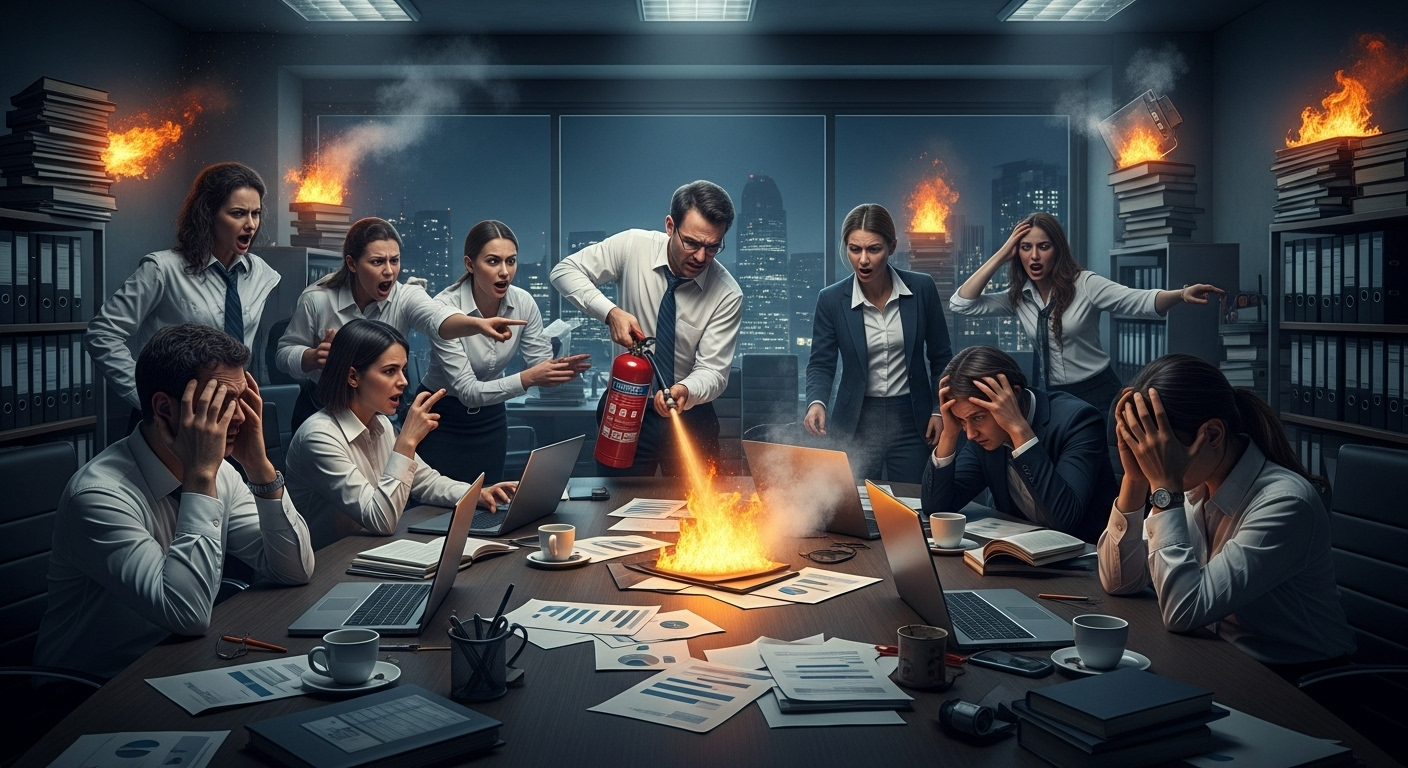
How I know companies won't succeed: Treating symptoms instead of analyzing the root causes – Management by Firefighting – Image: Xpert.Digital
The solution trap: When decision-makers solve the wrong problems and systematically weaken their companies as a result
China's economic crisis is merely a reflection: This phenomenon also threatens our industry
A dangerous complacency prevails in the boardrooms of Western corporations. While executives are preoccupied with quarterly reports and short-term optimizations, a fundamental shift is taking place in the global economy, one that has the potential to destabilize entire industries. This shift has a name that most decision-makers don't know and even fewer understand: Neijuan.
The Chinese term, which can be roughly translated as "rolling inwards," describes a phenomenon that extends far beyond China's borders. It is a form of self-destructive competition in which increased effort and investment lead to diminishing returns. Companies invest more capital, more labor hours, more resources, yet still achieve stagnant or declining returns. This economic involution is not simply intense competition, but a systemic failure in which the usual market mechanisms no longer function.
The relevance of this concept to the current global economic crisis can hardly be overstated. Since 2020, Neijuan has become the central buzzword of Chinese economic policy, and the leadership in Beijing declared war on the phenomenon at the Politburo meeting in July 2025. What initially appears to be an internal Chinese problem, upon closer examination, reveals itself as a warning sign for global economic structures. For example, the Chinese solar industry recorded net profit margins of only 4.3 percent in 2024, while the four largest module manufacturers reported combined net losses of the equivalent of US$1.54 billion in the first half of 2025.
These figures are not statistical outliers, but symptoms of a deeper crisis. In China, around 30 percent of all industrial companies are now operating at a loss, compared to seven percent in 2019. These so-called zombie companies continue to produce even though they are no longer economically viable, thereby exacerbating overcapacity. In the automotive sector, capacity utilization in 2023 was less than half of the available production capacity of 55 million vehicles.
Related to this:

Anatomy of Failure: Symptom Control as a Business Model
The real problem, however, lies not in China's overcapacity itself, but in how companies worldwide respond to structural challenges. The inability to distinguish between symptoms and causes has developed into a chronic management failure that systematically weakens organizations.
When a company faces declining margins, the typical reaction is cost-cutting. When market share shrinks, the marketing budget is increased. When productivity falls, new efficiency programs are launched. All these measures treat symptoms without addressing the underlying structural problems. It's like a doctor prescribing painkillers to a patient with a brain tumor for the headache.
This symptom management has developed a dynamic of its own. Organizations have created entire departments whose sole purpose is to react to acute problems. Management has become accustomed to a permanent crisis mode, which is considered normal. In the literature, this phenomenon is described as "management by firefighting," a leadership practice focused exclusively on extinguishing acute fires without ever asking why fires occur so frequently in the first place.
The costs of this reactive management culture are immense, yet they are rarely reflected in financial statements. Studies show that companies operating solely reactively experience 30 to 40 percent shorter lifecycles for their equipment because preventive maintenance is neglected in favor of emergency repairs. Energy costs increase by 15 to 20 percent because poorly maintained machinery operates inefficiently. Product quality declines, leading to customer complaints, recalls, and reputational damage.
But the greatest damage is intangible: the systematic erosion of organizational learning capacity. When companies only react to crises, they lose the ability to think ahead and act preventively. The best employees spend their time putting out fires instead of developing innovative solutions. Institutional knowledge about the true causes of problems is lost because no one has the time to conduct thorough analyses.
Solution fixation as a structural failure
Closely related to symptom management is a second phenomenon known in management research as the Solution Fixation Trap. This refers to the tendency of decision-makers to immediately seek solutions without truly understanding the problem. This fixation on quick answers is deeply ingrained in modern corporate culture and is reinforced by various structural factors.
The quarterly reporting requirement of listed companies is one of the main drivers of this fixation on solutions. When executives have to deliver results every three months, little room remains for in-depth analysis or long-term strategies. Research shows that the pressure to deliver short-term results has increased significantly since the 2008 financial crisis. In surveys, 57 percent of executives state that economic uncertainty is the main reason for increased short-term pressure to succeed, followed by higher profit expectations from the board of directors at 46 percent.
This short-term orientation has far-reaching consequences. Companies reduce investments in research and development, postpone projects that could be profitable in the long term, and forgo measures to develop their human resources. In a multi-year study of US companies, McKinsey demonstrated that firms with a long-term focus achieved cumulatively 47 percent higher revenue growth rates, created more jobs, and delivered better overall returns for shareholders between 2001 and 2014 than their short-term-oriented counterparts.
But the problem runs deeper than just quarterly pressure. Solution fixation is also a cognitive phenomenon. Experimental studies have shown that teams presented with potential solutions spend only half as much time understanding the problem as teams without pre-defined solutions. They also generate significantly fewer alternative approaches. This is due to two psychological mechanisms: confirmation bias, where people seek information that confirms their preconceived notions, and anchoring, where the first solution presented serves as the reference point for all subsequent considerations.
This pattern emerges repeatedly in consulting practice. Clients arrive with a clear idea of what the solution should be and expect consultants to simply confirm their assumptions or implement their ideas. Any attempt to analyze the problem more deeply or question the underlying assumptions is perceived as a waste of time. The question is not "What is the actual problem?" but "How do we solve it quickly?".
The Firefighting Syndrome: Reactive Leadership and Its Costs
Management by firefighting is more than just an inefficient working method; it is a systemic organizational failure with cascading effects. When leaders operate permanently in crisis mode, a culture develops in which reactive behavior is rewarded and preventative thinking is punished.
The paradoxical dynamic lies in the fact that those who extinguish fires are celebrated as heroes, while those who prevent fires from starting in the first place remain invisible. A manager who overcomes a production crisis and thereby saves a crucial shipment receives recognition and possibly a promotion. A manager who, through proactive planning and preventative measures, ensures that no crisis arises, goes unnoticed because success is measured by the absence of problems.
This incentive structure leads to a dangerous self-reinforcing cycle. Talented employees quickly learn that career advancement is achieved not through problem avoidance, but through spectacular problem-solving. They even have an incentive not to optimize systems because functioning systems offer no opportunity for heroic intervention. In extreme cases, so-called hero cultures emerge, in which employees consciously or unconsciously create or escalate crises in order to then appear as saviors.
The costs of this culture are considerable. First, the permanent crisis mode leads to exhaustion and burnout among employees. Those who constantly work under high pressure without time for recovery or strategic thinking suffer a long-term decline in performance. Second, resource allocation becomes highly inefficient. Emergency measures are almost always more expensive than planned interventions. Expedited shipping, overtime pay, emergency repairs, and production losses incur costs many times greater than those of preventative measures.
Thirdly, the capacity for innovation suffers. When an organization's best minds are busy solving immediate problems, the capacity for innovation and strategic development is lacking. Companies in firefighting mode can only react to change, not actively shape it. This makes them particularly vulnerable during times of structural change, such as the one we are currently experiencing.
Understanding Neijuan: The Chinese Mirror of Global Dynamics
To understand the significance of Neijuan for Western companies, one must first understand the mechanisms that triggered this phenomenon in China. As part of its Dual Circulation strategy, the Chinese government has invested heavily in new economic sectors such as electric vehicles, battery technology, high-quality manufacturing, and e-commerce. The idea was to make China less dependent on foreign markets while simultaneously becoming a global leader in promising industries.
This strategy, however, had unintended consequences. As various provinces launched their own programs and low barriers to entry facilitated rapid market access, production capacities exploded. Every successful initiative was immediately copied by other regions, leading to a race to the bottom. Market mechanisms failed because companies were not guided by actual demand but by the activities of their competitors.
The result is destructive competition, with companies systematically selling below cost. In the electric vehicle sector, capacity utilization in the first quarter of 2025 was significantly lower than the already low levels of 2023. In the solar industry, leading manufacturers were operating at only 55 to 70 percent of their capacity after administrative interventions were intended to remove some of the excess capacity from the market. Despite this, polysilicon prices rose by 48 percent in September 2025, demonstrating how distorted the markets already were.
The psychological dimension of Neijuan is just as important as the economic one. The term was initially used by young Chinese people to describe the hyper-competitive, but ultimately fruitless, struggle for conventional markers of success. The infamous 996 work culture, where people work from 9 a.m. to 9 p.m., six days a week, is a prime example. People work harder not to get ahead, but simply to avoid falling behind. Progress becomes impossible because everyone is making the same effort.
This dynamic is by no means limited to China. Western companies are experiencing similar phenomena, albeit under different circumstances. The platform economy, for example, exhibits classic Neijuan patterns: food delivery services burn through billions in venture capital in price wars without any improvement in their fundamental services. Streaming services outbid each other with content investments, while user satisfaction stagnates. Software companies constantly add new features that nobody needs, simply to avoid falling behind in feature comparisons.
Fittingly,
The deficit spiral: From overcapacity to self-destruction
The overcapacities that characterize Neijuan are not simply a temporary imbalance between supply and demand. They are the result of systemic perverse incentives that lead to a self-reinforcing downward spiral. This spiral has several characteristic phases that can be observed in different industries and regions.
In the first phase, excessive investment occurs, often driven by government subsidies, low interest rates, or FOMO (fear of missing out) among investors. Everyone wants to be involved when a new growth market is being developed. Capacity grows faster than actual demand because every player assumes they will be among the winners, capturing market share.
FOMO "Fear of Missing Out", the fear of missing something.
Many people invest not based on rational analysis, but out of fear of missing out on a lucrative opportunity when others are already in.
In the second phase, it becomes clear that demand is falling short of expectations. Instead of reducing capacity, however, companies intensify their marketing efforts and begin lowering prices. The logic is: if we can increase our capacity utilization, we will become profitable through economies of scale. This logic is rational for each individual player, but collectively it leads to a worsening of the situation.
In the third phase, price wars begin. Companies sell below cost to maintain or gain market share. Margins erode across the industry. Weaker suppliers go bankrupt, but their capacity is often acquired by competitors or kept alive by government aid. Total capacity does not decrease significantly, while profitability dwindles for all involved.
The fourth phase is characterized by deflation and stagnation. Falling prices lead to falling profits, which depresses investment and wages. Weak demand is further weakened by sluggish income growth. Companies cannot service their debts, banks become more cautious about lending, and the entire economy enters a deflationary spiral.
China is currently experiencing precisely this spiral. Producer prices have fallen for 33 consecutive months. Consumer prices are virtually stagnant. Youth unemployment stands at 17.8 percent. Exporters are cutting jobs and reducing wages. The housing crisis is exacerbating the feeling of declining prosperity and leading to even more cautious consumer behavior.
To Western observers, this may appear to be a specifically Chinese problem, but the mechanisms are universal. Japan experienced a similar deflationary trap in the 1990s, from which it has not yet fully recovered. Europe struggled with deflationary tendencies for years after the 2008 financial crisis. And individual sectors in Western economies are also showing symptoms of Neijuan: retail, the automotive industry, aviation, and increasingly, parts of the technology sector.
Our global industry and economic expertise in business development, sales and marketing


Our global industry and economic expertise in business development, sales and marketing - Image: Xpert.Digital
Industry focus areas: B2B, digitalization (from AI to XR), mechanical engineering, logistics, renewable energies and industry
More information here:
A thematic hub offering insights and expertise:
- Knowledge platform covering global and regional economies, innovation and industry-specific trends
- A collection of analyses, insights, and background information from our key areas of focus
- A place for expertise and information on current developments in business and technology
- A hub for companies seeking information on markets, digitalization, and industry innovations
From corporate blindness to industry crisis: How Neijuan destabilizes global markets
Why companies refuse to recognize the signs
Perhaps the most disturbing finding from the analysis of Neijuan and Management by Firefighting is not that these phenomena exist, but that companies systematically ignore or misinterpret them. This organizational blindness has structural causes deeply rooted in the way modern companies operate.
A key problem is the fear of consequences. In many organizations, bearers of bad news are punished. If a manager admits that the current strategy isn't working or that a problem is structural and can't be solved with quick fixes, they risk their reputation, career prospects, or even their job. This blame-shifting culture leads to problems being concealed, downplayed, or euphemized.
Research on organizational learning shows that companies that stigmatize mistakes systematically learn less from their experiences. When mistakes cannot be openly discussed, valuable information is lost. When problem analysis is perceived as finger-pointing, such analyses are avoided. The result is an organization that repeats the same mistakes because it never had the opportunity to learn from them.
A second structural problem is the lack of accountability for long-term consequences. Managers are typically rewarded for short-term results. If a strategy shows positive results in the first two years but fails after five, those responsible are usually already in other positions or companies. The negative consequences of their decisions are borne by others.
This temporal decoupling of decision and consequence leads to systematic perverse incentives. Managers have an incentive to maximize short-term gains at the expense of long-term sustainability. For example, they might cut research and development budgets, postpone maintenance, or lower quality standards to improve quarterly results. The negative effects of these measures only become apparent years later, when others are responsible.
A third problem is the complexity of modern economic systems. The relationships between cause and effect are often non-linear or subject to time lags. A decision can have positive effects in one area and negative effects in another. This complexity overwhelms both individual decision-makers and organizational learning mechanisms.
Furthermore, companies are often organized in silos. Each department optimizes for its own key performance indicators (KPIs) without considering system-wide effects. The sales department maximizes revenue, production minimizes costs, and the R&D department focuses on innovation. These local optimizations can be suboptimal or even detrimental globally, but there is no central authority that sees and coordinates the bigger picture.
Related to this:

The individual solution: Why standard recipes fail
One of the most important insights from the analysis of Neijuan and the associated management problems is that there can be no one-size-fits-all solution. Every company operates in a unique context with specific frameworks, histories, cultures, and challenges. What works for one company can be disastrous for another.
This insight directly contradicts a fundamental assumption of the management consulting industry: that there are best practices that can be applied regardless of context. In fact, empirical studies show that the success rate of organizational transformations is alarmingly low. Depending on the study, the failure rate ranges between 70 and 88 percent. This means that the vast majority of large-scale change initiatives fail to achieve their objectives.
The reasons for this systematic failure are manifold, but a key factor is the application of standardized solutions to non-standardized problems. Consulting firms sell frameworks and methods that have been successful in other contexts. These are then applied to new situations more or less unchanged, without adequately considering the specific circumstances.
The problem is exacerbated by the pressure to deliver quick solutions. Clients don't want a two-year analysis phase; they want results. Consultants are under pressure to demonstrate added value quickly. The consequence is that problems are superficially diagnosed and pre-packaged solutions are implemented. These solutions may alleviate some symptoms, but the underlying structural causes remain untouched.
The alternative to standard solutions is complex and requires patience, which is rare in today's business world. It begins with a thorough diagnosis that not only identifies the obvious symptoms but also understands the underlying systemic connections. It requires a willingness to accept uncomfortable truths and question established beliefs. It demands a customized strategy developed from the organization's specific strengths, weaknesses, and opportunities.
This approach is not only more time-consuming but also riskier. Standard solutions have the advantage of having already worked elsewhere, which provides a certain degree of security. Customized solutions must first be developed and tested, which involves uncertainty. Many organizations shy away from this risk and prefer to rely on familiar approaches, even if the chances of success are slim.
Structural transformation versus tactical firefighting
The fundamental difference between successful and unsuccessful crisis management lies in the distinction between strategic and tactical action. Strategic leadership means thinking before acting, proactively creating and allocating resources, and positioning others for success. Tactical leadership means acting during the crisis, managing resources in the execution of plans. Crisis management requires both simultaneously.
Most organizations are structurally geared towards excelling tactically. They have processes for execution, systems for monitoring, and incentives for achieving goals. What's often lacking is the strategic capacity to think beyond immediate execution and ask fundamental questions: Are we doing the right things? Are we solving the right problems? Are we investing in the capabilities we'll need in five or ten years?
This strategic neglect has structural causes. Strategic thinking doesn't produce immediate, measurable results. A good strategic decision may only pay off years later. In a culture that rewards quarterly results, strategic thinking is systematically undervalued. Leaders who invest time in strategic planning do so at the expense of their short-term performance metrics.
The problem intensifies when organizations face crises. In crisis situations, the pressure to act immediately increases. Strategic thinking is perceived as a luxury that cannot be afforded. Instead, tactical firefighting dominates. This reaction is understandable, but often counterproductive. Strategic thinking is particularly important in crises because decisions are made under uncertainty and time pressure, and have far-reaching consequences.
The challenge lies in managing both levels simultaneously. Organizations need the ability to respond to acute problems without losing sight of the long-term perspective. They must be able to extinguish fires while simultaneously working to make the building fireproof. This requires a differentiated organizational structure in which different teams serve different time horizons.
Some progressive organizations have begun to institutionalize this separation. They create separate units for strategic innovation, shielded from the short-term performance demands of day-to-day operations. They implement rolling forecasts instead of rigid annual budgets to respond more flexibly to change. They define metrics that capture long-term capacity building, not just short-term results.
The price of ignorance: Long-term consequences of short-sighted decisions
The consequences of the described management errors are not abstract or theoretical. They manifest themselves in measurable economic damage affecting companies, industries, and entire economies. The price of failing to understand Neijuan, treating symptoms instead of causes, and remaining in firefighting mode is exceptionally high.
At the company level, this combination of dysfunctional practices leads to a gradual erosion of competitiveness. Companies that only react lose their ability to innovate. They become price takers in markets they once dominated. Their best talent migrate to more agile competitors. Their cost structures rise while their margins shrink. Eventually, they reach the point where they become zombie companies: still formally existing, but no longer economically viable.
At the industry level, these dynamics can escalate into systemic crises. When a critical mass of companies in an industry simultaneously fall into the Neijuan trap, a downward spiral ensues from which no one can escape. The entire industry becomes unprofitable, investments dry up, and innovation stagnates. New technologies or business models from other industries or regions displace the established players.
The automotive industry is a prime example. For decades, optimization focused on combustion engines, while the signs of electrification were ignored. When the transformation became inevitable, established manufacturers were poorly positioned. They are now struggling with overcapacity in outdated production facilities, high conversion costs, and new competitors who can operate without legacy burdens.
At the macroeconomic level, Neijuan dynamics can lead to prolonged periods of weak growth or even deflationary spirals. Japan after the bubble economy of the 1990s is the classic example. China currently appears to be following a similar path, with potentially serious repercussions for the global economy, given that China now accounts for over a third of global industrial output.
The global dimension should not be underestimated. In a closely interconnected global economy, China exports its overcapacity and its deflation. Chinese manufacturers sell their products on global markets at prices that local suppliers cannot match. This puts pressure on companies worldwide to cut costs, which in turn depresses wages and investment. A global price war ensues, in which everyone loses except consumers, who benefit in the short term from low prices.
But even for consumers, this gain is deceptive. Low prices resulting from destructive competition go hand in hand with stagnant or declining wages, insecure jobs, and reduced product quality. The short-term advantage of cheap goods is more than offset by long-term economic uncertainty.
The question is not whether, but when and how these dynamics can be corrected. The Chinese government has begun to take action against Neijuan, but the measures are half-hearted and contradictory. Capacity reductions are demanded, but at the same time, mass layoffs are avoided for reasons of social stability. Price wars are criticized, but direct price controls are inefficient and difficult to enforce.
Western governments are responding with protectionist measures: tariffs on Chinese electric vehicles, solar panels, and other products. While these measures may protect individual industries in the short term, they do not solve the underlying problem. They merely slow the global spread of the crisis while simultaneously reducing the efficiency of the world economy.
The real solution lies at the level of the companies themselves. They must learn to recognize Neijuan dynamics before they become irreversible. They must develop the discipline to distinguish structural problems from cyclical ones and respond accordingly. They must have the courage to accept short-term pain if it ensures long-term sustainability. And they must cultivate the organizational learning capacity that allows them to learn from mistakes instead of repeating them.
This requires more than new management methods or consulting frameworks. It requires a fundamental shift in corporate culture, incentive systems, and how success is defined and measured. It requires leaders willing to ask uncomfortable questions and accept even more uncomfortable answers. It requires organizations that prioritize structural thinking over tactical firefighting.
The companies that successfully complete this transformation will be the winners of the coming decades. Those that continue to treat symptoms, resort to standard solutions, and remain in firefighting mode will become the case studies of organizational failure in future management textbooks.
Your global marketing and business development partner
☑️ Our business language is English or German
☑️ NEW: Correspondence in your native language!

Konrad Wolfenstein
I and my team are happy to be available to you as your personal advisor.
You can contact me by filling out the contact form here wolfenstein@xpert.digital:or simply call me at +49 7348 4088 965. My email address is
I'm looking forward to our joint project.
☑️ SME support in strategy, consulting, planning and implementation
☑️ Creation or realignment of the digital strategy and digitization
☑️ Expansion and optimization of international sales processes
☑️ Global & Digital B2B trading platforms
☑️ Pioneer Business Development / Marketing / PR / Trade Fairs
🎯🎯🎯 Benefit from Xpert.Digital's extensive, five-fold expertise in one comprehensive service package | BD, R&D, XR, PR & Digital Visibility Optimization

Benefit from Xpert.Digital's extensive, five-fold expertise in a comprehensive service package | R&D, XR, PR & Digital Visibility Optimization - Image: Xpert.Digital
Xpert.Digital possesses in-depth knowledge across various industries. This allows us to develop tailored strategies precisely aligned with the requirements and challenges of your specific market segment. By continuously analyzing market trends and monitoring industry developments, we can act proactively and offer innovative solutions. The combination of experience and expertise generates added value and provides our clients with a decisive competitive advantage.
More information here: