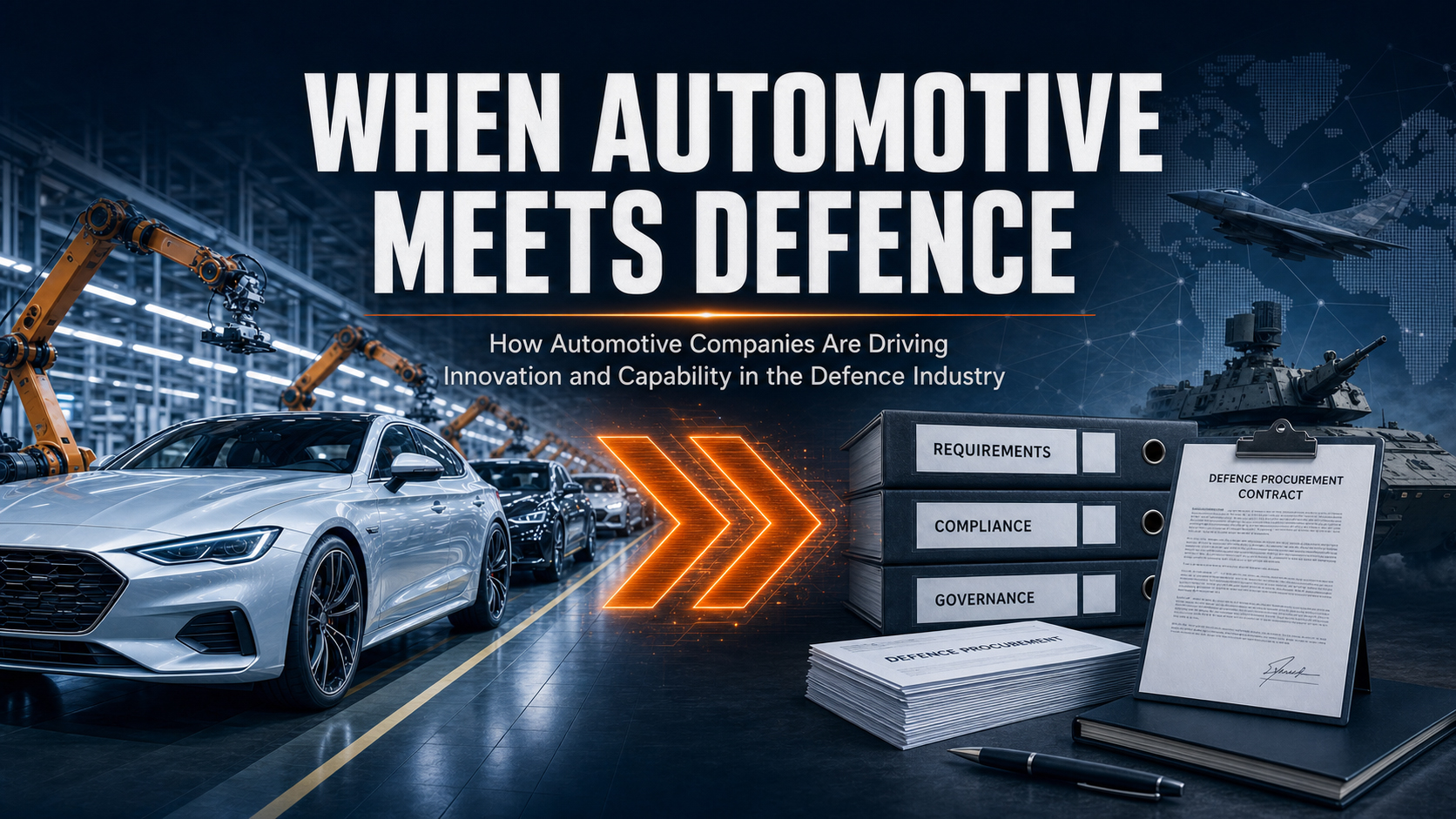
Suppliers in the defense market – Image: Xpert.Digital
When Automotive meets Defence: Why camouflage alone is not enough
Automotive suppliers gripped by arms fever: Expensive illusion instead of new business – The biggest pitfalls of the arms industry
Arms boom as a lifeline? The dangerous mistake of car manufacturers
The German automotive industry is in the midst of an unprecedented structural crisis. Faced with declining production figures, painful transformations towards electromobility, and crumbling supply chains, many suppliers are desperately searching for new markets. Their gaze almost inevitably falls on the booming defense sector: record budgets and rapid technological change promise lucrative contracts and seemingly limitless growth. However, the hope of simply transferring spare capacity and technical know-how from the automotive world to military projects often proves to be a dangerous misconception. The transition from the standardized, scale-driven automotive business to the highly regulated, security-sensitive world of defense is a monumental cultural and structural undertaking. Those who want to survive here must recognize that technological excellence alone is not enough to thrive in an industry characterized by the strictest compliance, decades-long cycles, and a completely different culture of learning from mistakes.
When Automotive meets Defence: The illusion of easy market switching
The crisis in the German automotive industry has triggered a reflex that is as understandable as it is dangerous: More and more companies are looking to the booming defense sector and wondering if it could be the new growth area. The budget figures are almost tempting. Germany's defense spending will rise to over €108 billion in 2026 – double the figure for 2024 – and is projected to increase to around €152 billion by 2029. Almost €48 billion is earmarked for military procurement alone in the 2026 budget. These figures seem like an open invitation. What many forget is that an open door is not the same as an accessible room.
This article analyzes the three central thought patterns that regularly cause automotive companies to fail at the threshold of the defense market – not due to a lack of technology, but due to a structural lack of understanding of the rules of a market that has less in common with the automotive world than it might initially appear.
Structural starting point: Two worlds, one hope
When an industry in crisis seeks a savior
The structural crisis facing German automotive suppliers is not new, but it has worsened dramatically in recent years. Since 2017, passenger car production in Germany has almost halved. The shift to electromobility is disrupting established supply chains, overcapacities are straining balance sheets, and job cuts are often the only short-term solution to declining volumes. In this complex situation, the defense sector is emerging as a potential lifeline. Industry expert Werner Olle, who analyzed 150 defense suppliers on behalf of the Automotive Association of Thuringia, put it cautiously but clearly: While defense is not the sole lifeline for the automotive sector, companies need to diversify – and defense could be one component of that.
This assessment is nuanced and is often misinterpreted. What follows is rarely a strategically sound diversification, but often a hopeful glance at available production space, supposedly similar manufacturing processes, and the desire tosegen one's own business with government funding. In fact, the analysis shows that more than 40 of the 150 defense suppliers examined belong to the automotive industry – ranging from metalworking to the plastics and glass industries, and even IT and engineering services. This demonstrates that there are overlaps. However, it does not yet prove that the transition is easy.
Why the initial situation is deceptive
The technological overlaps are real. Drive components, electronics, sensors, software for vehicle systems, precision mechanics – all of these have points of contact with military requirements. Automotive companies also bring strengths that objectively qualify them: experience with complex development and industrialization projects, high quality and documentation standards, and well-established structures for dealing with OEM customers and supply chain partners. Volkswagen, for example, is reportedly in talks with defense companies about the future of its plant in Osnabrück. KNDS, the tank manufacturer, took over the former railway carriage plant in Görlitz and plans to retain the existing employees.
These examples illustrate the difference between the targeted engagement of established defense companies, which acquire industrial capacities and integrate them into their existing structures, and an automotive company's attempt to enter the market independently. Those who produce under the auspices of a defense prime manufacturer operate within the familiar framework of a supplier. Those who want to become a supplier in the defense market themselves are entering a completely different arena.
The first misconception: Scaling as a universal competitive advantage
What the automotive industry understands by strength
The automotive industry is one of the most standardized and economies of scale in the world. Its success is based on the principle of repeating identical processes in ever-increasing volumes, with ever-lower defect rates and ever-shorter cycle times. ppm rates (defects per million parts) and on-time delivery are the key performance indicators. The logic is clear: whoever produces more cheaply, faster, and more reliably in mass production than the competition wins. This logic has worked for decades. However, it systematically fails in the defense market.
In the defense industry, ten parts can constitute an entire series. Every product, every unit, every prototype may require fine-tuning. Those who boast five-figure repetition rates might fail here. The crucial difference lies not in quality, but in the type of performance required: In the defense market, capacity and cadence are not the primary concerns, but rather traceability, integration capability, compliance, and the resilience of government contracts over very long periods. A defense system must not only function—it must function in a fully documented, traceable, and classified manner, and this must continue throughout a lifecycle that often spans several decades.
Traceability beats volume
The German Armed Forces, as a public contracting authority, are bound by comprehensive procurement regulations. This means that procurement processes follow a formal regime governed by the Act against Restraints of Competition (GWB), the Procurement Ordinance for the Defense and Security Sectors (VSVgV), and the Federal Armed Forces Procurement Acceleration Act. A threshold of €432,000 net already applies to supplies and services, above which a European tendering obligation exists. This is not the world of framework agreements with OEM buyers, but rather a world of formal procedures with preclusive objection periods, transparent award criteria, and complete documentation requirements.
Furthermore, the handling of classified information plays a crucial role: Information from defense programs can be classified in grades ranging from "VS – For Official Use Only" to "Top Secret." The requirements for the handling, storage, and dissemination of this information are regulated in detail in the Classified Information Directive (VSA). An automotive company that fails to consider this aspect can run into regulatory hurdles as early as the initial stages – long before production volumes and cycle times become relevant.
Quality standards beyond ISO 9001
Certification requirements in the defense sector go beyond what automotive companies typically require. While the German defense industry primarily relies on civilian standards (DIN, EN, ISO), it supplements these with military requirements, which result in independent defense technology standards when civilian standards cannot meet military needs. ISO 9001 is a necessary condition, but not sufficient. In addition, there are requirements according to ISO 14001 for environmental management, as well as extensive safety requirements that take into account the particular stresses military equipment endures in combat. Therefore, a supplier that is currently successfully certified according to IATF 16949 – the quality management system of the automotive industry – does not yet have a secure starting point for defense tenders.
The second misconception: Technological quality as a market entry criterion
The myth of self-selling technology
The second, particularly persistent misconception is that if the technology is good, it will prevail in the market. This idea stems from a basic market-economy logic that does not apply in its purest form to the defense sector. The defense market is structurally not a free market, but rather a highly regulated, politically influenced, and institutionally closed space. Government clients, specific requirement profiles, long decision-making cycles, and complex procurement processes make technological quality a necessary, but by no means sufficient, condition for market success.
Defense procurement programs often run for 15 to 30 years. During this time, requirements, political frameworks, budgets, and partnerships change fundamentally. A company wishing to participate in such a program must not only offer the best solution today—it must credibly demonstrate its ability to deliver, comply with regulations, and maintain organizational resilience over decades. Planning, requirements notification, capability development, testing, and series procurement—each phase of this process has its own institutional logic, its own stakeholders, and its own timelines.
Access via network, not via catalog
Market entry into the defense sector rarely occurs through tenders, but rather through integration into existing structures. The value chain hierarchy is clearly organized: from systems integrators to Tier 1 suppliers and specialized component providers, roles and relationships are established over the long term. Defense companies are not looking for generic capabilities, but rather differentiated capabilities with a clear military or dual-use focus – and they are looking for partners they know and trust.
In practice, this means that an automotive company aiming to enter the defense market must first invest in networks – in relationships with prime suppliers, government agencies, industry associations, and other Tier 1 players. It must translate its own capabilities into the language of the defense market: not as a technical specification sheet, but as a concrete answer to militarily defined needs. Companies that translate their strengths into concrete use cases and develop a robust product or system logic from them have a chance. Those who merely point to technological quality will be left behind.
Procurement requires patience as a basic requirement
The timescale involved in defense procurement is of paramount importance for automotive companies. While new models in the automotive industry mature from concept development to series production in three to five years, the planning and implementation of an armaments program can take a decade or more. The German Armed Forces Procurement Act (BwBBG) aims to accelerate planning, procurement, and implementation processes and is designed for a long-term perspective extending to 2035 – but even this acceleration operates within institutional timeframes that are alien to the automotive world. Furthermore, the German Armed Forces often only pay after delivery – frequently months, if not years, later. Companies accustomed to short-term working capital cycles must integrate this financing logic into their planning.
The third misconception: developing defense as a side business
The expensive illusion of the side strategy
The third, and perhaps most consequential, misconception is that the defense market can be entered "on the side"—as a supplement to the core business, without fundamental organizational changes, using existing resources and spare capacity. This idea systematically underestimates the effort required for a serious market entry.
Companies seeking a lasting foothold in the defense market need five structural prerequisites: governance, export controls, strategic partnerships, institutional patience, and a clearly defined go-to-market strategy. None of these prerequisites can be met overnight. Each requires dedicated investment in structures, processes, personnel, and knowledge – and all five must be developed concurrently.
Export control: The underestimated compliance mountain
The export control regime for defense goods is one of the most demanding areas of foreign trade law. It requires both in-depth legal and technical expertise. Key regulations include EU Regulation 2021/821 on dual-use goods, as well as the German Foreign Trade and Payments Act (AWG) and the German Foreign Trade and Payments Ordinance (AWV) with their export lists; for weapons of war, the German War Weapons Control Act (KrWaffKontrG) also applies. Of particular relevance is US export law – ITAR (International Traffic in Arms Regulations) and EAR (Export Administration Regulations) – which, due to its extraterritorial applicability, can also affect German companies as soon as US components, US technology, or payments via US banks are involved.
For automotive companies, this legal framework is particularly insidious because technologies that are completely inconspicuous in a civilian context suddenly become subject to approval in a defense context. High-performance semiconductors and microcontrollers for electric drives and control units, radar sensors, lasers for environmental and distance sensing, as well as key components for unmanned systems, typically fall into the relevant categories of the Dual-Use Regulation. This means that even the development, manufacture, or supply of individual components—not just the final product—can be subject to complex legal requirements. Those who treat this aspect as an operational detail rather than a core strategic requirement risk massive liability and the loss of their supply authorization.
In 2025 alone, the EU has already launched several sanctions packages against Russia and Belarus. The regulatory landscape is highly dynamic, and compliance must be understood as an ongoing task, not a one-off certification. Companies are well advised to establish a central export compliance function with a designated export manager and to systematically integrate engineering, sales, and logistics into export control processes.
Hub for Security and Defense - Advice and Information


Hub for Security and Defense - Image: Xpert.Digital
The Security and Defence Hub offers expert advice and up-to-date information to effectively support companies and organizations in strengthening their role in European security and defence policy. Working closely with the SME Connect Defence Working Group, it particularly promotes small and medium-sized enterprises (SMEs) that wish to further develop their innovative capacity and competitiveness in the defence sector. As a central point of contact, the Hub thus creates a crucial bridge between SMEs and European defence strategy.
Related to this:
Step by step into the defense industry: partnerships, niche strategies and M&A
Governance: More than an organizational chart
The defense industry understands governance differently than automotive companies. It encompasses not only decision-making structures and reporting lines, but also the complete documentation of responsibilities, approval processes, and the traceability of decisions throughout a system's entire lifecycle. System availability, operational readiness, and response times are legally binding contractual obligations for many years – not merely internal control metrics. Failure to meet these obligations can trigger warranty claims, lead to contractual penalties, and even give rise to termination rights.
Contracts with government clients and defense primes follow a different logic than traditional OEM supply contracts. Liability limitations encounter clear limits in the defense sector: liability caps and the exclusion of certain types of damage are often only effective in cases of simple negligence and only within narrow legal boundaries. Contracts frequently contain more extensive liability and indemnification clauses for specific third-party damages, IP infringements, or security-related incidents. Those who are unaware of these differences and fail to structurally reflect them assume risks they cannot price in – and often only realize this when it is too late.
System-of-Systems: Complexity as a business model
The term "system-of-systems" describes one of the fundamental characteristics of the defense market: Military systems are not isolated products, but rather components of highly complex, networked overall architectures in which sensors, platforms, software, communication, and control systems must interact. At its core, system-of-systems engineering is the management of interfaces, dependencies, and interoperability requirements across domain boundaries.
For automotive companies accustomed to the logic of clearly defined components or subsystems, this represents a fundamental shift in perspective. In the defense market, the ability to integrate one's own solution into a higher-level system architecture and accommodate changing requirements over decades is a key qualification. Companies operating in the fields of sensor technology, automation, or cybersecurity inherently possess relevant expertise – but this must be explicitly translated into concrete military applications. The step from "we have relevant technology" to "we are compatible with the client's existing system architecture" is larger than it initially appears.
Contracts, responsibility and risk management: The underestimated core issue
If 30 years isn't a problem – as long as you're prepared
Defense programs often run for 15 to 30 years. During this time, costs, supply chains, political frameworks, and technical requirements change in ways that cannot be fully anticipated at the time of contract signing. Without clearly defined change processes—including formal requirements, cost-recovery mechanisms, and deadline implications—unnecessary additional work and protracted negotiations are likely.
In this logic, price adjustment and hardship clauses become strategic instruments, not mere legal formalities. They determine whether a company must bear cost shifts due to inflation or crises, or whether it can activate adjustment mechanisms. Force majeure clauses, in the defense context, must be deliberately formulated for scenarios such as sanctions, export bans, and security-related closures—events that are rarely explicitly addressed in automotive contracts but are part of the typical risk profile in the defense business.
Particularly challenging are so-called offset bonds: Many procurement programs stipulate that the prime contractor must make certain investment, localization, or cooperation commitments to the procuring country. For automotive companies involved in defense programs, this can mean participating in offset programs—through local procurement, technology transfer, or joint ventures in the procuring country. In the Canadian defense market, for example, the principle of Industrial and Technological Benefits (ITB) applies: Suppliers must reinvest the entire contract value in Canada. Without credible commitments to local value creation, even the most advanced technology has no chance. Such requirements are structural elements of a successful defense market strategy—not a mere footnote in the contract.
Economic dimensions: Growth market with structural barriers to entry
The numbers that seduce
The financial scale of the German defense market is impressive. According to medium-term financial planning, Germany's total defense spending is projected to rise from €95 billion in 2025 to €162 billion in 2029. A constitutional amendment exempts defense spending from the debt brake restrictions – in combination with a credit-financed program of almost €400 billion. At the NATO level, a total budget for European member states of over €1 trillion is projected by 2035.
This objectively presents an attractive growth market for technology-oriented industrial companies. The increasing demand for ammunition, vehicle systems, electronics, communications technology, and logistics infrastructure creates real needs that the existing defense industry alone cannot fully meet. The new Federal Armed Forces Procurement Acceleration Act explicitly permits tenders without prior financing, contracts awarded without competition in cases of urgent need, and advance payments for innovative companies. This partially lowers the formal barriers to market entry.
The structural barriers remain
At the same time, the defense sector remains a structurally closed ecosystem. Existing supply chains are long-established. Certifications, networks, and relationships of trust are built up over years – they cannot be accelerated simply because budgets increase. Market entry rarely occurs through tenders, but rather through integration into existing structures: partnerships with prime or Tier 1 suppliers, niche focus in high-growth domains such as space, cyber, or autonomous systems, or the acquisition of existing capabilities and certifications through mergers and acquisitions.
Companies from the automotive, mechanical engineering, electronics, or IT sectors possess relevant expertise, but the crucial question is its translatability into concrete military or dual-use applications. Those who don't explicitly take this step—those who instead hope that the similarity of the technologies justifies their market legitimacy—will find that, in case of doubt, defense companies prefer to rely on established partners rather than technologically interesting but systemically unadapted newcomers.
The cultural divide: What cannot simply be rearranged
Two incompatible logics
Behind the three misconceptions outlined lies a deeper contradiction: the fundamental incompatibility of two corporate logics. The automotive industry is geared towards efficiency, scalability, and short-term production. The defense market is geared towards traceability, long-term perspectives, and institutional integration. These logics can coexist under one roof – but only if the company is prepared to develop a distinct organizational identity for its defense division, one that is not managed from within the automotive logic.
Executives transitioning from the automotive to the defense industry report a mental culture shock that is often underestimated. This shift affects not only processes and structures, but also mindsets: How is risk defined? How is quality measured? What does a customer mean when they are not a market player but a government contracting authority? Who determines what constitutes success – the company or the political procurement agency? These questions have different answers in the automotive world than in the defense market, and those who fail to ask them will eventually receive painful answers.
Arrogance as an entry trap
There is a specific form of failure that is particularly prevalent in the defense market: failure due to one's own strengths. Automotive companies are accustomed to being among the best in their home market. Their processes are efficient, their quality systems sophisticated, their delivery capabilities proven. These strengths are real – but they do not automatically guarantee market acceptance in a sector that applies different qualification criteria.
The real breaking point lies not in the technology, but in the contract and the institutional framework. Companies that underestimate this difference invest resources in products and solutions that are technically impressive, but are placed at the wrong end of the procurement process. They lose tenders not because of poor technology, but because of missing certifications, incomplete documentation, unmet compliance requirements, or insufficient networking with the right institutional players. Naiveté regarding the rules of the defense market is therefore not just an operational risk – it is a strategic misinvestment.
Realistic market entry: What really works
Gradual integration as a promising path forward
Insights from successful transitions from automotive to defense suggest that a phased approach is superior to direct entry. Supplying parts or components to defense companies or partnering with companies already active in this sector is particularly promising. Those who begin under the umbrella of an established defense player learn the market logic from the inside – and simultaneously build the networks, certifications, and compliance structures necessary for independent market participation.
Three patterns have proven particularly viable in practice: First, partnerships with prime and Tier 1 suppliers that structure access and distribute risk. Second, a niche focus in high-growth domains such as cybersecurity, space, autonomous systems, or software-defined defense, where technological innovation can be translated more directly into market positions. Third, mergers and acquisitions (M&A) – while acquiring existing companies with certifications, customer access, and defense experience is capital-intensive, it is structurally the safest way to shorten the lengthy development times.
Early strategic support as an investment
Given the complex regulatory and certification requirements, as well as significant market entry barriers, the early strategic involvement of specialized consultants with in-depth industry knowledge is highly recommended. This applies particularly to the areas of procurement law, export controls, contract drafting, and strategic positioning. Those who view this support as an avoidable expense are mistaken: the opportunity costs of a failed defense market entry regularly exceed the consulting fees many times over.
Developing a comprehensive market entry plan – including portfolio and target market analysis, partner and supply chain screening, risk mapping for export controls and sanctions, and milestone planning up to the first delivery – is not a bureaucratic exercise, but the central strategic achievement that determines success or failure. In the defense market, it is ultimately not ambition that decides success, but the ability to integrate with existing structures.
Growth area or expensive illusion: The answer lies in preparation
The defense market is neither an automatic growth area nor an inevitable illusion for automotive companies. It is what their strategic preparation makes of it. The budgetary resources are real, the demand is real, and the technological overlaps are real. But none of these three elements is sufficient on its own – and none replaces the institutional, legal, and cultural transformation required for serious market entry.
Companies entering the defense sector expecting their existing strengths to automatically translate into market share are regularly disappointed. However, companies that view the gap between the two worlds not as an obstacle but as a learning opportunity, and are prepared to make the necessary investments—in compliance, networks, governance, and patience—can develop this transformation into a serious pillar of their business. The difference between the two groups is not the quality of their technology; it is the quality of their self-assessment.
The real question for the German automotive supplier industry is therefore not: "Can I enter the defense market?" The question is: "Am I prepared to become a different company to do so?" Those who answer this question honestly – and take the answer seriously – have a realistic chance. Those who avoid it are financing an expensive illusion.
Consulting - Planning - Implementation

Markus Becker
I would be happy to serve as your personal advisor.
Head of Business Development
Chairman SME Connect Defense Working Group
Consulting - Planning - Implementation
Konrad Wolfenstein
I would be happy to serve as your personal advisor.
You can contact me at wolfenstein∂xpert.digital or
Just call me on +49 7348 4088 965 .