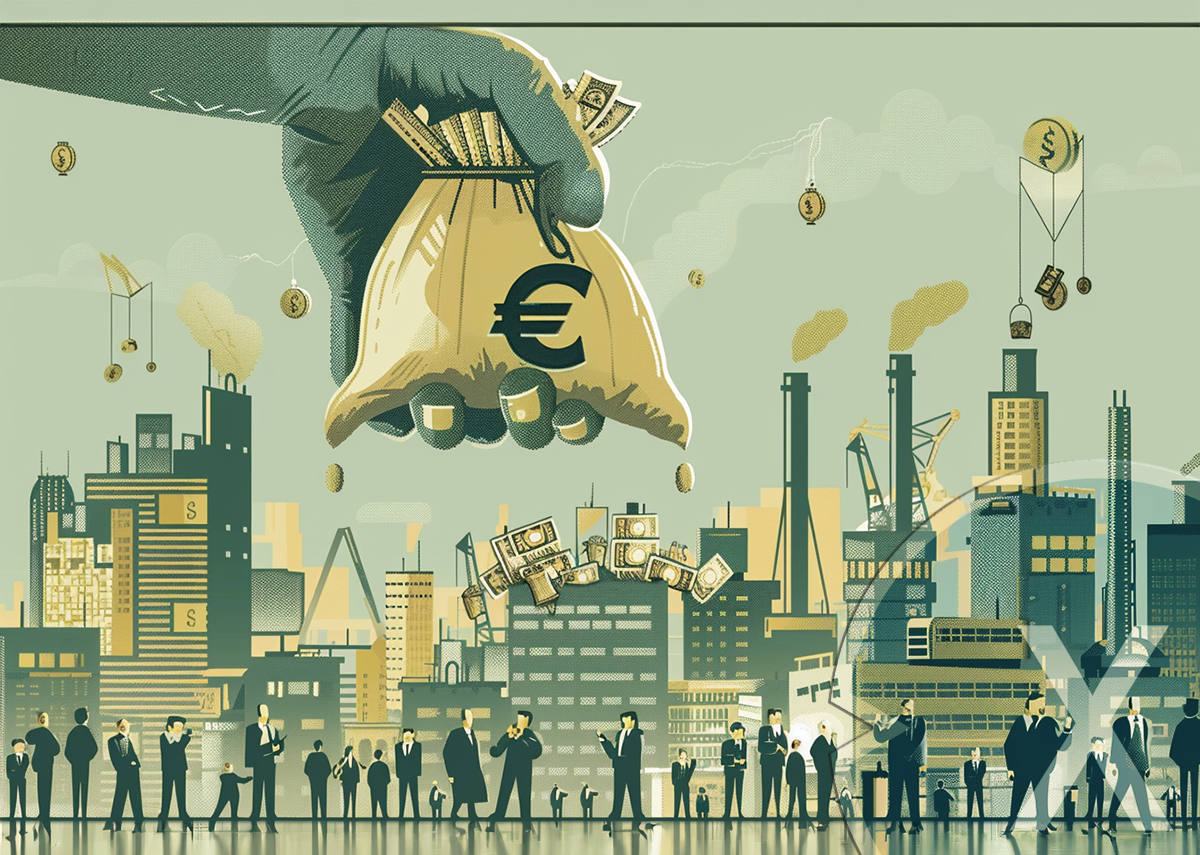
Promoting businesses without distorting competition? The subsidization of large German corporations: A critical examination – Image: Xpert.Digital
🌟 Subsidies: Promoting innovation and transformation without distorting competition?
🌟 In recent years, a remarkable development has taken place in Germany: State support for the country's largest listed companies has increased dramatically. This development raises important questions about economic policy, the role of the state in the market economy, and distributive justice.
📊 The figures at a glance
The latest analysis from the renowned Flossbach von Storch Research Institute reveals a striking increase in subsidies for DAX-listed companies. In 2023, these subsidies reached a record high of at least €10.7 billion. This represents almost double the previous year, when subsidies already amounted to €6 billion. Even more remarkable is the long-term trend: in 2018, the annual subsidy total was only around €2 billion. Overall, between 2016 and 2023, approximately €35 billion in public funds flowed into the coffers of the 40 DAX companies.
📈 Reasons for the increase
The drastic increase in subsidies can be attributed to various factors:
1. Economic challenges
The COVID-19 pandemic and its consequences have posed existential challenges for many companies. The government was forced to launch extensive aid programs to safeguard jobs and prevent bankruptcies.
2. Energy transition and climate protection
The transformation towards a sustainable economy requires massive investments. Many subsidies aim to support companies in this transition and create incentives for climate-friendly technologies.
3. International competitiveness
In a globalized market, German companies face intense international competition. Subsidies can serve to maintain or improve their competitiveness.
4. Structural change
Certain industries, such as the automotive industry, are undergoing profound change. Subsidies are intended to help make this process socially responsible and to promote innovation.
🏢 The largest receivers
Among the DAX-listed companies, there are several that particularly benefit from government subsidies. The largest recipients include:
1. Energy companies
Corporations like E.ON and RWE receive extensive subsidies as part of the energy transition. These subsidies are used, among other things, to expand renewable energies and to compensate for the phase-out of coal.
2. Automobile manufacturers
Companies like Volkswagen, BMW and Mercedes-Benz benefit from subsidies for the development and production of electric vehicles as well as for the construction of the necessary infrastructure.
3. Technology companies
Companies like Siemens or Infineon receive support for research and development in future technologies such as artificial intelligence or quantum computing.
4. Chemical and pharmaceutical companies
Corporations like Bayer or BASF receive funding for the development of new drugs or environmentally friendly production processes.
🛠️ Forms of subsidization
Government support for DAX-listed companies takes many forms:
1. Direct grants
These are non-repayable grants awarded for specific projects or investments.
2. Tax breaks
Companies can reduce their tax burden through special depreciation rules or tax breaks.
3. Low-interest loans
The state or state-owned banks like KfW grant loans at particularly favorable conditions.
4. Guarantees
The state provides guarantees for loans that companies take out from private banks.
5. Research funding
Public funds are invested in joint research projects between companies and scientific institutions.
6. Infrastructure measures
The state invests in infrastructure that benefits certain companies or industries, such as the expansion of charging stations for electric vehicles.
💬 Controversial discussion
The massive subsidization of large corporations is not without controversy. Proponents argue that this support is necessary to:
- To secure and create jobs
- Maintaining the international competitiveness of German companies
- Strengthening Germany as a business location
- To accelerate the transformation towards a sustainable economy
- To promote innovation and enable technological progress
Critics, however, see the subsidies as a distortion of competition and an unjustified advantage for large corporations. They argue that:
- Small and medium-sized enterprises are disadvantaged
- Inefficient structures are artificially kept alive
- Taxpayers subsidizing the profits of private companies
- Market mechanisms are overridden
- There is a risk of perverse incentives and windfall gains
🌍 International Perspective
The subsidization of large corporations is not a purely German phenomenon. A similar trend can be observed in many industrialized countries. Particularly in strategically important sectors such as the semiconductor industry and battery technology, a veritable subsidy race has developed. The European Union is attempting to curb this trend through strict state aid rules, but at the same time faces pressure to support European companies in global competition.
🔮 Future prospects
The question of how subsidy policy will develop in the coming years is the subject of intense debate. Some experts assume that the high subsidy amounts are a temporary phenomenon related to the particular challenges of recent years. Others see it as a long-term trend toward a closer integration of the state and the economy.
The crucial factor will be how policymakers strike a balance between necessary support and free-market principles. Possible approaches are as follows:
- A stronger focus on time-limited, earmarked funding
- Linking subsidies to clear targets and success criteria
- An expansion of funding to include small and medium-sized enterprises
- Creating more transparency in the awarding and use of subsidies
- A more intensive public debate about the meaning and purpose of government economic support
🚀 Fostering innovation and transformation without distorting competition
The massive increase in subsidies for DAX-listed companies in recent years poses fundamental questions for German economic policy. On the one hand, targeted government support measures can help achieve important economic and socio-political goals and strengthen Germany's position in international competition. On the other hand, excessive subsidies riskundermining free-market principles and creating perverse incentives.
Reducing subsidies while simultaneously deregulating and cutting red tape in both Germany and the EU would probably be the better way to increase the pressure for innovation and thereby boost overall economic productivity and achieve societal goals.
The challenge for policymakers is to find a balanced approach that fosters innovation and transformation without distorting fair competition. The issue of distributive justice must also be considered. An open and fact-based debate about the goals and limits of government economic support is essential to setting the right course for the future.
Related to this:
Ultimately, this is about nothing less than the question of what a modern, sustainable, and socially just market economy should look like in the 21st century. The answers to this question will significantly shape Germany's economic and social development in the coming decades.
📣 Similar topics
- 📊 Subsidies under scrutiny
- 💡 Focus on promotion and innovation
- 📈 Dramatic increase in subsidies
- 🏢 The biggest beneficiaries
- 🔍 Reasons for higher subsidies
- 💸 Diverse forms of support
- ⚖️ Controversies and discussions
- 🌍 International subsidy policy
- 🔮 Future prospects of subsidization
- ⚙️ Subsidies and structural change
#️⃣ Hashtags: #EconomicPolicy #Subsidies #Innovation #Sustainability #Competition
Our recommendation: 🌍 Limitless reach 🔗 Connected 🌐 Multilingual 💪 Sales power: 💡 Authentic with strategy 🚀 Innovation meets 🧠 Intuition

From local to global: SMEs conquer the world market with a clever strategy - Image: Xpert.Digital
In an era where a company's digital presence determines its success, the challenge lies in creating an authentic, personalized, and far-reaching presence. Xpert.Digital offers an innovative solution that positions itself as the intersection of an industry hub, a blog, and a brand ambassador. It combines the advantages of communication and sales channels in a single platform and enables publication in 18 different languages. Cooperation with partner portals and the ability to publish articles on Google News and a press distribution list with approximately 8,000 journalists and readers maximize the reach and visibility of the content. This represents a crucial factor in external sales and marketing (SMarketing).
More information here:
📊 Government subsidies for sustainable economic development
🌐 The role of subsidies in German economic policy
For many decades, Germany has used government subsidies to strengthen the economy, promote innovation, and support strategic industries. Large corporations, in particular, repeatedly benefit from this financial assistance. This raises the question, however, whether this practice actually leads to a healthier and more sustainable economy in the long run, or whether it distorts competition. At the same time, it is also questionable whether this support truly contributes to the desired innovations and transformations, or whether it creates dependencies that could be detrimental in the long term.
✅ The role of subsidies in German economic policy
Subsidies have traditionally played a central role in German economic policy. They are used as a means to protect and promote strategic economic sectors, such as the automotive industry, the energy sector, and mechanical engineering. These sectors form the backbone of the German economy and secure millions of jobs. Subsidies in the form of direct payments, tax breaks, or other financial incentives help these companies invest in research and development, modernize their production, and remain more resilient during economic crises.
Especially during times of economic upheaval, such as the current transformation towards a more climate-friendly economy, subsidies are a key tool for supporting companies in their adaptation. The automotive industry, which traditionally plays a central role in the German economy, receives, for example, substantial support for its transition to electromobility. This financial assistance is intended to promote the shift to more sustainable business models and secure Germany's position as a leading global industrial location in the future.
🚀 Subsidies as an engine of innovation?
One of the greatest hopes associated with subsidizing large companies lies in the promotion of innovation. Government funding is intended to encourage companies to invest in new technologies to remain internationally competitive. This is particularly true for industries facing intense international competition. The semiconductor industry, for example, is characterized by rising global demand for microchips and other digital technologies. Here, the government is specifically relying on subsidies to strengthen Germany's position as a location for high-tech production.
At the same time, however, the question arises as to what extent government aid actually delivers the desired boost to innovation. Critics argue that subsidies are often used inefficiently and that there is a risk that companies will use the funds to maintain existing structures rather than to promote genuine innovation. There are concerns that the constant availability of government funding reduces the incentive for companies to compete independently in the market and to develop new solutions in creative ways.
⚖️ Risk of distortion of competition
Another key argument against subsidizing large corporations is the risk of distorting competition. Small and medium-sized enterprises (SMEs), which make up a large part of the German economy, often feel disadvantaged. While large corporations have lobbying structures that facilitate their access to government aid, many SMEs do not have the same opportunities to benefit from such programs.
Furthermore, subsidies can often perpetuate inefficient structures instead of fostering competition. If a corporation repeatedly receives government aid to stay afloat, even though its business models are outdated or no longer viable, this can lead to an unhealthy distortion of the market. This creates "zombie companies" that survive only through subsidies, rather than competing in the market through innovation and efficiency.
One example of this is the aviation industry, which has repeatedly received government support in Germany to safeguard jobs and support strategically important companies. However, this raises the question of whether it wouldn't be more sensible to invest specifically in the development of more climate-friendly technologies instead of subsidizing outdated business models. Such questions are particularly crucial with regard to the sustainable transformation of the economy.
🌱 Transformation towards a climate-friendly economy
The transformation to a more climate-friendly economy presents Germany with enormous challenges. To achieve the German government's climate targets and drastically reduce CO2 emissions, immense investments in renewable energies, sustainable technologies, and green infrastructure are necessary. Government subsidies play a crucial role in this context, stimulating the required investments and supporting the economy in this transformation.
However, it is crucial that subsidies are used strategically to promote sustainable innovation. It is insufficient to support existing structures that may remain dependent on fossil fuels for many years to come. Instead, public funds should be invested in technologies that can contribute to solving the climate crisis in the long term. This includes, for example, promoting hydrogen technologies, expanding charging infrastructure for electric vehicles, and supporting research into energy-efficient production methods.
While numerous programs already exist that target precisely these goals, effective implementation remains a challenge. Funds must be provided efficiently and without major bureaucratic hurdles to rapidly advance the transformation of the economy. It must also be ensured that the companies benefiting from the subsidies actually use them for sustainable innovations and not merely to protect their existing structures.
⚙️ Opportunities and risks of subsidization
Subsidizing large German corporations is a double-edged sword. On the one hand, government aid offers the opportunity to promote innovation, secure jobs, and strengthen Germany's economic position in international competition. Especially in times of crisis, subsidies can be an important tool for cushioning short-term economic downturns and facilitating the transition to new technologies.
On the other hand, there is a risk that subsidies distort competition and perpetuate inefficient structures. If companies use government aid to offset losses instead of adapting their business models, this can weaken the economy in the long run. Furthermore, subsidies always entail significant costs for the state, which ultimately have to be borne by taxpayers.
📝 Use subsidies wisely
Subsidies for large German corporations can be a sensible economic policy measure to promote innovation and support the transformation towards a sustainable economy. However, they should be used judiciously and under clear conditions. It is crucial that the funds are specifically directed towards projects that contribute to strengthening the economy in the long term and to solving global challenges such as climate change. At the same time, it must be ensured that competition is not distorted by excessive support for individual sectors or companies.
Related to this:
A critical and careful examination of the award criteria, the monitoring of success, and the long-term effects of subsidies is therefore essential. Only in this way can it be ensured that government aid does not lead to dependency, but actually contributes to the promotion of innovation and the transformation of the German economy.
📣 Similar topics
- 📈 Economic development without dependencies
- 🌍 Sustainable subsidies for climate-friendly innovations
- 🚗 Supporting the automotive industry: Opportunities and risks
- 🌱 Subsidy policy in the context of the changing climate crisis
- 🤖 Innovation promotion through government aid?
- ⚖️ Distortions of competition through government subsidies
- 💼 Subsidies for large corporations: Curse or Segen?
- 🔋 Promotion of renewable energies and green technologies
- 🏢 The role of subsidies in Germany's economic policy
- 💰 Use subsidies efficiently
#️⃣ Hashtags: #Subsidies #Innovation #Competition #ClimateChange #Sustainability
We are here for you - Consulting - Planning - Implementation - Project Management
☑️ SME support in strategy, consulting, planning and implementation
☑️ Creation or realignment of the digital strategy and digitization
☑️ Expansion and optimization of international sales processes
☑️ Global & Digital B2B trading platforms
☑️ Pioneer Business Development

Konrad Wolfenstein
I would be happy to serve as your personal advisor.
You can contact me by filling out the contact form below or simply call me on +49 7348 4088 965 .
I'm looking forward to our joint project.
Write to me


Xpert.Digital - Konrad Wolfenstein
Xpert.Digital is a hub for industry focusing on digitalization, mechanical engineering, logistics/intralogistics and photovoltaics.
With our 360° Business Development solution, we support renowned companies from new business to after-sales.
Market intelligence, smarketing, marketing automation, content development, PR, mail campaigns, personalized social media and lead nurturing are part of our digital tools.
You can find more information at: www.xpert.digital - www.xpert.solar - www.xpert.plus
Keep in touch