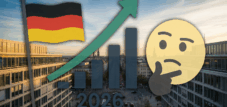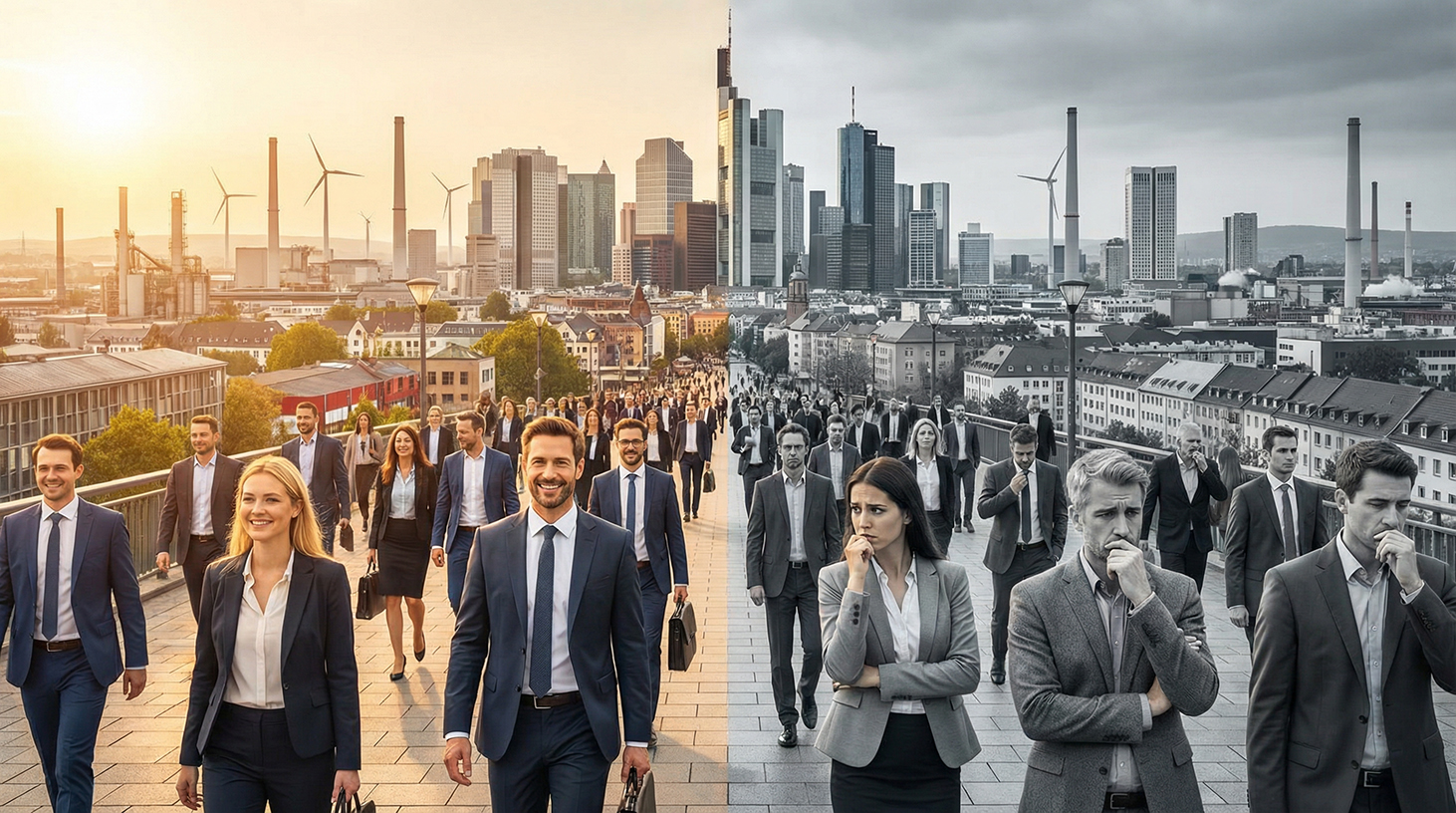
When an industrialized nation downplays itself: Strong, but insecure – How Germany fell into the economic confidence trap – Image: Xpert.Digital
Investment freeze due to fear: How constant crisis communication is paralyzing Germany as a business location
"Stagnation with substance": Why the obituary of German industry is completely premature
At the beginning of 2026, Germany faces a paradoxical problem: While the economic fundamentals are strained, they by no means justify the rampant sense of impending doom. Yet this very toxic pessimism threatens to become a self-fulfilling prophecy. If medium-sized companies freeze their investments due to a lack of trust in politics, and citizens curb consumption out of fear for the future, a purely "perceived" crisis will quickly become a real threat to prosperity. The following article analyzes how Germany fell into this dangerous trap of trust, what role a polarizing culture of debate plays in this, and what concrete reforms in taxes, education, and infrastructure the country must implement to find its way back to renewed economic self-confidence.
Related to this:

The key figures are better than gut feeling – but without bold reforms, the perceived crisis could become a real one.
At the beginning of 2026, Germany finds itself in a paradoxical situation. After several years of shocks, the economy is weak but has not collapsed, and key industrial sectors remain intact. Nevertheless, the public discourse is dominated by the image of a country in permanent decline. Companies are postponing investments, citizens are holding back on consumption, and many believe the country's best years are behind them.
Economic analyses now speak of a "crisis of confidence" that has cast a veil over real possibilities. Trust in politics, institutions, and economic viability has become a scarce commodity. This makes trust itself the decisive factor of production: without confidence, companies do not invest, and without investment, there is no growth to alleviate these fears.
Related to this:
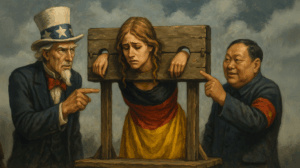
The objective situation: Stagnation with substance
In purely numerical terms, the situation is sobering, but not hopeless. In 2025, Germany's gross domestic product grew by only 0.2 percent, following several weaker years, and for 2026, institutes such as the DIW and the IMK are forecasting only a moderate increase of around 1 to 1.2 percent. This is far from a dynamic recovery, but it is not a collapse either. Despite the economic slowdown, the labor market remains comparatively stable, and the shortage of skilled workers continues to be more of a hindrance than a help in many places.
At the same time, the industrial base remains remarkably robust. Germany continues to be one of the world's largest exporters, with strong positions in mechanical engineering, the automotive industry, chemicals, and specialized industrial goods. The high energy prices, which caused a shock after 2022, have partially decreased, but still exceed the levels of many competitors and represent a structural disadvantage. Overall, the fundamentals are indeed strained, but they do not justify the widespread pessimism.
Loss of trust in politics and institutions
The real bottleneck is trust – both on the business and private sides. A special survey by DZ Bank shows that only 39 percent of medium-sized companies now trust the federal government to put the economy back on a growth path, down from 62 percent in spring 2025. Trust in the government's ability to reduce bureaucracy, lower energy prices, and modernize infrastructure has also declined significantly.
This shift in trend has a history. The 2008 financial crisis, the Euro crisis, the 2015 refugee crisis, the pandemic, the energy price shock following the war in Ukraine, and recurring budget and distribution conflicts have reinforced the expectation that politics primarily reacts and rarely acts proactively. Added to this is a media environment that strongly emphasizes crises, conflicts, and scandals, as well as social media, where outrage and polarization achieve greater reach than nuanced analyses. From an economic perspective, this constant crisis communication undermines predictability—a crucial factor when it comes to investments with long payback periods.
Elite alienation and debate culture
Besides real-world politics, the perception of elites plays a central role. Many people experience a growing distance from political decision-makers, business leaders, and media voices whose lived realities differ significantly from their own. In debates about climate protection, migration, digitalization, or the welfare state, abstract visions of the future often clash with very concrete everyday anxieties. Those who live in economically disadvantaged regions, operate energy-intensive industries, or have just started their own businesses perceive risks differently than someone with a well-secured urban elite background.
The current culture of debate exacerbates this problem. Talk shows and social media are dominated by pointed positions, symbolic conflicts, and moralizing. Sober assessments or long-term compromises struggle to gain traction. From an economic perspective, this communication logic acts like a tax on reform policy: the more complex and long-term a measure is, the harder it is to translate into a simple narrative—and the greater the risk of political costs. For companies, this in turn means greater uncertainty and a tendency to postpone investments.
Our EU and German expertise in business development, sales and marketing

Our EU and German expertise in business development, sales and marketing - Image: Xpert.Digital
Industry focus areas: B2B, digitalization (from AI to XR), mechanical engineering, logistics, renewable energies and industry
More information here:
A thematic hub offering insights and expertise:
- Knowledge platform covering global and regional economies, innovation and industry-specific trends
- A collection of analyses, insights, and background information from our key areas of focus
- A place for expertise and information on current developments in business and technology
- A hub for companies seeking information on markets, digitalization, and industry innovations
More than just numbers: Why a lack of trust is truly paralyzing Germany's economy
Competitiveness in international comparison
On a global scale, Germany has undoubtedly lost relative attractiveness. The US offers not only larger, more capital-rich markets, but also a more predictable digital and industrial policy with strong support programs for future technologies. China combines state-directed industrial policy with rapid infrastructure projects and aggressive technological development. In contrast, Germany and Europe often appear slow, fragmented, and overly regulated.
At the same time, its strengths should not be overlooked. The European single market offers legal certainty, a large and affluent customer base, and high standards – particularly in areas such as data security, product safety, and sustainability. Companies that thrive in this demanding environment are internationally competitive. Nevertheless, adjustments are necessary: excessively high taxes and social security contributions on labor, complex regulations, and sluggish approval processes stifle investment and innovation projects.
Related to this:

Education, digitalization and social justice as levers
Analyses like the one by the DIW identify three major structural problem areas: Europe, taxes, and the welfare state, supplemented by cross-cutting issues such as education and digitalization. In the education sector, it's not just about more money, but about quality, permeability, and adaptability. Germany suffers from too many school dropouts, too few young people pursuing STEM careers, and overly rigid educational pathways, while at the same time the demand for highly qualified professionals is increasing.
The digitalization of the state is another bottleneck. Administrative procedures are often paper-based, fragmented across federal states, and not user-friendly, which stifles investment and costs businesses time. Finally, social justice is not just a moral category, but a factor in economic stability. If broad segments of the middle class feel they are slipping away despite working or are not benefiting from growth, their willingness to support necessary transformations decreases.
Trust as an economic production factor
In economic theory, trust reduces transaction costs, facilitates cooperation, and lowers the risk premium that investors demand. Applied to a country, this means: the more strongly businesses and households believe that framework conditions are reliable, rules are consistent, and government institutions are effective, the more likely they are to invest in the future. Without this trust, safety margins, reserves, and risk premiums increase—at the expense of innovation and growth.
Germany is at a critical juncture. If companies expect energy prices, tax regimes, and subsidy policies to be constantly changing, their willingness to invest in long-term projects like decarbonization, digitalization, or new production sites decreases. Households react similarly: those who fear the future consume less and save more, even if their objective income remains stable. This creates a negative spiral in which the fear of the crisis itself generates the crisis.
Three reform paths that could restore trust
Several economic analyses therefore propose three major reform pathways that would be suitable for strengthening confidence. First, a deepening of Europe: A more integrated single market with common industrial, energy, and innovation policies could increase planning certainty and reduce unilateral national actions. Germany would have a strong interest in positioning itself as a driving force behind such reforms, rather than primarily using Europe as a stage for national debates.
Secondly, a major tax reform. Currently, labor is heavily taxed while wealth is comparatively lightly taxed, which is considered inefficient. Tax relief for businesses and low- and middle-income earners – financed by higher taxes on large fortunes and the reduction of subsidies – could stimulate consumption and investment without overburdening public finances.
Thirdly, a reform of the welfare state that better balances incentives, protection, and investment in human capital. The goal would be, on the one hand, to cushion transitions in the labor market—for example, those caused by digitalization and climate policy—and, on the other hand, to actively strengthen skills development and labor force participation. Combined with the consistent digitalization of public administration and investments in infrastructure, such a reform package could send a clear signal: The state is capable of acting and is prepared to re-evaluate cherished structures.
Courageous center instead of culture war
Whether Germany can escape this trust trap depends not only on economic parameters but also on its political culture. If reforms are consistently portrayed as zero-sum games between "winners" and "losers," the lines will harden. A "courageous center" in the political spectrum would have to be prepared to question both fiscal taboos and structural dogmas without resorting to populist oversimplifications.
For companies, this means they must redefine their role. Instead of simply presenting demands to policymakers, they could increasingly act as active participants – for example, in regional transformation alliances, education networks, or sectoral innovation clusters. Germany's economic starting point is undoubtedly weaker than it was ten years ago, but it is significantly stronger than public discourse suggests. Whether this leads to a gradual decline or a renewed upswing depends crucially on whether it is possible to rebuild trust in a targeted manner.
Your global marketing and business development partner
☑️ Our business language is English or German
☑️ NEW: Correspondence in your native language!

Konrad Wolfenstein
I and my team are happy to be available to you as your personal advisor.
You can contact me by filling out the contact form here wolfenstein@xpert.digital:or simply call me at +49 7348 4088 965. My email address is
I'm looking forward to our joint project.
☑️ SME support in strategy, consulting, planning and implementation
☑️ Creation or realignment of the digital strategy and digitization
☑️ Expansion and optimization of international sales processes
☑️ Global & Digital B2B trading platforms
☑️ Pioneer Business Development / Marketing / PR / Trade Fairs
🎯🎯🎯 Benefit from Xpert.Digital's extensive, five-fold expertise in one comprehensive service package | BD, R&D, XR, PR & Digital Visibility Optimization

Benefit from Xpert.Digital's extensive, five-fold expertise in a comprehensive service package | R&D, XR, PR & Digital Visibility Optimization - Image: Xpert.Digital
Xpert.Digital possesses in-depth knowledge across various industries. This allows us to develop tailored strategies precisely aligned with the requirements and challenges of your specific market segment. By continuously analyzing market trends and monitoring industry developments, we can act proactively and offer innovative solutions. The combination of experience and expertise generates added value and provides our clients with a decisive competitive advantage.
More information here: