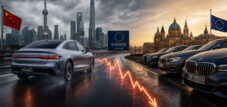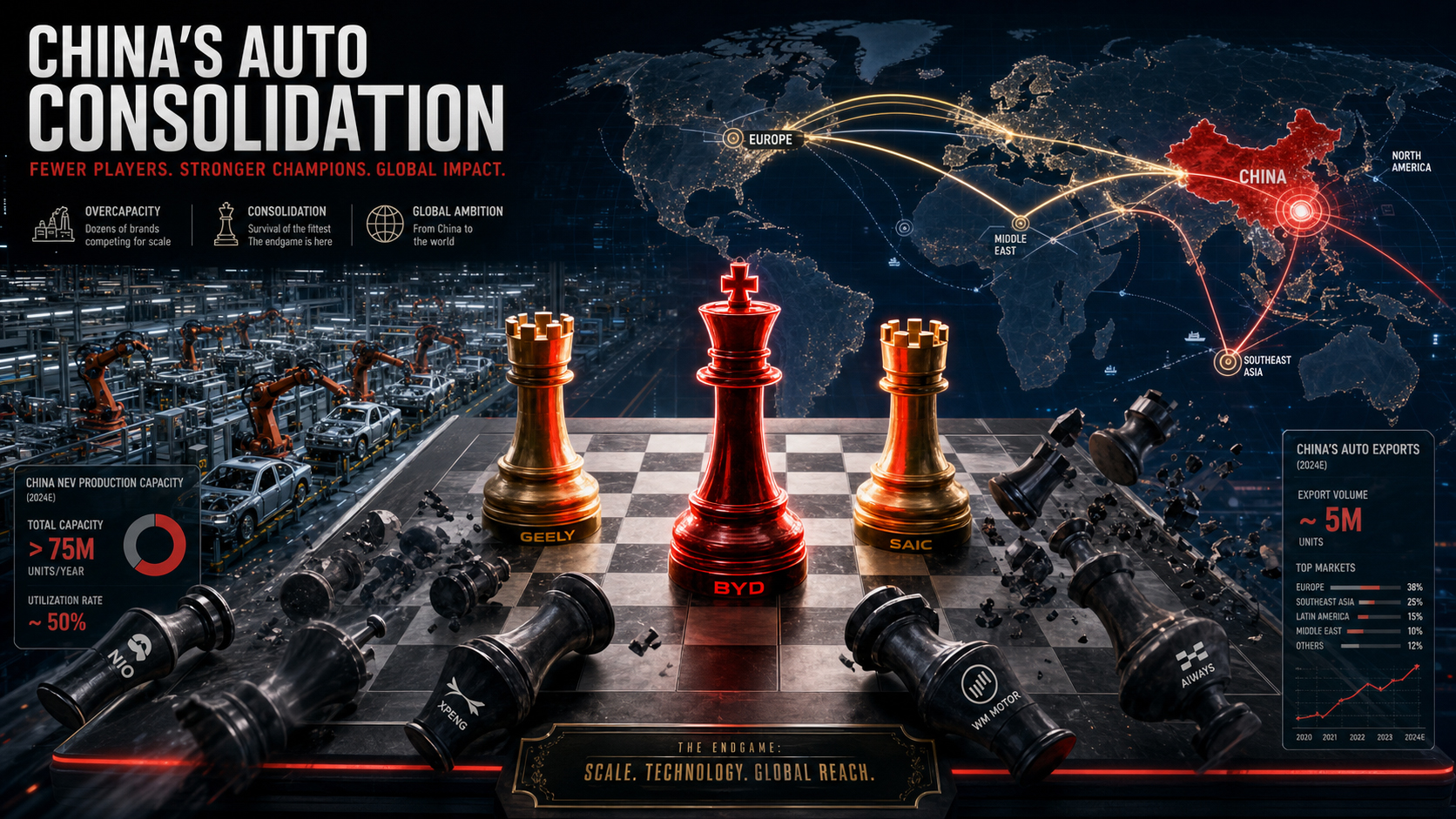
State-sponsored bankruptcies: The end for the "China Porsche" – Beijing pulls the plug on 8 well-known car brands – Image: Xpert.Digital
Millions of cars that nobody buys: The ticking time bomb of the Chinese auto industry
Ruinous price war: This is why China is deliberately letting its own car manufacturers go bankrupt
Discount shock and empty factories: The well-disguised billion-dollar problem of BYD and Co.
At first glance, China's auto industry appears invincible. With enormous export figures and brands like BYD flooding the global market, the People's Republic is giving established Western automakers a run for their money. But behind the glittering facade of China's electric vehicle miracle, a merciless, ruinous fight for survival is raging. Gigantic state subsidies have created a historic overcapacity – millions of cars are rolling off the assembly lines, for which there are simply no buyers left in the struggling domestic market. The result is an unprecedented price war that is now claiming its first prominent victims: Beijing is cracking down hard, permanently revoking the licenses of eight automakers – including the builder of the infamous "Chinese Porsche." This state-mandated decimation, however, is not a sign of weakness, but part of a cold-blooded master plan. To forge global champions, China is deliberately letting the weak die. For Western corporations like VW, BMW, and Mercedes, this ruthless market shakeout will be the ultimate strategic stress test.
When the state pulls the plug: The economic logic behind China's autopurge
The history of the Chinese automotive market is no ordinary industrial history. It is the story of a grand state strategy pursued consistently for decades – with one clear goal: to make the People's Republic not only the world's largest car market, but also the dominant force in global automotive production. What is often overlooked is the remarkable consistency with which Beijing pursued this path – and how readily Western corporations accepted the conditions under which they were allowed to participate in the Chinese boom.
For decades, Western manufacturers had to access the Chinese market exclusively through joint ventures, sharing profits and transferring technical expertise to local partners. This condition, which from the outside appeared to be a peculiar form of protectionist tariffs, was in reality an industrial transfer program of gigantic proportions. German corporations such as Volkswagen, BMW, and Mercedes-Benz built factories in China under the supervision of state-owned partners, trained engineers, and effectively laid the foundations for the competition that now threatens them in Europe. For example, in 2003, BMW founded the joint venture BMW Brilliance Automotive (BBA) in Shenyang together with Brilliance China Automotive, which has since become BMW's largest production site worldwide.
The results of this strategy are now evident in the sales figures. In 2025, China produced more than 34.5 million vehicles for the first time – a production increase of 10.4 percent compared to the previous year – surpassing all previous records. The market developed not only in breadth but also in depth: Local manufacturers such as BYD, Geely, and Chery have transformed themselves from imitators to innovators and are now directly challenging established Western brands.
Subsidized Dominance: The Financial System Behind the Success Model
The rise of Chinese automakers was not solely based on entrepreneurial creativity. It was enabled by a state subsidy system whose scale is unparalleled internationally. According to a study by the Kiel Institute for the World Economy (IfW), Chinese companies received, on average, three to eight times more state support between 2005 and 2024 than companies in other OECD countries. An OECD analysis of subsidies in 15 key industries recorded approximately US$108 billion worldwide for 2024 – with Chinese companies receiving the largest share.
In the field of electromobility, Beijing invested at least US$230.8 billion in the electric vehicle industry between 2009 and 2023, according to estimates by the US think tank Center for Strategic and International Studies – although it should be noted that this is an extremely conservative estimate. The subsidies included direct buyer discounts, tax exemptions, infrastructure spending, research grants, and government-funded vehicle purchases. BYD alone received the equivalent of almost €3.5 billion in direct government subsidies between 2018 and 2022, according to calculations by the Kiel Institute for the World Economy (IfW). In addition, there were purchase incentives, of which BYD received €1.6 billion in 2022 alone.
This government support wasn't limited to direct payments. Chinese automakers benefited from subsidized loans with interest rates as low as two percent – half the market rate. Local authorities provided affordable land, subsidized electricity, and resisted factory closures for fear of losing local jobs. The result was an ecosystem that systematically prioritized capacity growth over profitability.
The paradox of strength: Export records and domestic slump at the same time
In the public eye, China's automotive industry currently presents itself as a triumphant rising star. Chinese brands are celebrating export records, with BYD raising its export target for 2026 to 1.5 million vehicles – a 43 percent increase compared to the previous year. XPeng, Xiaomi Automotive, and other new competitors are pushing into European markets with innovative electric vehicles. But behind this success story lies an internal tension that is destabilizing the entire industry.
Domestically, the Chinese car market suffered a dramatic downturn in the spring of 2026. According to data from the China Passenger Car Association (CPCA), only around 1.5 million vehicles were sold in May 2026 – a decline of approximately 20 to 22 percent compared to the same month of the previous year. The situation was no better in April 2026: only 1.4 million passenger cars were delivered, a decrease of 21.5 percent, and the cumulative decline over the first four months was 18.5 percent. The market had been in decline for seven consecutive months – a level last seen during the strictest COVID-19 lockdowns.
The causes are multifaceted. An immediate trigger was the Iran-Iraq War, which disrupted the Strait of Hormuz and caused oil prices to rise by up to nine percent per day at times. Diesel became more expensive in China by over 30 percent, and gasoline by around 20 percent. In a country where purchasing power and average income are significantly below Western European levels, this shock directly impacted the wallets of potential car buyers. Added to this were structural factors: the withdrawal of government purchase incentives at the end of 2022, a continuing economic downturn resulting from the housing crisis, and growing reluctance to consume among broad segments of the population. The value of sales fell by almost 20 percent between January and May – even though electric vehicles and plug-in hybrids, the so-called New Energy Vehicles (NEVs), should have actually benefited from a boost due to rising fuel prices.
The core structural problem: Overcapacities as a ticking time bomb
The current decline in sales reveals a deep structural problem that has been building up for years and can no longer be ignored. According to various calculations, China has the production capacity for almost 40 million combustion engine vehicles per year – while domestic sales of these vehicles are shrinking dramatically. At the same time, dozens of new electric car factories have been opened in recent years without a corresponding shutdown of older facilities. The Chinese National Bureau of Statistics has calculated that capacity utilization across the entire industry has fallen to around 65 percent – significantly below the benchmark of 80 percent, at which point car factories are considered efficient and profitable.
The problem becomes particularly clear when looking at individual locations. In Chongqing, the largest city in western China, stands a former assembly and engine plant belonging to the South Korean giant Hyundai. Just seven years ago, it was equipped with state-of-the-art robots and built for US$1.1 billion. Hyundai sold it for a fraction of that sum – US$224 million – to a municipal development corporation, which has since failed to find any new buyers or tenants. The grass on the abandoned site has grown knee-high. This episode is emblematic of an industry that has become structurally overheated.
The overcapacity is not a coincidence, but a direct result of the state-sponsored growth model. Municipally subsidized banks generously granted loans for new factories, and local governments used automotive plants as job creators and political prestige projects. Chinese manufacturers discovered that it was cheaper to build new factories than to upgrade existing ones—an economically perverse incentive that led to a massive misinvestment in production capacity. For the manufacturers themselves, this had dramatic consequences: From 2021 to 2025, the phenomenon of spiraling profit decline affected almost every domestic automaker.
The ruinous discount war and its victims
The logical consequence of too many factories for too little demand was a price war of historic proportions. In a market with around 49 manufacturers and over 100 different brands, fierce competition erupted, with customers waiting for bargains and manufacturers undercutting each other with discounts. BYD, which has since become the world's largest car manufacturer, temporarily lowered its prices by up to 34 percent in the course of this conflict. Manufacturers' margins—already under pressure due to structural overcapacity—were further eroded. For many smaller suppliers, this price war was a death trap, in which they could survive neither through volume increases nor margin adjustments.
The price war had a self-reinforcing dynamic: those who didn't lower their prices lost market share; those who did lower them lost margins. The profits of many car manufacturers were almost completely eroded. State-supported companies, living off preferential loans and municipal subsidies, were able to sustain this battle longer—without actually being economically viable. This created a vicious cycle in which the most efficient market participants were not necessarily the strongest economically, but rather those with the deepest access to government support.
At the same time, the pressure increased to export vehicles that could no longer be sold domestically. China's car exports exploded during this period: The country became the world's largest car exporter, surpassing Japan and Germany. Three-quarters of these exports were initially combustion engine vehicles for which the domestic market could no longer find buyers. This export pressure is what directly affects Europe – and what triggered the discussion about punitive tariffs by the European Union.
Our China expertise in business development, sales and marketing

Our China expertise in business development, sales and marketing - Image: Xpert.Digital
Industry focus areas: B2B, digitalization (from AI to XR), mechanical engineering, logistics, renewable energies and industry
More information here:
A thematic hub offering insights and expertise:
- Knowledge platform covering global and regional economies, innovation and industry-specific trends
- A collection of analyses, insights, and background information from our key areas of focus
- A place for expertise and information on current developments in business and technology
- A hub for companies seeking information on markets, digitalization, and industry innovations
State selection instead of market failure: China's strategy behind the license revocations
Beijing's answer: Market consolidation as a matter of national interest
In light of these structural deficiencies, the recent government intervention is not a surprising about-face, but rather the logical continuation of an industrial policy that has been announced for years. The Chinese Ministry of Industry and Information Technology (MIIT) has officially removed eight automakers from its trademark register, thereby revoking their production licenses. These are FAW Xiali, Brilliance Auto, Zotye Auto, Leopaard, Lifan, Hawtai, BAIC Yinxiang, and Haima. For these companies, the license revocation marks the formal end of their operations as independent automakers – even though many of them had already effectively ceased production years ago.
The timing is not accidental. The Chinese government aims to systematically reduce overcapacity and strengthen the international competitiveness of domestic industry. An industry with too many weak players harms the strong ones: delaying consolidation prolongs price competition and weakens the capital base of all participants. By formally eliminating the weak players, Beijing is closing a chapter that was economically closed long ago but had not yet been fully realized politically.
This consolidation should not be understood as an expression of free-market principles, but rather as active industrial policy management. The difference is crucial: In a market economy, companies exit the market because they can no longer find customers. In China's directed-capitalist system, this happens because the state deems it optimal. The government defines winners and losers with a precision that is structurally alien to Western economies – and which creates a completely different kind of market risk for international investors and competitors.
The eight convicted men: Portraits of failed ambitions
A look at the companies involved reveals the full spectrum of Chinese automotive history – from ambitious up-and-comers to failed plagiarists, from former state-owned companies to forgotten regional suppliers.
Zotye Auto is the case that garnered the most international attention. The company achieved dubious notoriety with its SR9 model, a blatant yet remarkably well-crafted replica of the Porsche Macan. The vehicle not only copied the German sports car's exterior silhouette almost identically, but also adopted the interior design, steering wheel shape, trim, center console, and even the analog clock on the dashboard. With a starting price of around €15,000 – a fraction of the original Porsche's – the car actually found buyers. Porsche sued, apparently with limited success, while Chinese law offered little recourse. With the MIIT license revocation, the story of a company that thrived more on the creativity of others than on its own innovation has now come to an end.
FAW Xiali was once a true people's car. The brand produced affordable small cars and was a long-time presence in the taxi market; the Xiali became one of China's best-selling vehicles in the 1990s and early 2000s. But what was once a mass phenomenon has been displaced by modern electric vehicles and changing consumer tastes. Brilliance Auto, on the other hand, is a name familiar to German automotive enthusiasts, albeit with negative connotations: Nearly two decades ago, the brand attempted to enter the European market with sedans like the BS6 and BS4, but failed due to exorbitant prices, poor quality, and a lack of future prospects. The BMW Brilliance Automotive joint venture, however, continues to operate and recently announced the seven millionth BMW produced in China.
Hawtai has been considered virtually inactive in the market since 2019. Leopaard hadn't sold any vehicles for years and existed only in name. BAIC Yinxiang filed for bankruptcy back in 2021; reports indicate that vehicles are now being produced again under the name BAIC Ruixiang. Haima made a name for itself through licensed production of other manufacturers' vehicles but failed to establish an independent market identity. Finally, Lifan was known as a manufacturer of small cars that strongly resembled models from established competitors.
The winners of the consolidation: Who benefits from the market shakeout?
The state-mandated market consolidation is not a defeat for China's automotive industry as a whole—it is a targeted restructuring that benefits a select few. The obvious beneficiaries are the large, well-capitalized corporations that survived the price war thanks to state backing and economies of scale: BYD, Geely, Chery, and SAIC will capture market share after the exit of smaller competitors. Successful newcomers like XPeng and Xiaomi Automotive are also well-positioned, having established a clear product identity and strong technological foundations despite fierce competition.
BYD exemplifies the new face of the Chinese automotive industry. The company has not only dominated the domestic market but is also strategically pursuing international expansion. Its export target of 1.5 million vehicles for 2026 is ambitious, but not unrealistic. BYD benefits from a unique combination of government support, vertical integration – the company produces its own batteries – and a speed of model development that challenges Western corporations. HSBC analysts projected growth of 14 percent for BYD in 2025 – a still remarkable figure given the overall market pressure.
For the small manufacturers that have left the market and their employees, however, consolidation means the end. Tens of thousands of jobs in assembly plants, supplier factories, and distribution networks are at risk. The municipalities that once proudly touted their local car brands as drivers of employment now face difficult social adjustments. This is the domestic political price for the efficiency gains mandated by Beijing—a price rarely mentioned in international reporting on China's automotive miracle.
Mirror effects: What the transformation means for Europe and Germany
The consolidation of the Chinese automotive market is not purely a domestic economic matter – it has direct strategic consequences for the European and especially the German automotive industry. German companies are caught in a dilemma: the Chinese market remains indispensable for them, yet is simultaneously declining. At Volkswagen, China accounted for around 30 percent of total deliveries at the group level, with 644,000 cars; for Mercedes, it was 34 percent in the passenger car sector; and for BMW, it was still a good 26 percent – despite a significant decline.
The withdrawal of government purchase incentives and the structural weakness of demand in the Chinese market mean immediate revenue losses for these corporations. At the same time, Chinese manufacturers, unable to find domestic buyers, are pushing into Europe with export offensives. This double effect – shrinking revenues from their most important single market coupled with increasing competitive pressure from that very market – is one of the most dangerous challenges the German automotive industry has ever faced.
The EU has responded with punitive tariffs on Chinese electric vehicles. Whether this measure is sufficient to offset the structural asymmetry in competition is debatable. Chinese manufacturers benefit from economies of scale, government subsidies, and lower production costs, which tariffs can only partially compensate for. Automotive expert Philipp Seidel of Arthur D. Little has pointed out that the expansionary pressure from China will be felt even more strongly in Europe in the coming years – especially if the US continues to restrict its exports as a target market. The scenario of a targeted export offensive on Europe as an alternative market for production capacity that can no longer be sold in China is no longer theoretical, but already a reality.
Structural questions and the long trajectory of history
The current market consolidation in China does not mark the end of a cycle, but rather the beginning of a new phase. Industry observers expect the consolidation to continue and could affect larger brands in the future. The Chinese government will not cease actively shaping the structures of its key industry – the only question is which instrument it will use and when it will intervene.
In the long term, Beijing's stated goal is clear: a small group of highly specialized, globally competitive national champions dominating the world market for electric vehicles and related technologies. From this perspective, the fierce competition of recent years, which destroyed so many margins and threatened so many jobs, was not a mistake, but rather part of a calculated selection process. The weak were not randomly eliminated, but systematically weeded out – with the aim of making the strong even stronger.
For Western economies and their companies, this is a challenging realization. Competition with China in the automotive sector is not simply a competition between companies, but a competition between different economic systems: one that prioritizes short-term profitability and shareholder interests, and one that pursues long-term market dominance as a state objective, cross-subsidizing losses for decades. The balance sheet of these two models will not be settled in a quarterly report, but over generations.
The closure of these eight manufacturers is, in this context, a small page in a very long story. It demonstrates that Beijing is capable and willing to make even painful economic decisions when they serve a larger strategic goal. And it shows that China's automotive industry is not a static entity, but a dynamic system in constant flux – driven by government will, international pressure, and a demographic and economic transformation whose outcome is far from certain.
Your global marketing and business development partner
☑️ Our business language is English or German
☑️ NEW: Correspondence in your native language!

Konrad Wolfenstein
I and my team are happy to be available to you as your personal advisor.
You can contact me by filling out the contact form here wolfenstein@xpert.digital:or simply call me at +49 7348 4088 965. My email address is
I'm looking forward to our joint project.
☑️ SME support in strategy, consulting, planning and implementation
☑️ Creation or realignment of the digital strategy and digitization
☑️ Expansion and optimization of international sales processes
☑️ Global & Digital B2B trading platforms
☑️ Pioneer Business Development / Marketing / PR / Trade Fairs
🎯🎯🎯 Data-driven B2B industry hub as a quasi-in-house solution


The quasi-in-house solution: How Xpert.Digital closes operational gaps in B2B marketing and sales – Smart Content-Driven Business - Image: Xpert.Digital
Xpert.Digital is a data-driven B2B industry hub led by Konrad Wolfenstein . The company acts as an external, quasi-in-house solution for industrial partners, closing operational gaps in marketing, content, and sales – without requiring additional resources on the client side.
More information here: