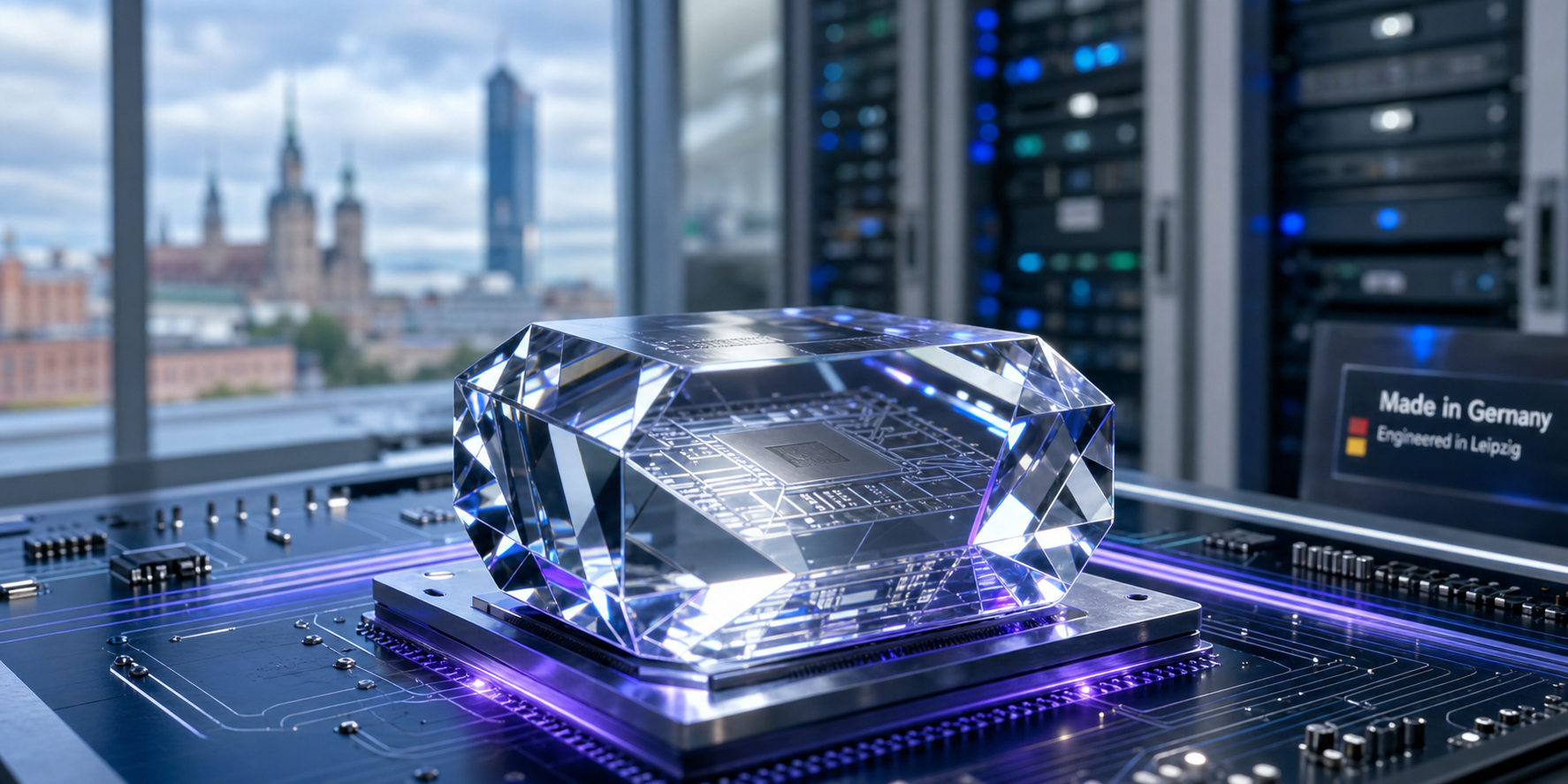
The secret of diamonds: German start-up solves the biggest problem of quantum technology – Image: Xpert.Digital
David versus Goliath: Leipzig start-up builds quantum computer that fits in a suitcase
512 qubits from the wall socket: That's why the global tech world is currently looking to Saxony
A billion-dollar bet on a gemstone: Why the future of quantum computing lies in Leipzig
The Leipzig-based startup SaxonQ is challenging tech giants Google and IBM with a revolutionary approach: Instead of relying on enormous, ultra-cold systems, the Saxon researchers are building quantum computers based on synthetic diamonds. These require no elaborate cooling systems, operate at normal room temperature, and are so compact that they fit into a standard suitcase. With the recent announcement of highly scaled systems with up to 512 qubits by 2026, the startup is proving that quantum computing doesn't have to remain the monopoly of multi-billion-dollar corporations. Backed by decades of fundamental research and supported by millions in government funding, this "diamond technology" could pave the way for making enormous computing power accessible to small and medium-sized enterprises (SMEs) and autonomous systems in the future – a technological paradigm shift that is challenging the fundamental principles of the entire industry.
Diamond instead of cryostat: How a Leipzig start-up is rewriting the physics of quantum computers
Germany's billion-dollar bet on a gemstone that bypasses the competitor's refrigerator trap
The news initially sounds like a minor tidbit from the East German startup scene: A Leipzig-based company with just 15 employees claims to have developed a technology that can potentially compete with the multi-billion-dollar research departments of IBM and Google. However, closer examination reveals that this story has a solid technological and economic core that challenges the fundamental principles of the quantum computing industry.
An artificial defect in the crystal lattice as a computing core
SaxonQ, a spin-off from the University of Leipzig, has pursued an approach that differs fundamentally from the dominant architectures. While established technology companies rely on superconducting circuits that must be cooled to temperatures near absolute zero, SaxonQ uses so-called nitrogen-vacancy centers, or NV centers, in artificially produced diamond crystals. The operating principle is remarkably elegant. A nitrogen atom is precisely implanted into the carbon lattice of a diamond, creating a vacancy directly adjacent to it, where a carbon atom is missing. This defect pair behaves physically like an artificial atom and can be used as a qubit, the smallest unit of information in a quantum computer. Particularly interesting is the fact that multiple qubits can be realized simultaneously per NV center because both the electron spin of the center itself and the nuclear spins of neighboring carbon isotopes serve as separately controllable processing units. This multiple use of a single physical defect gives the technology a certain density efficiency that is not readily achievable with other approaches.
Why a gemstone is cold-resistant and saves billions in infrastructure
The decisive economic advantage of this technology lies in the thermal stability of diamond. Its crystal lattice is extremely rigid, meaning that thermal vibrations of the atoms, which would destroy the delicate quantum states in other materials, are practically non-existent at room temperature. Diamond can therefore be aptly described as a high-temperature-compatible quantum material whose vibrational properties at room temperature correspond to those of silicon at minus 253 degrees Celsius. For operators, this translates into a fundamental cost advantage. Superconducting quantum chips require complex dilution cryostats that must be cooled down to just a few millikelvin, along with massive vacuum chambers, specialized cooling systems, and correspondingly high energy consumption and considerable space requirements. SaxonQ's diamond chips, on the other hand, require no elaborate cooling, hardly any space-consuming peripherals, and literally only need to be plugged into a standard electrical outlet. The company has already put this advantage into practice by shrinking its quantum computer to the size of a suitcase and selling it to customers such as the German Aerospace Center (DLR) and the Fraunhofer Institute for Machine Tools and Forming Technology. This miniaturization and mobility is a first in the industry, because while competitors require room-filling systems, the SaxonQ system fits into a handy, flexible box that could even be installed in a vehicle, as demonstrated by a successful test conducted by the DLR quantum computing initiative in 2024.
The bottleneck in the entanglement as the biggest obstacle to growth
Despite these promising properties, the technology faces a serious physical hurdle, repeatedly emphasized by independent experts. NV centers in diamond are relatively rare at the atomic level, and the individual qubits are comparatively far apart. For useful quantum computing, however, many qubits must be entangled and coupled to perform complex computations. This coupling problem can be solved either via optical links, as researchers in the Netherlands are testing for quantum repeaters, or by the targeted creation of densely packed clusters of NV centers that are spatially close enough to interact. While SaxonQ has made progress in the controlled and reproducible placement of NV centers with its patented, implantation-based fabrication method, scaling up to larger, practically relevant numbers of qubits remains a key technological challenge. As early as 2024, the company was working on scaling from four to eight qubits, which it estimated would result in an exponential performance increase. It wasn't until July 2026 that SaxonQ announced the commercial availability of significantly larger systems, specifically a 128-qubit processor and a 512-qubit system. The latter, as one of the first diamond-based NV Center systems ever, clearly surpasses the ten-qubit mark. These systems are designed to fit into standard server racks and run continuously without the usual recalibration cycles and environmental monitoring. Whether this scaling can be achieved without significant error rates remains the crucial test against which its practicality will be measured against competing superconducting and ion-trap-based technologies.
East German locational advantage meets global corporate power
The geographical origin of this innovation is by no means accidental. Leipzig is considered by many to be one of the birthplaces of quantum mechanics and boasts a well-established scientific infrastructure at its university, from which SaxonQ was spun off in 2021 by physics professors Marius Grundmann and Jan Meijer. Grundmann brings over three decades of experience in nanotechnology and semiconductor physics, while Meijer is known as a developer of novel ion beam implantation methods. To protect its intellectual property, the company has accumulated more than 220 patents and patent applications, demonstrating a remarkably high level of innovation given its size. This growth is financially supported by a seven-figure investment from the Saxony Technology Founders Fund and by the appointment of Frank Schlichting, an industry-experienced manager with previous leadership roles in the IT, semiconductor, automotive, and energy sectors, to the company's operational leadership. This professionalization of the management team signals the transition from a purely research-oriented spin-off to a company with serious commercial ambitions. Nevertheless, the gap to the resources of IBM and Google remains enormous. These corporations invest billions annually in their quantum programs, possess established cloud infrastructures for marketing quantum computing power, and can draw on decades of experience in scaling superconducting systems. SaxonQ's real strength, therefore, lies less in a direct race for the highest qubit count, but rather in developing niche applications where mobility, robustness against vibrations, and the elimination of cooling infrastructure make all the difference—for example, in automotive engineering, aerospace, or decentralized industrial environments.
🎯🎯🎯 Data-driven B2B industry hub as a quasi-in-house solution


The quasi-in-house solution: How Xpert.Digital closes operational gaps in B2B marketing and sales – Smart Content-Driven Business - Image: Xpert.Digital
Xpert.Digital is a data-driven B2B industry hub led by Konrad Wolfenstein . The company acts as an external, quasi-in-house solution for industrial partners, closing operational gaps in marketing, content, and sales – without requiring additional resources on the client side.
More information here:
How billions in government investment are shaping German quantum technology – Quantum computing market forecasts between one billion and trillion euros
A multi-billion dollar market with widely diverging growth expectations
The economic relevance of this development can only be understood within the context of the entire quantum computing industry, whose market forecasts, however, exhibit a remarkable range. While conservative estimates project a global market volume of approximately US$1.2 to US$1.5 billion in 2025 and forecast growth to around US$10 to US$15 billion by 2035, corresponding to an annual growth rate of approximately 23 to 27 percent, more optimistic analysts paint a considerably more dramatic picture. The investment bank UBS, for example, anticipates that the industry's market capitalization could already rise to US$300 to US$400 billion by 2030, while the addressable market is expected to grow from the current US$1.8 billion to US$20 billion. The consulting firm McKinsey, in turn, has significantly revised its estimate of the total economic value of quantum technologies upwards in 2026, to a range of between $1.3 and $2.7 trillion by 2035, after the industry first surpassed the $1 billion mark in total revenue in 2025. This enormous range of forecasts illustrates how early the industry still is in its development and how difficult it is for even established research firms to provide a reliable assessment. For a small company like SaxonQ, this presents both opportunities and risks: A growing overall market creates space for niche providers with differentiated technological approaches, but at the same time, there is a danger that the more capital-intensive, already more scalable technologies will ultimately prevail before alternative approaches such as NV center technology reach maturity.
Government funding provides a boost to the German quantum technology scene
The German Federal Government recognized the strategic importance of quantum technologies early on and backed this up with substantial funding. The framework program for quantum technologies was launched as early as 2018, followed by the allocation of two billion euros from the economic stimulus and future-oriented package in 2020. The action plan for quantum technologies, adopted in 2023, envisages investments of approximately 2.18 billion euros from the participating ministries for the period up to 2026, supplemented by a further 850 million euros from scientific institutions, totaling just over three billion euros. Within this framework, the DLR quantum computing initiative, with a volume of 740 million US dollars, plays a central role, as it specifically awards contracts to emerging companies like SaxonQ to help domestic providers achieve market readiness. Looking ahead, the German government, as part of its "1,000 Qubits, 100 Applications" initiative, plans to establish several pilot production lines in a European manufacturing network starting in 2026, as well as to build at least two high-performance quantum computers by 2030. This targeted government funding policy differs significantly from the more privately driven American model and creates a protected market environment for smaller German companies like SaxonQ, allowing them to generate initial revenue through public research contracts before the full impact of international competition takes hold. Critics, however, point out that the funding amount is still modest in international comparison, for example, compared to the European Union's total of 7.2 billion US dollars, and that the US alone invests many times that amount in individual companies like IBM or Google through private venture capital.
What the diamond approach means for the future technology landscape
The real economic point of the SaxonQ story lies not in the claim that it will overtake IBM or Google in the short term, but in the demonstration that quantum computing doesn't have to remain a monopoly of large, well-capitalized corporations. By making cryogenics, the most expensive and complex component of conventional quantum systems, simply obsolete, the diamond technology significantly lowers the barrier to entry for research institutions, medium-sized industrial companies, and even educational institutions. This is precisely the core of the vision pursued by CEO Marius Grundmann when he speaks of a democratization of quantum technology, which could allow smaller players to gain access to quantum computing power in the future without investing millions in infrastructure. In the long term, the company even envisions using its chips in autonomous systems such as robots and self-driving cars, where the technology's energy efficiency compared to classical computing power could offer decisive advantages in solving complex optimization problems. Whether this diamond-based approach will ultimately prove superior or remain a niche technology alongside the dominant superconducting and ion-trap-based methods will depend on the successful scaling of qubit numbers while simultaneously controlling error rates in the coming years. What is already clear, however, is that a small Leipzig-based company, with a clever physical innovation based on years of fundamental research at an East German university, has added a surprising and economically plausible new dimension to the international debate on the future of quantum computing.
📈🚀 From visibility to trust 👀🤝 Your scalable path with Xpert.Digital


From visibility to trust: Your scalable path with Xpert.Digital - Image: Xpert.Digital
In industrial B2B, sustainable business relationships rarely emerge overnight. They develop step by step – through visibility, professional relevance, recurring touchpoints, and growing trust. Xpert.Digital's 4-stage model addresses precisely this: It offers a structured path that begins with a manageable entry point and can evolve into deeper collaboration in business development if needed.
Instead of relying on loud marketing promises, this model puts the relationship at the forefront. Companies start with clearly defined, easily calculable measures and then decide, based on their own experience, how far they want to expand the collaboration. A key factor for this undisturbed trust-building process: The platform completely avoids annoying advertising ads, so the editorial focus remains solely on the companies' expertise.
More information here:
Your global marketing and business development partner
☑️ Our business language is English or German
☑️ NEW: Correspondence in your native language!

Konrad Wolfenstein
I and my team are happy to be available to you as your personal advisor.
You can contact me by filling out the contact form here wolfenstein@xpert.digital:or simply call me at +49 7348 4088 965. My email address is
I'm looking forward to our joint project.