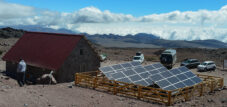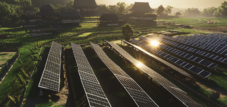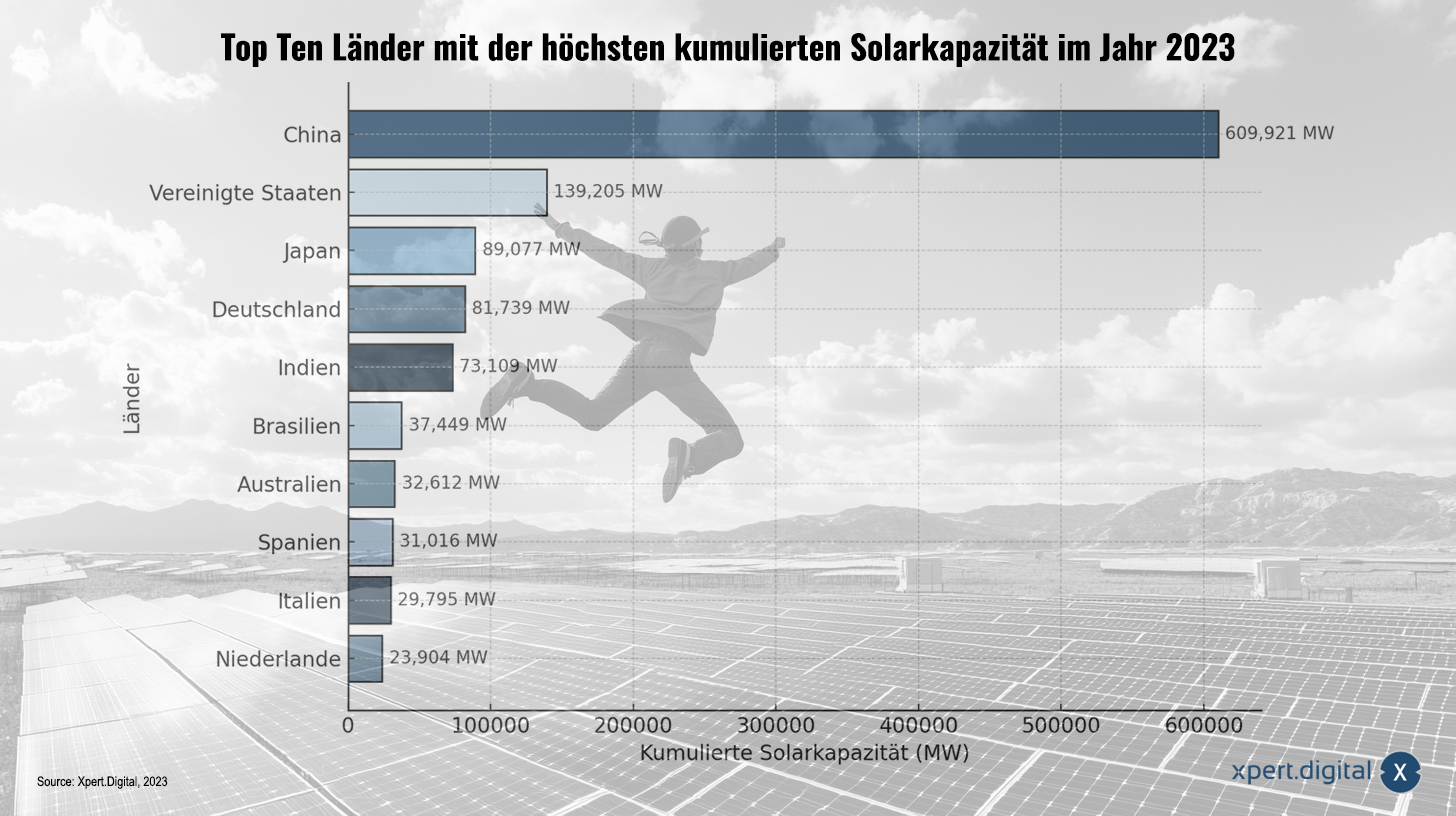
Top ten countries with the highest cumulative solar capacity in 2023 – Image: Xpert.Digital
🌟 The rise of solar energy as a key technology in the global energy system
🌏🌞 The top ten countries with the highest cumulative solar capacity worldwide
Solar energy has established itself as one of the most important technologies for generating renewable energy over the past two decades. Countries around the world are investing heavily in the development and expansion of solar projects to address the challenges of climate change, reduce their energy dependence, and promote sustainable economic systems.
- China: With an impressive capacity of approximately 609,921 MW, China is a world leader in solar energy.
- United States: The USA follows with an installed capacity of 139,205 MW.
- Japan: Japan has a solar capacity of 89,077 MW.
- Germany: Germany comes in fourth place with a capacity of 81,739 MW.
- India: India has an installed capacity of 73,109 MW.
- Brazil: The capacity in Brazil is 37,449 MW.
- Australia: Australia has a solar capacity of 32,612 MW.
- Spain: Spain has an installed capacity of 31,016 MW.
- Italy: In Italy, the solar capacity is 29,795 MW.
- Netherlands: The Netherlands has a capacity of 23,904 MW.
🏗️ China: An undisputed market leader
China plays a dominant role in the global solar industry. With an impressive cumulative capacity of over 600 gigawatts (GW), the country is a leader in the installation, production, and innovation of solar technologies. This success is the result of extensive government support programs, massive investments in research and development, and a strategic positioning as an exporter of photovoltaic modules. China's central role stems not only from its large production capacity but also from its ability to construct large-scale solar parks in remote regions such as the Gobi Desert.
🚀 The USA: Growth through innovation and private investment
The United States, with a cumulative capacity of nearly 140 GW, ranks second worldwide. This success is attributable to a combination of federal tax incentives, regional initiatives, and strong private sector involvement. The US has taken a leading role, particularly in the area of decentralized solar power systems, such as rooftop installations for homes and businesses. California, Texas, and Florida are the flagship states, leading the way with ambitious goals and innovative projects.
🌏 Japan and Germany: Pioneers of solar energy
Japan, with over 89 GW of cumulative capacity, identified solar energy early on as a strategic energy source, particularly after the Fukushima disaster in 2011. The introduction of attractive feed-in tariffs and the focus on rooftop solar installations have significantly driven growth in Japan.
Germany, ranked fourth, remains a role model for the integration of renewable energies into a modern energy system. With over 81 GW, Germany has proven that even a country with limited solar irradiance can be a significant player in the solar sector. This was made possible by progressive energy transition policies, long-term investments, and the active participation of the population.
🌄 India: A rising giant
With a capacity exceeding 73 GW, India has become one of the world's fastest-growing solar markets. The government has set ambitious targets to expand solar energy to over 300 GW by 2030. Initiatives such as the International Solar Alliance and the development of massive solar parks, like those in Rajasthan and Gujarat, underscore India's commitment to a sustainable energy future.
🌍 Global Trends in Solar Energy
The rapid development of the solar industry is characterized by several trends:
1. Decreasing costs for solar technologies
The cost of photovoltaic modules has fallen by over 80% in the last ten years. This decline is driven by economies of scale, technological innovations, and increased demand.
2. Decentralization of energy supply
More and more households and businesses are relying on decentralized solar power systems, which not only reduce electricity costs but also contribute to energy security.
3. Integration of storage solutions
The combination of solar power systems with battery storage is becoming increasingly popular. This technology makes it possible to store excess electricity and use it when needed, thus improving grid stability.
4. Smart Grids and Digitalization
With increasing digitalization, intelligent power grids are being developed that make the use of solar energy more efficient and flexible.
5. Hybrid solutions
The combination of solar energy with other renewable energies, such as wind power, creates hybrid energy parks that can compensate for weather-related fluctuations.
💡 Challenges and opportunities
Despite the impressive progress, challenges remain:
1. Land use and infrastructure
The construction of large solar parks requires extensive land areas and a high-performance grid infrastructure. This can be particularly problematic in densely populated regions.
2. Resources for production
The production of solar modules requires raw materials such as silicon, silver and rare earths, the availability and environmentally friendly extraction of which are increasingly being discussed.
3. Recycling and Sustainability
Solar modules must be recycled at the end of their lifespan. Developing sustainable recycling processes is a priority.
On the other hand, solar energy offers enormous opportunities:
- Climate protection: Solar energy contributes significantly to reducing greenhouse gas emissions and helps countries achieve their climate goals.
- Job creation: The solar industry creates millions of jobs, from production and installation to maintenance.
- Energy independence: By expanding solar energy, countries can reduce their dependence on fossil fuels and energy imports.
🌅 Innovations and future prospects
The future of solar energy will be shaped by groundbreaking innovations:
- Perovskite solar cells: This new generation of solar cells promises higher efficiency and lower manufacturing costs.
- Agri-photovoltaics: The combination of agriculture and solar energy maximizes land use and brings additional income for farmers.
- Floating solar power plants: In countries with limited land area, floating solar power plants on lakes and reservoirs are gaining in importance.
⚡ Solar energy: One of the most promising technologies
Solar energy is at the heart of the global energy transition and offers a sustainable solution for the energy supply of the future. Countries like China, the USA, Germany, and India demonstrate how different strategies and policy frameworks can promote the expansion of solar energy. Despite existing challenges, solar energy remains one of the most promising technologies for ensuring a clean, secure, and sustainable energy future.
This global transition to renewable energy is not just a technological project, but also a social and economic one that requires collaboration between governments, businesses, and society. The journey is far from over, but the progress made is an encouraging sign for a greener and more sustainable world. 🌎✨
📣 Similar topics
- 📣 The world's solar energy leaders
- 🌞 Solar capacities: Where the sun delivers the most energy
- 🌍 Solar energy in global competition: The top countries in focus
- ⚡ How China dominates the world in solar energy
- 🇩🇪 Germany's role model in the global energy transition
- 📈 India: The rising star of the solar industry
- 💡 Innovations in the solar sector: From perovskite to agri-photovoltaics
- 🌱 Challenges and opportunities of the solar energy revolution
- 🔋 Solar energy and storage technology: The solution for a sustainable future
- 🚀 The future of solar energy: Global trends and perspectives
#️⃣ Hashtags: #SolarEnergy #EnergyTransition #ClimateProtection #Sustainability #Innovation
🎯🎯🎯 Benefit from Xpert.Digital's extensive, five-fold expertise in one comprehensive service package | BD, R&D, XR, PR & Digital Visibility Optimization

Benefit from Xpert.Digital's extensive, five-fold expertise in a comprehensive service package | R&D, XR, PR & Digital Visibility Optimization - Image: Xpert.Digital
Xpert.Digital possesses in-depth knowledge across various industries. This allows us to develop tailored strategies precisely aligned with the requirements and challenges of your specific market segment. By continuously analyzing market trends and monitoring industry developments, we can act proactively and offer innovative solutions. The combination of experience and expertise generates added value and provides our clients with a decisive competitive advantage.
More information here:
We are here for you - Consulting - Planning - Implementation - Project Management
☑️ SME support in strategy, consulting, planning and implementation
☑️ Creation or realignment of the digital strategy and digitization
☑️ Expansion and optimization of international sales processes
☑️ Global & Digital B2B trading platforms
☑️ Pioneer Business Development

Konrad Wolfenstein
I would be happy to serve as your personal advisor.
You can contact me by filling out the contact form below or simply call me on +49 7348 4088 965 .
I'm looking forward to our joint project.
Write to me



Xpert.Digital - Konrad Wolfenstein
Xpert.Digital is a hub for industry focusing on digitalization, mechanical engineering, logistics/intralogistics and photovoltaics.
With our 360° Business Development solution, we support renowned companies from new business to after-sales.
Market intelligence, smarketing, marketing automation, content development, PR, mail campaigns, personalized social media and lead nurturing are part of our digital tools.
You can find more information at: www.xpert.digital - www.xpert.solar - www.xpert.plus
Keep in touch