



Solar parking lots as a key to achieving Germany's climate goals – Image: Xpert.Digital
Untapped potential: How parking lot PV can advance the energy transition
Parking lot becomes power plant: Photovoltaics in parking lots as a key technology
The installation of photovoltaic systems in parking lots offers enormous potential for increasing renewable energy production in Germany and could make a significant contribution to achieving climate goals. A detailed analysis shows that parking lot PV represents a largely untapped potential that can be developed without additional land use.
Related to this:

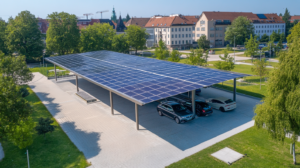
The potential of parking lot photovoltaics in Germany
Germany has a considerable amount of parking space that could be used for solar energy generation. According to calculations by the Fraunhofer Institute for Solar Energy Systems (ISE), the total area of parking lots in Germany amounts to approximately 47,060 hectares with nearly 360,555 parking spaces. This area represents a technical potential that is currently largely untapped.
A comprehensive installation of photovoltaic systems on these parking lots would result in a potential installed area of 284 square kilometers, corresponding to a potential peak power output of 59 gigawatts (GWp). With a specific yield of 930 kWh/kWp per year, this could generate 54,870 GWh of electricity. This amount of energy would be sufficient to cover the annual electricity needs of over 17.2 million households, assuming an average electricity consumption of 3,190 kWh per household.
Contribution to Germany's climate goals
The Renewable Energy Sources Act (EEG) stipulates that an installed PV capacity of 215 GW must be achieved by 2030. With the identified 59 GWp capacity potential, parking lot PV alone could cover almost a quarter of this target. Some sources even assume that the existing parking lot areas could theoretically cover a third of the PV capacity targeted for 2030.
Particularly noteworthy is the fact that this development can be realized without additional land use, as it involves already sealed surfaces. This is a crucial advantage in a country where land scarcity is becoming an increasingly pressing problem.
Current status and utilization rate
Despite the enormous potential, a query in the market master data register shows that, with approximately three megawatts of installed capacity, only a very small portion of the possible potential is currently being utilized. This stands in stark contrast to the overall expansion of photovoltaics in Germany: by the end of 2024, around 4.75 million solar power systems with a total capacity of 99 GW were already installed, accounting for 14.5% of German electricity generation.
In 2024, photovoltaic systems with a capacity of 15.9 gigawatts were newly installed, demonstrating that the expansion of photovoltaics has gained significant momentum overall. This trend could also benefit the parking lot PV segment.
Advantages and synergies of parking lot photovoltaics
Parking lot PV offers numerous advantages that go beyond simply generating electricity:
Multiple use of already sealed surfaces
A key advantage of parking lot PV is the use of already sealed surfaces. Unlike conventional solar parks, no additional land is required, which avoids competition for land, especially with agriculture, and reduces the need for land in rural areas.
Protection and comfort for vehicles
The photovoltaic modules above parking lots provide shade and protect the vehicles and paved surfaces from overheating and weather damage. This offers added comfort for users and can extend the lifespan of the vehicles and the parking areas.
Synergies with electromobility
Parking lot photovoltaics offer ideal conditions for combination with charging infrastructure for electric vehicles. The energy generated on-site can be used directly for charging electric vehicles, which promotes the use of renewable energies in the transport sector and contributes to reducing CO2 emissions.
Related to this:

Legal framework and economic efficiency
Eligibility and remuneration
Since the amendment to the Renewable Energy Sources Act (EEG) in 2023, parking lot photovoltaic systems are eligible for subsidies, provided the systems were commissioned after January 1, 2023. These solar installations are compensated at a rate of 7 ct/kWh, the same as ground-mounted PV systems. This eligibility applies to both public and private land.
Country-specific regulations
Several German states have already introduced mandatory solar panel installations for new parking lots. For example, Baden-Württemberg and North Rhine-Westphalia have required solar panels for new parking lots with 35 or more spaces since the beginning of 2022. Rhineland-Palatinate, Lower Saxony, and Schleswig-Holstein followed suit at the beginning of 2023, although the minimum number of spaces required for solar panels to be mandatory varies between 50 and 100.
Economic efficiency and amortization
The investment costs for installing a photovoltaic system in parking lots are typically recouped within eight to twelve years through savings on electricity costs and feed-in tariffs. After that, the systems generate profits while reliably producing electricity for many more years.
Exemplary projects
National flagship projects
Germany's largest photovoltaic parking lot is currently under construction at the Mosolf Group's logistics center in Rackwitz, Saxony. Covering an area of nine hectares, the facility will feature 35,000 solar modules with a peak capacity of 16 MW, providing shelter for approximately 6,000 parking spaces. This system will generate 40 times more electricity than the company consumes.
Another major project was implemented at Düsseldorf Weeze Airport, where a four MW solar power plant was installed on 66 carports, covering 1,350 parking spaces. The electricity generated is used directly by the airport.
International pioneers
The world's largest parking lot photovoltaic system is located in Biddinghuizen, Netherlands. The 35 MW solar carport, with its 90,000 solar panels, covers 15,000 parking spaces at an event venue that hosts several large music festivals annually. The electricity generated there replaces the previous use of environmentally harmful generators.
Parking lot PV: An underestimated potential for the energy transition in Germany
Parking lot photovoltaics offer enormous, largely untapped potential for increasing solar power generation in Germany. With a technical capacity of 59 GWp, almost a quarter of Germany's 2030 PV target could be achieved on already sealed surfaces. This would not only contribute to achieving climate goals but also generate numerous synergies, particularly in the field of electromobility.
Increasing regulatory requirements and funding opportunities, along with rising economic viability, are likely to lead to a significant expansion of parking lot photovoltaics in the coming years. Given Germany's ambitious climate targets and limited land availability, parking lot photovoltaics represent a promising option for advancing the necessary expansion of renewable energies without requiring additional land.
Related to this: