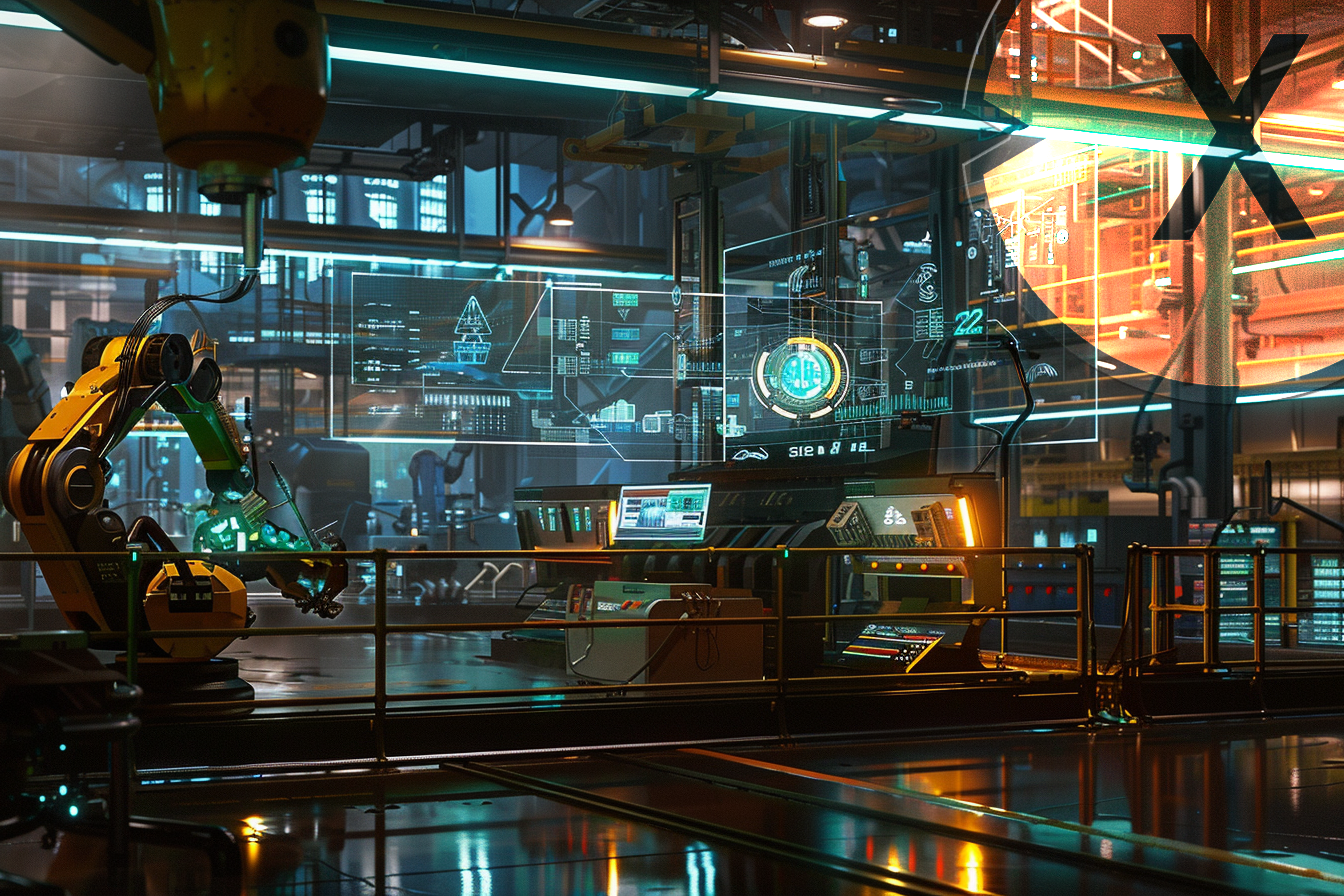
The future of manufacturing in global SME mechanical engineering is digital, automated, sensor-controlled, networked, AI- and robot-supported – Image: Xpert.Digital
🤖 Automation and AI: The new standard for manufacturing
🌟 Innovation and quality: The path of SMEs to top performance
The future of manufacturing in the global SME mechanical engineering sector is increasingly digital, automated, networked, and based on artificial intelligence (AI) and robotics. These developments not only open up new opportunities for small and medium-sized enterprises (SMEs) in the mechanical engineering industry, but also set new standards for efficiency, flexibility, and quality in production. The use of state-of-the-art technologies enables SMEs to hold their own in a global market characterized by growing competition, dynamic customer demands, and rapid technological advancements.
🔑 Digital transformation as the key to competitiveness
Digital transformation is indispensable in the modern manufacturing landscape. Companies that adopt digital tools and processes early on have a clear competitive advantage. At the heart of this transformation is the concept of "Industry 4.0," which promotes the integration of digital technologies into production processes. Smart machines and networked systems enable seamless communication and data transfer along the entire value chain. Sensors capture relevant production data in real time, which is then stored in cloud systems and analyzed by AI algorithms. In this way, companies can create precise forecasts, identify potential bottlenecks, and continuously optimize their production processes.
One advantage of digitalization lies in the ability to simulate production processes and optimize them even before actual manufacturing begins. Virtual twins, i.e., digital representations of real production systems, enable risk-free planning and adjustment of production. SMEs can thus reduce investment costs, avoid production downtimes, and react quickly to market changes. In practice, this means that companies can respond more flexibly and agilely to customer needs and offer customized solutions.
⚙️ Automation as a driver of efficiency
Process automation represents another key building block for the future of manufacturing in SME mechanical engineering. The use of automated systems allows routine tasks to be completed faster and more accurately. This not only increases productivity but also reduces the error rate and lowers production costs. Modern robots integrated into production lines, for example, take over monotonous or physically demanding tasks previously performed by human workers.
Automated systems are also capable of operating around the clock, increasing production capacity and offering companies greater flexibility. This flexibility can be crucial, especially in international competition, as it allows companies to react more quickly to fluctuations in demand. Integrating intelligent robots into the manufacturing process not only makes production more efficient but also more scalable, facilitating adaptation to market fluctuations.
📡 Sensor-controlled systems for precise data analysis
Sensors are at the heart of modern manufacturing systems and play a crucial role in process optimization. These systems continuously collect data on production parameters such as temperature, pressure, speed, and quality, enabling seamless monitoring of manufacturing processes. Combined with big data analytics and AI, companies can use this data to identify potential problems early and prevent downtime.
Sensor technology enables predictive maintenance. This type of maintenance reduces unplanned downtime because machines are only serviced when actually necessary. A machine learning model based on historical data can recognize patterns and indicate when maintenance is due. This is particularly advantageous for SMEs, as unplanned downtime can incur significant costs. Predictive maintenance optimizes maintenance cycles and contributes to cost reduction and increased machine lifespan.
🌐 Networking as the basis for smart production processes
Networked production is the foundation for modern manufacturing concepts. Machines, equipment, and systems are interconnected via the "Internet of Things" (IoT) and communicate in real time. This communication enables seamless collaboration and ensures that each production step is optimally coordinated with the previous one. This allows companies to improve their material flow, avoid bottlenecks, and reduce production costs.
A fully networked production facility also allows companies to react to global changes in the supply chain. They can track data on the origin and condition of raw materials and make adjustments in real time to address supply chain disruptions or raw material shortages. In this way, SMEs not only remain competitive but can also respond more flexibly and proactively to external challenges.
🔍 Artificial intelligence as a decision-making aid
Artificial intelligence (AI) has the potential to revolutionize production processes in mechanical engineering. AI algorithms analyze vast amounts of data collected by networked systems and support companies in their decision-making. Based on this data, production plans can be created, production lines optimized, and bottlenecks identified early on. AI is also an important tool for quality control, as deviations or defects in products can be automatically detected and reported.
In addition to quality assurance, AI can also optimize workforce planning. By analyzing working hours, production capacity, and employee absences, human resources can be deployed efficiently. For SMEs, this means optimal employee utilization and reduced personnel costs, which in turn increases competitiveness.
🤖 Robotics: A glimpse into the future of production halls
Modern robotics technology has ushered in a new era in industrial manufacturing. Robots are no longer solely responsible for heavy or dangerous tasks, but are increasingly taking on precise and demanding jobs that require the highest accuracy. The use of collaborative robots, so-called "cobots," is particularly attractive for SMEs, as they work alongside humans and can be easily integrated into existing processes.
These cobots can be flexibly deployed for various tasks and contribute to increased productivity without requiring large investments in new equipment. Especially for SMEs, which often have limited resources, the use of such robots offers a cost-effective way to raise production to a new level while simultaneously improving working conditions for employees.
🌱 Challenges and opportunities of digital transformation for SMEs
Despite its numerous advantages, the digitalization of manufacturing also presents challenges. SMEs often face the task of implementing new technologies without the financial resources and technical expertise of large corporations. The move to digitalization is often associated with high investment costs that do not pay off immediately. Furthermore, employees need to be trained to use the new technologies, which requires additional effort and time.
Nevertheless, digital transformation also offers enormous opportunities for SMEs in the mechanical engineering sector. By adapting to modern standards, they can significantly increase their competitiveness and tap into new market segments. Particularly in specialized niche markets, where flexibility and innovation are key, SMEs have the opportunity to strengthen their position and differentiate themselves from the competition through customized solutions.
🚀 The future of manufacturing in SME mechanical engineering
The technologies described will continue to grow in importance in the coming years and will have a lasting impact on the manufacturing landscape. SMEs that embrace digital transformation early on will benefit from the advantages in the long term and strengthen their market position. The combination of digitalization, automation, AI, and robotics enables these companies to establish innovative production models and meet the increasing demands of the global market.
The future of manufacturing in the global SME mechanical engineering sector is exciting and promising. The use of modern technologies opens up diverse opportunities for increasing efficiency, reducing costs, and ensuring quality. This development presents an opportunity for companies willing to embrace new approaches and integrate digitalization as a core component of their business strategy. In this way, mechanical engineering will continue to be a key driver of innovation and growth, enabling SMEs to solidify their position in the global economy.
📣 Similar topics
- 🤖 The future of manufacturing: AI and robotics in SME mechanical engineering
- 🔗 Networked systems: IoT as the basis of modern production
- 📊 Sensor-controlled processes: The path to precise data analysis
- 🌐 Mastering global challenges: Flexibility through digitalization
- 🚀 Industry 4.0: Opportunities for SMEs in international competition
- 🌱 Sustainability in manufacturing: Increasing efficiency through automation
- ⚙️ Smart machines: Drivers of digital transformation
- 🤝 Cobots in action: Humans and robots working hand in hand
- 📈 Competitive advantages through digital twins
- 💡 Artificial intelligence as the key to increasing efficiency
#️⃣ Hashtags: #Digitalization #IoT #Automation #ArtificialIntelligence #KMUInnovation
Our recommendation: 🌍 Limitless reach 🔗 Connected 🌐 Multilingual 💪 Sales power: 💡 Authentic with strategy 🚀 Innovation meets 🧠 Intuition


From local to global: SMEs conquer the world market with a clever strategy - Image: Xpert.Digital
In an era where a company's digital presence determines its success, the challenge lies in creating an authentic, personalized, and far-reaching presence. Xpert.Digital offers an innovative solution that positions itself as the intersection of an industry hub, a blog, and a brand ambassador. It combines the advantages of communication and sales channels in a single platform and enables publication in 18 different languages. Cooperation with partner portals and the ability to publish articles on Google News and a press distribution list with approximately 8,000 journalists and readers maximize the reach and visibility of the content. This represents a crucial factor in external sales and marketing (SMarketing).
More information here:
We are here for you - Consulting - Planning - Implementation - Project Management
☑️ SME support in strategy, consulting, planning and implementation
☑️ Creation or realignment of the digital strategy and digitization
☑️ Expansion and optimization of international sales processes
☑️ Global & Digital B2B trading platforms
☑️ Pioneer Business Development

Konrad Wolfenstein
I would be happy to serve as your personal advisor.
You can contact me by filling out the contact form below or simply call me on +49 7348 4088 965 .
I'm looking forward to our joint project.
Write to me


Xpert.Digital - Konrad Wolfenstein
Xpert.Digital is a hub for industry focusing on digitalization, mechanical engineering, logistics/intralogistics and photovoltaics.
With our 360° Business Development solution, we support renowned companies from new business to after-sales.
Market intelligence, smarketing, marketing automation, content development, PR, mail campaigns, personalized social media and lead nurturing are part of our digital tools.
You can find more information at: www.xpert.digital - www.xpert.solar - www.xpert.plus
Keep in touch