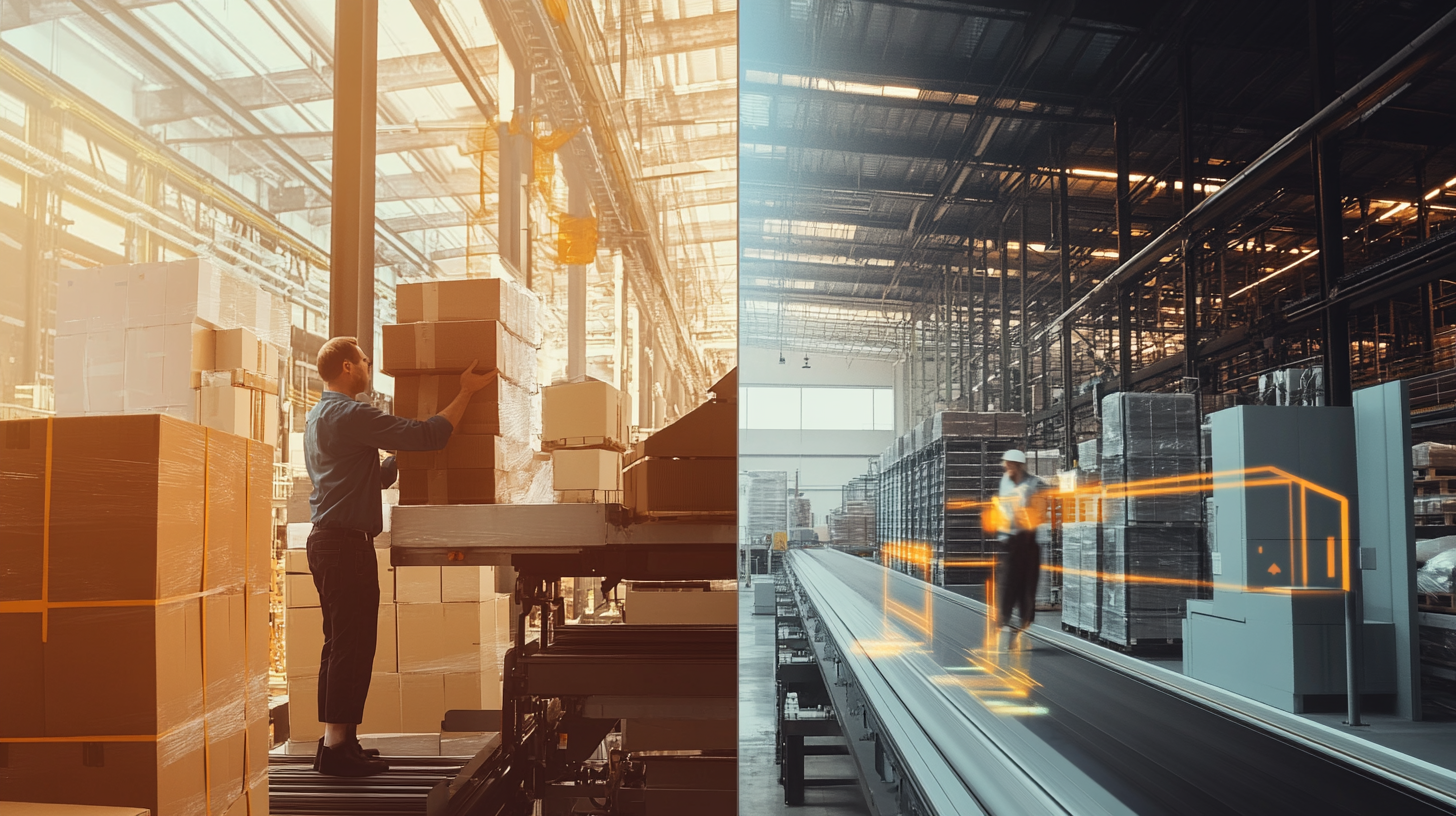
Automation is now affordable for SMEs! No more expensive and complicated solutions: Intralogistics automation is finally becoming simple and affordable – Image: Xpert.Digital
Intralogistics of the future: Scalable solutions for every business – Here's how it works
Efficiency Boosters for Intralogistics: How Standardized Systems Reduce Your Costs & Accelerate Your Processes
The intralogistics industry is constantly evolving to meet the growing demands of the modern economy. Efficiency, flexibility, and automation are now crucial success factors. A leading Hamburg-based intralogistics specialist focuses on simple and scalable solutions to make automation accessible not only to large corporations but also to small and medium-sized enterprises.
The new strategy: Simple and scalable automation
To make it easier for companies of all sizes to get started with automation, the intralogistics specialist is pursuing a strategy that focuses on standardization, scalability, and efficiency. The most important aspects of this strategy are:
Expansion of the product portfolio
In addition to its established solutions for large corporations, the company is expanding its offerings to include modular and scalable systems. These enable small and medium-sized enterprises to start with a basic solution and expand it as needed.
Standardization and availability
Standardized products with high availability ensure faster implementation. Companies benefit from reduced planning and implementation time, allowing them to reap the benefits of automation more quickly.
Individual consultation despite standardization
Despite the focus on standardized systems, individual consultation remains a central element of the offering. Companies receive tailor-made solutions that can be flexibly adapted to their specific requirements.
Tailor-made service packages
To ensure optimal use of the new systems, tailored service packages are offered that include maintenance, training, and support. This ensures that companies can get the most out of their investment.
Why automation is indispensable for intralogistics
Automating intralogistics is no longer a luxury, but a necessity. Companies face a multitude of challenges that can be overcome through automation:
- Increased productivity: Automated systems operate around the clock with constant efficiency, which significantly increases throughput.
- Increased efficiency: Automation reduces unnecessary transport routes, optimizes inventory levels and lowers costs.
- Improved process reliability: Automated processes minimize human error and ensure consistently high quality.
- Competitiveness: In a globalized market, companies can hardly hold their own without automation.
- Solution to the skills shortage: The increasing shortage of qualified workers can be at least partially compensated for through automation.
Related to this:
Advantages of simple and scalable intralogistics solutions
The approach of making automation accessible through simple and scalable solutions brings with it a multitude of advantages:
1. Lower entry barriers
- Lower investment costs: Standardized solutions reduce initial investments and enable even smaller companies to access automation.
- Easy implementation: Predefined components and standardized interfaces allow companies to start automating faster.
- User-friendliness: Systems like Still's iGo easy are intuitive to use and require only a short training period.
2. Flexibility and adaptability
- Modular design: Scalable solutions grow with a company's needs. New modules can be easily added or existing systems adapted.
- Gradual expansion: Companies can initially implement small projects and expand automation step by step.
3. Efficiency and cost-effectiveness
- Faster implementation: Standardized components ensure rapid implementation and reduce downtime during rollout.
- Reduced risk of failure: Proven technologies minimize the risk of system failures and enable reliable operation.
- Cost savings: Optimized processes can reduce costs in the long term, especially through more efficient use of personnel and storage space.
4. Improved integration and compatibility
- Standardized interfaces: Solutions such as the VDA 5050 interface enable seamless integration of different systems and vehicles – even from different manufacturers.
- Future-proof: Companies benefit from long-term planning security because their systems are expandable and adaptable.
Related to this:
How standardization increases efficiency
Standardized intralogistics solutions offer companies clear advantages:
Simplification and optimization of processes
- Predictability and planning: Standardized processes facilitate control and avoid unexpected bottlenecks.
- Reduced complexity: Uniform interfaces and standardized components facilitate integration and management.
- Faster project implementation: Standardized systems are often faster to implement than individually developed solutions.
Cost efficiency and scalability
- Low initial costs: Companies can begin automating without high investments.
- Flexible expansion: Systems can be easily expanded as demand increases.
- Long-term savings: Automated processes reduce operating costs and optimize resource utilization.
Improvement of quality and performance
- Consistent quality: Automated systems deliver consistently high quality, without fluctuations due to human error.
- Increased efficiency: 24/7 operation maximizes productivity and minimizes downtime.
- Error reduction: Standardized workflows and intuitive user guidance minimize operator errors.
Future-proof and flexible
- Interoperability: Standardized interfaces allow different systems to communicate easily with each other.
- Adaptability: Modular systems can be flexibly adapted to changing market requirements.
- Transparency and traceability: Changes to processes, machines or parameters are easily traceable.
The future of intralogistics
Intralogistics is at a turning point. While automation was long only feasible for large companies, standardized and scalable solutions now also enable small and medium-sized enterprises to enter the market. The advantages are numerous: increased efficiency, lower costs, improved quality, and future-proofing.
The Hamburg-based intralogistics specialist is setting a clear course for the future of the industry with its new approach. Through an intelligent combination of standardization, customization, and scalability, automation is becoming accessible to a broad target group. This could mark the beginning of a new era in intralogistics, where automation is no longer just an option, but a given.
Expert partner in warehouse planning and construction

Our recommendation: 🌍 Limitless reach 🔗 Connected 🌐 Multilingual 💪 Sales power: 💡 Authentic with strategy 🚀 Innovation meets 🧠 Intuition


From local to global: SMEs conquer the world market with a clever strategy - Image: Xpert.Digital
In an era where a company's digital presence determines its success, the challenge lies in creating an authentic, personalized, and far-reaching presence. Xpert.Digital offers an innovative solution that positions itself as the intersection of an industry hub, a blog, and a brand ambassador. It combines the advantages of communication and sales channels in a single platform and enables publication in 18 different languages. Cooperation with partner portals and the ability to publish articles on Google News and a press distribution list with approximately 8,000 journalists and readers maximize the reach and visibility of the content. This represents a crucial factor in external sales and marketing (SMarketing).
More information here:
The future of intralogistics: How automation can become achievable for all companies - background analysis
Intralogistics in transition: Simple and scalable automation solutions as the key to success
Intralogistics, the backbone of every manufacturing or distribution-oriented company, is undergoing continuous and rapid change. Driven by the increasing demands of a globalized economy, the growing e-commerce sector, and the growing pressure for efficiency and flexibility, companies are increasingly seeking innovative solutions to optimize their internal material and goods flows. In this dynamic environment, a leading Hamburg-based intralogistics specialist is positioning itself with a new strategy aimed at making automation solutions accessible to a wider range of companies. The focus is on simple, scalable, and standardized systems that facilitate entry into the world of intralogistics automation while simultaneously ensuring the flexibility needed for future growth and evolving requirements.
Key points of the new corporate strategy: Automation for all
The strategy of the Hamburg-based intralogistics specialist is based on several interconnected pillars that represent a comprehensive response to current market challenges. At its core is the conviction that automation should no longer be reserved for large corporations, but can also be a decisive competitive advantage for small and medium-sized enterprises (SMEs).
Related to this:
Expanded and diversified solution portfolio
The company is expanding its existing product range, traditionally geared towards large and medium-sized enterprises, to include a spectrum of simpler, scalable, and modular automation solutions. This portfolio expansion aims to make automation accessible to smaller businesses with more limited budgets and resources. Instead of offering complex, customized systems that often require significant investment and lengthy implementation times, the company is now focusing on standardized products that can be flexibly adapted to individual customer needs. This includes, for example, the use of automated guided vehicles (AGVs) in simpler configurations, modular conveyor solutions, and software systems with intuitive user interfaces.
Focus on standardization and high availability
A key aspect of the new strategy is the focus on standardized products and components. Standardization not only reduces production costs but also significantly increases system availability. Standardized products are generally available more quickly and easier to install and maintain. Furthermore, customers benefit from shorter implementation times and reduced downtime risks, as standardized technologies are typically more mature and better tested. High system availability is a crucial factor, since production downtime and intralogistics failures can incur substantial costs. Standardized service processes and the use of remote maintenance technologies also minimize response times to malfunctions and ensure a rapid restoration of operational readiness.
Personal consultation and individual solution finding
Despite its increased focus on standardization and scalable solutions, the company continues to place great emphasis on personalized customer consultation. Every implementation begins with a comprehensive analysis of the customer's individual requirements and processes. Experienced intralogistics experts take the time to understand the specific needs of each company, analyze existing workflows, and work with the customer to develop the optimal automation solution. This personalized consultation is crucial to ensuring that the chosen solution is not only cost-effective and scalable, but also perfectly tailored to the customer's specific requirements and generates maximum added value. The consultation encompasses not only the selection of suitable technologies, but also support with integration into the existing IT infrastructure, employee training, and long-term system maintenance.
Tailor-made service packages for optimal system utilization
In addition to its products and consulting services, the Hamburg-based intralogistics specialist offers tailored service packages designed to ensure optimal use and maintenance of the implemented systems. These service packages can include various services depending on the customer's needs, such as regular maintenance inspections, preventative maintenance, 24/7 hotline support, training, and software updates. This comprehensive service offering ensures that customers not only receive a high-quality automation solution but also benefit from the smooth operation and maximum performance of their systems in the long term. The service packages are modular and can be flexibly adapted to the individual needs and budgets of each customer.
The growing importance of automation in intralogistics: drivers and benefits
The automation of processes in intralogistics is no longer just a trend, but a necessity for companies that want to remain competitive in the global market. The reasons for this development are manifold and range from economic and technological to societal factors.
Related to this:
- Warehouse at its limit? Warehouse automation: Warehouse optimization vs. retrofit – The right decision for your warehouse
- Smart warehouses with warehouse automation and AI: Why warehouse automation is becoming the heart of the supply chain
Increased productivity and efficiency
Automated systems typically operate significantly faster, more precisely, and more reliably than manual processes. They can be used around the clock, 7 days a week, without fatigue or fluctuations in performance. This leads to a significant increase in throughput and productivity in intralogistics. By automating repetitive and physically demanding tasks, employees are relieved of these burdens and can focus on more value-added activities. Efficiency gains are also achieved through the optimization of material flows, the reduction of downtime and waiting times, and the minimization of errors.
Increased efficiency and cost reduction
Automation significantly contributes to increased efficiency and cost reduction in intralogistics. Optimized processes allow for more efficient use of resources such as energy, materials, and personnel. Automated systems can, for example, better utilize storage capacities, optimize energy consumption, and reduce material consumption. Automation can also reduce personnel costs, as fewer employees are needed for repetitive tasks. In the long term, investments in automation solutions pay for themselves through the resulting efficiency gains and cost savings.
Improved process reliability and quality enhancement
Automated systems operate in a standardized and precise manner, minimizing human error and significantly increasing process reliability. This is particularly important in sectors with high quality standards and traceability requirements, such as the pharmaceutical and food industries. Automating order picking processes, for example, reduces the likelihood of incorrect deliveries and increases customer satisfaction. Occupational safety is also improved through automation, as dangerous or physically demanding tasks can be taken over by machines.
Increased competitiveness
In an increasingly globalized and competitive market, the efficiency and flexibility of intralogistics are crucial factors for a company's competitiveness. Companies that automate their intralogistics processes can reduce costs, shorten delivery times, improve quality, and respond more quickly to changing market demands. This gives them a significant competitive advantage over companies that still rely on manual or semi-automated processes.
Solution to the labor shortage and demographic change
Many industrialized countries are experiencing a growing shortage of skilled workers, particularly in the logistics sector. Automation can help alleviate this shortage by taking over repetitive and physically demanding tasks, thereby increasing the attractiveness of jobs in logistics. Furthermore, automation enables companies to maintain and even expand their production and logistics processes despite an aging workforce and a declining working-age population.
Simple and scalable intralogistics solutions: Advantages in detail
The approach of the Hamburg-based intralogistics specialist, which focuses on simple and scalable solutions, offers a number of crucial advantages compared to complex and customized systems, especially for SMEs.
Lower entry barriers and cost efficiency
Simple and scalable solutions are characterized by lower acquisition costs and reduced implementation efforts. Standardized components and modular designs reduce complexity and enable faster, more cost-effective installation. This makes automation accessible even to companies with limited budgets and resources, dispelling the myth that automation is only affordable for large corporations. The lower initial investment and faster amortization make these solutions particularly attractive for SMEs, which are often more cautious when investing in new technologies.
Flexibility and adaptability to growing demands
Scalable solutions allow companies to start small and gradually increase their level of automation as they gain experience and their needs grow. Thanks to their modular design, systems can be flexibly expanded or adapted to changing requirements without having to replace large parts of the existing infrastructure. This flexibility is particularly important in dynamic markets where requirements can change rapidly. Companies can thus optimize their intralogistics step by step and adapt it to their individual growth.
Faster implementation and shorter project durations
By using standardized components and interfaces, projects with simple and scalable solutions can be implemented significantly faster than with complex, customized solutions. Shorter project durations mean faster system commissioning and a quicker return on investment for companies. This is particularly advantageous in industries where rapid response times and short time-to-market cycles are crucial.
Reduced failure risks and improved maintainability
Standardized and proven technologies minimize the risk of system failures and enable faster, simpler service. The use of standard components generally makes spare parts more readily available, and maintenance can be performed by a wider range of technicians. This reduces reliance on specialized service providers and lowers maintenance costs. Furthermore, many simple and scalable solutions can be equipped with remote maintenance technologies, allowing for rapid diagnosis and resolution of malfunctions.
Improved integration and compatibility through standardized interfaces
Many simple and scalable intralogistics solutions rely on standardized interfaces, such as the VDA 5050 interface for automated guided vehicles (AGVs). These standardized interfaces facilitate the integration of various systems and vehicles, even from different manufacturers. This increases the flexibility and interoperability of the systems and enables companies to operate a heterogeneous fleet of automation solutions that are optimally tailored to their specific needs. Easy integration into existing IT systems, such as warehouse management systems (WMS) or enterprise resource planning (ERP) systems, is also a significant advantage.
Standardization as the key to increasing efficiency in intralogistics
Increasing efficiency in intralogistics through standardized products and processes offers numerous advantages for companies and is an essential part of the strategy of the Hamburg-based intralogistics specialist.
Simplification and optimization of processes
Standardized products and processes create clarity and predictability in intralogistics. Processes become more plannable and controllable, increasing the efficiency and transparency of the entire value chain. By reducing complexity and product variety, potential errors are minimized and lead times are shortened. Standardized workflows and user interfaces facilitate employee onboarding and reduce training requirements.
Cost efficiency and scalability through reusable modules
Standardized solutions are often based on reusable modules and components that can be used in various applications and configurations. This reduces development, production, and warehousing costs. The scalability of standardized solutions allows companies to gradually expand their intralogistics and adapt it to their growth without having to invest in completely new systems each time.
Improvement of quality and performance through proven technologies
Standardized processes and products are generally based on tried and tested technologies that have proven themselves in practice. This ensures high quality and reliability of the systems. By automating standardized processes, companies can guarantee consistently high quality in their products and services and increase their competitiveness. The efficiency gains achieved through standardization enable companies to accomplish more with fewer resources and improve their profitability.
Future-proof and flexible through open standards
The use of open standards and interfaces in standardized intralogistics solutions ensures interoperability with systems from different manufacturers and future-proofs the investment. Companies remain flexible and can expand their systems as needed or adapt them to new technologies without being tied to a single vendor. The transparency and traceability of standardized processes and systems facilitate error analysis, optimization, and adaptation to changing requirements.
The path to comprehensive intralogistics automation
The Hamburg-based intralogistics specialist is pursuing a promising path with its new strategy to make the benefits of automation accessible to a wider customer base. By focusing on simple, scalable, and standardized solutions, the company lowers the barriers to entry for SMEs and improves the cost-effectiveness of automation projects. This could represent a significant step towards the widespread modernization of intralogistics in Germany and beyond. The combination of standardized products, individual consulting, and tailored service packages offers companies of all sizes the opportunity to make their intralogistics more efficient, flexible, and future-proof, thereby sustainably strengthening their competitiveness. Intralogistics automation is no longer a question of "if," but "how," and the Hamburg specialist's approach provides compelling answers to this question.

Xpert.Plus Warehouse Optimization - High-bay warehouses and pallet warehouses: Consulting and planning
We are here for you - Consulting - Planning - Implementation - Project Management
☑️ SME support in strategy, consulting, planning and implementation
☑️ Creation or realignment of the digital strategy and digitization
☑️ Expansion and optimization of international sales processes
☑️ Global & Digital B2B trading platforms
☑️ Pioneer Business Development

Konrad Wolfenstein
I would be happy to serve as your personal advisor.
You can contact me by filling out the contact form below or simply call me on +49 7348 4088 965 .
I'm looking forward to our joint project.
Write to me


Xpert.Digital - Konrad Wolfenstein
Xpert.Digital is a hub for industry focusing on digitalization, mechanical engineering, logistics/intralogistics and photovoltaics.
With our 360° Business Development solution, we support renowned companies from new business to after-sales.
Market intelligence, smarketing, marketing automation, content development, PR, mail campaigns, personalized social media and lead nurturing are part of our digital tools.
You can find more information at: www.xpert.digital - www.xpert.solar - www.xpert.plus
Keep in touch