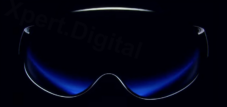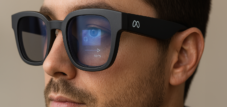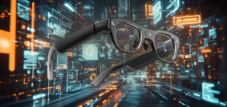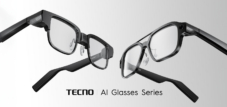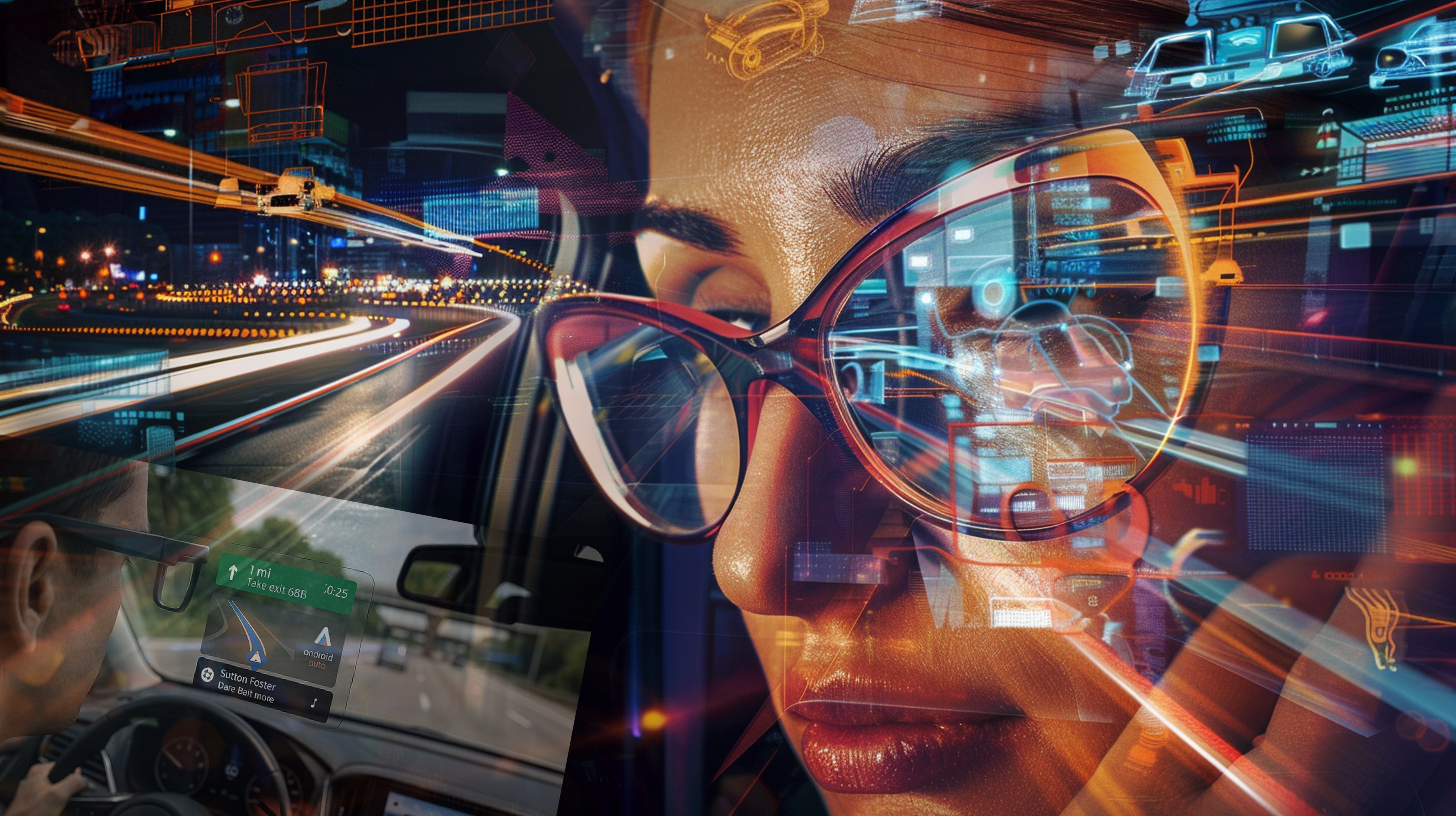
Safer driving thanks to smart glasses? Android Auto hints at a new feature – A head-up display 2.0? – Image: Xpert.Digital
Android Auto and Smart Glasses: The next generation of the driving experience?
Is Android Auto preparing for integration with smart glasses? A new era of navigation?
An analysis of the latest Android Auto update reveals strong indications of upcoming connectivity with smart glasses, which could revolutionize the driving experience. This development coincides with Google's increased activity in the field of augmented reality (XR) and promises to fundamentally change the way we use navigation information while driving.
Related to this:


The discovery in the code: Hints of smart glasses integration
In the latest version of Android Auto (v14.2.151544), experts have discovered revealing text snippets while analyzing the code. Two new strings in the code clearly indicate a planned integration with smart glasses. The first string simply defines a "Glasses Option," while the second, with the instruction "Start navigation to launch Glasses," is more specific.
Particularly revealing is the Hindi version of this second string, which translates more clearly as "To display navigation on smart glasses, start navigation." The German string, discovered by Android Authority, is similarly unambiguous: "To display navigation on smart glasses, start navigation." This wording leaves little doubt that Google is working on a feature that will allow navigation instructions from Android Auto to be transmitted directly to smart glasses.
The discovery in the source code was made by various technical publications such as Android Authority, 9to5Google and SammyGuru, who all come to the same conclusion: Android Auto is preparing for integration with smart glasses.
Android XR: Google's new platform for smart glasses
The discovered code clues appear particularly relevant in the context of Google's recent activities in the field of smart glasses. Just recently, at the TED 2025 conference, Google presented its Android XR glasses. During this demonstration, the Android XR product manager personally showcased a pair of smart Google glasses that were virtually indistinguishable from regular glasses.
The concept behind these glasses is based on a constant connection between the smartphone and the glasses: "These glasses work with your phone, streaming back and forth, allowing the glasses to be very lightweight and access all of your phone apps." This principle enables a compact design, as the computationally intensive work is handled by the smartphone, while the glasses primarily function as a display and input device.
From "car" to "vehicle": A significant terminological change
Interestingly, Google recently made a subtle but significant change to Android Auto: the term "car" or "cars" was replaced with "vehicle" or "vehicles." While the product name "Android Auto" remains, all interfaces relating to the car itself have been renamed.
This change suggests that Google wants to open the platform to a wider range of vehicles. In fact, Android Auto has been used on motorcycles from manufacturers like Ducati, Honda, and KTM for several years. The renaming could indicate that Google is now planning more specific adaptations for different vehicle types – possibly in conjunction with smart glasses integration.
Related to this:

Potential applications and benefits
Increased safety through head-up display functionality
The most obvious advantage of integrating Android Auto with smart glasses lies in increased safety. Instead of having to take their eyes off the road to look at the infotainment screen, drivers could receive navigation instructions directly in their field of vision.
“Looking at a screen for navigation while driving is undoubtedly a hazard. So overlaying guidance on glasses, that lets you keep focused on the road, makes a lot of sense,” one of the reports states. The smart glasses would thus function as a kind of head-up display, without the vehicle itself needing to be equipped with this technology.
Expanded application areas beyond the automotive sector
Smart glasses integration could be particularly interesting for motorcyclists and cyclists. These user groups often lack the ability to safely use an infotainment display while riding. Smart glasses could fill this gap and make Android Auto's navigation functions accessible to a wider range of road users.
The use of the term "vehicle" instead of "car" in the Android Auto interface underlines this focus on different forms of mobility.
Potential integration with Gemini AI
Another exciting aspect is the potential integration of the Android Auto Smart Glasses function with Google's Gemini AI. At the TED 2025 demo, Google demonstrated how the XR glasses, in conjunction with Gemini, can function as a "memory.".
In the demonstration, a user asked where she had left her hotel room key, and Gemini, thanks to the XR glasses, was able to answer: "The hotel key card is to the left of the music record." Applied to the driving context, this could mean that the glasses not only help with navigation but also with remembering important locations such as gas stations, cafes, or suitable stopping points.
Timeframe and outlook
The discovered code snippets indicate that the feature is still in an early stage of development. "This is just a few lines of code at this point, so it appears to be in the very early stages of development," a report states.
More precise details or an official announcement could come at the upcoming Google I/O in May 2025. This also raises the question of which smart glasses will support this feature – Google's own Android XR glasses are an obvious candidate, but devices from other manufacturers may also be compatible.
The Android XR product manager hinted during the TED conference that Google is currently still working on improving battery life and lowering the price. This could indicate that while the first devices will be unveiled soon, they might not be immediately intended for the mass market.
Competition in the smart glasses market
Google isn't the only company working on smart glasses. Reports indicate that Samsung is also developing its own smart glasses, codenamed "HAEAN." These are expected to be announced before the end of the year and will reportedly feature Qualcomm's AR1 chipset, a 12MP Sony IMX681 camera, and a 155mAh battery. Weighing around 50 grams, they are also said to offer AI features powered by Google's Gemini LLM.
Android Auto and Smart Glasses: A look into the future of infotainment
The discovery of smart glasses references in the Android Auto code marks a significant step in the evolution of Google's infotainment platform. This integration could revolutionize how we use navigation while driving, while simultaneously increasing safety.
The timing of this discovery is particularly interesting, as it coincides with Google's increased activity in the areas of smart glasses and XR. The combination of Android Auto, smart glasses, and AI features like Gemini could create a powerful ecosystem that extends far beyond the traditional boundaries of infotainment systems.
While we await official announcements, the evolution of Android Auto towards smart glasses integration remains a fascinating example of how the boundaries between different technology areas are increasingly blurring, creating new and innovative user experiences.
Related to this:
Your global marketing and business development partner
☑️ Our business language is English or German
☑️ NEW: Correspondence in your native language!

Konrad Wolfenstein
I and my team are happy to be available to you as your personal advisor.
You can contact me by filling out the contact form here wolfenstein@xpert.digital:or simply call me at +49 7348 4088 965. My email address is
I'm looking forward to our joint project.