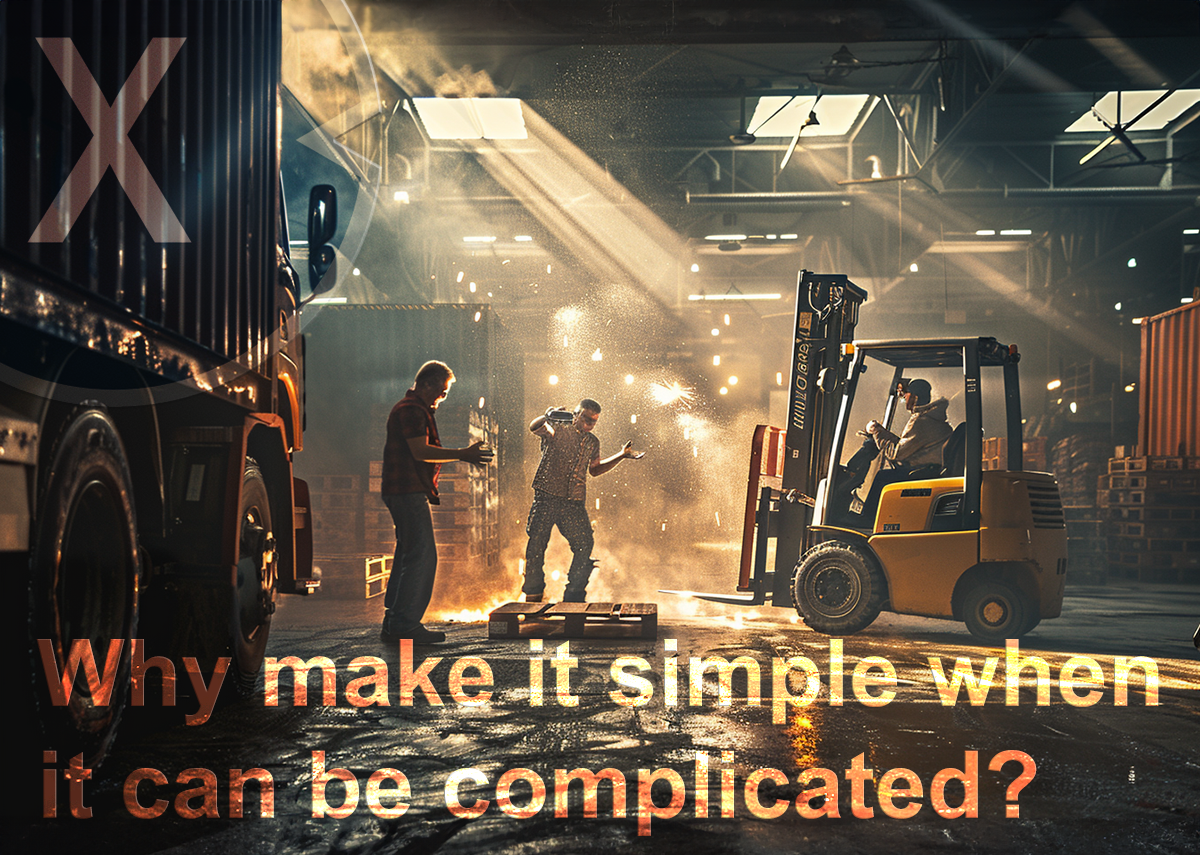
Treatise: Why make it simple when you can make it complicated – The current situation in the German economy – Image: Xpert.Digital
🛑📉 No prospect of growth: When the focus is on the negative
📉💡 Missed opportunities: The danger of a negative economic mentality
When the dominant attitude in an economy is to first point out what doesn't work or isn't possible, it's a clear sign that little growth or sustainability can be expected in that environment. A culture of rejection and stagnation emerges, stifling innovation and entrepreneurial initiative. In many companies and service sectors, one can observe how rigid regulations, bureaucracy, and the constant highlighting of limitations lead to a blockage. Instead of seeking solutions and seizing opportunities, the focus is often directed toward what is impossible.
🏢 The bureaucracy's obstructionist stance
One example that illustrates this attitude is the way bureaucratic hurdles are handled in many industries. Businesses and individuals often find themselves confronted with a flood of regulations that present more obstacles than help. While regulations are necessary to ensure standards and prevent abuse, the entire economy suffers when these regulations become so prevalent that they stifle flexibility.
Sustainability and growth depend on the ability to adapt flexibly to new circumstances, and this requires openness to innovation and creativity. However, if an economy is primarily focused on identifying problems and risks rather than recognizing opportunities, sustainable solutions will not emerge. Businesses need room to take risks, make mistakes, and learn from them. But when every decision is slowed down by endless bureaucratic processes, crucial opportunities are lost.
🌟📖✨ My recent personal experiences with examples
🚛 The example of the freight forwarder
An example from my everyday business life illustrates this problem: A freight forwarder explained to me that a pallet, loaded with bulky materials due to the circumstances, could not be transported because the pallet jack supposedly couldn't support the weight or fit under the Euro pallet. However, when I demonstrated that it was indeed possible to transport the pallet, the initial resistance became obvious. This isn't a technical or logistical problem, but rather a mindset focused on finding problems instead of solutions. Such situations often arise when companies prioritize minimizing risks and responsibilities over providing added value to the customer.
This behavior can also be applied to other areas: When service providers prefer rejections and excuses instead of actively seeking solutions, it leads to a loss of trust and, in the long run, to a deterioration of business relationships. In an economy that aims for growth and sustainability, however, the focus should be on overcoming obstacles and finding new ways to solve problems.
Unclear communication and lack of responsibility 🔄
Another example illustrates the problem of a lack of accountability and clear communication: A company advertising "Refrigeration – Air Conditioning – Electrical Engineering – Heat Pumps" provides a quote for the installation of an air conditioning system. After the installation, however, they explain that the connection cannot be made because the company lacks the necessary qualifications (in this case, a master electrician). This demonstrates a discrepancy between what the company promises and what it can actually deliver. Customers trust that a service provider offering a specific service will fully deliver it. If this trust is not met, frustration arises, and trust in the company erodes.
Unclear or misleading self-presentation, as in this case, is not only annoying for the customer but also damages the company itself in the long run. The word-of-mouth that arises after such negative experiences often deters potential new customers. However, a company that communicates honestly about its capabilities and limitations builds trust and strengthens its market position in the long term.
Lack of commitment and delays ⏳
A third example illustrates a "convenient" delay by a tradesman who doesn't want to immediately rectify a defect he caused on the house wall. Although the scaffolding, which is about to be dismantled, is still in place, the tradesman prefers to go on his lunch break instead of fixing the problem right away. He emphasizes beforehand that he can't fix the defect using a ladder for safety reasons – only via the scaffolding. The scaffolding company therefore had to wait to dismantle it. Such behavior demonstrates not only a lack of willingness to take responsibility but also a lack of sense of urgency and customer focus.
In many cases, it is not technical or organizational incompetence that hinders progress, but rather a mentality of "comfortable waiting" and "complacency." Such behaviors delay projects and lead to unnecessary costs and losses of time. Sustainable business practices and growth, however, require companies and their employees to act proactively, face challenges, and take responsibility.
🌟 The importance of solution-oriented thinking
These examples illustrate the importance of fostering a positive and solution-oriented work culture. Companies striving for long-term success must move away from a mindset primarily focused on risk avoidance. Instead, they should concentrate on how to overcome obstacles and seize new opportunities. Such an attitude begins with leadership and must be embedded at all levels of the organization. Leaders play a crucial role in creating an environment that encourages innovation and empowers employees to take ownership.
Clearly defined responsibilities and expectations are also essential. When employees know exactly what is expected of them and what their authority is, they can act more proactively and make decisions faster. This not only reduces delays but also increases customer satisfaction and strengthens the long-term relationship between the customer and the company.
💡 The connection between innovation, flexibility and sustainability
Companies that operate sustainably and innovatively recognize early on the need to react flexibly to change. Whether through technological innovations, evolving customer needs, or legal requirements – the ability to adapt and change is the key to long-term success. Rigid structures based on insisting on "what can't be done" cannot achieve this.
Instead, companies should increasingly focus on agile management that allows room for experimentation and creative thinking. This doesn't mean that every idea has to be successful, but the willingness to try new things and take risks is the foundation for progress. Such companies are able to continuously evolve and operate successfully even in uncertain times.
🔄 A change in mindset is necessary
If companies and entire sectors of the economy continue to focus on what can't be done, it will be difficult to foster sustainable growth and innovation. A shift in mindset is necessary: instead of creating obstacles, solutions should be sought and opportunities seized. This requires not only courage but also the consistent promotion of a positive and proactive corporate culture. Only in this way can companies achieve long-term, successful, and sustainable growth.
In a constantly changing world, we must learn to remain flexible and open to new ideas. Instead of focusing on the obstacles, we should concentrate on what is possible – because that is the only way we can achieve long-term success.
📣 Similar topics
- 📣 New paths for Germany's economy
- 🚀 Innovation instead of stagnation: Change is necessary
- 📉 From obstacles to opportunities: Rethinking bureaucracy
- 🛠️ Overcoming technical skills vs. mental hurdles
- 🌱 Sustainability requires flexible thinking
- 🔍 Risk vs. Opportunity: A Culture of Entrepreneurship
- 🏢 Exposing bureaucracy as an obstacle to innovation
- 🤝 Trust creates growth: Honest communication
- ⚙️ Proactive action: Key to productivity and success
- 🌐 Economic transformation through agility and creativity
#️⃣ Hashtags: #bureaucracy, #innovation, #sustainability, #growth, #mindsetchange

Xpert.Plus Warehouse Optimization - High-bay warehouses and pallet warehouses: Consulting and planning
🚀🌱 The importance of a positive economic culture for sustainability and growth
🚫➡️✨ From obstacles to solutions: The path to economic renewal
In an economy characterized by globalization and rapid change, it is essential to foster a corporate culture that prioritizes innovation, creativity, and problem-solving skills. An economy that primarily focuses on emphasizing obstacles and impossibilities risks stagnation and cannot enable sustainable growth or innovation in the long run. A paradigm shift toward a proactive, solution-oriented mindset is therefore indispensable.
⚠️ Challenges of a restrictive economic culture
An economic culture heavily influenced by regulation, bureaucracy, and a focus on restrictions can have serious negative consequences. These manifest themselves in various areas:
Inhibition of innovation
Companies and employees who are constantly confronted with regulations and restrictions often experience stunted creativity and a reduced willingness to innovate. New ideas can be stifled in their infancy because the path to their realization seems too complex or risky.
Loss of competitiveness
In a globalized economy, where agility and adaptability represent crucial competitive advantages, a rigid corporate culture can cause companies to fall behind their more flexible competitors.
Demotivation of employees
An atmosphere that constantly emphasizes what is impossible can significantly impair employee motivation and engagement. This leads to a decline in productivity and a higher turnover rate of qualified professionals.
Missed opportunities
An overly cautious attitude towards new opportunities can lead to important business opportunities being missed, which in the long term impairs the growth and development of an organization.
🌿 The path to a sustainable and growth-oriented economy
To achieve a sustainable and growth-oriented economy, a fundamental rethink is required at various levels:
Promoting a culture of opportunity
Companies should cultivate a culture that focuses on opportunities and solutions, rather than problems. This requires encouraging employees to think creatively and develop new, potentially unconventional, approaches.
Investment in further education and skills development
Employees need the right skills and knowledge to develop and implement innovative solutions. Therefore, further training should be a high priority.
Creating flexible structures
Companies need to rethink their organizational structures and make them more adaptable in order to react more quickly to changing market conditions and to promote interdisciplinary collaboration.
Promoting intrapreneurship
Employees should be encouraged to develop entrepreneurial thinking. This can be achieved through initiatives such as internal innovation competitions and the provision of resources for pilot projects.
Implementation of agile methods
The introduction of agile working methods can enable companies to respond more efficiently to changes and promote innovation.
📈 Practical examples and solutions
Example 1: The freight forwarder and the bulky pallet
A freight forwarder who was unable to transport a large pallet demonstrated a lack of flexibility and problem-solving skills. To improve this, employees should be trained in creative problem-solving and customer focus. Additionally, a reward system for innovative solutions could be implemented, and the sharing of successful problem-solving experiences within the team could be encouraged.
Example 2: The company for refrigeration, air conditioning, electrical engineering and heat pumps
A company that advertises services it cannot fully provide suffers from communication problems and misleading marketing. Clear communication of its actual capabilities and partnerships with qualified professionals could help in this situation. Investing in employee training is also crucial to ensure that all advertised services can actually be delivered.
Example 3: The craftsman and the correction on the house wall
A tradesman who was unreliable with repairs demonstrated a lack of responsibility and customer focus. Improvements could be achieved through the implementation of comprehensive quality management, customer service training, and incentives for outstanding service.
👥 The role of leadership in transformation
Leaders play a crucial role in the transition to a positive, solution-oriented business culture. They must act as role models and communicate a vision that inspires and motivates employees
Communication of company values
The company's values, especially the emphasis on innovation and solution-oriented thinking, must be clearly communicated and lived.
Creating a culture that tolerates mistakes
Leaders should foster an environment where mistakes are recognized as learning opportunities, so that employees feel confident trying out new ideas.
Promoting personal responsibility
Employees should be encouraged to take responsibility for their work and to develop solutions independently.
Setting up feedback loops
Regular feedback, both internal and external, promotes continuous improvement.
🌍 The importance of sustainability and long-term thinking
A positive, solution-oriented business culture is closely linked to sustainability. Sustainable business practices require a long-term consideration of ecological, social, and economic aspects
Resource efficiency
Companies should develop innovative solutions to use resources more efficiently.
Circular economy
Promoting models that focus on reuse and recycling.
Social responsibility
The impact of business decisions on employees, communities and society must be taken into account.
Ecological sustainability
Development of products and services that minimize environmental impact.
💡 The role of digitalization and technology
Digitalization and the use of new technologies are key factors in fostering an innovative and solution-oriented business culture. They open up opportunities for increased efficiency, the development of new markets, and the creation of innovative products and services
Investing in digital skills
Employees should be trained in digital technologies and methods.
Data-driven decision-making
By using big data and analytics, informed decisions can be made.
Exploring new technologies
Companies should experiment with technologies such as artificial intelligence and the Internet of Things to unlock new business opportunities.
Digital collaboration
Digital tools improve collaboration and knowledge sharing both within the company and with external partners.
🚀 Commitment and continuous efforts
A business focus on opportunities and solutions offers better chances for sustainable growth and development. The shift towards such a culture requires time, commitment, and continuous effort at all organizational levels. Companies that successfully implement this change are better equipped to meet future challenges, respond flexibly to market changes, and develop innovative solutions. In the long term, they increase their competitiveness.
Creating a positive, solution-oriented business culture is challenging, but essential for the long-term success and sustainability of companies and economies. Everyone – from management to individual employees – must do their part to establish a culture of opportunity, instead of being limited by obstacles.
📣 Similar topics
- 🌱 The importance of a positive economic culture for sustainable growth
- 💡 Promoting innovation in a dynamic economy
- 📈 Competitive advantages through a flexible corporate culture
- 🔄 Intrapreneurship as the key to agility
- 🌍 Sustainability through resource-efficient practices
- 🧠 Creativity and problem-solving in corporate culture
- 📊 The importance of agile methods for organizational change
- 🔧 Practical examples of solution-oriented approaches
- 👥 Employee engagement in a positive company culture
- 🚀 Digitalization as a driver of economic success
#️⃣ Hashtags: #BusinessCulture #Sustainability #Innovation #Agility #Digitalization
We are here for you - Consulting - Planning - Implementation - Project Management
☑️ Smart City & Factory: Industry expert for energy-efficient 5G buildings and halls, as well as consulting and installation of solar systems
☑️ Xpert.Plus - Logistics consulting and logistics optimization
☑️ Industry expert, here with his own Xpert.Digital industry hub with over 2,500 specialist articles

Konrad Wolfenstein
I would be happy to serve as your personal advisor.
You can contact me by filling out the contact form below or simply call me on +49 7348 4088 965 .
I'm looking forward to our joint project.
Write to me


Xpert.Digital - Konrad Wolfenstein
Xpert.Digital is a hub for industry focusing on digitalization, mechanical engineering, logistics/intralogistics and photovoltaics.
With our 360° Business Development solution, we support renowned companies from new business to after-sales.
Market intelligence, smarketing, marketing automation, content development, PR, mail campaigns, personalized social media and lead nurturing are part of our digital tools.
You can find more information at: www.xpert.digital - www.xpert.solar - www.xpert.plus
Keep in touch