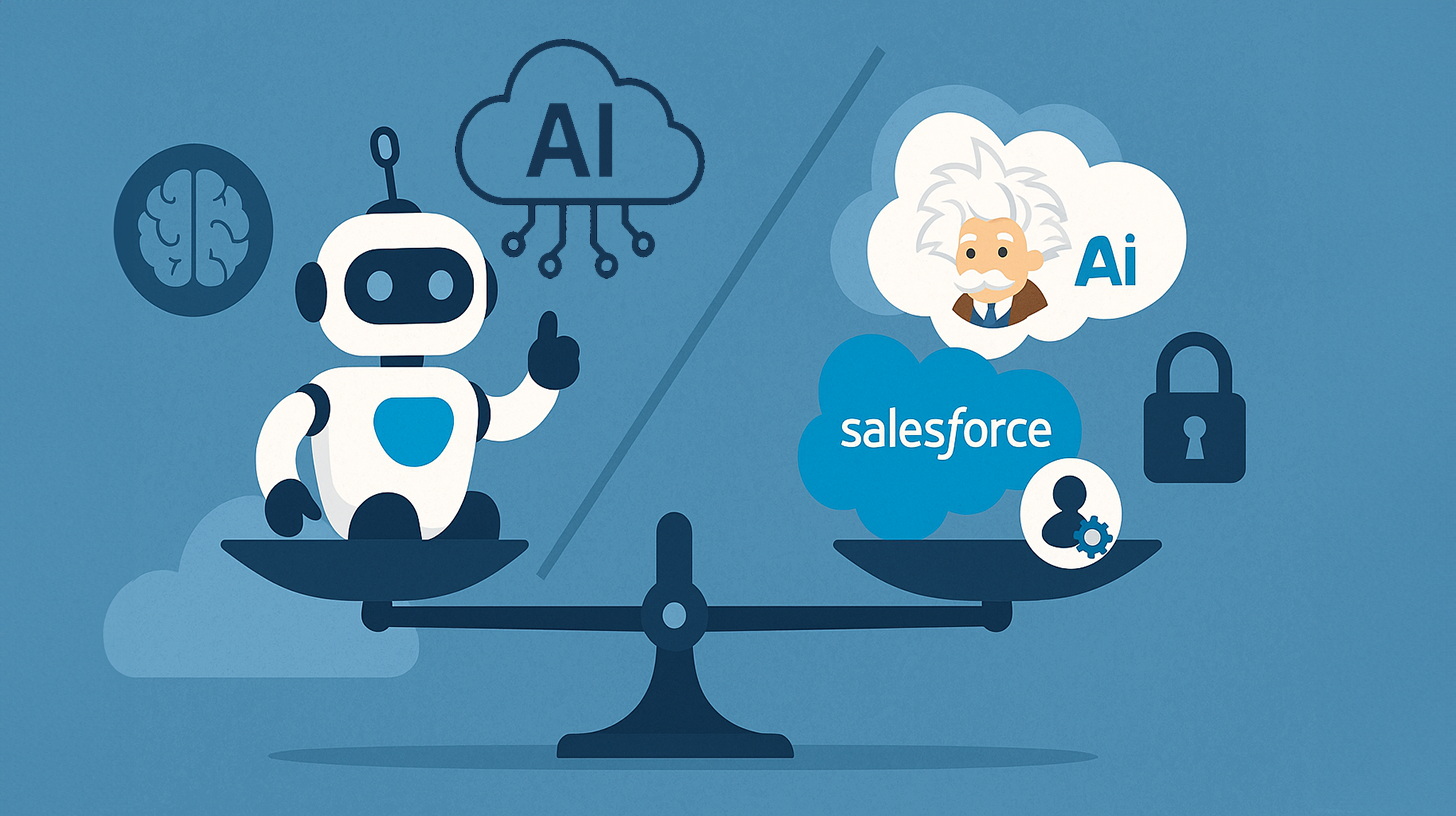
The Anthropic debacle shows: The new SaaS lock-in trap is now called single-vendor AI – a fatal provider risk – Image: Xpert.Digital
Worse than the SaaS lock-in: The insidious AI trap that almost every company is currently falling into
470,000 employees on one system: Why Deloitte's AI bet could turn into a nightmare
Imagine your most important technology partner being declared a national security threat overnight, and your entire digital business processes suddenly teetering on the brink. This dystopian, yet highly realistic, scenario shook the American tech industry in the spring of 2026: An unprecedented US boycott of the AI company Anthropic sent shockwaves through boardrooms worldwide. What began as a political bombshell in Washington ruthlessly exposed one of the most dangerous vulnerabilities of modern enterprise IT. In the relentless pursuit of efficiency and innovation, countless corporations blindly stumbled into a new, far deeper dependency trap than the classic SaaS model – single-vendor AI lock-in. Whether it's creeping shadow AI, unpredictable server outages, or unforeseeable geopolitical sanctions: Anyone who relies on a single language model for their competitiveness today is taking an existential risk. The events surrounding Anthropic served as a stark wake-up call. They demonstrate why complete transparency of AI supply chains and the rapid development of vendor-independent multi-model architectures are now becoming the ultimate strategic imperative for every CIO.
Related to this:

When the AI partner becomes a concentration risk – Why dependence on a single provider leads companies into the next dead end
On February 27, 2026, something unprecedented in the history of the American technology industry occurred. President Donald Trump ordered all federal agencies to cease using any and all technologies from the AI company Anthropic within six months. Defense Secretary Pete Hegseth went even further, classifying Anthropic as a supply chain risk to national security—a label historically reserved for foreign companies with ties to adversaries of the United States. This unprecedented escalation against an American technology company sent shockwaves far beyond Washington and exposed an uncomfortable truth: Reliance on a single AI provider is not just a technical risk. It is an existential business risk.
The full implications of this decision only become clear when viewed in the context of market data. Anthropic now holds a 32 percent market share in enterprise-wide LLM usage, ahead of OpenAI with 25 percent and Google with 20 percent. This is not a niche provider, but rather the most widely used AI service in companies worldwide. When such a dominant player is declared a risk factor overnight, every CIO, CTO, and board member must fundamentally reassess their own vendor dependencies.
The anatomy of a crisis: What happened in Washington
To understand the magnitude of the Anthropic debacle, one must know the backstory. In July 2025, Anthropic and the Pentagon signed a contract authorizing Claude as the first Frontier AI model for use on the military's classified network. It was a breakthrough that gave Anthropic a tremendous competitive advantage. However, the contract contained usage restrictions that Anthropic insisted upon. When the Pentagon demanded unrestricted use of Claude for all legal military purposes, including surveillance of American citizens and support for autonomous weapons, Anthropic CEO Dario Amodei refused. He explained that he could not reconcile this with his conscience.
The White House's reaction was immediate and drastic. No contractor, supplier, or partner doing business with the U.S. military is permitted to conduct any commercial activity with Anthropic, Hegseth declared. Lockheed Martin, one of the world's largest defense contractors, immediately announced it would comply with the directive and seek alternatives for large-scale speech models, emphasizing that it was not dependent on any single LLM vendor. Palantir, on the other hand, was in a far more precarious position: roughly 60 percent of its U.S. government revenue depended on the use of Anthropic technology.
The law firm Mayer Brown analyzed the legal implications and identified several scenarios, including the application of the Federal Acquisition Supply Chain Security Act of 2018 (FASCSA), which grants the government broad powers to prohibit contractors from using products classified as high-risk. Anthropic countered that the classification was legally untenable and could only apply to Pentagon-related contracts, not to all commercial use. But the damage had already been done: The message to the market was unmistakable. No company is too big to become a risk factor overnight.
The invisible chain of dependencies
The Anthropic debacle has exposed a far more fundamental problem: Most companies have no idea how deep their dependence on individual AI vendors actually goes. A Panorays survey from January 2026 of 200 US CISOs found that only 15 percent have complete transparency over their software supply chains, down from just three percent the previous year. Forty-nine percent of employees had adopted AI tools without employer approval, and 69 percent of C-suite members had no problem with this.
This creates undocumented AI vendor dependencies that remain invisible to the security team until a forced migration makes them a problem for everyone. Merritt Baer, CSO at Enkrypt AI and former Deputy CISO at AWS, describes the scale: “If you asked a typical organization to create a dependency graph that includes second- and third-level AI calls, they would have to build it from scratch under time pressure.” Most security programs were built for static assets. AI is dynamic, compositional, and increasingly indirect.
The figures on shadow risk are alarming. IBM's Cost of a Data Breach Report 2025 shows that shadow AI incidents now account for 20 percent of all data breaches and increase the average cost of a breach by up to $670,000. This isn't just an IT problem. It's a board-level issue.
From SaaS lock-in to AI lock-in: The repetition of a familiar pattern
The irony is undeniable. Companies that have only just emerged from the painful experience of SaaS lock-in now risk falling into an even deeper dependency. SaaS providers want to embed AI into their platforms. The promise is "native context and governance," but the reality is control. Embedded AI forces customers to upgrade to the latest versions, bundles intelligence into higher-priced SKUs, and strengthens customer loyalty. AI is becoming the enforcement mechanism of the SaaS business model.
The new lock-in patterns are more subtle and dangerous than their SaaS predecessors. Unlike traditional cloud vendor lock-in, AI platform dependencies operate on multiple levels simultaneously. Proprietary prompt architectures mean that applications using vendor-specific prompt syntax—such as OpenAI's Function-Calling format or Anthropic's Constitutional AI pattern—encode vendor dependency directly into the business logic. Migration thus becomes a complete application rebuild, not just a simple API switch.
Anthropic's own strategy exacerbates this problem. In March 2026, the company launched a marketplace through which enterprise customers could purchase Claude-powered tools from partners like Snowflake and Lovable—integrated into their existing Anthropic budget. Every time a customer uses a partner tool via the marketplace, they deepen their relationship with Anthropic rather than with the actual software vendor. The intelligence layer, Claude, is deliberately the constant in this process.
A new dimension of digital transformation with 'Managed AI' (Artificial Intelligence) - Platform & B2B solution | Xpert Consulting

A new dimension of digital transformation with 'Managed AI' (Artificial Intelligence) – Platform & B2B solution | Xpert Consulting - Image: Xpert.Digital
Here you will learn how your company can implement customized AI solutions quickly, securely and without high entry barriers.
A managed AI platform is your all-inclusive, worry-free solution for artificial intelligence. Instead of dealing with complex technology, expensive infrastructure, and lengthy development processes, you receive a ready-made solution tailored to your needs from a specialized partner – often within just a few days.
The key advantages at a glance:
⚡ Rapid implementation: From idea to ready-to-use application in days, not months. We deliver practical solutions that create immediate added value.
🔒 Maximum data security: Your sensitive data stays with you. We guarantee secure and compliant processing without sharing data with third parties.
💸 No financial risk: You only pay for results. High upfront investments in hardware, software, or personnel are completely eliminated.
🎯 Focus on your core business: Concentrate on what you do best. We take care of the entire technical implementation, operation, and maintenance of your AI solution.
📈 Future-proof & scalable: Your AI grows with you. We ensure continuous optimization and scalability, and flexibly adapt the models to new requirements.
More information here:
Sovereignty instead of lock-in: The architecture that makes your AI future-proof
The Claude outage: A real-time wake-up call
As if the political crisis weren't enough, Anthropic suffered a global outage on March 2, 2026, painfully demonstrating the practical consequences of single-vendor dependency. For many modern teams, Claude now drives critical development, content creation, and automation workflows. When Anthropic goes down, the ripple effect is immediate and costly.
For a 25-person engineering team at an hourly rate of £90, even a four-hour outage translates to over £9,000 in lost productivity, not including subsequent delays. If a customer-facing application, such as a support bot or data analytics tool, is hard-coded to a specific model and that model goes offline, the brand's reputation for reliability suffers. Without a backup, there's no way to verify whether the problem lies within the company's own code or on the provider's server until the official status page is updated hours later.
The outage mirrors what was observed during the AWS outage in October 2025: A single point of failure at a primary cloud provider can have a massive impact on global business operations. The rolling nature of the Anthropic outage demonstrated that even if part of the system is restored, the underlying infrastructure remains fragile under the weight of unprecedented demand.
Related to this:

The Deloitte bet: When 470,000 employees put their faith in one model
Deloitte's decision to deploy Claude across its entire workforce of 470,000 employees—the largest enterprise AI deployment ever—offers a particularly revealing insight into the risk dimension. While the productivity gains at such a scale are likely real, the reliance on a single vendor raises fundamental questions. If that one LLM experiences downtime, makes policy changes, or suffers a security breach, the entire system grinds to a halt. "Model drift" means that updates can subtly alter how Claude performs in core use cases overnight. Furthermore, security exposure is maximized: all sensitive data, prompts, and business logic flow through a single point of failure.
Accenture takes the opposite approach. The company has signed both OpenAI and Anthropic as primary partners, rather than committing to a single LLM provider. If even the world's largest systems integrator isn't choosing a single LLM provider, then its own single-vendor strategy becomes an even riskier gamble.
Managed AI as a way out: The architecture of independence
The solution isn't simply to replace one AI provider with another. It lies in a fundamentally different architecture. 37 percent of companies already use five or more models, an increase from 29 percent last year. This shows that sophisticated organizations are already diversifying their risks.
Managed AI platforms provide the architectural framework for this multi-model strategy. Instead of committing to a single vendor, they create an abstraction layer that intelligently deploys different AI models based on task, cost, and availability. Companies treat LLMs as interchangeable infrastructure components rather than isolated silos, so a failure of one model or vendor doesn't bring the entire operation to a standstill.
The hybrid architecture, which leading analysts predict will dominate by 2026, combines the neural intuition of Foundation Models with the structured thinking of symbolic and semantic systems. Instead of relying on a single vendor or methodology, forward-thinking organizations will orchestrate hybrid stacks across clouds, open-source ecosystems, and proprietary systems. This AI orchestration layer will become the backbone of business agility, capable of seamlessly switching between models, enforcing compliance, and contextualizing every decision with business logic.
Three questions every CIO must answer immediately
The practical consequences of the Anthropic case can be summarized in three immediate instructions for action:
- Are you a government contractor? If so, the existing Anthropic contract could now pose a compliance risk and a liability issue.
- Are you operating in regulated industries? Finance, healthcare, defense supply chain – anywhere federal AI procurement rules could spill over into commercial contracts, legal departments need to assess exposure.
- What does your own vendor diversification strategy look like? Dependence on a single AI provider is now a documented risk.
The Claude API structure itself highlights the problem. It restricts developers to Claude models and makes it difficult to migrate workflows or capabilities to other AI platforms. This practice can pose significant challenges for companies seeking long-term scalability and flexibility in their AI investments. A Forrester report shows that hybrid AI strategies can reduce vendor lock-in risks by 30 percent by allowing companies to mix models from different vendors.
The regulatory dimension: From the EU AI Act to FASCSA
The regulatory landscape is increasing pressure to diversify. The EU AI Act, in effect since August 2024, mandates transparency in AI systems to reduce dependencies. The 2018 FASCSA grants the US government broad authority to prohibit products deemed to pose a supply chain risk. While FASCSA orders apply only to federal work and are not intended to prohibit contractors from using the affected products commercially, FAR 52.204-30 includes a clause allowing the government to seek a contract amendment that restricts ongoing use.
European companies using American AI services face a dual regulatory landscape. They must comply with both European and US regulatory requirements while simultaneously ensuring that geopolitical tensions between the United States and its technology companies do not jeopardize their business operations.
The way forward: Sovereignty through architectural intelligence
The lesson from the Anthropic case is not that AI should be avoided. The lesson is that organizations must embrace AI sovereignty as a strategic imperative. This begins with a comprehensive inventory of all Anthropic products and services within the organization—including direct use, indirect use in functions that support general business operations, and internal use for non-federal commercial activities.
It continues with the development of contingency plans for each of these use cases, the assessment of transition costs, the testing of alternative platforms, and the preparation of justifications for continued use where business-critical. And it culminates in an architectural decision: building a vendor-agnostic AI layer that allows companies to maintain stable systems, avoid unnecessary upgrades, and always choose the best AI tool for each specific task. This way, savings are channeled into innovation rather than mere maintenance.
The managed AI approach offers precisely this architecture: a managed infrastructure that combines the flexibility of multi-model deployment with the governance, security, and scalability that businesses require. In contrast to the SaaS lock-in of the past decade and the looming AI lock-in of the coming years, managed AI creates the conditions for true technological sovereignty. This allows companies to retain full control over their intelligence layer without having to forgo the benefits of external innovation.
Your global marketing and business development partner
☑️ Our business language is English or German
☑️ NEW: Correspondence in your native language!

Konrad Wolfenstein
I and my team are happy to be available to you as your personal advisor.
You can contact me by filling out the contact form here wolfenstein@xpert.digital:or simply call me at +49 7348 4088 965. My email address is
I'm looking forward to our joint project.
☑️ SME support in strategy, consulting, planning and implementation
☑️ Creation or realignment of the digital strategy and digitization
☑️ Expansion and optimization of international sales processes
☑️ Global & Digital B2B trading platforms
☑️ Pioneer Business Development / Marketing / PR / Trade Fairs
🎯🎯🎯 Benefit from Xpert.Digital's extensive, five-fold expertise in one comprehensive service package | BD, R&D, XR, PR & Digital Visibility Optimization
Benefit from Xpert.Digital's extensive, five-fold expertise in a comprehensive service package | R&D, XR, PR & Digital Visibility Optimization - Image: Xpert.Digital
Xpert.Digital possesses in-depth knowledge across various industries. This allows us to develop tailored strategies precisely aligned with the requirements and challenges of your specific market segment. By continuously analyzing market trends and monitoring industry developments, we can act proactively and offer innovative solutions. The combination of experience and expertise generates added value and provides our clients with a decisive competitive advantage.
More information here: