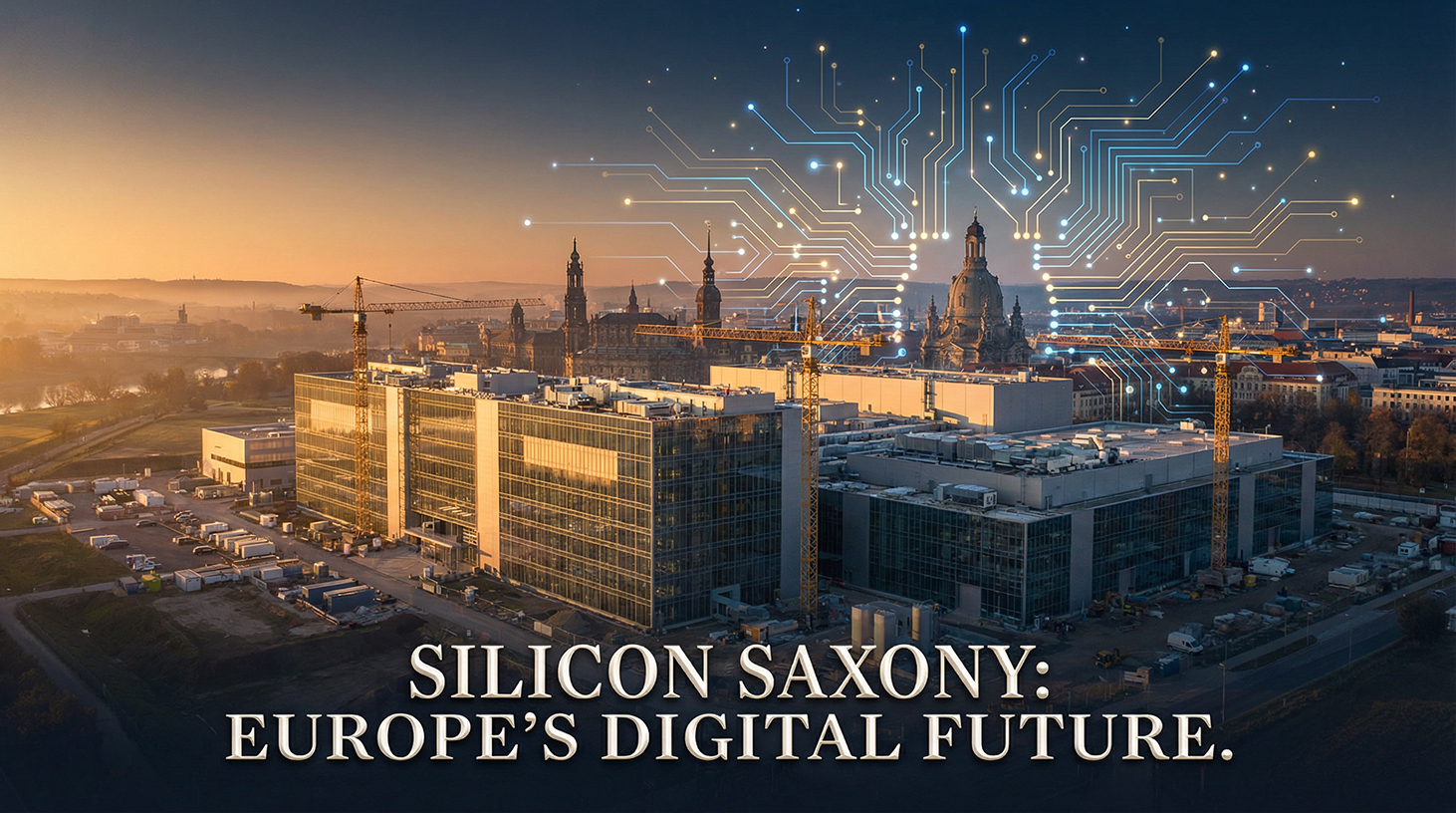
Silicon Saxony – Europe's chip manufacturing hub and most important construction site: How economic and geopolitics are currently being shaped in Dresden – Image: Xpert.Digital
16 billion euros for mega-factories: What the chip boom in Saxony means for Germany
A billion-dollar bet in Dresden: Why Silicon Saxony is deciding Europe's future
After the Intel shock: This is how Saxony is now saving the European semiconductor dream
The global economy is facing a tectonic shift – and the epicenter of the European response lies in Saxony. While the global semiconductor market is projected to break the magic one trillion US dollar mark by 2030, the so-called "Silicon Saxony" is massively expanding its operations. With unprecedented investments of over 16 billion euros, industry giants like TSMC, Infineon, and GlobalFoundries are transforming Dresden into the most important bulwark for European industry. But the path to the coveted technological sovereignty is fraught with obstacles: Intel's painful withdrawal from Magdeburg has demonstrated the fragility of industrial policy bets. Moreover, homegrown problems such as exploding energy costs, a severe shortage of skilled workers, and structural deficiencies threaten to derail this historic upswing. This article delves into why nothing less than the geopolitical and industrial future of the continent is currently being negotiated in Dresden – and what tasks must now be urgently completed in Berlin and Brussels to prevent Europe's ambitious chip-making dream from collapsing.
Saxony alone cannot save Europe – but without Saxony, nothing is possible
Why semiconductors are becoming a matter of destiny
The global semiconductor market is poised for a historic leap in growth. McKinsey predicts that the industry will surpass the one trillion US dollar mark by 2030, driven by an annual growth rate of six to eight percent. Considering that the market value was still around 600 billion US dollars in 2021, this illustrates the magnitude of the tectonic shift that has gripped the global economy. TSMC executive Kevin Zhang describes this decade as a "golden age for the semiconductor industry"—referring not only to technological dynamism but, more importantly, to the economic and political significance that chips have acquired as a strategic resource.
Semiconductors are far more than just electronic components today. They are the invisible infrastructure of the digital economy, electromobility, artificial intelligence, defense, and the energy transition. No modern vehicle, no data center, no industrial plant can function without them. Europe's dependence on supply chains stretching thousands of kilometers and concentrated in a few Asian countries has proven costly: the chip shortages of the COVID-19 years brought entire industries to a standstill and alarmed the political establishment. In 2020, Europe produced only around ten percent of the world's semiconductors, while almost 80 percent of European chip suppliers were located outside the EU.
This situation makes the rise of Silicon Saxony an economic issue with far-reaching geopolitical dimensions. What is happening in the Saxon state capital of Dresden is not merely a regional industrial story. It is perhaps Europe's most important attempt to gain ground in technological sovereignty.
Saxony's emerging chip industry in a European context
Dresden didn't become the center of European semiconductor manufacturing overnight. The Dresden-Chemnitz-Freiberg triangle has spent decades building a unique industrial ecosystem, now known as "Silicon Saxony," which is considered Europe's largest ICT and microelectronics hub. Every third chip produced in Europe bears the "Made in Saxony" label. This concentration is no accident, but rather the result of a deliberate industrial policy strategy combined with long-standing engineering traditions, high-performing universities, and a dense network of research institutions.
The industrial base is impressive. Infineon Technologies, GlobalFoundries, Bosch, and X-FAB operate some of the world's most advanced semiconductor fabs in Saxony. GlobalFoundries Dresden is currently the largest semiconductor plant in Europe, with a production capacity of 850,000 wafer starts per year. Infineon already operates several fabs in Dresden and is currently building its fourth. In 2021, Bosch opened its AI-driven factory in Dresden, the first major new chip plant in Europe in two decades – a symbolically significant return to semiconductor manufacturing in Europe.
In 2022, the Silicon Saxony ecosystem already employed around 76,100 people in microelectronics, software, and related industries, representing growth of approximately four percent compared to the previous year. By 2023, employment had risen to 81,000, an increase of 6.4 percent. The industry association Silicon Saxony anticipates that the 100,000 employee mark will not only be reached but even surpassed by 2030.
The billion-euro investment: Who is investing how much in Dresden?
The wave of investment sweeping through Dresden is unparalleled in German industrial history since reunification. Three megaprojects alone are currently shaping the future face of Silicon Saxony:
The largest and most symbolically significant project is the European Semiconductor Manufacturing Company (ESMC) – a joint venture between the Taiwanese global market leader TSMC and the European industrial groups Bosch, Infineon, and NXP. TSMC holds 70 percent of the company, with the three European partners each holding ten percent. The total investment exceeds ten billion euros, of which the German government is contributing up to five billion euros. Ground was broken in August 2024, and the funding was contractually secured at the end of 2024. The construction site in Dresden-Klotzsche is now one of the largest in Europe: Up to 30 cranes operate simultaneously, around 1,200 workers are on site daily, and construction continues almost around the clock. The factory, measuring 200 by 200 meters, extends ten meters underground and will include 45,000 square meters of cleanroom space, requiring 155,000 cubic meters of concrete. Production is scheduled to start at the end of 2027, creating 2,000 direct jobs.
In parallel, Infineon is investing around five billion euros in its new "Smart Power Fab"—the largest single investment in the company's history. The opening is scheduled for July 2, 2026, even earlier than originally planned. 1,000 additional jobs will be created directly at the factory, which is specifically designed for chips for renewable energies, data centers, and electromobility. Most recently, Infineon increased its ongoing investment volume to 2.7 billion euros for the current fiscal year—half a billion more than originally planned.
Finally, in October 2025, GlobalFoundries announced investments of €1.1 billion for the expansion of its Dresden site. The project, dubbed "SPRINT," aims to increase production capacity to more than one million wafer starts per year by the end of 2028, making Dresden the largest semiconductor plant of its kind in Europe. The German Federal Government and the Free State of Saxony are also supporting this project under the European Chips Act.
In total, the announced investments in Saxony's chip industry amount to well over 16 billion euros – a figure that is unprecedented in the economic history of eastern Germany.
What lies behind the numbers: Economic multiplier effects
An investment of one euro in the semiconductor industry does not have the same impact as one in other sectors. The value chain in microelectronics is so complex and interconnected that every new factory attracts dozens of suppliers, service providers, and research institutions. A study commissioned by Saxony's economic development agency and conducted by the Institute for Innovation and Technology (iit) in Berlin has quantified this multiplier effect for Saxony.
During the construction phase of the factories, additional economic growth of around €1.6 billion was expected in Saxony alone by 2025. The spillover effect on other federal states is even greater: since the large construction consortia operate nationwide, the other states will benefit in total by €9.1 billion. In the production phase, which is scheduled to be fully operational from 2030 onwards, this ratio will reverse. At that point, additional effects of €12.6 billion are expected for Saxony compared to a scenario without these investments – and the semiconductor industry will increase the Free State's economic output by seven percent per year.
The study forecasts approximately 24,200 new jobs in Saxony by 2030 – distributed not only across the chip factories themselves, but also among suppliers, logistics providers, and service providers. As early as 2026/2027, 5,500 direct new jobs in the semiconductor industry and a further 9,900 indirect jobs are expected. Earnings prospects are above average: employees in the sector earn an average gross monthly salary of €4,545 – significantly higher than the average in eastern Germany.
These figures impressively demonstrate why government subsidies for TSMC, Infineon, and GlobalFoundries must be assessed differently in economic policy debates than comparable support programs in other sectors. Here, the government is not investing in a single company, but in an industrial policy ecosystem with significant positive externalities for the entire economy.
Science as a silent location factor: Universities and research
A frequently underestimated factor in the success of Silicon Saxony is the research and education ecosystem that has developed over decades. The Technical University of Dresden is one of the most prestigious technical universities in Germany and continuously provides young talent for the semiconductor industry. The Freiberg University of Mining and Technology and the Chemnitz University of Technology complement this offering with specialized expertise in materials science and electrical engineering.
Even more significant for the region's innovative strength is the presence of the Fraunhofer Society. With the Fraunhofer Institute for Photonic Microsystems (IPMS) and the Fraunhofer Institute branch IZM-ASSID (All Silicon System Integration Dresden), Saxony is home to the only two German research institutions conducting research based on the 300 mm wafer industry standard. This is the same technology platform used in large production fabs – a direct technology transfer channel between basic research and industry, unique in this form in Germany.
In 2023, Fraunhofer IPMS and Fraunhofer IZM-ASSID opened the joint "Center for Advanced CMOS & Heterointegration Saxony" (CACHS) – a research center that covers the entire value chain of 300 mm microelectronics, thus enabling high-tech research for future technologies with international reach. Over its 15 years, Fraunhofer IZM-ASSID has developed key technologies for 3D system integration, wafer-level packaging, and high-precision hybrid bonding – technologies that are essential for modern AI chip architectures and even quantum computers.
This close integration of industry and research is no accident. It is the result of targeted cluster formation, which has been consistently pursued since the 1990s, and represents a decisive locational advantage over other European regions attempting to gain a foothold in the semiconductor sector.
Our EU and German expertise in business development, sales and marketing

Our EU and German expertise in business development, sales and marketing - Image: Xpert.Digital
Industry focus areas: B2B, digitalization (from AI to XR), mechanical engineering, logistics, renewable energies and industry
More information here:
A thematic hub offering insights and expertise:
- Knowledge platform covering global and regional economies, innovation and industry-specific trends
- A collection of analyses, insights, and background information from our key areas of focus
- A place for expertise and information on current developments in business and technology
- A hub for companies seeking information on markets, digitalization, and industry innovations
Silicon Saxony 2030 — Opportunities, limitations and the new realpolitik of chips
The EU Chips Act: Ambitious goal meets stubborn reality
The European Chips Act of 2023 lays the political foundation for the wave of investment in Saxony and other European regions. The stated goal: to double the global market share of European semiconductor production from ten to 20 percent by 2030. Over €43 billion in public and private investment is to be mobilized for this purpose, of which only €3.3 billion will come directly from the EU budget – the remainder from national funding programs and private investors.
Criticism of this target was loud from the outset. Compared to the US Chips and Science Act of 2022 with its $52 billion investment and China's estimated $150 billion in state aid by 2025, the European volume seems modest. But the more fundamental problem lies elsewhere: In a report from April 2025, the European Court of Auditors soberly concluded that the EU would not achieve the 20 percent target by 2030. Insufficient investment by the European Commission, limited access to raw materials, high energy costs, and geopolitical tensions are hindering the development of new capacity at a pace that would make the target achievable.
The EU member states themselves have recognized the situation. In September 2025, they issued a joint statement to the European Commission calling for a fundamental revision of the Chips Act. They argued that the semiconductor sector should be classified as a strategic industry – on par with aerospace or defense. The targeted revision of the law, planned for 2026, offers the opportunity to adapt the regulatory architecture to the changed geopolitical realities. Whether policymakers seize this opportunity will be crucial in determining whether Europe can realize its technological sovereignty ambitions in the medium term.
Intel Magdeburg: A painful lesson in industrial policy bets
No analysis of the German semiconductor sector would be complete without the Intel Magdeburg case – a project that has become a costly lesson in the limits of state-supported industrial policy. As part of its ambitious efforts to catch up with TSMC and Samsung, Intel had announced plans to build two chip factories in Saxony-Anhalt for around €30 billion, creating approximately 3,000 direct jobs. The German government had promised €9.9 billion in state aid.
Following a series of production problems, a loss of customer confidence, the resignation of CEO Pat Gelsinger at the end of 2024, and massive losses in the billions, Intel finally announced in July 2025 that it was abandoning its plans for the Magdeburg plant. A parallel factory in Poland will also not be built. As part of the restructuring program under the new CEO Lip-Bu Tan, Intel is cutting a quarter of its nearly 100,000 jobs worldwide.
The economic damage is considerable, though manageable. Silicon Saxony CEO Frank Bösenberg saw no direct impact on the Saxon projects. This is accurate, as ESMC, Infineon, and GlobalFoundries are proceeding as planned. However, Bösenberg is honest enough to admit that the EU target of a 20 percent global market share is definitely no longer achievable without the Intel plant. Intel Magdeburg was the building block that would have made the Chips Act's calculations work. Its failure reveals a structural dilemma of European industrial policy: it can create incentives and improve framework conditions, but it cannot replace the strategic decisions of private corporations, which are under pressure from global market cycles.
Cars and chips: The dangerous double addiction
The economic significance of Silicon Saxony cannot be fully understood without considering its most important customer sector: the automotive industry. ESMC, Infineon's Smart Power Fab, and GlobalFoundries Dresden primarily manufacture chips for automotive applications – from engine control units and power electronics for electric vehicles to ADAS systems for autonomous driving.
An event in the fall of 2025 starkly illustrated the vulnerability of this dependency. When the Netherlands dismissed the Chinese CEO of the chipmaker Nexperia – a supplier to European automakers – for strategic security reasons, and the Chinese parent company Wingtech reacted, Volkswagen faced a production halt due to a lack of chips. VW had to admit that it could no longer rule out production restrictions, and short-time work was to begin in Zwickau. The message is unmistakable: Europe remains highly vulnerable to politically motivated supply disruptions of key components.
Silicon Saxony will reduce this dependency in the long term, but not eliminate it. The fabs in Dresden are specialized in specific process nodes and application segments. The breadth of demand for modern vehicles—from ultra-low-power chips for body electronics to high-performance processors for AI-powered driving functions—exceeds what even a fully developed Silicon Saxony can supply. Diversification of sourcing and strategic warehousing, which are increasingly discussed in post-just-in-time supply chains, remain essential complements.
The structural brakes: Challenges beyond investment
As dynamic as the investment landscape in Saxony is, the structural weaknesses that burden Germany as a whole are becoming increasingly apparent. While the semiconductor industry is one of the few sectors that has escaped the general industrial slowdown, it too suffers from the same location-related problems that the ifo Institute clearly described in November 2025. At that time, more than a third of all German industrial companies reported a decline in their competitiveness compared to countries outside the EU – a new record low. Among manufacturers of electronic and optical products, this figure was 47 percent.
Three problems are particularly serious for the semiconductor industry. First: energy costs. Chip factories are extremely energy-intensive. Operating a cleanroom around the clock requires a constant power supply at competitive prices. Despite recent relief measures, German industrial electricity prices are still significantly higher than in the USA, Taiwan, or South Korea. The promise of affordable renewable energy must be translated into actually available and affordable capacity if Germany wants to maintain its competitive edge in the semiconductor sector.
Secondly: the skills shortage. Silicon Saxony CEO Bösenberg has repeatedly described this as the most pressing structural problem. By 2030, the industry will need almost 24,000 additional skilled workers. The gap between supply and demand is real, and it cannot be closed solely by the training capacities of Saxony's universities. International immigration of skilled workers, a redesign of job profiles, and targeted support programs for STEM professions are necessary – but these are still underdeveloped politically and bureaucratically.
Thirdly: infrastructure and bureaucracy. The symbolic partial collapse of Dresden's Carolabrücke bridge in 2024 has made Bösenberg a fitting metaphor for the infrastructure problem: a high-tech industry needs functioning bridges, resilient fiber optic networks, reliable rail connections, and accelerated approval processes. There is still considerable room for improvement in this area.
Geopolitical dimension: Chips as weapon and shield
The economic analysis of Silicon Saxony would be incomplete without considering the geopolitical context that makes these investments understandable. The semiconductor crisis of the pandemic years, the US development of a chip export control architecture against China, and the growing tensions surrounding Taiwan – all of these factors have drastically increased the strategic value of domestic production capacities.
TSMC finds itself in a paradoxical position. The company is the dominant manufacturer of the world's most advanced chips, making it a major global power. At the same time, its geographic concentration in Taiwan represents a constant source of vulnerability for all those dependent on TSMC chips – essentially the entire Western industry. TSMC's decision to establish fabs in the US (Arizona), Japan (Kumamoto), and now Germany (Dresden) is therefore not merely a capacity decision, but a geopolitical risk diversification strategy. With ESMC, Europe is gaining not only a chip manufacturer, but also a kind of industrial policy insurance.
This dimension becomes particularly evident in light of the increasing militarization of the semiconductor sector. In Silicon Saxony, the issue of dual-use technology is openly discussed: chips for automotive, industrial, and defense applications are manufactured on the same production platforms, and the boundary between civilian and military use is becoming increasingly blurred. EU member states are demanding that the semiconductor sector be explicitly elevated to the same priority level as aerospace and defense. This is not rhetorical exaggeration, but a sober assessment of the strategic situation.
The subsidy question: Necessary evil or efficient industrial policy?
The government funding of the TSMC factory has sparked a lively economic policy debate in Germany. Five billion euros in federal subsidies for a project in which a foreign company retains majority control – is this sensible industrial policy or a windfall for a corporation that would have invested in Europe even without government funding?
The debate cannot be resolved with a simple yes or no. On the criticism side is the valid argument that small and medium-sized enterprises (SMEs) are structurally disadvantaged by the massive state subsidies for large corporations. Small and medium-sized suppliers, which form the true backbone of the German economy, complain of a distortion of competition in energy, skilled labor, and funding. On the other hand, the figures from the iit study clearly show that the macroeconomic multiplier effects far outweigh the direct subsidy costs. TSMC brings not only manufacturing capacity to Europe, but also process know-how, supplier ecosystems, and global networks that would be virtually impossible to build organically.
A more nuanced assessment concludes that in a world where the US, with $52 billion, China, with an estimated $150 billion, and India, with growing domestic investments, are all vying for semiconductor manufacturing, Europe can no longer maintain the luxury of a stateless industrial model. The question is not whether government support is necessary, but rather how targeted it should be and what control mechanisms should be in place.
Outlook: Dresden 2030 – between potential and disillusionment
What will Silicon Saxony be like in 2030? Based on the available data, a differentiated picture is emerging.
The strengths are evident: By 2027 and 2028, three of the world's most advanced semiconductor facilities – ESMC, Infineon's Smart Power Fab, and the expanded GlobalFoundries plant – will be operational. Employment will exceed 100,000, Saxony's gross domestic product will measurably increase, and Germany will be significantly more independent in its automotive chip supply than it is today. At the same time, the research infrastructure of the Fraunhofer network and TU Dresden will continue to ensure a steady transfer of technology.
The limitations are equally clear: the EU's 20 percent target will be missed. Germany and Europe will not achieve a leading position in the most advanced manufacturing hubs – the race for sub-5nm chips will remain, for the time being, in Taiwan, South Korea, and the USA. Silicon Saxony specializes in niche markets where Europe is indeed competitive: automotive chips, industrial semiconductors, power electronics for energy applications – all segments with consistently high demand and comparatively less competition from Asian suppliers.
The strategic conclusion is this: Silicon Saxony cannot and should not become a full-range semiconductor center competing with Taiwan or South Korea in every field. It can and should secure and expand Europe's core industrial competence in specific, highly relevant semiconductor segments. This is more modest than the grandiose promises of some political speeches – but it is realistic, sustainable, and of considerable geopolitical value.
Whether investments in the region will ultimately achieve their full effect depends on whether Germany decisively addresses its well-known structural weaknesses. Affordable energy, fast permitting processes, an influx of international skilled workers, and a robust infrastructure are not mere industrial policy extras – they are fundamental prerequisites for billions in investments to actually lead to lasting competitiveness. Silicon Saxony demonstrates Europe's will to be strong. Whether this will translate into action will not be decided in Dresden – but in Berlin and Brussels.
Your global marketing and business development partner
☑️ Our business language is English or German
☑️ NEW: Correspondence in your native language!

Konrad Wolfenstein
I and my team are happy to be available to you as your personal advisor.
You can contact me by filling out the contact form here wolfenstein@xpert.digital:or simply call me at +49 7348 4088 965. My email address is
I'm looking forward to our joint project.
☑️ SME support in strategy, consulting, planning and implementation
☑️ Creation or realignment of the digital strategy and digitization
☑️ Expansion and optimization of international sales processes
☑️ Global & Digital B2B trading platforms
☑️ Pioneer Business Development / Marketing / PR / Trade Fairs
🎯🎯🎯 Data-driven B2B industry hub as a quasi-in-house solution

The quasi-in-house solution: How Xpert.Digital closes operational gaps in B2B marketing and sales – Smart Content-Driven Business - Image: Xpert.Digital
Xpert.Digital is a data-driven B2B industry hub led by Konrad Wolfenstein . The company acts as an external, quasi-in-house solution for industrial partners, closing operational gaps in marketing, content, and sales – without requiring additional resources on the client side.
More information here: