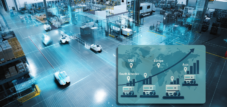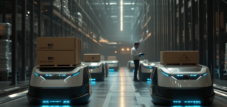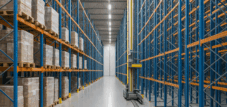
Automated warehouse with robots – Image: Xpert.Digital
Autonomous robots or shuttle systems? Transformative warehouse technology: Which strategy secures a competitive edge for companies?
The automation revolution in intralogistics
Intralogistics, the nervous system of the modern economy, is undergoing a profound transformation. The question of which warehouse system will dominate the future—the structured, throughput-optimized shuttle system or the flexible, autonomous robot—is far more than a technical debate. It has become a crucial strategic decision that will determine the competitiveness, resilience, and future viability of companies in an increasingly volatile world.
Related to this:

Why is the “shuttle vs. robot” debate so crucial for the future of industry today?
Three fundamental forces are driving this development forward inexorably.
- First, the exponential growth of e-commerce has forever redefined customer expectations. The demand for immediate availability, same-day delivery, and error-free order processing creates immense pressure on warehouses and distribution centers.
- Secondly, a persistent shortage of skilled and general labor in many industrialized nations is dramatically exacerbating the situation. Finding and retaining qualified personnel for repetitive and physically demanding warehouse work is becoming one of the biggest operational hurdles.
- Thirdly, rising operating, energy and real estate costs are forcing companies to use their space more efficiently and to optimize processes down to the last detail.
Against this backdrop, automation is no longer an option, but a necessity. The global warehouse automation market reflects this urgency: with an estimated value of US$26.5 billion in 2024 and a projected compound annual growth rate (CAGR) of over 15.9% through 2034, it is one of the most dynamic technology sectors. Remarkably, however, despite this rapid growth, around 80% of all warehouses worldwide are still predominantly manually operated. This immense untapped potential forms the battleground where shuttle systems and autonomous mobile robots (AMRs) are vying for dominance.
The choice between these two technological philosophies is a decision about a company's strategic direction. It reflects a fundamental tension in modern supply chains: the conflict between the need for cost efficiency through highly optimized, predictable processes and the demand for agility through maximally adaptable, flexible operations. Shuttle systems are the physical embodiment of structured efficiency, designed for maximum storage density and highest throughput within a fixed infrastructure. AMRs, on the other hand, embody adaptive flexibility, created to navigate dynamic, constantly changing environments. A company investing in a shuttle system is betting on a future where its product mix and order structure are stable enough to benefit from this extreme optimization. A company opting for AMRs anticipates a future full of variability and unpredictability, where the ability to adapt quickly is the decisive competitive advantage. The technological decision thus becomes a reflection of a company's strategic forecast for its own market.
Definition and Functioning of Core Technologies
What exactly is meant by a shuttle system and what are its core components?
A shuttle system is a highly dynamic, computer-controlled automated small parts warehouse (AS/RS) designed for the fast and efficient storage, relocation, and retrieval of standardized load units such as containers, cartons, or trays. It is a complex mechatronic system that goes far beyond the simplified analogy of a "conveyor belt." The performance and efficiency of such a system result from the precise interaction of its core components:
- Racking system: The static backbone of the system is a high-density steel structure that forms storage channels for the loading units. These racks are designed to maximize the use of available height and can reach heights of over 20 meters, in some cases even up to 30 meters.
- Shuttles (vehicles): These are the real "workhorses." They are autonomously operating vehicles that move horizontally on rails within a single shelf level. Equipped with telescopic forks or similar load-handling devices, they pick up the load units from the shelf compartments and transport them to the end of the aisle.
- Lifts/hoists: These essential components provide the vertical connection. They transport either the loading units or, in some system architectures, the shuttles themselves between the different racking levels and the pre-zone, which usually consists of conveyor technology. Their performance is often a critical factor for the overall throughput of the system.
- Conveyor technology: A connected network of roller or belt conveyors forms the interface to the outside world. It transports the goods from the storage station to the lifts and from the lifts to downstream processes such as picking, packing or shipping workstations.
- Control & Software (WMS/WCS/MFS): The "brain" of the entire operation. A higher-level warehouse management software (WMS) or a specialized Warehouse Control System (WCS) or Material Flow System (MFS) coordinates every single movement. It manages the storage locations, optimizes the travel strategies of the shuttles and lifts, and ensures seamless integration with the company's overarching IT landscape, such as the Enterprise Resource Planning (ERP) system.
What are the basic types of shuttle systems and how do they differ in their architecture and application?
Shuttle system technology has undergone a remarkable evolution, moving from rigid, one-dimensional architectures to highly flexible, three-dimensional systems. This development is a direct response to the increasing market demands for greater flexibility and scalability.
- Single-level shuttle: This is the classic architecture where each shuttle is permanently assigned to a single rack level and aisle. Throughput is determined by the number of shuttles per level and the lift's capacity. Scalability is primarily achieved by adding more aisles. Examples of this are the SSI Flexi and Cuby systems.
- Multi-level shuttle: This variant, often described as a hybrid between a classic storage and retrieval machine (SRM) and a shuttle, can serve multiple levels within an aisle via an integrated lifting mechanism. This reduces the complexity and cost of the racking structure and offers an attractive price-performance ratio for medium to high throughput applications. An example is the Schäfer Lift & Run (SLR) system.
- Lane-changing / 3D shuttles: A significant evolutionary leap. These shuttles can not only travel horizontally within their aisle but also change aisles. This completely decouples performance (number of shuttles) from storage capacity (number of rack locations). A company can start with just a few shuttles and easily add more as demand increases. Furthermore, they enable the creation of a 100% sequence of goods to be retrieved directly within the system, potentially eliminating the need for downstream sorting processes. The KNAPP Evo Shuttle 2D is a prominent example of this type of shuttle.
- Climbing robots / cube storage systems: This revolutionary development breaks with traditional shuttle architecture. Here, robots either travel on a grid frame above densely stacked containers (e.g., AutoStore) or climb directly up and down the racking structure (e.g., Exotec Skypod). These 3D systems completely eliminate the need for separate aisles and lifts, resulting in extremely high storage density and flexibility.
- Pallet shuttles: A specialized category for the high-density storage of entire pallets. These robust shuttles operate in deep storage channels and are often used in cold storage facilities or for buffer storage in production.
This technological evolution within the shuttle world is remarkable. It demonstrates that manufacturers have recognized the challenge posed by more flexible AMRs and are actively attempting to integrate AMR-like characteristics—such as the ability to change aisles or operate three-dimensionally—into their high-density storage paradigm. As a result, the once clear boundaries are blurring, and the most advanced "shuttle systems" today are essentially specialized, vertically oriented AMR systems operating within a defined structure.
What is a "robot" in a warehouse context, and what is the crucial difference between autonomous mobile robots (AMRs) and driverless transport systems (AGVs)?
In the context of warehousing, the distinction between "robot" as a general term and the specific technologies AGV (Automated Guided Vehicle) and AMR (Autonomous Mobile Robot) is of fundamental importance. Although both transport materials, they are based on fundamentally different navigation philosophies.
- AGV (Automated Guided Vehicle): This is the older, established technology. AGVs are "guided" vehicles. They follow fixed, physically or virtually defined paths, predetermined by magnetic strips in the floor, colored lines, laser scanners aimed at reflectors, or other guidance systems. Their intelligence is limited: If an AGV encounters an obstacle, it stops and waits until the path is clear again. Implementation is complex, often requires structural modifications to the infrastructure, and the resulting system is rigid. Any change to the route involves considerable effort.
- AMR (Autonomous Mobile Robot): This is the newer, far more intelligent and flexible technology. AMRs are "autonomous" vehicles. They do not require external guidance. Instead, they create a digital map of their surroundings and navigate freely, much like a self-driving car. Using their advanced sensors, they detect obstacles such as people, forklifts, or unattended pallets in real time and dynamically plan an alternative route to avoid them. Implementation is quick, requires no structural modifications, and offers maximum flexibility.
While the technological boundaries are increasingly blurring as AGVs are also equipped with more intelligent functions, the core difference remains: An AGV follows a predefined path, while an AMR navigates intelligently in a freely traversable space. Therefore, the following analysis focuses clearly on flexible AMRs as the true technological counterpart to structured shuttle systems.
How do AMRs navigate and operate in a dynamic warehouse environment to autonomously perform their tasks?
The autonomy and flexibility of AMRs are based on a highly sophisticated interplay of mapping, sensors, and intelligent software. The process can be divided into several steps:
- Mapping: Before an AMR can begin its work, a digital map of the warehouse must be created. This is done either "offline," by manually driving a robot through the environment to collect the data, or "online," where the robot creates and refines the map in real time during operation.
- Localization (SLAM): To know its location, the AMR uses a technology called SLAM (Simultaneous Localization and Mapping). The robot continuously compares the data from its sensors with the stored map to determine its own position and orientation in real time with high precision.
- Sensors: AMRs are equipped with a variety of sensors that provide them with a comprehensive 360-degree overview of their surroundings:
- LiDAR (Light Detection and Ranging): Laser scanners emit light pulses and measure their reflections to create a precise point cloud of the environment. This is the primary technology for mapping and detecting obstacles at a distance.
- 3D cameras: They capture visual data and depth information, which improves object recognition. They are also often used for fine positioning by reading QR codes or other markings on the floor or shelves.
- IMU (Inertial Measurement Unit): An inertial measurement system that measures acceleration and rotation rates and helps the robot track its own movement between sensor updates.
- Navigation and obstacle avoidance: The fleet management system assigns a destination to the AMR (e.g., "drive to parcel station 5"). The robot then calculates the optimal route. During the journey, sensors continuously monitor the path. If an unexpected obstacle is detected, the AMR doesn't simply stop, but analyzes the situation and plans a detour in fractions of a second to still reach its destination.
- Artificial intelligence (AI) and machine learning (ML): Advanced algorithms work in the background, interpreting the huge amounts of data from the sensors, making the safest and most efficient route planning decisions, and improving the robot's navigation performance through continuous learning over time.
Your intralogistics experts
Consulting, planning and implementation of complete solutions for high-bay warehouses and automated storage systems - Image: Xpert.Digital
More information here:
Shuttle vs. AMR: Intelligent robots or classic shuttle systems?
Direct system comparison – A multidimensional analysis
How do shuttle systems and AMRs perform in a direct performance comparison regarding throughput and speed?
Performance, measured by throughput (e.g., storage and retrieval per hour), is one of the key distinguishing features between the two system philosophies.
Shuttle systems are designed from the ground up for extremely high throughput in a defined environment. Their architecture is engineered to parallelize movements. While dozens of shuttles move horizontally on their respective levels simultaneously, the lifts operate independently in the vertical direction. This decoupling of horizontal and vertical transport paths enables massive peak performance. Leading systems can achieve throughput rates of over 1,000 double cycles (one storage and one retrieval) per hour and aisle. This makes shuttle systems the undisputed "sprinters" for high-frequency, repetitive storage and retrieval tasks in a fixed structure.
Autonomous Mobile Robots (AMRs), in their traditional form, are not primarily optimized for maximum throughput in the smallest possible space. Their strength lies in the flexible and efficient transport of goods over variable and often long distances in a dynamic environment. While a single AMR can reach speeds of up to 4 m/s, the overall throughput of a fleet depends on many factors: the complexity of the routes, the volume of traffic from other robots or humans, the distance between stations, and the general order structure. They are more like "marathon runners," adapting to changing conditions.
However, the aforementioned convergence of technologies is also evident here. So-called cube storage systems like the Exotec Skypod, which are based on climbing robots, are explicitly designed to combine the flexibility of AMRs with very high throughput. At connected picking stations, throughputs of up to 400 picks per hour per station can be achieved. These hybrid approaches are increasingly challenging the traditional dichotomy of "shuttle = high throughput" and "AMR = high flexibility".
Related to this:

Which system offers higher storage density and uses the available space more efficiently?
Storage density is a traditional key argument and a domain of shuttle systems. In a world of rising real estate and land prices, maximizing volume utilization is a crucial economic factor.
Shuttle systems offer unparalleled storage density. By minimizing the number of aisles and utilizing the full available building height of up to 30 meters or more, storage space is extremely compacted. Techniques such as double- or multi-deep storage of containers within the channels further maximize capacity on a given footprint.
AMRs in their classic form, which transport goods between widely spaced shelves, naturally require wider travel paths and cannot utilize the vertical dimension as efficiently. Their optimization focuses not on static storage density, but on dynamic process efficiency.
However, even in this discipline, the clear boundaries are blurring. The aforementioned cube storage systems (such as AutoStore or Exotec Skypod) achieve extremely high storage density by stacking containers directly on top of each other without shelving, with robots accessing the required container from above. They combine the density of a compact warehouse with the flexibility of robots. A further development is climbing AMRs (Automated Climbing Robots, ACRs), which are capable of serving tall standard shelves, thus significantly improving vertical space utilization compared to purely ground-based vehicles.
How flexible and scalable are the two systems with regard to changing business requirements and seasonal peaks?
Flexibility and scalability are the hallmarks of AMRs and often represent the decisive argument for their use in volatile markets.
AMRs offer maximum flexibility and scalability:
- Scalability: Adapting to higher order volumes is remarkably easy. To increase throughput, additional robots are simply added to the existing fleet. This process can be completed within minutes or hours without any operational interruption. Storage capacity can be expanded by installing additional shelving, completely independent of throughput (i.e., the number of robots).
- Flexibility: AMRs are software-defined. New routes, additional workstations, or completely changed process flows can be implemented immediately via software updates. The system adapts to a new warehouse layout or changing requirements without any physical modifications. This makes them the ideal solution for highly dynamic environments such as e-commerce or third-party logistics (3PL), where order volumes and structures fluctuate significantly.
Shuttle systems are traditionally much more rigid:
- Scalability: While modern shuttle systems are modular and scalable in principle, the process is considerably more complex. Additional shuttles can be added to the aisles to increase throughput, or entire rack aisles can be extended to expand storage capacity. However, such expansions are significant construction projects requiring extensive planning, substantial investment, and often a partial or complete shutdown of operations.
- Flexibility: The basic infrastructure of racking aisles, rails, and lifts is fixed. A fundamental change to the material flow, such as relocating a picking zone, is extremely difficult and costly. The system is designed for a specific, optimized process and struggles to adapt to fundamental changes.
How do the systems differ in terms of capital expenditure (CAPEX), operating expenses (OPEX) and implementation time?
Analyzing the total cost of ownership (TCO) and the speed of implementation reveals fundamentally different business models and is crucial for investment decisions.
- Initial investment (CAPEX):
- Shuttle systems: These involve very high initial investments. The costs include not only the vehicles themselves, but also a massive infrastructure consisting of high-precision steel construction, powerful lifts, kilometers of conveyor technology, and complex control technology.
- AMRs: Require significantly lower initial investments. Because they navigate within existing infrastructure, expensive and complex modifications are unnecessary. Companies can start with a small fleet of just a few robots and gradually adjust their investment to business growth ("pay-as-you-grow"). Models such as "Robot-as-a-Service" (RaaS), where hardware is rented, are also becoming increasingly established, further reducing the capital expenditure (CAPEX) hurdle and converting costs into variable operating expenses (OPEX).
- Implementation time:
- Shuttle systems: Implementing a shuttle project is a lengthy process that can take many months or even years, from planning and manufacturing to installation and commissioning. Installation inevitably leads to significant operational disruptions.
- AMRs: Implementation is extremely fast. After mapping the environment, the robots can often be put into operation within a few days or weeks, frequently even in parallel with ongoing operations. This rapid deployment leads to a significantly faster return on investment (ROI), which in many cases can be less than a year.
- Operating expenses (OPEX):
- Shuttle systems: Due to their high efficiency and reduced personnel requirements, they can be very cost-effective in the long term. However, maintaining the complex overall system can be demanding and expensive. Modern shuttles are significantly more energy-efficient than older storage and retrieval machines.
- AMRs: Maintenance costs per robot are relatively low, but for a large fleet, the overall effort for maintenance and battery management must be considered. Modern lithium-ion batteries and intelligent, automated charging cycles keep energy consumption and operational effort low.
The financial models underlying these technologies are as diverse as their technical characteristics. Shuttle systems represent a traditional, long-term, large-scale project requiring a high degree of investment security and accurate forecasts of future demand. AMRs, on the other hand, particularly with RaaS models, represent a paradigm shift toward agile financing and operational spending. They allow companies to view automation as a scalable service rather than a tied-up asset. This financial flexibility is as disruptive for many companies as the technology itself, democratizing access to advanced logistics automation by enabling smaller and medium-sized enterprises to compete with industry giants.
Detailed comparison of criteria: Shuttle systems vs. Autonomous Mobile Robots (AMR)
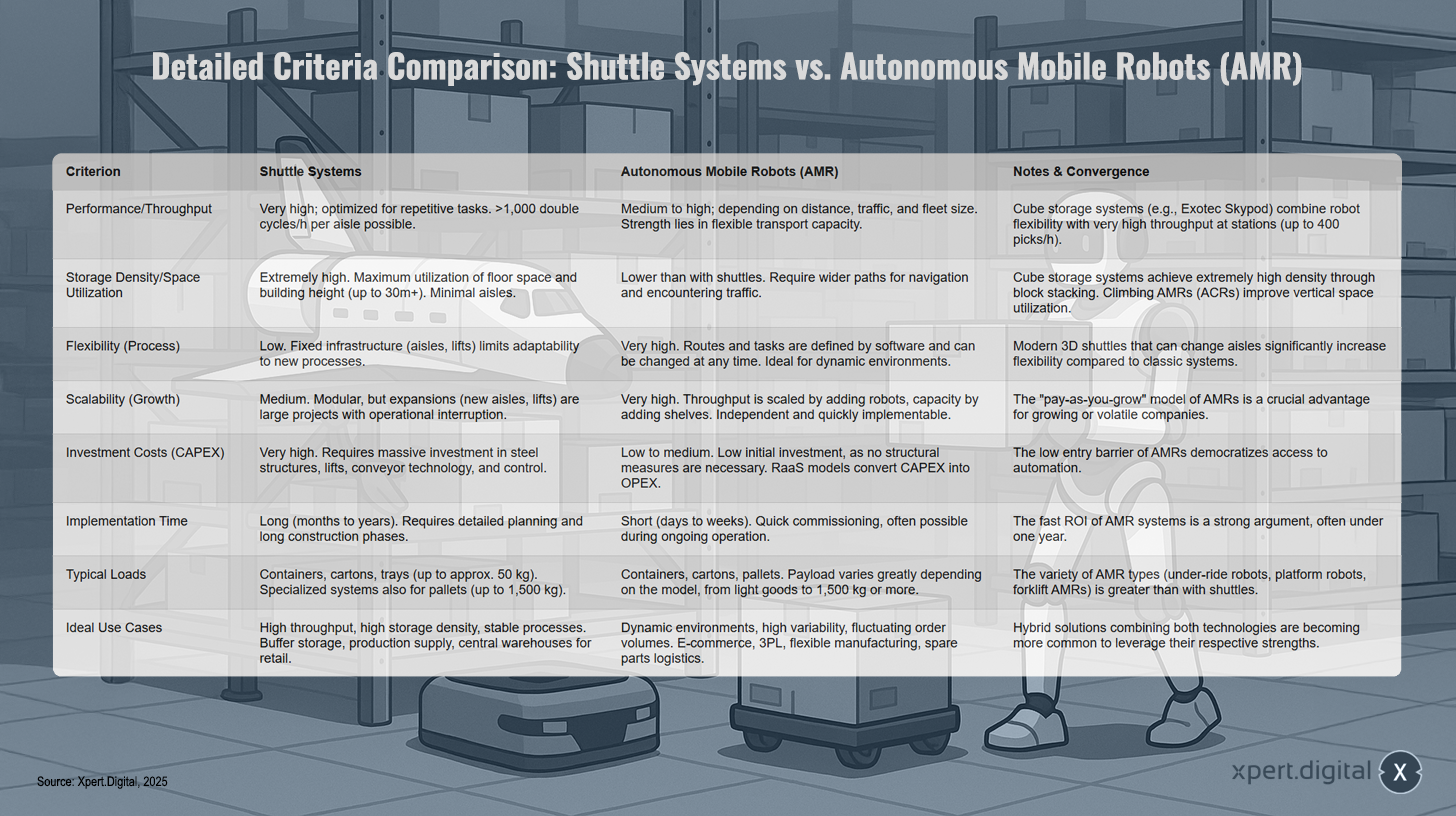
Detailed comparison of criteria: Shuttle systems vs. Autonomous Mobile Robots (AMR) – Image: Xpert.Digital
A comparison between shuttle systems and autonomous mobile robots (AMRs) reveals a fascinating development in warehouse technology. Both systems have their specific strengths and weaknesses, which must be weighted differently depending on the application.
Shuttle systems excel with an extremely high throughput of over 1,000 double cycles per hour and maximum space utilization up to 30 meters in height. They are ideal for stable, repetitive, high-volume processes. However, the investment costs are substantial, and flexibility is limited by the fixed infrastructure.
In contrast, autonomous mobile robots offer remarkable process flexibility. Their routes and tasks can be quickly adapted via software, making them perfect for dynamic environments. Implementation time is short, and initial investments are significantly lower. Modern approaches such as cube storage systems already demonstrate how both technologies can converge.
The choice between shuttle systems and AMRs depends on specific business requirements: Shuttle systems are ideal for high throughput and storage density, while AMRs are the better choice for flexibility and rapid scalability. Increasingly, companies are also opting for hybrid solutions to combine the advantages of both technologies.
The brain of the operation – software, control and integration
What role does the software play in controlling shuttle systems and how is it integrated into the existing IT landscape (WMS/WMS)?
Without an intelligent software layer, a shuttle system is merely a collection of "dumb metal." Its true potential is only unlocked through its interaction with the system's digital brain. This role is typically fulfilled by a combination of warehouse management software (WMS) and an underlying material flow system (MFS) or warehouse control system (WCS).
The tasks of this software are diverse and crucial for performance:
- Warehouse location management: The software decides in real time which storage location is optimal for a newly arriving item. Criteria can include access frequency (ABC analysis), the grouping of items for an order, or the even utilization of the aisles.
- Order and sequence management: The system receives orders from the higher-level ERP system and breaks them down into individual transport orders for the hardware. It ensures that the items are retrieved in the optimal sequence for the downstream process (e.g., packaging).
- Hardware control: The software is the conductor of the orchestra. It sends the specific travel commands to each individual shuttle, each lift, and each segment of the conveyor system and synchronizes their movements to ensure a smooth and efficient flow of materials.
- Real-time inventory control: Because every single movement is recorded, the system offers a continuous, second-by-second inventory. The stock level is 100% transparent at all times.
Integration into the existing IT landscape is key to success. Seamless communication between the WMS/MFS and the company's Enterprise Resource Planning (ERP) system is essential. Standardized interfaces (APIs) facilitate the exchange of order data, master data, and inventory information to guarantee a continuous flow of information from customer order to shipment.
Why is fleet management software indispensable for AMRs and what intelligent, AI-based functions does it offer?
If the WMS represents the strategic level that defines the "what" and "when" of logistics processes, then the fleet management software is the tactical intelligence that decides the "who" and "how" for an AMR fleet in real time. A single AMR is a tool; a fleet without central management would be pure chaos.
Fleet management software is indispensable and offers a range of highly intelligent functions:
- Traffic management: Similar to air traffic control, the software coordinates the routes of all robots in the warehouse. It prevents collisions, regulates right-of-way at intersections, and prevents congestion by dynamically controlling the flow of traffic.
- Intelligent task allocation: When a new transport order is received from the WMS, the fleet management software decides which robot is best suited for the task. AI-based algorithms take a multitude of factors into account in real time: the robots' current position, their battery charge level, their current workload, and the priority of the order.
- AI-based route planning: The software doesn't just calculate the shortest route, but the most efficient one. It can predict and bypass traffic jams, find alternative routes when roads are blocked, and optimize the entire fleet's material flow to minimize transport times.
- Integration of peripheral devices: Modern fleet managers not only control the robots themselves, but also orchestrate their interaction with their environment. They can automatically open gates, call elevators, or coordinate the transfer of goods to robotic arms and conveyor belts.
- Automatic energy management: The software monitors the charge level of each robot and automatically sends it to the nearest available charging station in good time when the battery level is low, in order to ensure 24/7 operation.
A crucial advancement is the development of manufacturer-independent communication standards such as VDA 5050. Fleet managers that support this standard can control heterogeneous fleets of vehicles from different manufacturers. This gives companies the freedom to select the best robot for each task and prevents long-term dependence on a single supplier ("vendor lock-in").
What are the biggest challenges in achieving interoperability and seamless integration of these complex systems into existing operational processes?
Implementing advanced automation solutions is a complex undertaking that extends far beyond pure technology. The challenges can be divided into technical and organizational aspects.
- Technical challenges:
- System compatibility and interfaces: The biggest technical hurdle is ensuring seamless communication between the different software layers: ERP, WMS, MFS, and fleet management. This often requires the use of special middleware or the complex development of customized application programming interfaces (APIs) to allow the systems to communicate with each other.
- Data harmonization: Data formats and protocols must be correctly "translated" and standardized between systems (data mapping) so that an order from the ERP system ultimately leads to a correct physical movement in the warehouse.
- Network infrastructure: AMRs, in particular, rely on an extremely stable, comprehensive, and high-performance Wi-Fi connection. In many existing warehouses, the network is not designed for these requirements and requires costly upgrades.
- Security: The integration must guarantee both physical and digital security. This includes connecting to existing security systems such as emergency stop circuits and fire protection systems, as well as securing the entire network against cyberattacks that could cripple an entire fleet.
- Organizational challenges:
- Employee acceptance and change management: The introduction of robots can trigger fears of job loss among the workforce. A successful project therefore requires an open communication strategy, early employee involvement, and comprehensive training programs to develop new skills for working with the machines (e.g., fleet monitoring, maintenance).
- Process reengineering: The greatest return on investment is not achieved by simply replacing a human with a machine. True success lies in fundamentally redesigning the entire process chain to fully leverage the unique capabilities of automation. This requires a rethinking of workflows, performance metrics, and management philosophies.
- Initial investment: Despite the advantages, the costs, especially for comprehensive shuttle systems, represent a significant hurdle for many medium-sized companies. Strategies such as starting with small pilot projects, gradual scaling, or using RaaS financing models can help overcome this barrier.
Experience shows that the biggest challenges are often not technical, but organizational. An automation project is not simply an IT project, but a profound business transformation project. Companies that merely try to "plug in" new technology into old, manual processes will not realize its full potential. The winners will be those who use technology as a catalyst to reinvent their entire operating model.
🎯🎯🎯 Benefit from Xpert.Digital's extensive, five-fold expertise in one comprehensive service package | BD, R&D, XR, PR & Digital Visibility Optimization

Benefit from Xpert.Digital's extensive, five-fold expertise in a comprehensive service package | R&D, XR, PR & Digital Visibility Optimization - Image: Xpert.Digital
Xpert.Digital possesses in-depth knowledge across various industries. This allows us to develop tailored strategies precisely aligned with the requirements and challenges of your specific market segment. By continuously analyzing market trends and monitoring industry developments, we can act proactively and offer innovative solutions. The combination of experience and expertise generates added value and provides our clients with a decisive competitive advantage.
More information here:
Shuttles vs. AMRs – Hybrid Systems: The Key to Logistics Success in the Next Decade?
Market, players and future trends
What does the current market landscape look like and what growth forecasts exist for warehouse automation?
The warehouse automation market is experiencing explosive growth, driven by the irreversible trends of e-commerce, omnichannel retailing, and the global labor shortage. The data paints a clear picture of an industry on the rise:
- Market Size and Growth: The global market was estimated to reach a volume of US$26.5 billion in 2024. Forecasts predict an impressive compound annual growth rate (CAGR) of over 15.9% for the period up to 2034. Specifically for Europe, growth from US$4.9 billion in 2024 to US$9.59 billion in 2029 is expected, representing a CAGR of 14.4%. Similar dynamics are evident in North America, where the US market is projected to more than double by 2030.
- Market penetration: Despite these impressive growth figures, the potential is far from exhausted. It is estimated that only about 5% of warehouses worldwide are highly automated today. Another 15% use partial solutions such as conveyor belts, while the overwhelming majority of 80% are still largely manually operated. This low level of automation signals enormous future growth potential for technologies such as shuttle systems and AMRs.
- Regional focus areas: Europe, and Germany in particular, boasts one of the highest robot densities in the world and is a hotspot for OEMs and system integrators. At the same time, Central and Eastern Europe are considered rapidly growing future markets. In the USA, especially in the large segment of medium-sized enterprises, there is a significant need to catch up in automation, which is also driving strong growth there.
Related to this:

Which companies are the leading providers of shuttle and AMR systems?
The competitive landscape is heterogeneous. In the shuttle systems sector, large, established intralogistics providers dominate, often offering complete turnkey solutions. The AMR market is more dynamic and fragmented, with a mix of established industrial companies and highly specialized, agile robotics startups.
- Leading providers of shuttle systems (often as part of overall solutions):
- DAIFUKU (Japan)
- SSI Schäfer (Germany)
- Dematic (part of the Kion Group, Germany)
- KNAPP (Austria)
- TGW Logistics Group (Austria)
- Vanderlande (part of Toyota Industries, Netherlands)
- Mecalux (Spain)
- Swisslog (part of KUKA AG, Switzerland)
- WITRON Logistics + Informatics (Germany)
- Leading providers of AMR systems (selection by specialization):
- Goods-to-Person / Climbing robots: Exotec (France), Geek+ (China), Hai Robotics (China).
- Person-to-Goods / Collaborative Robots: Locus Robotics (USA), Mobile Industrial Robots (MiR, part of Teradyne, Denmark).
- Industrial AMRs & Fleet Management: KUKA (Germany), ABB (Switzerland/Sweden), DS AUTOMOTION (part of SSI Schäfer, Austria).
Overall, market concentration is rated as "medium", which indicates healthy and innovation-driven competition between the players.
Which technological trends, such as hybrid systems, AI and cobots, will shape the next generation of warehouse systems?
Developments in warehouse automation are constantly evolving. Several key trends will define the next generation of systems and further push the boundaries of what is possible today.
- Hybrid systems and convergence: The strict separation between different system worlds is dissolving. The future belongs to integrated, hybrid solutions that intelligently combine their respective strengths. A typical scenario involves using a high-density shuttle or cube storage system for warehousing and connecting it to flexible automated guided vehicles (AGVs) for transporting goods to decentralized, ergonomic picking stations or between different storage and production areas. This avoids rigid conveyor technology and maximizes both density and flexibility.
- Ubiquitous artificial intelligence (AI) and machine learning (ML): AI is evolving from a niche function to an integral part of overall warehouse management. Beyond simple route planning for automated guided vehicles (AGVs), it is being used for global process optimization: predictive analytics to forecast demand peaks and proactively adjust resources, intelligent inventory optimization that dynamically relocates items based on predicted orders, and adaptive learning algorithms that continuously improve the overall system by analyzing operational data.
- Human-robot collaboration and cobots: Humans won't disappear from the warehouse, but their role will shift from manual labor to monitoring, control, and problem-solving. Collaborative robots (cobots) and automated guided vehicles (AGVs) are being developed to work safely and efficiently alongside humans. Ergonomic "goods-to-person" or "goods-to-robot" workstations, where humans and machines pick orders hand in hand, are becoming the standard.
- Internet of Things (IoT) and total connectivity: The warehouse of the future is fully networked. Sensors in shelves, on machines, on robots, and even on the loading units themselves deliver a constant stream of real-time data. This data is used by AI systems to create a digital twin of the warehouse and to control and optimize physical processes with unprecedented precision.
- Sustainability and energy efficiency: In light of rising energy costs and societal pressure, sustainability is becoming a crucial design criterion. Systems with low energy consumption, such as AutoStore's robots that can supply each other with energy, or energy-efficient shuttle drives, are gaining in importance. Promoting the circular economy through optimized returns processes is also becoming a key aspect.
Future trends in intralogistics and their impact
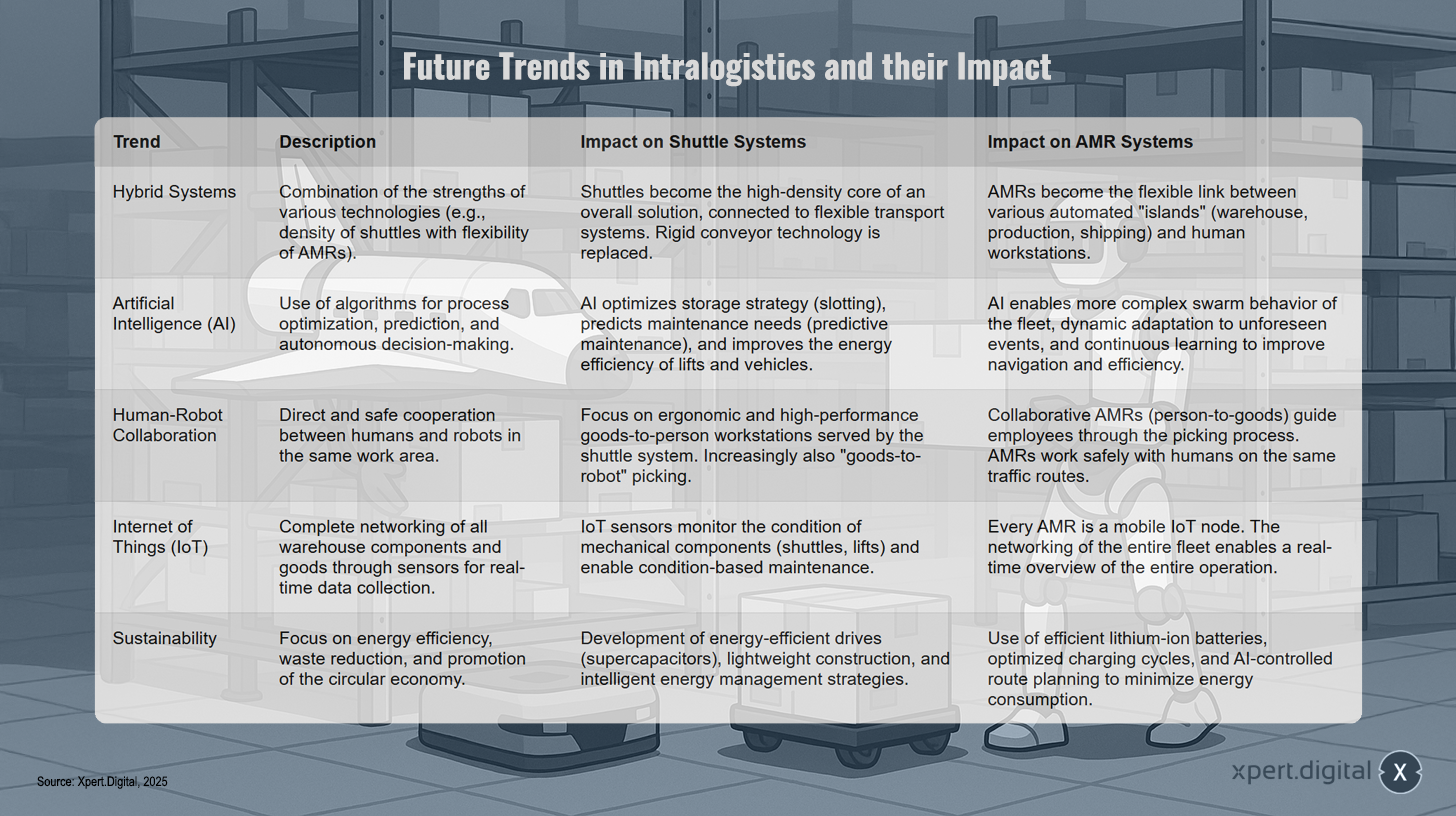
Future trends in intralogistics and their impact – Image: Xpert.Digital
The future of intralogistics will be shaped by several significant trends that will revolutionize the performance and efficiency of logistics systems. Hybrid systems represent a key strategy, combining the strengths of various technologies. Shuttle systems will form the high-density core of a comprehensive solution, while autonomous mobile robots (AMRs) will act as a flexible link between different automated areas.
Artificial intelligence (AI) plays a key role in process optimization. It enables not only improved inventory management strategies and predictive maintenance, but also more complex swarm behavior from robot fleets. Human-robot collaboration is becoming a crucial aspect, where robots work safely and ergonomically alongside human employees.
The Internet of Things (IoT) connects all warehouse components in real time, creating comprehensive transparency. Every robot becomes a mobile data hub, exchanging and analyzing information. At the same time, sustainability is gaining increasing importance. Energy-efficient drives, optimized battery technologies, and AI-driven route planning aim to minimize the ecological footprint of intralogistics.
These trends show that the future of intralogistics will be characterized by networking, intelligence and sustainability, with humans and technology working together ever more closely.
Coexistence instead of competition – Which system will dominate the future?
Will one system therefore displace the other, or are we moving towards a future of coexistence and hybrid solutions?
After an in-depth analysis of the technologies, their performance characteristics, cost structures, and future trends, one thing becomes clear: the question of "shuttle vs. robot" is wrongly posed if it implies that one system will be replaced by the other. The idea of a single, all-dominating technology is a relic from a simpler time. The future of warehouse automation will not be shaped by a single winner, but by an intelligent, application-specific coexistence and an increasing convergence of technologies.
There will be no complete displacement. Instead, the systems will prevail in those application areas where their respective core strengths are best utilized:
- Shuttle systems (and their further developments such as cube storage) will continue to dominate where maximum storage density and extremely high, predictable throughput are the decisive criteria. This applies to buffer storage in industry, the supply of high-performance production lines, large central warehouses in the food retail sector, or for fast-moving items in e-commerce fulfillment.
- Autonomous mobile robots (AMRs) will demonstrate their dominance in all areas where flexibility, rapid scalability, and adaptability to dynamic processes are paramount. These include volatile e-commerce environments with highly fluctuating order profiles, third-party logistics (3PL) with frequently changing customers and requirements, and flexible, modular production concepts.
The most important and defining trend, however, is the convergence of technologies and the emergence of hybrid systems. The most efficient logistics centers of the future will not rely on either shuttles or AMRs, but rather on integrated, comprehensive solutions that combine the best of both worlds. Dominance will therefore not be exercised by a specific hardware technology. The true winner in the race for the future of intralogistics is the software ecosystem. The intelligence capable of seamlessly orchestrating heterogeneous technologies—shuttles, AMRs, cobots, conveyor technology, and manual workstations—into a highly efficient, flexible, and resilient whole will represent the decisive competitive advantage.
The future of industry will be dominated by intelligent, flexible and hybrid automation ecosystems, where the choice of the right hardware for the specific task and its perfect integration through superior software will determine success.

Xpert.Plus Warehouse Optimization - High-bay warehouses and pallet warehouses: Consulting and planning
We are here for you - Consulting - Planning - Implementation - Project Management
☑️ Our business language is English or German
☑️ NEW: Correspondence in your native language!

Konrad Wolfenstein
I and my team are happy to be available to you as your personal advisor.
You can contact me by filling out the contact form here wolfenstein@xpert.digital:or simply call me at +49 7348 4088 965. My email address is
I'm looking forward to our joint project.