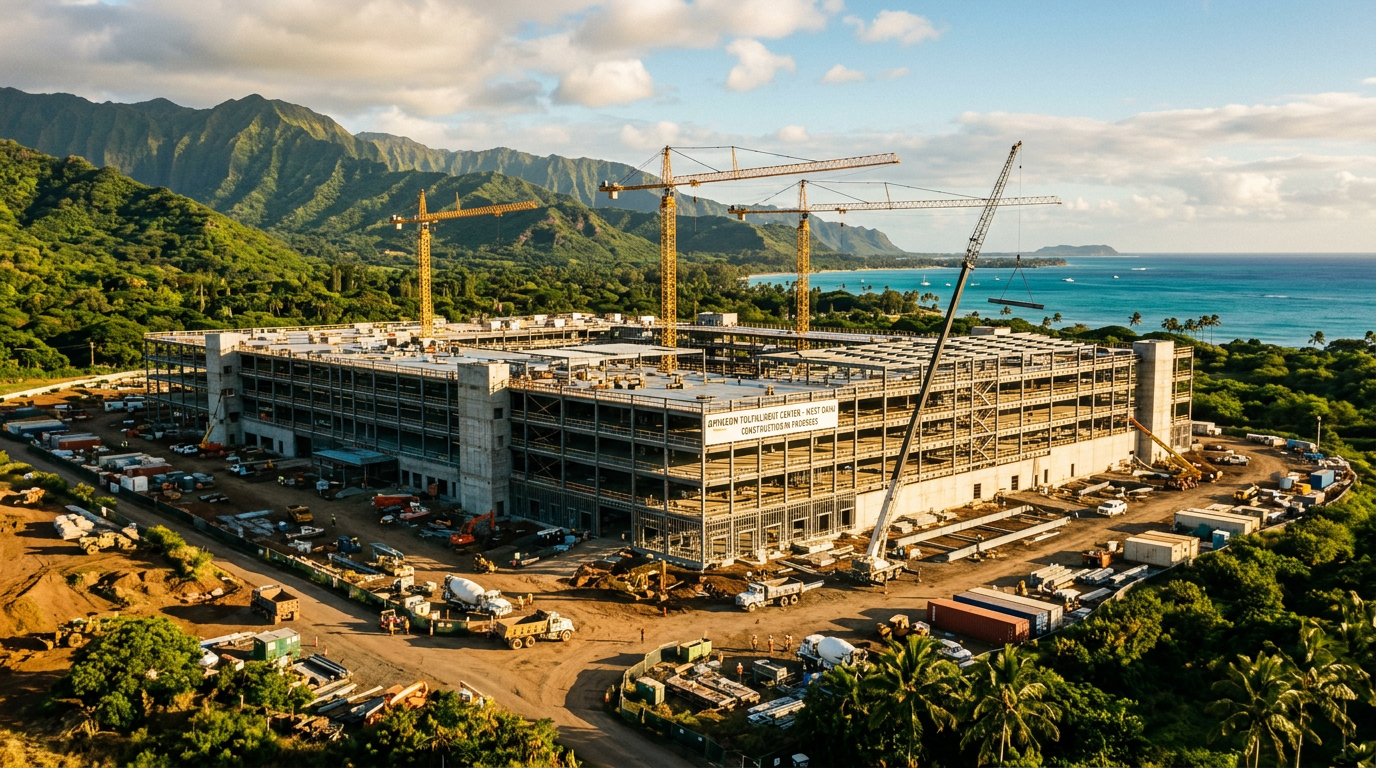
“Project Savoy”: Amazon’s planned 600-million-dollar mega-warehouse – Same-day delivery in paradise – Creative image on the topic, with AI: Xpert.Digital
Dispute over 30-meter behemoth: How a new logistics center could change Hawaii forever – The high price of Amazon's Pacific conquest
The giant that devours islands: Amazon's master plan for the Hawaiian market
With what it calls "Project Savoy," Amazon is planning a historic breakthrough in the middle of the Pacific: a roughly $600 million, highly automated mega-logistics center on the Hawaiian island of Oahu is intended to herald the end of long delivery times and bring same-day delivery to the island paradise. While the e-commerce giant is enticing businesses with thousands of new jobs and aims to boost the economy of the structurally disadvantaged region, local resistance is forming. Residents and politicians fear not only unprecedented traffic chaos and serious environmental consequences, but are also vehemently opposing a 30-meter-high concrete colossus that would permanently alter the landscape of West Oahu. The battle over this gigantic construction project exemplifies how thin the line has become between logistical progress and the displacement of local structures – and that even an all-powerful corporation like Amazon can stumble over the hurdles of local democracy.
A trading giant discovers the Pacific island
Amazon is planning one of the largest construction projects the Hawaiian archipelago has ever seen in West Oahu, in the Campbell Industrial Park near Kapolei. On a 49-hectare site, which the company acquired in 2021 for approximately $76 million, a five-story logistics and fulfillment center with nearly three million square meters of floor space is to be built. The sheer scale of this project surpasses all previous benchmarks in the local construction industry and marks a turning point in how Hawaii could be supplied with consumer goods in the future. While Amazon has long operated massive fulfillment centers in cities on the US mainland, the Pacific island state has thus far been a logistical backwater with limited storage capacity and long delivery times. The company now intends to address precisely this deficiency with a massive undertaking that is likely to significantly alter the construction industry, the job market, and real estate prices on West Oahu.
The timing of this expansion is interesting. Amazon only opened its first distribution center on Sand Island about two years ago, a three-story facility of approximately 55,000 square meters, which served as a test for the Hawaiian market. The success of this first step seems to have encouraged the company to take a significantly more ambitious second step. The new project, known internally as "Project Savoy," would not only be larger but also far more technologically advanced, as it is expected to rely heavily on robotics and automation.
Why Hawaii is suddenly becoming important for Amazon
The location decision follows a sober economic logic. Hawaii is traditionally considered one of the most expensive and logistically challenging regions in the United States, as virtually all consumer goods must be imported by sea or air freight. This geographical isolation leads to long delivery times, high freight costs, and limited product availability compared to the mainland. For a company like Amazon, whose business model is based on speed and availability, this situation presents both a problem and an opportunity.
With its own on-site fulfillment center, Amazon could for the first time offer same-day and next-day deliveries on a significant scale for customers on Oahu and beyond—a level of service that was previously virtually unthinkable. The planned facility would act as a central hub, from which goods would be forwarded to the existing distribution center in Kalihi Kai and from there delivered to end customers using smaller vehicles. This would create a two-stage logistics chain, mirroring the model Amazon uses in metropolitan areas on the mainland.
The company also points to the steadily growing demand in Hawaiian online retail. The island nation, with its approximately 1.4 million inhabitants and strong tourism industry, offers Amazon an attractive, albeit geographically limited, market potential that has so far been dominated by local retailers and expensive import structures. Having its own warehouse on-site would allow Amazon to at least partially control this value chain and reduce its dependence on third-party suppliers and external freight companies.
The dimensions of a gigantic construction project
The planned dimensions of the project illustrate why it is causing such a stir locally. The building is slated to have five stories and, at almost 30 meters (nearly 100 feet) in height, will significantly exceed the existing 60-foot height restriction for this industrial zone. Amazon justifies this necessity with the operational requirements of vertical warehousing, which it argues is essential for efficient storage and retrieval as well as short processing times. Without this height exception, the company contends, the planned capacity and efficiency of the site would not be achievable.
On the total area of 49 hectares, Amazon plans to actually build on only a portion of approximately 6.5 to 16.5 hectares, while the remainder is designated for expansion areas, parking, and buffer zones. The infrastructure will include 47 loading docks, several hundred parking spaces for trailers, and a multi-story parking garage with nearly 900 spaces, the majority of which would be reserved for employees. These figures suggest that this is not a simple warehouse, but a highly complex logistics infrastructure designed to operate 24/7.
The total investment is estimated at around $600 million, making it one of the largest private investments in the history of West Oahu. For comparison, previous major construction projects in the region, such as retail or residential developments, rarely reached anything close to comparable sums. This scale underscores the strategic importance Amazon now places on the Hawaiian market, even though it is relatively small compared to the major metropolitan areas of the mainland.
Jobs between promise and fear of automation
The project promises significant employment benefits for the local economy. Amazon anticipates that the fully operational facility will create more than 1,500 full-time jobs, organized in two daily shifts. In addition, several hundred temporary jobs will be created during the two-year construction phase, providing a welcome boost to the regional construction industry. In a region traditionally heavily reliant on tourism and the public sector, such diversification of the labor market could have positive structural effects.
However, closer inspection warrants skepticism. Amazon itself emphasizes that the planned facility will rely heavily on robotics and automation technologies to support processes such as receiving, storing, packing, and labeling. These technologies are already standard in modern Amazon fulfillment centers on the mainland and have historically led to a continuous decrease in the number of workers required per square meter, while throughput has increased. Critics therefore fear that the promised number of jobs may be overly optimistic or that the actual jobs created will consist primarily of low-skilled, physically demanding tasks characterized by algorithmic performance monitoring, as have been repeatedly criticized in the professional community.
Furthermore, the question of long-term job security arises. Should technological progress in warehouse logistics continue to accelerate in the coming years, some of the jobs promised today could disappear again in the medium term, as robots and artificial intelligence increasingly take over tasks currently performed by humans. This development would not be a unique Hawaiian phenomenon, but rather follows a global trend in the logistics industry that can already be observed in numerous other regions.
Your intralogistics experts

Consulting, planning and implementation of complete solutions for high-bay warehouses and automated storage systems - Image: Xpert.Digital
More information here:
Traffic, environment, and local power: Why the construction of Amazon's mega-warehouse in Honolulu is delayed
The political dispute over building height
Before Amazon can even begin construction, the company must overcome significant regulatory hurdles. At the heart of the matter is the requested exemption to the building's height, which would need to be increased from the current 60 feet to nearly 100 feet. This change requires the approval of several city institutions, including the Department of Planning and Permitting of the City and County of Honolulu, the Honolulu Planning Commission, and ultimately the Honolulu City Council, which would have to vote on the corresponding bill in three readings.
The progress of this approval process so far shows that the resistance is by no means to be underestimated. The Honolulu Planning Commission unanimously postponed its decision on the requested zoning change in September 2026, which has already significantly delayed the project's timeline. A final decision is now not expected until November at the earliest, demonstrating that even a financially powerful corporation like Amazon cannot simply disregard local democratic processes.
While there was already preliminary, conditional support within the relevant neighborhood committees, individual members, such as the well-known critic of a neighborhood council, expressed significant concerns. These concerns were directed less against the fundamental economic development than against the specific consequences of such a large industrial complex in the immediate vicinity of residential areas.
Traffic, the environment, and the concerns of local residents
A key argument from critics concerns the anticipated increase in traffic. A 24/7 fulfillment center of this size would inevitably lead to a significant increase in truck traffic on the surrounding roads, which are already regularly congested in West Oahu. Given that Kapolei and the surrounding communities are already experiencing rapid growth and increasingly serve as residential areas for commuters traveling daily to Honolulu, additional heavy truck traffic could further exacerbate the already strained traffic situation.
Furthermore, there are environmental concerns. The construction of such a massive industrial facility on previously undeveloped land raises questions about managing stormwater runoff, soil sealing, and the impact on local ecosystems, which are particularly sensitive in an island region with limited natural resources. The energy supply for a facility of this size, operating around the clock with cooling, lighting, conveyor technology, and robotics, is also likely to place an additional burden on Hawaii's already strained energy market, which is traditionally among the most expensive in the United States.
The planned height exemption also raises aesthetic and urban planning concerns. A building nearly 30 meters high would significantly tower over the existing, predominantly low-rise buildings in the region and alter the landscape in an area traditionally characterized by open spaces, industrial brownfields, and views of the volcanic hills. Such visual interventions are often the subject of particularly critical debate in tourist regions like Hawaii, as they can potentially diminish the area's appeal to visitors.
A larger pattern: Amazon's silent conquest of the Pacific
The Kapolei project is not an isolated phenomenon, but rather part of Amazon's broader strategic expansion in the Hawaiian market. Since 2010, the company has reportedly invested more than $800 million in the state, with the pace of these investments accelerating significantly in recent years. In addition to its existing distribution center on Sand Island and the planned large-scale project in Kapolei, Amazon is also developing a smaller warehouse and distribution center of approximately 42,000 square feet on the island of Kauai, in partnership with a local real estate developer, and is expected to open later this year.
This multi-pronged expansion suggests that Amazon no longer views Hawaii as a mere logistical sideshow, but rather as an independent, scalable regional market. It is telling that the company is increasingly venturing beyond the main island of Oahu into smaller neighboring islands, where the logistical challenges are actually even greater due to lower population density and weaker infrastructure. Amazon's decision to pursue such an expansion nevertheless indicates a high degree of strategic confidence in the long-term growth potential of Hawaiian online retail.
Additionally, air freight infrastructure plays a crucial role in the overall picture. Amazon has maintained a close contractual relationship with Hawaiian Airlines (now owned by Alaska Airlines) for several years, under which several converted cargo planes are used exclusively for transporting the company's goods. However, reports of tensions during the renegotiation of these freight contracts suggest that the operational relationship between the companies involved is not without its economic friction points, which could have long-term repercussions for the cost-efficiency of the planned supply chains to and from Hawaii.
Economic opportunities for a structurally disadvantaged region
From a purely economic perspective, the project offers significant opportunities for West Oahu. The Kapolei region has been considered a strategic growth focus for Honolulu's urban planning for years, which aims to relocate economic activity and housing from the overburdened capital to the island's west side. An investment of $600 million would provide a significant boost to this development goal and could act as a catalyst for further private investment in adjacent commercial areas.
The indirect economic effects should not be underestimated either. A fulfillment center of this size regularly generates demand for local services such as maintenance, security, catering, and transportation, which can create additional jobs in upstream and downstream industries. Furthermore, the anticipated tax revenue from business and property taxes should benefit the city administration, which could then invest these funds in local infrastructure projects.
On the other hand, there is a risk that such a dominant player will put additional pressure on local retailers. Small, owner-operated businesses in Hawaii have been struggling for years with the state's high cost of living and growing competition from nationwide online retailers. Should Amazon be able to offer even faster and cheaper deliveries with its own fulfillment center, this competitive pressure is likely to intensify further, potentially leading to the continued displacement of local businesses in the long term—an effect already documented in numerous studies on Amazon's impact on local retail structures on the US mainland.
The fine line between progress and displacement
Overall, the planned fulfillment center in Kapolei exemplifies the tension many regions worldwide face when a global technology corporation with significant financial market power encounters a structurally limited, geographically isolated economy. On the one hand, the project promises significant short-term economic benefits: new jobs, substantial construction investments, improved delivery times for consumers, and a degree of modernization of the local logistics infrastructure. On the other hand, there are legitimate concerns regarding increasing automation, traffic congestion, environmental costs, and a further weakening of local, owner-operated retail businesses.
It is also noteworthy how clearly the example of Hawaii demonstrates that even financially powerful corporations like Amazon cannot operate free from democratic control. The repeated delays in the approval process by the Honolulu Planning Commission illustrate that local political institutions are indeed capable of significantly influencing the timeline and ultimately the specific design of such a large-scale project. Whether the project is ultimately realized in its planned form therefore depends not only on corporate considerations, but also crucially on the further course of a political negotiation process that is likely to take several more months.
The outcome of this approval process is likely to be pivotal for the future development of Hawaii as an independent, albeit small, economic region in the vast Pacific. Should Amazon be able to implement its plans as intended, it would send a clear signal that even geographically isolated island regions are increasingly being integrated into the global logistics networks of major technology companies – with all the associated economic opportunities and structural risks that such integration typically entails.
Your global marketing and business development partner
☑️ Our business language is English or German
☑️ NEW: Correspondence in your native language!

Konrad Wolfenstein
I and my team are happy to be available to you as your personal advisor.
You can contact me by filling out the contact form here wolfenstein@xpert.digital:or simply call me at +49 7348 4088 965. My email address is
I'm looking forward to our joint project.