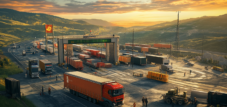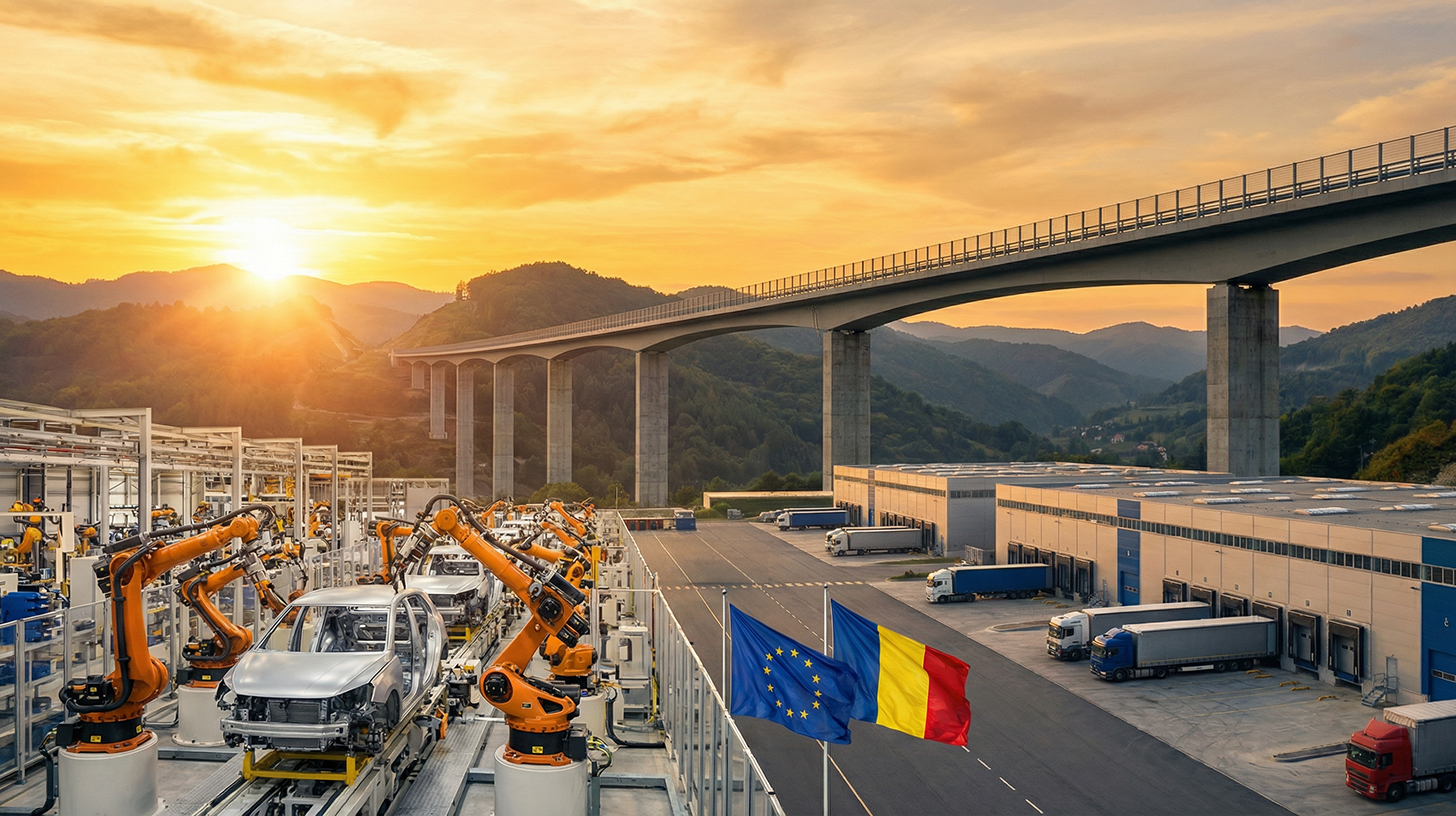
From impoverished nation to economic powerhouse: Romania's incredible rise in the EU – thanks to the EU single market – Image: Xpert.Digital
Europe's last great economic miracle: Why Romania is indispensable for German companies
Growth market in the East: Why you need to have Romania's economy on your radar now
For a long time, Romania flew under the radar of the Western economic elite – often unfairly labeled as a mere low-wage country or even the poorhouse of Europe. But in the past two decades, the sixth-largest member state of the European Union has undergone an unprecedented economic transformation. Fueled by its now full accession to the Schengen Area, an unprecedented influx of billions from Brussels, and a rapidly growing, highly innovative IT sector, the country has quietly and steadily developed into a strategic powerhouse. International corporations and German SMEs have long operated state-of-the-art production facilities here and benefit from a vast pool of young, highly skilled professionals. Even though structural challenges such as high inflation and a growing budget deficit still make the path difficult, Romania is now the last major growth market in Central Europe – and a logistical hub that will be indispensable for European industry in the future.
How the EU single market is transforming a former poorhouse into the growth engine of Southeast Europe
The European single market comprises around 450 million consumers and represents the world's largest contiguous economic area. Within this vast market, one country has transformed itself over the past two decades from an economic laggard into a significant location factor, attracting both multinational corporations and medium-sized enterprises from the heart of Europe. This country is Romania, the sixth-largest EU member state with nearly 19 million inhabitants, whose economic transformation receives far less media attention than its strategic importance warrants.
Romania joined the European Union in 2007, and since then the country has undergone remarkable development. Its gross domestic product per capita, which in the early 2000s was a fraction of the EU average, has now reached approximately 78 percent of the European average in purchasing power standards. In absolute terms, GDP per capita amounted to around US$20,210 in 2024, and forecasts indicate a continued increase to over US$27,000 by 2029. This places Romania among the EU countries whose catch-up potential is particularly exciting for investors.
From a country in transition to a world-class production location
The story of Romania's economic transformation begins with the bumpy transition from a planned economy to a market economy in the 1990s. Compared to other Eastern European countries like Poland or the Czech Republic, the privatization process was slower and marked by setbacks, corruption, and bureaucratic hurdles. However, with EU accession, a dynamic began that fundamentally changed the country.
Today, international corporations operate state-of-the-art production facilities in Romania, which are virtually indistinguishable in quality from their Western European counterparts. In regions like Timisoara, Arad, and Craiova, a significant German industrial presence has established itself in the automotive and manufacturing sectors. Star Assembly, a Daimler subsidiary, produces transmissions for Mercedes vehicles there. Bosch, Continental, and Schaeffler maintain large plants. In the retail sector, Lidl, Kaufland, and Metro dominate the market, while in the energy sector, companies like E.ON and Siemens shape the landscape.
Germany has been Romania's largest trading partner continuously since 2006. In the first half of 2025, bilateral trade volume amounted to €21.1 billion. Romanian exports to Germany totaled €9.7 billion, while imports from Germany amounted to approximately €11.4 billion. Overall, Romania conducts nearly three-quarters of its total foreign trade with EU partner countries. Romanian exports are dominated by machinery and vehicles, accounting for around 47 percent, followed by other manufactured goods at 29 percent.
Schengen accession as an economic game changer
A turning point, the significance of which has so far been underestimated by the general public, was Romania's full accession to the Schengen Area on January 1, 2025. Having already been part of the Schengen Area by air and sea since March 2024, the country now also abolished border controls at its land borders with Hungary and Bulgaria.
The economic impact is significant. Before Romania joined the Schengen Area, truck drivers regularly had to wait up to ten hours at Romanian border crossings. These delays hampered just-in-time deliveries, forced companies into costly warehousing, and caused immense personnel costs for transport companies. The European Economic and Social Committee has calculated that the Romanian economy can save up to €2.5 billion in consequential costs by eliminating internal border controls.
The Romanian government itself estimates that open internal borders can generate approximately 0.5 percentage points of additional GDP growth annually. Measurable improvements are already evident just a few months after full accession: greater reliability in cross-border traffic, shorter transit times, and more efficient logistics processes. Romania is increasingly establishing itself as a logistics hub along Europe's east-west corridors, particularly along the pan-European Corridor IX.
The pan-European transport corridor IX is a multimodal transport axis (rail and road network) in European east-west traffic, which was defined within the framework of the so-called “Helsinki corridors”.
The corridor runs roughly from Helsinki (Finland) via St. Petersburg, Moscow, Kyiv, Chișinău, Bucharest, Ruse (Russia), Stara Zagora, Dimitrovgrad to Alexandroupolis (Greece) on the Aegean Sea. It also has several northern and eastern branches, for example to Klaipėda, Vilnius, Minsk, Gomel and Odesa, thus opening up large parts of Northern and Eastern Europe.
Corridor IX serves as a long-distance east-west connection for passenger and freight transport, particularly important for transit between Russia/Northern and Eastern Europe and Southeastern Europe/the Aegean region. It is part of a historical network of pan-European corridors, which were later largely integrated into the planning of the Trans-European Transport Network (TEN-T).
Our EU and German expertise in business development, sales and marketing

Our EU and German expertise in business development, sales and marketing - Image: Xpert.Digital
Industry focus areas: B2B, digitalization (from AI to XR), mechanical engineering, logistics, renewable energies and industry
More information here:
A thematic hub offering insights and expertise:
- Knowledge platform covering global and regional economies, innovation and industry-specific trends
- A collection of analyses, insights, and background information from our key areas of focus
- A place for expertise and information on current developments in business and technology
- A hub for companies seeking information on markets, digitalization, and industry innovations
Europe's next economic miracle? How 100 billion euros are now transforming Romania
The billions in funding from Brussels
Few other EU countries are currently benefiting as much from European funding programs as Romania. For the period 2021 to 2027, the country has access to a total of around 80 to 100 billion euros in EU funds. Under the Recovery and Resilience Facility alone, Romania can access up to 29.2 billion euros by the end of 2026, almost half of which consists of non-repayable grants.
The funds will be invested in infrastructure, digitalization, healthcare, and the green transformation. In the transport sector, the Romanian government plans infrastructure projects worth at least €43.2 billion over the next five years. This includes the construction of new highways and expressways for €25.6 billion, which will increase the highway and expressway network to 1,280 kilometers. An additional €17.6 billion will be invested in modernizing the railway infrastructure. The EU is providing approximately €7.3 billion for this purpose from the Recovery and Resilience Facility.
A flagship project is the A1 motorway, which is planned to run from Bucharest to the western border and will cost a total of around €5.5 billion. The European Investment Bank has already granted a loan of €500 million for a 122-kilometer section through the Carpathian Mountains. In December 2025, the European Commission also transferred over €586 million to Romania, earmarked for the development of transport infrastructure.
In 2026, Romania will be able to access up to €13.5 billion in EU funding. This money will provide a financial boost for roads, railways, power grids, hospitals, and digitalization projects. For German providers of construction services, energy and environmental technology, and digitalization solutions, this presents a strategic opportunity to position themselves as partners.
Romania's IT sector as a European powerhouse
Beyond traditional industry, Romania has established itself as one of Europe's most powerful IT hubs. With approximately 192,000 software developers in 2023, the country boasts one of the continent's largest IT talent pools. The total ICT workforce reached 240,800, with a remarkable 82 percent under the age of 34.
The IT sector is growing at an annual rate of around 8 percent and already contributed approximately 5.5 percent to GDP in 2019. By 2030, this share could rise to almost 10 percent, corresponding to a market volume of around 52 billion euros. Cities like Cluj-Napoca and Iași have developed into technological hubs with strong university partnerships. Thousands of engineers and computer scientists are trained annually at 41 technical universities.
This offers German companies a double advantage: On the one hand, Romania provides cost-efficient development resources within the EU legal framework; on the other hand, the modernization drive in the Romanian manufacturing sector offers ideal starting points for German Industry 4.0 expertise. Automotive suppliers are actively seeking advanced automation solutions there to maintain their competitiveness.
The downsides of the rise
Despite all the progress, Romania faces significant challenges. The budget deficit reached an alarming 9.3 percent of GDP in 2024 and is projected to fall to 8.4 percent in 2025 and 6.2 percent in 2026. Public debt is expected to rise from 55 percent of GDP in 2024 to 63 percent in 2027.
GDP growth will remain subdued for the time being. The European Commission expects growth of only 0.7 percent in 2025, just 1.1 percent in 2026, and an acceleration to 2.1 percent only in 2027. The necessary fiscal consolidation, including a freeze on public wages and pensions as well as tax increases, is expected to shrink private consumption by 0.8 percent in 2026.
Inflation remains the highest in the EU at 5.8 percent in 2024, burdening both consumers and businesses. The skills shortage has become a structural problem. Many well-educated Romanians have emigrated to Western Europe in recent decades, weakening the country's demographic foundation. Added to this are political instability and bureaucratic hurdles, which are regularly cited as major criticisms in business surveys.
The double dividend of the single market
The economic benefits of European integration are by no means one-sided. For the older EU member states, especially Germany, access to the Romanian market has brought tangible gains. The growing market, with its increasing purchasing power, attracts German exports of high-tech machinery, vehicles, and medical technology. Romania is now among the 20 most important markets for German goods.
Conversely, Romania benefits from the influx of capital, technology, and know-how. Foreign direct investment has increased the productivity of Romanian companies, created jobs, and raised standards. Integration into European supply chains has modernized Romanian industry and made it more export-oriented.
For Romania, the EU single market also provides a safety net. Around 70 percent of Romanian exports go to EU countries, offering a degree of stability in the face of global trade disruptions. The competitive cost structure, combined with EU-compliant standards and legal frameworks, makes the country attractive to investors seeking both efficiency and legal certainty.
Central Europe's last major growth market
Romania is often described as the last major market in Central Europe with Western standards, offering genuine competitive advantages in value creation. Its strategic location as the EU's gateway to the Black Sea region is gaining further importance in light of geopolitical shifts. Logistical advantages for distribution throughout Southeast Europe also make the location attractive from a geostrategic perspective.
The energy transition offers further opportunities. Romania possesses significant natural gas and wind power resources and is massively expanding its renewable energy sector. German companies with expertise in this area are finding growing opportunities there. The defense sector is also developing dynamically: The country has significantly increased its military spending and is investing in modern equipment, which is providing impetus for the defense industry.
Romania's history within the EU is ultimately a story of successful, albeit incomplete, integration. It is a country that has used its EU membership and Schengen accession to build modern institutions while simultaneously preserving cost advantages and growth potential. The coming years will show whether Romania can demonstrate the necessary fiscal discipline, close its infrastructure gaps, and use EU funding efficiently. The conditions for the next major leap forward have been created. The question is no longer whether Romania will experience economic growth, but how quickly and sustainably this growth will be.
Your global marketing and business development partner
☑️ Our business language is English or German
☑️ NEW: Correspondence in your native language!

Konrad Wolfenstein
I and my team are happy to be available to you as your personal advisor.
You can contact me by filling out the contact form here wolfenstein@xpert.digital:or simply call me at +49 7348 4088 965. My email address is
I'm looking forward to our joint project.
☑️ SME support in strategy, consulting, planning and implementation
☑️ Creation or realignment of the digital strategy and digitization
☑️ Expansion and optimization of international sales processes
☑️ Global & Digital B2B trading platforms
☑️ Pioneer Business Development / Marketing / PR / Trade Fairs
🎯🎯🎯 Benefit from Xpert.Digital's extensive, five-fold expertise in one comprehensive service package | BD, R&D, XR, PR & Digital Visibility Optimization

Benefit from Xpert.Digital's extensive, five-fold expertise in a comprehensive service package | R&D, XR, PR & Digital Visibility Optimization - Image: Xpert.Digital
Xpert.Digital possesses in-depth knowledge across various industries. This allows us to develop tailored strategies precisely aligned with the requirements and challenges of your specific market segment. By continuously analyzing market trends and monitoring industry developments, we can act proactively and offer innovative solutions. The combination of experience and expertise generates added value and provides our clients with a decisive competitive advantage.
More information here: