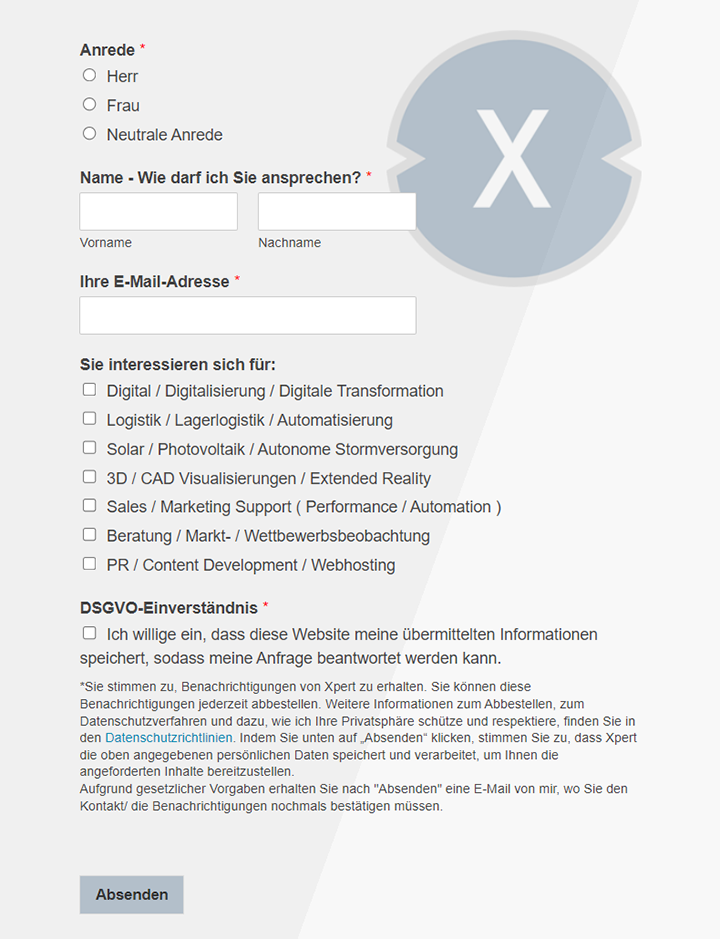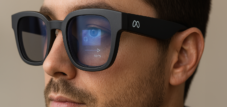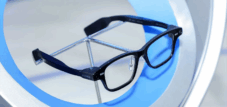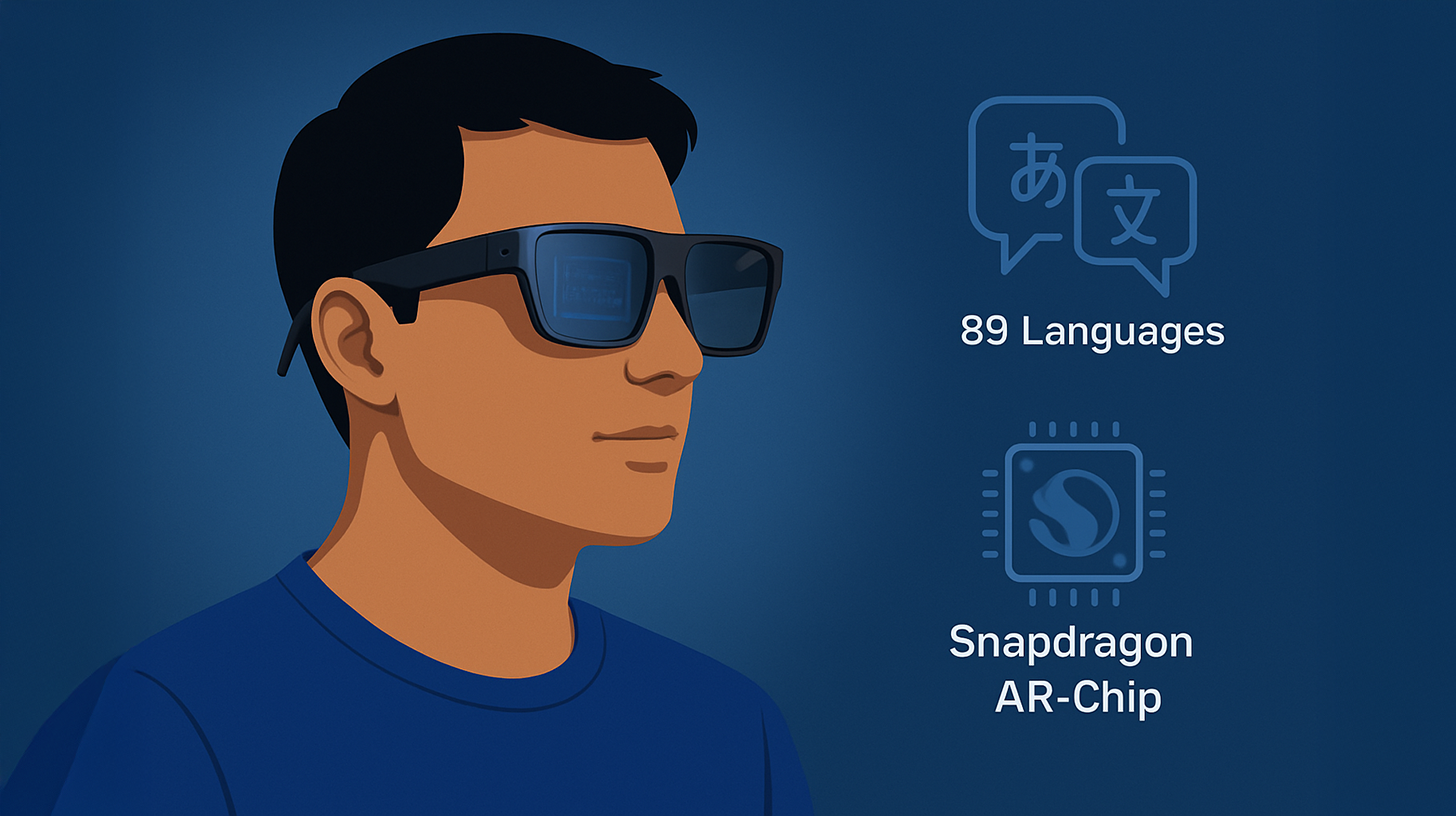
Rokid Glasses: Ultra-lightweight AI smart glasses with waveguide display, 89-language translation and Snapdragon AR chip – Image: Xpert.Digital
No more language barriers: These smart glasses translate 89 languages right before your eyes
### While Apple & Google are still asleep: These AI glasses are breaking all records ### Why everyone wants these smart glasses: Kickstarter hit raises $500,000 in 24 hours ### Lighter than normal glasses? This AI gadget with ChatGPT can do more than you think ### Is the smartphone dead? Rokid Glasses show what the AI future really looks like ###
The ultimate cheat sheet: AI glasses become a teleprompter and live translator
The smart glasses market is exploding, and while tech giants like Meta, Apple, and Google are still refining their visions, a Chinese company is already causing a sensation. Rokid Glasses are more than just a camera on your head—they're ultra-lightweight AI glasses that project information directly into your eyes, potentially fundamentally changing how we interact with the digital world. Weighing just 49 grams, featuring an advanced waveguide display, the power of ChatGPT, and impressive real-time translation for 89 languages, they've taken the tech world by storm. A Kickstarter project that smashed its funding goal in minutes and raised over half a million dollars in 24 hours demonstrates the enormous interest in a future where digital assistance is seamlessly integrated into our field of vision. But what exactly is behind this technology, how does it compare to emerging competition, and what societal questions does it raise? We delve deep into the world of Rokid Glasses and the future of wearable AI.
Related to this:


What are Rokid Glasses and why are they causing such a stir?
The Rokid Glasses are a new generation of smart glasses from the Chinese AR company Rokid, which gained international attention through an impressive Kickstarter campaign. Within the first 24 hours, the project raised over $500,000, despite an initial funding goal of just $18,000. These smart glasses differentiate themselves from many competing products through their integration of visual displays and AI capabilities in an ultra-lightweight 49-gram design.
How does the display technology of the Rokid Glasses work?
The Rokid Glasses use advanced waveguide technology to project information directly in front of the wearer's eyes. The system is based on two integrated waveguides with a 23-degree field of view, producing a monochrome green display with up to 1,500 nits of brightness. This technology allows digital content such as navigation, live captions, or app notifications to be projected while the wearer retains a clear view of their surroundings.
Waveguide technology utilizes the principle of total internal reflection to guide light through a thin optical layer. Rokid Glasses employ micro-LED displays, known for their energy efficiency and high brightness. The monochrome green display was a deliberate choice, as green light is best perceived by the human eye and is also energy-efficient.
Related to this:
What technical specifications do the Rokid Glasses offer?
The Rokid Glasses are equipped with the Qualcomm Snapdragon AR1 processor, a chip specifically designed for AR applications. This processor features four 1.9 GHz Kryo CPU cores, an Adreno GPU, and supports up to 2 GB of LPDDR4x RAM. The integrated Hexagon NPU enables AI functions directly on the device.
For image capture, a Sony IMX681 camera with 12 megapixels and a 109-degree field of view is integrated. This supports HDR modes and digital image stabilization for high-quality photos and videos from a first-person perspective. The audio system consists of four microphones with wind noise cancellation and AAC speakers positioned near the ears, enabling private audio playback.
Battery life varies depending on usage: 5-6 hours of music playback, 4 hours of talk time, 2 hours of display operation, or 45 minutes of continuous video recording. An optional 3,000 mAh charging case can recharge the glasses more than ten times, significantly extending usage time.
Related to this:

What are the most important AI features of the Rokid Glasses?
The Rokid Glasses offer a variety of AI-powered features enabled by the integration of ChatGPT. Users can interact with the AI assistant using the voice command "Hi Rokid" to ask questions, identify objects, or request translations. The system supports real-time translations in 89 languages, with five languages also available offline thanks to a dedicated language model.
A special feature is the intelligent teleprompter, which displays spoken words as subtitles in real time, taking into account the speaking pace and pauses. This is particularly useful for presentations or people with hearing impairments. The AI can also convert speech queries into text and transcribe meeting audio with speaker recognition and intelligent summaries.
What does the current smart glasses market look like?
The smart glasses market is currently experiencing impressive growth. According to market researchers at Counterpoint Research, the global smart glasses market grew by 110 percent in the first half of 2025. Meta dominates with a market share of 73 percent, driven by the successful Ray-Ban Meta smart glasses, which saw growth of over 200 percent.
Particularly noteworthy is the boom in AI-based smart glasses, which accounted for 78 percent of all shipments and grew by over 250 percent. Chinese manufacturers such as Xiaomi, TCL-RayNeo, and Rokid are increasingly pushing into the market and launching innovative products with advanced AI features.
The global smart glasses market was valued at US$925.22 million in 2024 and is projected to reach US$2,496.45 billion by 2032, representing a compound annual growth rate (CAGR) of 13.21 percent. Growth rates vary between 14.5 and 29.4 percent depending on the study, highlighting the significant market potential.
What are the competitors of the Rokid Glasses?
Rokid Glasses are entering a highly competitive market where various tech giants are vying for dominance. Meta is currently the market leader with its Ray-Ban Meta Smart Glasses, which have been on the market since 2021 and are continuously being developed. The company plans to launch its first smart glasses with an integrated heads-up display in 2025 and is working on a fully-fledged AR headset for 2027.
Google is developing Android XR smart glasses in collaboration with various partners such as Warby Parker and Samsung, which are expected to launch in 2026. Apple is also working on smart glasses, but these are not expected until late 2026 and will initially be released without AR capabilities, but with strong AI integration.
Other competitors include Chinese manufacturers like Xiaomi, which is already testing AI glasses in China, as well as established AR companies like Vuzix with professional solutions. Snap plans to release AR glasses for consumers starting in 2026.
Our recommendation: 🌍 Limitless reach 🔗 Connected 🌐 Multilingual 💪 Sales power: 💡 Authentic with strategy 🚀 Innovation meets 🧠 Intuition


From local to global: SMEs conquer the world market with a clever strategy - Image: Xpert.Digital
In an era where a company's digital presence determines its success, the challenge lies in creating an authentic, personalized, and far-reaching presence. Xpert.Digital offers an innovative solution that positions itself as the intersection of an industry hub, a blog, and a brand ambassador. It combines the advantages of communication and sales channels in a single platform and enables publication in 18 different languages. Cooperation with partner portals and the ability to publish articles on Google News and a press distribution list with approximately 8,000 journalists and readers maximize the reach and visibility of the content. This represents a crucial factor in external sales and marketing (SMarketing).
More information here:
Future technology between privacy and innovation
What are the main areas of application for smart glasses?
Smart glasses are used in various sectors, with usage patterns differing depending on the target group. In the consumer sector, entertainment, social media, and everyday assistance functions are paramount. Rokid glasses are specifically aimed at travelers, who can benefit from real-time translation and navigation.
In professional settings, smart glasses are increasingly being used in manufacturing, healthcare, and logistics. Doctors use AR glasses to access patient data and imaging during operations, while technicians in industry can receive instructions and diagnoses in real time.
The education sector is discovering smart glasses as an innovative learning aid that offers immersive experiences and context-related information. People with disabilities also benefit from features such as text-to-speech functionality, navigation for the visually impaired, and live subtitles for the hearing impaired.
Related to this:

What data privacy concerns exist regarding smart glasses?
Smart glasses raise significant privacy concerns because they can continuously collect data about their wearers and their surroundings. The biggest concern is the unobtrusive recording of individuals without their knowledge or consent. Although most smart glasses have LED indicators that signal active recording, these are often small and difficult to see.
Meta has already sparked controversy with its Ray-Ban smart glasses when the company changed its privacy policy and now automatically activates the camera when the voice command "Hey Meta" is used. All recorded audio data is saved by default and can be used to train AI models.
A particularly disturbing example was provided by two Harvard students who used Ray-Ban Meta smart glasses to automatically identify individuals and collect personal data such as addresses and even social security numbers. This demonstrated how easily smart glasses can be misused for surveillance purposes.
How do waveguide displays differ from other display technologies?
Waveguide displays are a specialized technology for AR applications that differ fundamentally from conventional screens. They use optical waveguides to guide light from a small projector to the wearer's eyes, with the light remaining trapped within the waveguide through total internal reflection.
There are two main types of waveguides: reflective (geometric) and diffractive waveguides. Reflective waveguides use semi-transparent mirrors within the waveguide to reflect the projected image, while diffractive waveguides use diffractive optical elements such as surface relief gratings.
The advantages of waveguide displays lie in their thinness, high transparency, and the ability to create a large field of view without obstructing the view of the real world. New developments like the Lumus Z-30 Optical Engine demonstrate that waveguide displays are becoming increasingly lighter and more energy-efficient, weighing only 14.5 grams and offering over 3,000 nits per watt of brightness.

What technical challenges still exist for smart glasses?
Despite advances in smart glasses technology, several technical challenges remain. Battery life remains a critical factor, as the compact batteries in eyeglass frames are limited and must simultaneously power the display, processor, cameras, and sensors.
Display brightness is particularly problematic in bright sunlight, as the displays need to be bright enough to compete with sunlight without consuming too much energy. The Rokid Glasses attempt to solve this with 1,500 nits of brightness and 10-step brightness control.
Another challenge is integrating corrective lenses, as waveguide technology requires specific optical properties. Rokid addresses this with magnetic clip frames for corrective lenses, but this adds further complexity. Heat generation during intensive use can also be problematic, especially with compact designs.
How does Rokid position itself in relation to Apple, Meta and Google?
Rokid is positioning itself as a pioneer in smart glasses with integrated displays, aiming to be ahead of the major tech giants in the market. While Meta is currently focusing on audio-only glasses without a display, and Google and Apple are still in the development phase, Rokid is already launching a product with visual output.
The company has over a decade of experience in AR development and already operates a developer ecosystem with over 15,000 developers and 5,000 companies in China. Rokid plans to expand this network internationally to include an additional 1,000 developers.
However, the major corporations have significantly more resources and established ecosystems. Meta has extensive AI resources and social media integration, Google has Android and search technologies, while Apple can leverage its closed ecosystem and premium positioning. Rokid must therefore focus on speed and innovation to maintain its lead.
What developments can be expected for the future of smart glasses?
The future of smart glasses will be shaped by several trends. The integration of advanced AI will continue to increase, with device-local AI processing providing better data privacy and faster response times. The new Qualcomm Snapdragon AR1+ Gen1 processor already points in this direction, with a 28 percent more compact design and up to 7 percent lower power consumption.
Miniaturization and discreet designs are key to making smart glasses suitable for mass production. The glasses should be virtually indistinguishable from regular glasses and designed for all-day wear. Longer battery life is expected thanks to new energy-saving technologies, along with wellness features such as stress level measurement.
The next few years will see what experts describe as a "battle of hundreds of smart glasses." The market is expected to split into two segments: consumer-oriented AI glasses for style and basic assistance, and more technologically advanced AR/XR devices for immersive experiences and professional applications. 5G connectivity will transform smart glasses into true collaboration tools, enabling new use cases.
Related to this:

How will smart glasses affect society?
Smart glasses have the potential to fundamentally change the way people interact with technology and their environment. The constant availability of information and AI assistance could increase productivity and reduce barriers, especially for people with disabilities.
At the same time, smart glasses raise important societal questions. The normalization of cameras in public spaces could significantly impair privacy. Examples like the Harvard experiment already demonstrate how smart glasses can be misused for surveillance and data collection.
Social acceptance will be crucial for the success of smart glasses. Unlike smartphones, which can be used discreetly, smart glasses are visible to others and may indicate recording. Therefore, the development of social norms and legal frameworks for the use of smart glasses will be of great importance.
Education and working life could be revolutionized by immersive AR experiences, while at the same time new forms of the digital divide could emerge between those who have access to advanced AR technology and those who do not. The coming years will show how society will strike this balance between innovation and data privacy, between technological progress and social responsibility.
We are here for you - Consulting - Planning - Implementation - Project Management
☑️ SME support in strategy, consulting, planning and implementation
☑️ Creation or realignment of the AI strategy
☑️ Pioneer Business Development

Konrad Wolfenstein
I would be happy to serve as your personal advisor.
You can contact me by filling out the contact form below or simply call me on +49 7348 4088 965 .
I'm looking forward to our joint project.
Write to me


Xpert.Digital - Konrad Wolfenstein
Xpert.Digital is a hub for industry focusing on digitalization, mechanical engineering, logistics/intralogistics and photovoltaics.
With our 360° Business Development solution, we support renowned companies from new business to after-sales.
Market intelligence, smarketing, marketing automation, content development, PR, mail campaigns, personalized social media and lead nurturing are part of our digital tools.
You can find more information at: www.xpert.digital - www.xpert.solar - www.xpert.plus
Keep in touch