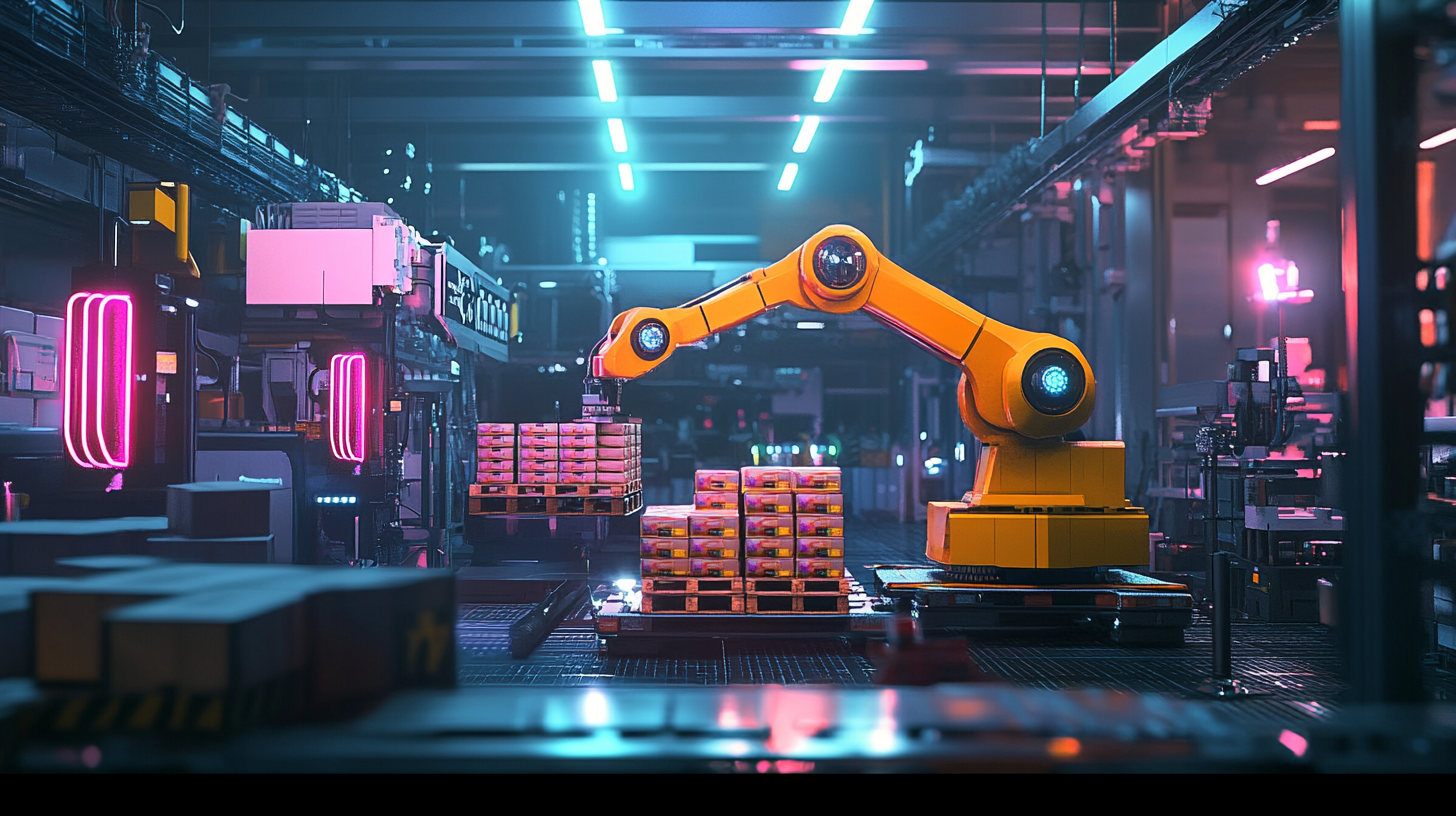
Robots in motion: Advances in logistics automation – Image: Xpert.Digital
🤖📦 Automation in the logistics industry with robots
Intelligent logistics: The future of the industry is robot-driven
Automation in the logistics industry has made enormous strides in recent years through the use of robots. These developments are fundamentally changing the industry, increasing efficiency, accuracy, and speed in various areas of logistics. From order picking and transport to warehouse management, robots are increasingly taking over tasks that were previously performed by humans. The integration of robots into logistics processes has become not just a trend, but a necessity to meet the growing demands of global trade.
🌟 Advances in robotics technology
Robotics technologies have developed rapidly and now enable a wide range of applications in logistics. These technologies are no longer limited to simple tasks but are increasingly taking over more complex activities. The most common applications include:
Order picking and packing
Robots can retrieve goods from shelves, pack them, and prepare them for shipping. These processes are not only faster but also more precise, significantly reducing the error rate. Robots offer considerable relief, especially in large warehouses where thousands of items need to be processed daily.
Transport within the warehouse
Autonomous mobile robots (AMRs) move goods efficiently through warehouses. They use advanced sensors and cameras to detect obstacles and navigate dynamically. These robots are flexible and can adapt to changing environments, making them particularly valuable for dynamic warehouse environments.
Loading and unloading of trucks
Automated systems enable the loading and unloading of vehicles without human intervention. This significantly speeds up the inbound and outbound processes while simultaneously reducing the risk of accidents or damage to goods.
Advances in artificial intelligence (AI) and sensor technology have enabled robots to adapt to complex and changing environments. Modern robots are increasingly capable of handling more demanding tasks and collaborating with human employees. These collaborative robots, also known as "cobots," complement human capabilities and increase flexibility in dynamic warehouse environments.
🚀 Advantages of automation
Automation offers numerous advantages for the logistics industry. Companies benefit in many ways from the introduction of robot-based systems:
Increased efficiency
Robots work around the clock without fatigue or loss of performance. This leads to a significant increase in productivity and a reduction in lead times. Especially during periods of high demand, companies can thus respond to orders more quickly.
Error reduction
Human error in order picking, packing, or transporting goods can be costly. Automated systems significantly minimize these sources of error, leading to higher customer satisfaction.
Cost savings
Companies can reduce their labor costs by using robots. Because repetitive tasks are automated, less staff is needed, leading to significant savings in the long run.
Faster delivery times
Autonomous vehicles and drones enable faster delivery, especially in remote or hard-to-reach areas. This is particularly relevant in the e-commerce sector, where customers expect increasingly shorter delivery times.
In addition to these direct advantages, automation also offers indirect benefits such as increased workplace safety. As dangerous or tiring tasks are increasingly taken over by robots, the risk of workplace accidents decreases.
⚠️ Implementation challenges
Despite the numerous advantages, there are also challenges in implementing robotic systems in logistics:
High initial investments
Acquiring and implementing robust robotic systems requires significant investments in technology and infrastructure. Many small and medium-sized enterprises are therefore still hesitant to introduce such systems.
Security concerns
With the increasing connectivity of devices in the Internet of Things (IoT), the risk of cyberattacks also rises. Companies must therefore implement robust security measures to protect their systems from potential threats.
Integration with existing systems
The complete integration of robots into existing logistics processes can be complex. Often, customized solutions are required to ensure that all systems communicate seamlessly with each other.
However, these challenges should not be seen as insurmountable obstacles. Rather, they require careful planning and strategic investments to fully exploit the long-term benefits of automation.
🌈 Innovations and Trends
The future of logistics automation promises even more innovations and technological breakthroughs. Key trends include:
Autonomous Mobile Robots (AMRs)
These robots will continue to grow in importance because they are more flexible than traditional automated transport systems. They can quickly adapt to new environments and are therefore ideally suited for dynamic warehouse environments.
Collaborative robots (cobots)
Cobots work side-by-side with human employees, complementing their skills. This collaboration significantly increases productivity, as cobots can take over repetitive or physically demanding tasks, allowing humans to focus on more complex activities.
Artificial Intelligence (AI)
AI will continue to play a central role, particularly in optimizing route planning, inventory management, and forecasting future demand. Through machine learning, algorithms can make increasingly accurate predictions, thereby optimizing the entire logistics process.
Another exciting trend is the development of autonomous delivery vehicles and drones for last-mile delivery. These technologies could be revolutionary, especially in urban areas or hard-to-reach regions. While autonomous vehicles are already being tested on public roads, drones are on the verge of taking over regular delivery services – particularly for small packages or urgent shipments.
🔧 Impact on the labor market
However, increasing automation also raises questions about its impact on the labor market. Many fear that the use of robots could lead to the loss of numerous jobs – especially in manual tasks such as order picking or packaging.
However, it is important to emphasize that automation does not necessarily have to lead to job losses. Rather, the demands on the workforce are shifting towards more highly skilled tasks such as maintenance, programming, or monitoring of automated systems. Companies must therefore invest in the further training of their employees early on to ensure that they can keep pace with the new technologies.
At the same time, automation is also creating new professional fields – for example in the areas of data analysis or AI development – which in turn offer new employment opportunities.
🔍 Robot Potential
Automation through robots has the potential to fundamentally transform the logistics industry. Companies benefit from increased efficiency, lower error rates, and cost savings – but at the same time, they face challenges such as high initial investments and safety risks.
However, the future promises further innovations: Autonomous mobile robots (AMRs), collaborative robots (cobots) and artificial intelligence will continue to play central roles and make logistics processes even more efficient.
Companies should not see these developments as a threat, but rather as an opportunity – because those who adopt these technologies early on can secure and expand their competitiveness in the long term.
📣 Similar topics
- 📦 Robots are revolutionizing logistics
- 🚚 Increased efficiency through automation
- 🤖 Advances in robotics technology
- 🔧 Implementation challenges
- 📊 Benefits of automation for businesses
- 📈 Innovations and trends in logistics
- 🛠️ Integration of cobots into warehouse processes
- 💡 The role of AI in logistics
- 🚀 Autonomous mobile robots: The future of logistics
- 🔍 Job market in transition due to automation
#️⃣ Hashtags: #Automation #Logistics #Robot Technology #Efficiency #AI

Expert partner in warehouse planning and construction

🌟🤖 The advantages of automation for companies: A look at the changing labor market
📈💼 Automation is fundamentally changing the world of work and the economy. While companies gain significant advantages through the use of modern technologies, the labor market is facing profound changes. Automation is not only a driving force behind efficiency gains and cost reductions, but also a factor shaping the demand for new skills and job profiles. This text highlights the key benefits of automation for companies and analyzes how it is transforming the labor market.
🌟 Automation: A strategic gain for companies
1. Time and cost savings
Automated systems enable companies to complete repetitive tasks more efficiently and quickly. Activities such as data processing, production workflows, and logistics processes, which were previously time-consuming and prone to errors, can be seamlessly automated using modern technologies. This leads not only to a significant reduction in personnel costs but also to improved resource utilization. As a result, companies can optimize their cost structure and increase their competitiveness.
2. Error reduction and quality improvement
Human error is often the result of monotonous tasks or excessive workload. Automated systems, on the other hand, work precisely, consistently, and without fatigue. This leads to significantly higher product quality and minimizes rejects and production downtime. This precision is invaluable, especially in industries such as medicine, electronics, and automotive.
3. Productivity increase through 24/7 operation
Automated systems never take breaks. Machines can operate around the clock, significantly increasing production speed. Production bottlenecks caused by working time restrictions or staff shortages are compensated for by the continuous operation of automated systems. This allows companies to achieve higher production targets and improve their delivery capabilities.
4. Flexibility and scalability
The ability to flexibly adapt production processes is another advantage of automation. Companies can quickly adjust their manufacturing to changing market conditions, develop new product variants, or increase production capacity without requiring additional personnel. This enables a rapid response to customer needs and increases the company's agility.
5. Relieving the burden on employees and focusing on value-adding activities
Automation can free employees from repetitive, physically demanding, or dangerous tasks. This creates space for creative, strategic, or customer-oriented activities that not only add value but also increase employee satisfaction and motivation. Automation thus contributes to a better working environment.
📈 The impact of automation on the labor market
Automation not only brings advantages for companies, but also changes the structure of the labor market. The redistribution of tasks and the requirements for new qualifications are particularly important in this context.
1. Transformation of jobs instead of massive job losses
Contrary to the often-expressed fear that automation will destroy countless jobs, in practice a more nuanced development is emerging. Instead of a complete elimination of jobs, a shift in tasks is taking place. Tasks with a high degree of routine are increasingly being automated, while more demanding, creative, or analytical tasks are gaining in importance. This is creating a new demand for highly qualified specialists who are able to monitor, optimize, and further develop automated systems.
2. The decline of routine activities
Occupations heavily repetitive are particularly vulnerable to automation. Tasks such as data entry, assembly work, or standardized services can be up to 84% automated by machines or algorithms. Sectors like nursing, education, or creative professions that require interactive or analytical skills, on the other hand, are less affected. This trend underscores the need to focus on jobs that cannot be so easily replaced by technology.
3. Creation of new jobs through technology
Alongside the disappearance of certain jobs, technological progress is also creating new professions. Experts in artificial intelligence (AI), robotics, data analysis, and systems integration are particularly in demand. Furthermore, the development and maintenance of automated systems are opening up employment opportunities in areas such as IT security, machine learning, and process optimization. In the long term, this could lead to moderate job growth if companies and governments make the necessary adjustments.
4. The challenge of income inequality
A critical aspect of automation is its potential impact on income distribution. While highly skilled workers disproportionately benefit from the demand for specialized expertise, low-skilled workers are more at risk of losing their jobs. This can further widen the income gap and exacerbate social inequalities. A well-designed labor market policy that promotes further education and retraining can counteract this trend.
5. Continuing education as the key to success
Automation demands new skills. Companies are challenged to actively prepare their employees for technological change. Investments in training and professional development, especially in technological competence, problem-solving, and critical thinking, are essential. At the same time, educational institutions must adapt their curricula to meet the demands of the digitized workplace. Only through a consistent skills development initiative can companies and employees successfully navigate this transformation.
🌍 Societal implications of automation
Besides its direct impact on businesses and the labor market, automation also has far-reaching societal consequences. It offers the potential to raise living standards by enabling more efficient services and cheaper products. At the same time, however, ethical questions must be addressed, such as those concerning data protection, surveillance, and the responsible use of technological resources.
⚖️ Balance between opportunities and challenges
Automation offers tremendous opportunities for companies, including cost savings, increased productivity, and improved quality. At the same time, it fundamentally changes the labor market by replacing routine jobs and creating a need for new skills. The key to success lies in strategically leveraging the benefits of automation without neglecting the societal and labor market challenges.
Businesses, policymakers, and educational institutions must work together to shape a future where technology is perceived not as a threat, but as an opportunity. With targeted investment in further education, the promotion of innovation, and fair social compensation, automation can contribute to sustainable and inclusive growth.
📣 Similar topics
- 🚚 Robots transport goods more efficiently through warehouses.
- 🤖 Modern technology is driving automation in logistics.
- 📦 Intelligent systems optimize warehousing through precise planning.
- ⏱️ The speed of supply chains is increasing thanks to smart machines.
- 🔄 Flexible processes enable faster responses to market changes.
- 🔍 Sensors improve accuracy and safety in goods handling.
- ⚙️ Innovations in robotics reduce human workload.
- 🌐 Global networks benefit from better integrated technology.
- 📈 Companies achieve higher efficiency and profitability through automation.
- 🌟 Advances in logistics automation are shaping the future of commerce.

Xpert.Plus Warehouse Optimization - High-bay warehouses and pallet warehouses: Consulting and planning
We are here for you - Consulting - Planning - Implementation - Project Management
☑️ SME support in strategy, consulting, planning and implementation
☑️ Creation or realignment of the digital strategy and digitization
☑️ Expansion and optimization of international sales processes
☑️ Global & Digital B2B trading platforms
☑️ Pioneer Business Development

Konrad Wolfenstein
I would be happy to serve as your personal advisor.
You can contact me by filling out the contact form below or simply call me on +49 7348 4088 965 .
I'm looking forward to our joint project.
Write to me


Xpert.Digital - Konrad Wolfenstein
Xpert.Digital is a hub for industry focusing on digitalization, mechanical engineering, logistics/intralogistics and photovoltaics.
With our 360° Business Development solution, we support renowned companies from new business to after-sales.
Market intelligence, smarketing, marketing automation, content development, PR, mail campaigns, personalized social media and lead nurturing are part of our digital tools.
You can find more information at: www.xpert.digital - www.xpert.solar - www.xpert.plus
Keep in touch