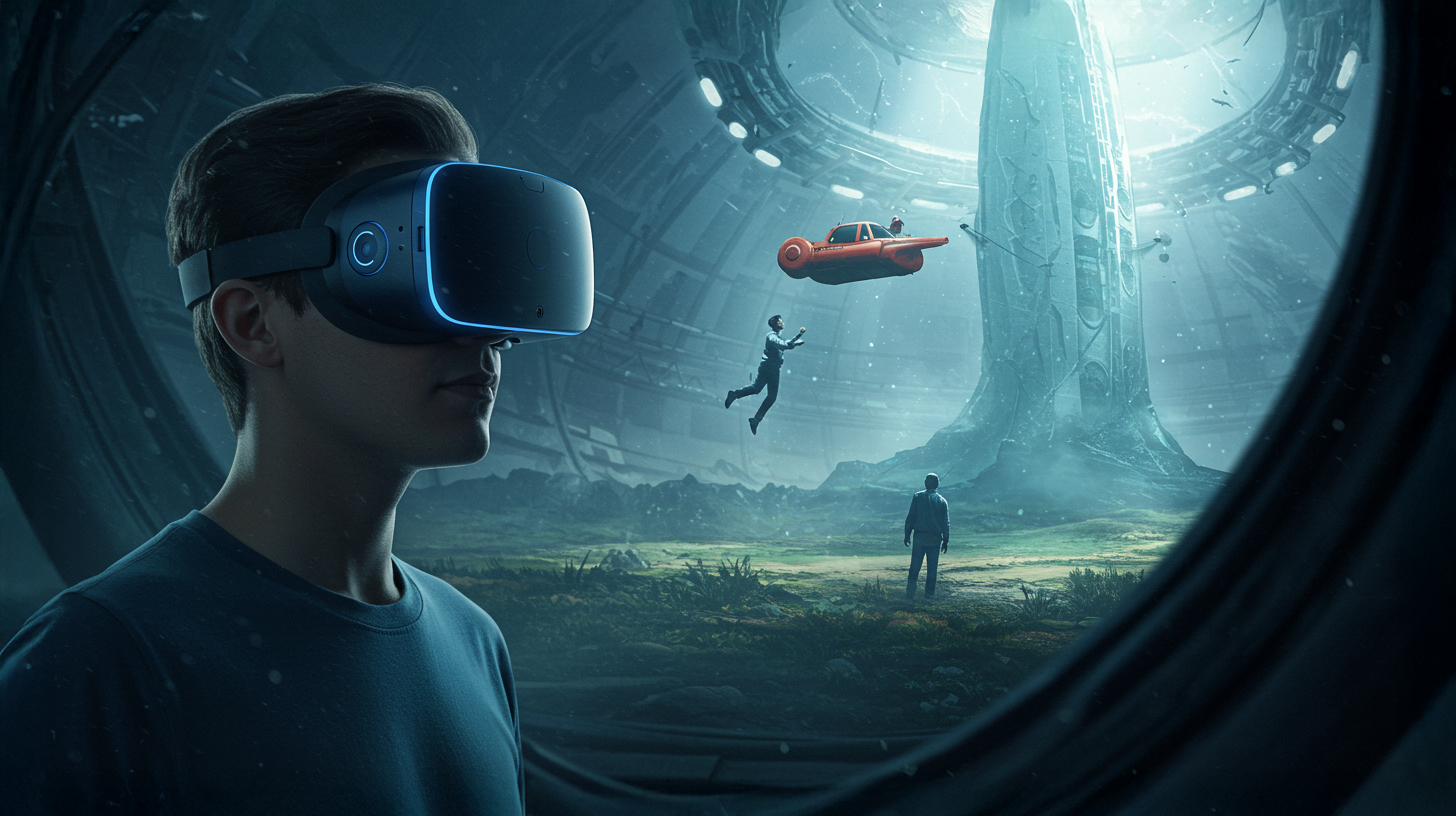
The revival of Windows Mixed Reality VR headsets: The Oasis driver as a lifeline – Image: Xpert.Digital
Abandoned by Microsoft: How a single developer is now saving thousands of VR headsets from the scrap heap
The VR miracle of 2025: How a hobby project is reviving the supposedly dead Windows Mixed Reality
For owners of VR headsets like the HP Reverb G2 or the Samsung Odyssey+, it was devastating news: With the Windows 11 24H2 update in October 2024, Microsoft definitively ended support for its Windows Mixed Reality (WMR) platform. This decision threatened to turn thousands of fully functional VR headsets, some only a few years old, into expensive electronic waste. But where a multi-billion dollar corporation pulled the plug for strategic reasons, an unexpected hero has now emerged: software developer Matthieu Bucchianeri.
In an impressive act of reverse engineering, the former developer from Sony PlayStation, SpaceX, and even Microsoft's HoloLens team created an alternative driver called "Oasis" in his spare time. This technical feat completely bypasses the discontinued WMR system and integrates the old headsets directly into SteamVR, not only saving them but also enhancing them with new features such as expanded image settings and improved passthrough functionality.
The Oasis driver is therefore more than just a piece of software – it's a powerful statement against planned obsolescence and a shining example of the power of community. It offers countless VR users the chance to continue using their hardware, even if its exclusivity for Nvidia graphics cards is a significant drawback. This project breathes new life into a technology platform that was thought to be dead and demonstrates what the passion of one individual can achieve.
The end of an era
With the release of Windows 11 version 24H2 in October 2024, Microsoft definitively ended support for its Windows Mixed Reality (WMR) platform. This decision rendered an entire generation of VR headsets virtually unusable, including devices from well-known manufacturers such as HP, Samsung, Acer, Lenovo, Dell, and Asus. For many users of this hardware, the end came as a surprise and was frustrating – after all, the last WMR device, the HP Reverb G2, had only reached the market at the end of 2020.
The impact was drastic: Not only did the Mixed Reality Portal disappear from Windows, but support for SteamVR and other VR applications was also cut. Users who installed the update suddenly found themselves with expensive electronic devices that had become mere dust collectors. Microsoft had already announced the discontinuation in December 2023, but many hoped until the very end for an extension or alternative solutions.
The story of Windows Mixed Reality
Windows Mixed Reality launched in 2015 as Windows Holographic, an ambitious Microsoft project to enter the burgeoning VR and AR market. Originally developed for the HoloLens, Microsoft opened the platform to third-party developers in 2016. The first VR headsets from various manufacturers, based on the WMR platform, appeared in 2017.
The WMR headsets were technological pioneers in a crucial area: they were the first to introduce inside-out tracking to the mass market. This technology uses cameras integrated into the headset for positional tracking, eliminating the need for external sensors – a concept that is now standard in almost all modern VR headsets. The devices used two cameras for 6DoF (six degrees of freedom) tracking, enabling complete freedom of movement in space.
Despite this innovation and sometimes aggressive pricing, WMR headsets never truly gained market traction. The platform suffered from several problems: limited tracking volume compared to external systems, a restricted software library, and dependence on the Windows ecosystem. Even substantial discounts failed to attract a broad user base.
The savior in times of need: Matthieu Bucchianeri
In this seemingly hopeless situation, an unexpected hero steps in: Matthieu Bucchianeri, an experienced software developer with an impressive resume. Bucchianeri worked at Sony on the PlayStation 4 and the first PlayStation VR, was responsible for the flight software of SpaceX's Falcon 9 and Dragon capsules, and later moved to Microsoft, where he worked on HoloLens and Windows Mixed Reality. He currently serves as Principal Firmware Engineering Manager on the Xbox team.
As a personal project, Bucchianeri has developed several important open-source tools for the VR community in his spare time, including the popular OpenXR Toolkit, which injects features like eye-tracked foveated rendering into AAA games such as Microsoft Flight Simulator 2020 and can improve performance by up to 30 percent. His technical understanding and passion for VR made him the ideal candidate for a seemingly impossible undertaking: saving WMR headsets.
The Oasis driver: A technical masterpiece
The Oasis driver is the result of months of intensive reverse engineering. Bucchianeri had to understand and replicate the functionality of the WMR headsets without access to proprietary Microsoft documentation. The project required a combination of technical skill, perseverance, and, as Bucchianeri himself admits, "a bit of luck.".
The driver functions as a native SteamVR integration, meaning it integrates WMR headsets directly into the SteamVR environment as if they were native SteamVR devices like the Valve Index or HTC Vive. This fundamentally differentiates Oasis from other approaches like Monado, which recreate alternative runtime environments. By directly utilizing Valve's existing infrastructure, Oasis achieves better compatibility and performance.
Functional scope and features
The Oasis driver offers an impressive range of functions that go far beyond basic functionality:
Full 6DoF tracking
The full spatial tracking with six degrees of freedom works flawlessly, both for the headset and the motion controllers. Users can move freely in the room and perform all the usual VR interactions.
Advanced customization options
Bucchianeri has integrated numerous convenience features that were partially lacking in the original WMR software. These include adjustable brightness, customizable color channels, and variable field-of-view parameters. These options allow users to optimally tailor the VR experience to their needs.
Eye-tracking support
The HP Reverb G2 Omnicept Edition even integrates eye-tracking functionality – a feature that didn't always work reliably even with the official Microsoft software.
Experimental Passthrough Functions
Initial passthrough features have been implemented, allowing users to see the real-world environment through the headset cameras. These currently only function monocularly and are still experimental, but Bucchianeri plans a full stereoscopic view for future versions.
Optimized Distortion Profiles
The distortion correction has been revised and optimized, resulting in a clearer and more comfortable image. This is especially important for longer VR sessions, as faulty distortion correction can lead to nausea and eye strain.
The Achilles' heel: GPU compatibility
The biggest limitation of the Oasis driver concerns graphics card compatibility. The driver works exclusively with Nvidia GPUs, which excludes a significant number of potential users. This limitation is not due to a lack of will or technical incompetence, but rather to fundamental differences in how various GPU manufacturers implement the so-called "Direct Mode.".
Direct Mode is a special operating mode in which the GPU communicates directly with the VR headset, bypassing Windows and preventing it from being treated as a regular monitor. This is essential for a smooth VR experience with minimal latency. Nvidia implements this mode in a way that allows third-party developers to access it. AMD, on the other hand, controls access more tightly, which significantly complicates integration.
Bucchianeri had already submitted a working version of the driver to AMD in June 2024, but saw no progress from the company. He now refers to AMD support as a "dead project." For Intel GPU users, the situation is even clearer: SteamVR doesn't offer direct-to-display support on these GPUs, making support technically impossible.
Legal and ethical aspects
A particularly sensitive aspect of the project is its legal implications. Bucchianeri repeatedly emphasizes that Oasis does not use any proprietary Microsoft software and does not violate any non-disclosure agreements (NDAs). As a current Microsoft employee, he had to proceed with particular care to avoid violating internal guidelines.
The project is entirely based on reverse engineering publicly available interfaces and utilizes the SteamVR infrastructure for the heavy lifting. Bucchianeri deliberately chose not to release the source code to avoid even accidental intellectual property infringements. This caution may disappoint some open-source advocates, but it is understandable given the legal complexities.
🗒️ Xpert.Digital: A pioneer in the field of Extended and Augmented Reality

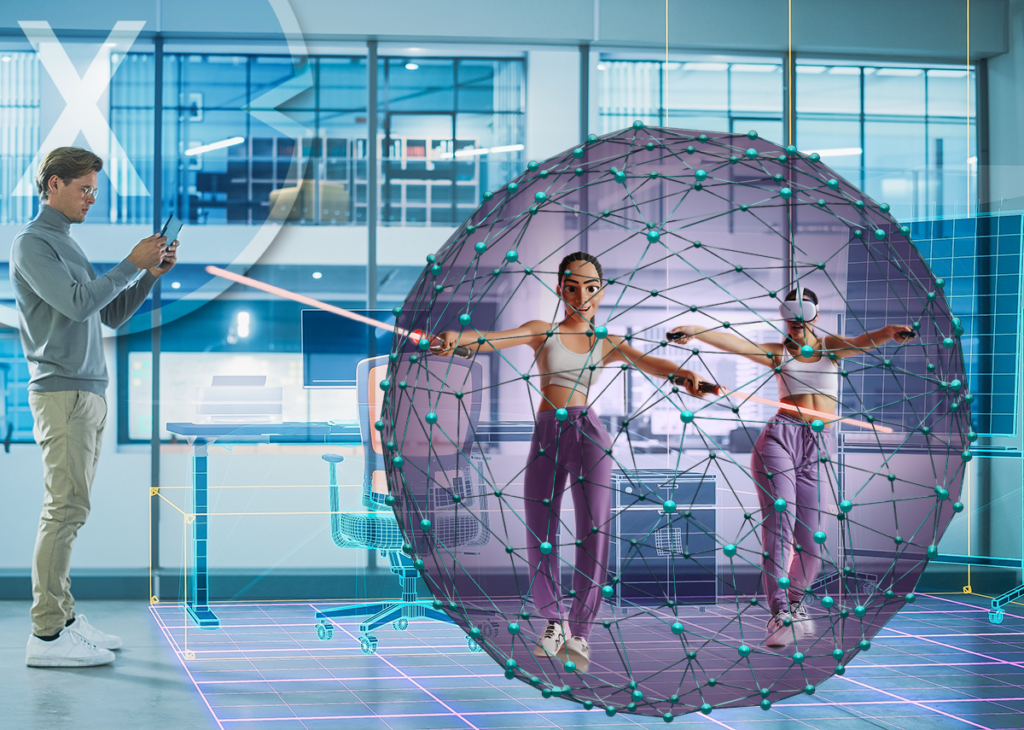
Finding the right Metaverse agency, planning office, or consulting firm - Image: Xpert.Digital
🗒️ Finding the right Metaverse agency, planning office, or consulting firm – Search and search: Top Ten Tips for Consulting & Planning
More information here:
Technical milestone: This is how the new Oasis driver works without a beta phase
Publication and availability
The global release of the Oasis driver is planned for August 29, 2025, provided Valve approves its listing on the Steam Store. This dependence on Valve's approval underscores the tight integration with the SteamVR platform. The driver will be available free of charge—a generous gift to the VR community from someone who has dedicated their free time to this project.
The release will proceed without a beta phase or early access, which Bucchianeri explains is due to his special situation as a Microsoft employee. He wants to minimize risk and only release the project when it is fully mature.
Significance for the VR community
The significance of the Oasis driver extends far beyond its mere functionality. It symbolically represents several important aspects of modern technological development:
Sustainability in technology
In a time when electronic waste is becoming an increasingly serious environmental problem, Oasis demonstrates that functioning hardware doesn't necessarily have to become obsolete just because the manufacturer discontinues support. Extending the lifespan of these devices is an important contribution to sustainability.
The power of the community
This project impressively demonstrates what dedicated individuals can achieve for a community. Where a multi-billion dollar corporation like Microsoft discontinues support for business reasons, a passionate developer steps in and finds a solution.
Technical innovation
Developing such a driver without access to internal documentation is a remarkable technical achievement. It demonstrates that with sufficient expertise and dedication, even seemingly impossible projects can be realized.
Affected devices in detail
To understand the scope of the Oasis project, it is worth taking a look at the affected devices and their technical specifications:
HP Reverb G2 (2020)
The flagship WMR headset boasted an impressive resolution of 2160 × 2160 pixels per eye. Developed in collaboration with Valve, the G2 utilized their lens system and off-ear speakers. With a 114-degree field of view and a 90 Hz refresh rate, it offered specifications that remain competitive even today.
Samsung Odyssey+ (2018)
With AMOLED displays and a resolution of 1440 × 1600 pixels per eye, the Odyssey+ offered vibrant colors and deep blacks. Samsung's Anti-SDE (Screen Door Effect) technology significantly reduced the screen-door effect, resulting in a clearer picture. The 110-degree field of view and integrated AKG headphones made it one of the best WMR headsets.
Lenovo Explorer (2017)
As one of the first WMR headsets, the Explorer offered a balanced price-performance ratio with 1440 × 1440 pixels per eye and a lightweight design of only 380 grams.
Acer Windows Mixed Reality Headset (2017)
With its distinctive blue design and adjustable headband, the Acer headset offered a comfortable entry into the VR world.
The future of the VR industry
The Oasis driver arrives at an interesting point in VR development. While Microsoft is withdrawing from VR hardware, the company is simultaneously intensifying its collaboration with Meta. Volumetric Windows apps for Quest headsets and the integration of Office applications demonstrate that Microsoft hasn't completely abandoned VR, but is adapting its strategy.
The VR industry itself is in an exciting phase in 2025. Meta dominates the market with its Quest series, while Valve is reportedly working on a new standalone SteamVR headset. Apple has tapped into a high-end market with the Vision Pro, and various other manufacturers are positioning themselves in niche markets.
In this context, the Oasis driver demonstrates that there is room for innovation and community-driven solutions even outside of major corporate strategies. It could even serve as a model for similar projects in the future when other manufacturers discontinue their VR platforms.
Technical challenges and solutions
Developing the Oasis driver presented numerous technical challenges. The WMR system used proprietary protocols and interfaces that Bucchianeri had to understand without documentation. Integrating inside-out tracking, which required precise camera analysis and sensor fusion, was particularly complex.
Solving these problems required a deep understanding of various technologies: computer vision for tracking, low-level driver development for hardware communication, and VR-specific rendering pipelines. Bucchianeri drew on his experience from various projects to overcome these challenges.
A particular focus was placed on performance optimization. VR requires consistently high frame rates and minimal latency to avoid nausea. The Oasis driver had to meet these requirements without access to hardware-specific optimizations that Microsoft could utilize in its software.
Community reactions and expectations
The announcement of the Oasis driver was met with great enthusiasm in the VR community. In forums and on Reddit, many users expressed their gratitude and relief that their hardware would not become e-waste after all. Owners of the HP Reverb G2, which is only a few years old, were particularly pleased at the prospect of continued use.
At the same time, there are also critical voices criticizing the Nvidia exclusivity. AMD GPU users feel excluded and hope for future support. Some also fear that Microsoft could take legal action against the project, although Bucchianeri assures that all legal aspects have been carefully examined.
Expectations for performance and stability are high. Many hope that the Oasis driver will not only restore basic functionality but may even offer improvements over the original Microsoft software.
Oasis Drivers 2025: Future Prospects and Planned Innovation Impulses
Following its planned release in August 2025, the further development of the Oasis driver will depend on various factors. Bucchianeri has already indicated that he is planning additional features, including full stereoscopic passthrough viewing and possibly improvements to tracking.
The community could play a crucial role in further development. Even though the source code is not open, users could contribute to improvements through feedback and bug reports. Complementary tools and utilities might also emerge around the Oasis driver.
An interesting aspect is the potential inspiration for other projects. If Oasis is successful, it could encourage other developers to launch similar rescue missions for abandoned hardware. This could lead to a movement advocating for more sustainable technology use.
From obsolete model to innovation: Oasis demonstrates the power of the community
The Oasis driver is more than just a technical solution – it's a statement against planned obsolescence and for the power of dedicated individuals. Matthieu Bucchianeri's project shows that functioning hardware doesn't necessarily have to become useless just because a manufacturer discontinues support.
For owners of Windows Mixed Reality headsets, Oasis represents a second chance. Their investment in VR hardware retains its value, and they can continue to participate in the development of virtual reality. While the limitation to Nvidia GPUs is regrettable, the driver still offers a solution for many users.
The project's significance extends beyond those directly affected. It sends a signal to the industry that users are not helpless when companies abandon products. It also demonstrates that there is still room for passion projects and altruistic acts within the technology community.
When the Oasis driver is released on August 29, 2025, it will not only mark the revival of a platform thought to be dead. It will also be a triumph of the individual over corporate logic and an example of how technology enthusiasts can take control of the future of their devices. In an era where sustainability is increasingly important, Oasis is a shining example of how we can extend the lifespan of our technology while simultaneously driving innovation.
We are here for you - Consulting - Planning - Implementation - Project Management
☑️ SME support in strategy, consulting, planning and implementation
☑️ Creation or realignment of the digital strategy and digitization
☑️ Expansion and optimization of international sales processes
☑️ Global & Digital B2B trading platforms
☑️ Pioneer Business Development

Konrad Wolfenstein
I would be happy to serve as your personal advisor.
You can contact me by filling out the contact form below or simply call me on +49 7348 4088 965 .
I'm looking forward to our joint project.
Write to me


Xpert.Digital - Konrad Wolfenstein
Xpert.Digital is a hub for industry focusing on digitalization, mechanical engineering, logistics/intralogistics and photovoltaics.
With our 360° Business Development solution, we support renowned companies from new business to after-sales.
Market intelligence, smarketing, marketing automation, content development, PR, mail campaigns, personalized social media and lead nurturing are part of our digital tools.
You can find more information at: www.xpert.digital - www.xpert.solar - www.xpert.plus
Keep in touch