


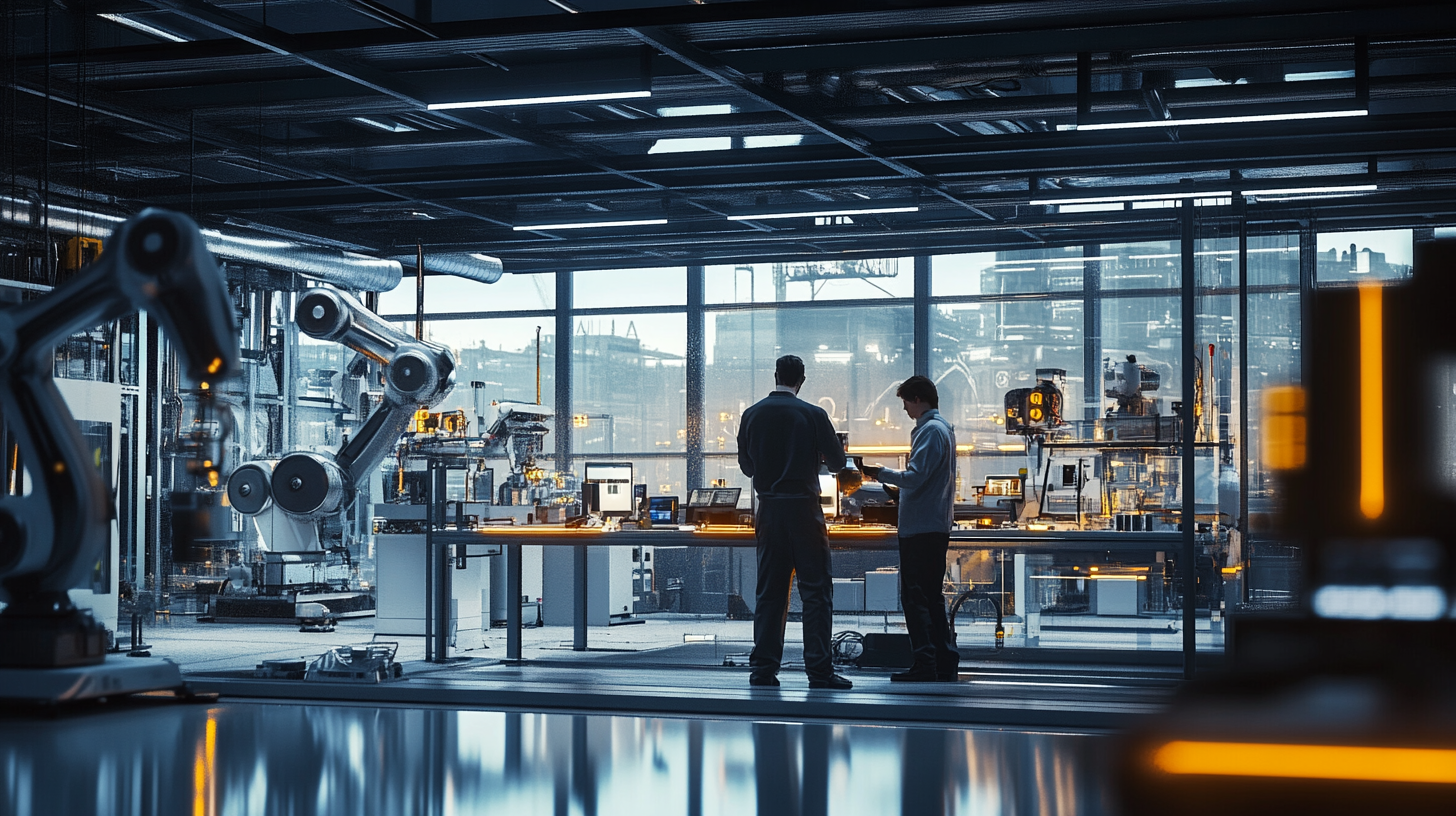
Staying competitive: The key role of innovation in German industry – cross-sector collaboration is crucial – Image: Xpert.Digital
Staying competitive: The key role of innovation in German industry
Industry meets service – why cross-sector collaboration is crucial
German industry faces major challenges in global competition. Rising energy prices, a shortage of skilled workers, and increasing competition from Asia are putting companies under pressure. Innovation is a crucial factor in remaining competitive. This report analyzes the current situation of German industry and shows how innovation and collaboration between industrial and service companies can help strengthen its competitiveness.
Related to this:
The current situation of German industry in global competition
Germany is one of the world's leading industrial nations. However, the competitiveness of German industry has noticeably declined in recent years. Studies show that Germany lags behind other industrialized countries, particularly in the areas of digitalization and sustainability. High energy costs and a growing shortage of skilled workers are also putting significant strain on companies.
Another indicator of declining competitiveness is weak export performance. While other countries are increasing their productivity and market share, Germany is losing ground in key industries such as automotive, mechanical engineering, and chemicals. The lack of adaptation to new technologies and market dynamics also contributes to the weakening of Germany's competitive position in international comparison.
Challenges for German industry in global competition
German industry faces a multitude of challenges, both technological and structural in nature:
Transformation to data-driven organizations
The use of data is crucial for the future viability of companies. The ability to collect, analyze, and use large amounts of data for decision-making distinguishes successful companies from their competitors. However, many German companies are still at the beginning of this transformation.
Sustainable and transparent supply chains
Globalization and increasing regulation necessitate transparent and sustainable supply chain management. Companies must be able to monitor their supply chains, predict bottlenecks, and reduce their CO2 emissions.
Skilled worker shortage
Another major problem is the shortage of skilled workers. This affects not only technical professions but also specialists in research and development, who are essential for innovative solutions. Without sufficient talent, companies risk falling behind internationally.
Geopolitical changes and global competition policy
The changing geopolitical landscape, characterized by trade conflicts and so-called "decoupling," is forcing companies to adapt their business models and investment strategies. Innovative approaches are needed to build more resilient structures.
Opportunities for German industry in global competition
Despite the challenges, there are also numerous opportunities:
Industry 4.0
The intelligent networking of machines and processes – known as Industry 4.0 – offers considerable potential. Through the use of sensors, IoT technologies, and artificial intelligence, production processes can be made more flexible and efficient.
Transformable factories
Modularizing production facilities allows for rapid adaptation to new requirements. This enables companies to react more quickly to market changes and meet individual customer needs.
Customer-centric solutions
Linking industry and services creates new opportunities to more precisely understand customer needs and offer customized products and services. This approach strengthens customer loyalty and creates competitive advantages.
Innovation as the key to competitiveness
Innovation is the key to success in global competition. It enables companies to differentiate themselves from the competition, tap into new markets, and operate more efficiently. Innovative companies invest strategically in research and development, foster the creativity of their employees, and collaborate closely with partners from academia and industry.
Successful examples from Germany
- Siemens: The technology group is a pioneer in digitalization and develops innovative solutions for industry, energy supply, and healthcare. Through close collaboration with universities and research institutions, Siemens remains at the forefront of technology.
- Bosch: The company is investing heavily in electromobility and autonomous driving. Bosch relies on its own development centers and cooperation with start-ups to create innovative mobility solutions.
- SAP: The software giant focuses on customized solutions for businesses. Through close collaboration with customers and partners, the products are continuously developed and adapted to new requirements.
Related to this:
- What accounts for the current success of some companies in the mechanical engineering sector despite the economic crisis in Germany?
- Successful mechanical engineering companies in Germany include Bosch, CLAAS, Dürr, Exyte, Festo, Krones, Voith, Zeiss and others
Industry 4.0: The merging of industry and services
Industry 4.0 stands for the digitalization of production. Through the use of smart technologies such as the Internet of Things (IoT), intelligent factories are emerging that operate not only more efficiently but also more flexibly. The merging of industry and services creates new opportunities:
- Flexible production: Production processes can be adapted more quickly to new requirements.
- Personalized products: Customers can actively participate in designing their products.
- New business models: Data-based services such as predictive maintenance are gaining in importance.
A key success factor is the involvement of trade unions and social partners. Germany has succeeded in integrating them into Industry 4.0 initiatives, which has significantly improved the acceptance and feasibility of these approaches.
Successful collaborations between industry and service companies
Collaboration between industry and services is becoming increasingly important. Examples show how cooperation leads to success:
- BMW and IBM: The companies are working together on technologies for autonomous driving.
- BASF and DHL: The chemical company is optimizing its global supply chains with the help of DHL.
Such partnerships enable companies to use resources more efficiently, minimize risks, and tap into new markets.
Cross-industry collaboration: A driver of innovation
Collaboration across industry boundaries is another driver of innovation. Companies can benefit from the experiences and perspectives of other sectors. Successful examples include:
- Daimler and Bosch: The cooperation promotes the development of technologies for connected driving.
- E.ON and Vodafone: The two companies are jointly building smart grids.
Such partnerships create new opportunities to develop products and services that go beyond traditional industry boundaries.
Support through funding programs and initiatives
The German government promotes innovation and cooperation through a variety of programs:
- Central Innovation Programme for SMEs (ZIM): This programme supports SMEs in the development of new products and technologies.
- "Industry 4.0" initiative: Companies receive assistance with the digitalization of their production processes.
- A boost for innovation: This program enables both feasibility studies and projects to reach market maturity.
Related to this:
We are here for you - Consulting - Planning - Implementation - Project Management
☑️ Our business language is English or German
☑️ NEW: Correspondence in your native language!

Konrad Wolfenstein
I and my team are happy to be available to you as your personal advisor.
You can contact me by filling out the contact form here wolfenstein@xpert.digital:or simply call me at +49 7348 4088 965. My email address is
I'm looking forward to our joint project.