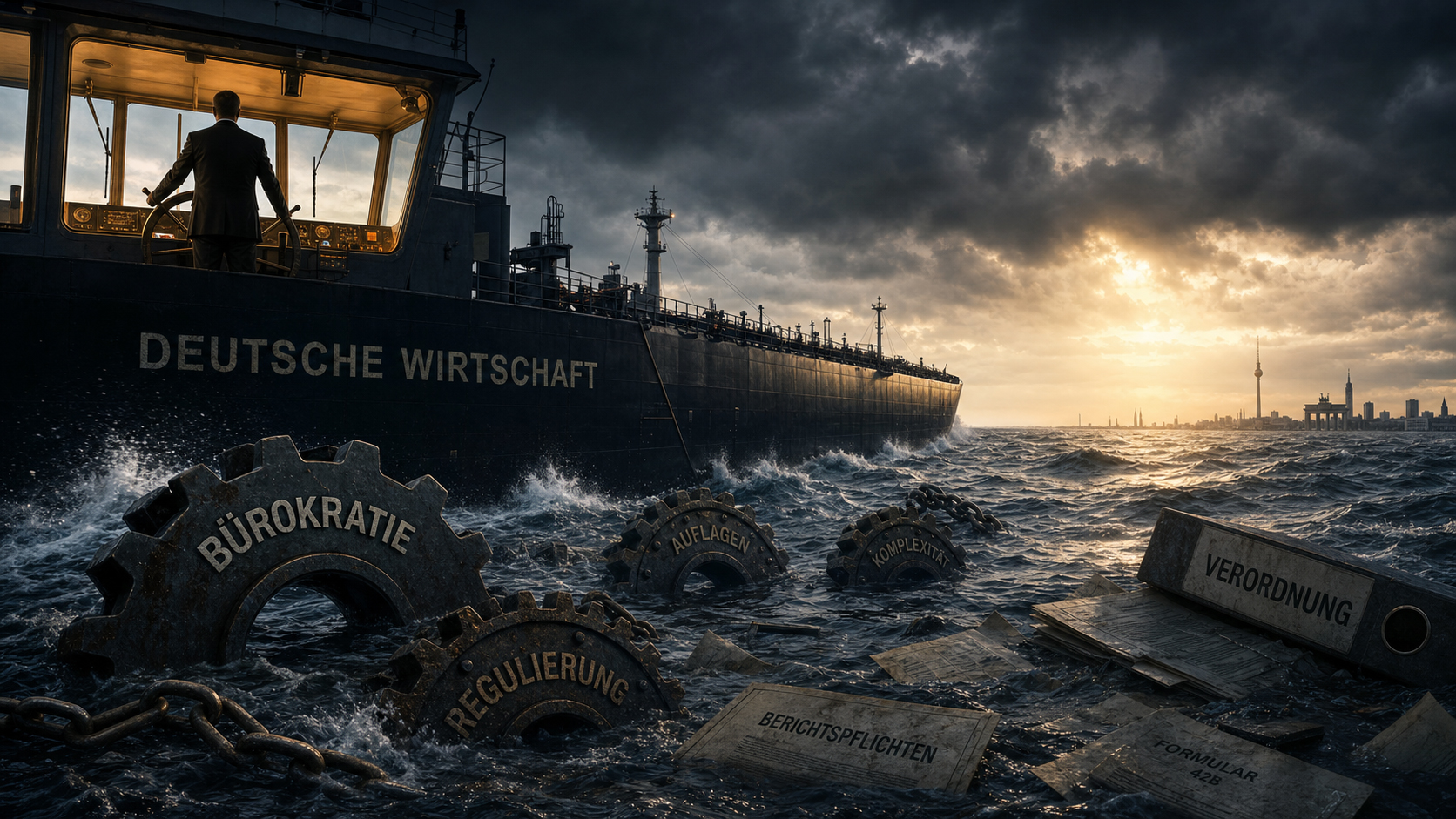
Economic crisis: A knee-jerk reaction to negativity – or fatal self-deception? Why Chancellor Merz is dangerously mistaken with his tanker metaphor – Image: Xpert.Digital
The bare facts: Why the German economy isn't just being "badmouthed"
Exodus of companies: The fairy tale of the German economic comeback
Taxes, bureaucracy, energy: Why the “tanker Germany” is massively losing cargo
In his recent speech at the East German Economic Forum, Chancellor Friedrich Merz used a memorable yet controversial image: Germany is not a nimble speedboat, but a heavy tanker – on the right course, albeit still too cumbersome. He categorically ruled out the radical breakthrough hoped for by the business community, the big "Big Bang," and instead warned against the typically German "reflex to criticize." But does this political rhetoric of reassurance stand up to a ruthless reality check? While the government urges patience and points to minimal economic improvements, the structural data tells a different, far more dramatic story. Exploding bureaucratic costs in the billions, a government spending ratio exceeding the critical 50 percent mark, persistent international competitive disadvantages in energy and taxation, and an unprecedented exodus of small and medium-sized industrial companies paint a picture of a location that is massively losing its substance. The crucial question, therefore, is not whether pessimism is helpful, but whether politicians still recognize the seriousness of the situation. A thorough analysis shows that the tanker is already losing cargo at an alarming rate – and the time for mere course corrections is over.
When reassurance rhetoric becomes location policy: Why Chancellor Merz is right – and where he is dangerously wrong
The Chancellor, the tanker and the bridge
At the East German Economic Forum in Bad Saarow in early June 2026, Chancellor Friedrich Merz delivered a speech whose ambivalence is symptomatic of political Berlin. Merz warned against what he called the "very German reflex of badmouthing," conjured up a future in which Germany's best years still lay ahead, and categorically ruled out the structural liberation many had hoped for: there would be no big "Big Bang" in the reforms. Germany, he said, was not a speedboat, but a heavy tanker – the course was right, only the speed was lacking. This metaphor deserves serious analysis, for it contains both a kernel of analytical truth and a kernel of dangerous complacency.
The question is not whether pessimism is a useful political stance – it undoubtedly is not. The question is whether the economic signals Germany is currently sending out are actually doom and gloom, or whether they represent a fact-based assessment of the situation to which politicians should respond with more substance than with tanker metaphors.
Where Merz's analysis has a kernel of truth
Before analyzing the weaknesses of a political position, it is intellectually honest to acknowledge its strengths. And indeed, there are some compelling arguments for the thesis that Germany is not in free fall, but rather in the midst of a prolonged, painful process of structural adjustment.
The macroeconomic situation has stabilized on the brink after three years of stagnation and recession. The Federal Statistical Office confirmed that price-adjusted GDP grew by 0.2 percent in 2025 – following two consecutive years of recession with declines of 0.3 percent in 2023 and 0.2 percent in 2024. This is not a triumphant recovery, but it is not another collapse either. KfW Research forecasts growth of 1.5 percent for 2026, with an acceleration in the second half of the year, when government investment and defense spending are expected to take effect. The ifo Institute, however, was more pessimistic and revised its 2026 forecast downward to 0.8 percent, after previously expecting 1.3 percent.
The Chancellor is also right to point out that Germany's perception abroad differs from its self-perception at home. Germany possesses a robust industrial base, excellent medium-sized global market leaders, a well-educated – albeit shrinking – skilled workforce, and an infrastructure that, despite recognizable shortcomings, still ranks in the upper middle range globally. The pessimistic reflex is indeed a well-known cultural phenomenon, historically pronounced in Germany, which can have a dysfunctional influence on economic decisions.
Furthermore, the Merz government has implemented initial, tangible economic relief measures: The accelerated depreciation allowance for corporate investments has been increased to 30 percent, a gradual reduction of the corporate tax rate from 15 to 10 percent by 2028 has been decided, the gas storage levy has been abolished, and transmission network charges have been reduced. These are not symbolic gestures, but real, albeit modest in total, improvements to the tax framework.
The extent of the structural crisis: What the data really say
Anyone who wants to judge Merz's speech fairly and completely must measure it against reality – and this reality is significantly more worrying than tanker metaphors suggest.
Bureaucracy as an economic erosion factor
A study commissioned by the Munich and Upper Bavaria Chamber of Industry and Commerce (IHK) by the ifo Institute calculated that Germany loses up to €146 billion in economic output annually due to excessive bureaucracy. The Federal Statistical Office puts the direct costs of fulfilling reporting obligations alone at €62.5 billion annually – a slight decrease from the previous year's €66.6 billion. A KfW study of approximately 10,000 small and medium-sized enterprises (SMEs) found that the 3.8 million employees in this sector spend an average of seven percent of their working time on bureaucratic processes – equivalent to 1.5 billion working hours per year and costs of around €61 billion. The self-employed bear the greatest relative burden, spending 8.7 percent of their working time on bureaucratic processes.
What these figures really mean: Bureaucratic overhead not only costs Germany direct money, it also reduces risk appetite, slows down investment decisions, and systematically increases the transaction costs of economic activity. While Merz has announced "annual laws to reduce bureaucracy," and the one-in-two-out rule is enshrined as a principle in the coalition agreement, the number of reporting obligations has only decreased from 12,390 to 12,364 – a reduction of 0.2 percent after years of public promises to cut red tape. Anyone who, in light of this discrepancy, speaks of "the right course" is misjudging the extent of the need for action.
Government spending ratio beyond the warning line
The government spending ratio rose to 50.3 percent in 2025 – exceeding the 50 percent mark for the first time since the COVID-19 pandemic. Helmut Kohl once famously stated that socialism begins at 50 percent. While this quote may be a simplistic one, it describes a fundamental problem: when every second euro of gross domestic product flows into government hands, structurally limited scope remains for private investment, capital accumulation, and entrepreneurial risk. The Scientific Advisory Board of the Federal Ministry of Finance predicted that the government spending ratio could rise to 52 percent by 2030. The federal budget has a funding gap of approximately 172 billion euros for the years 2027 to 2029.
The government deficit already amounted to €119 billion in 2025, representing a deficit ratio of 2.7 percent of GDP. Social spending, demographics, long-term care, and the special fund for the German Armed Forces are structurally driving this development. A policy that simultaneously defends the welfare state's promises of benefits in an insurance-like manner, nominally maintains the debt brake, aims to cut taxes, and must invest massively in infrastructure is attempting fiscal squaring of the circle – and, naturally, cannot deliver any transformative, immediately noticeable relief for the middle class.
Energy: The competitive disadvantage remains dramatic
A particularly painful factor, and one that is existential for Germany's industrial base, is the energy price difference compared to international competitors. In 2024, the average wholesale price for electricity in Germany was around €80 per megawatt-hour – after a historic high of around €235 in 2022, but still far above pre-crisis levels. According to the Brussels-based think tank Bruegel, industrial electricity tariffs in the EU in 2023 were 158 percent higher than those in the US. German households and businesses paid the highest tariff in the EU, at €39.50 per 100 kilowatt-hours.
Current BDEW data does show some improvement: The average industrial electricity price for small and medium-sized enterprises will be 16.7 cents per kilowatt-hour in 2026, a decrease of 0.9 cents compared to the previous year. However, this improvement is marginal compared to the structural competitive disadvantages that have accumulated over the years. Companies producing in energy-intensive industries in Germany today pay significantly more than their competitors in the USA, China, or Eastern Europe – a situation that cannot be remedied overnight by a 500-billion-euro special fund.
Tax competition: Germany in the middle of the OECD field
In terms of international tax competitiveness, Germany is ranked 20th out of 38 OECD countries in 2025 – in the lower middle of the pack. The combined corporate tax rate in 2024 was around 29.93 percent, placing Germany among the four highest corporate tax rates in the OECD. Even if the planned reduction of the corporate tax rate to 10 percent by 2028 were fully implemented, Germany would only reach 14th place at best, according to the Tax Foundation – which would still not be a top position. By comparison, Ireland, with a corporate tax rate of 12.5 percent, attracts the European headquarters of Google, Apple, and numerous other corporations.
The exodus: The strongest argument against the tanker rhetoric
The most compelling evidence that the concerns of the German economy are not mere sentimentalism is provided by the behavior of the companies themselves – because companies vote with their feet.
According to a study by Deloitte and the Federation of German Industries (BDI), almost one in five companies has stated that it no longer produces in Germany – an increase of eight percentage points compared to two years prior. Seventeen percent have relocated their development operations, and 13 percent have moved their research and development activities – and these figures are set to rise further: In the next two to three years, 43 percent of the surveyed companies plan to relocate their production, compared to 33 percent in a similar survey two years earlier. This relocation therefore affects not only manufacturing but increasingly also intellectual capital in the form of research and development.
Concrete examples illustrate this trend: Volkswagen is relocating its Golf production to Mexico and developing vehicles entirely in China. BASF is outsourcing services to India. MAN Trucks is moving parts of its production to Poland. ZF Friedrichshafen is relocating large parts of its operations to Hungary. Energy-intensive corporations – including 86 percent of basic chemical companies – are shifting their investments abroad because energy prices in Germany are eroding their international competitive margins.
If the business reality is that almost three out of four energy-intensive corporations are relocating their investments out of Germany, then the question is justified: Which tanker is Merz actually referring to? One that is on course doesn't lose any cargo along the way.
Our EU and German expertise in business development, sales and marketing

Our EU and German expertise in business development, sales and marketing - Image: Xpert.Digital
Industry focus areas: B2B, digitalization (from AI to XR), mechanical engineering, logistics, renewable energies and industry
More information here:
A thematic hub offering insights and expertise:
- Knowledge platform covering global and regional economies, innovation and industry-specific trends
- A collection of analyses, insights, and background information from our key areas of focus
- A place for expertise and information on current developments in business and technology
- A hub for companies seeking information on markets, digitalization, and industry innovations
Why German SMEs must act now – and how
The confidence of entrepreneurs is collapsing
The shift in business sentiment is evident not only in location decisions but also in concrete survey data. According to a survey by DZ Bank, in the fall of 2025, only 39 percent of the more than 1,000 CEOs and decision-makers surveyed in medium-sized businesses expected the Merz government to be able to put the economy on a growth path – down from 62 percent in the spring. The conviction that the government could create greater planning certainty was now shared by less than a third of respondents (27 percent), compared to 45 percent at the beginning of the year. This is not a knee-jerk reaction of negativity; it is a measurable, quantifiable loss of trust in concrete surveys.
At the Berlin SME Dialogue in autumn 2025, leading business representatives openly demanded action. Peter Adrian, President of the Association of German Chambers of Industry and Commerce (DIHK), described the "silent demise" of many businesses due to bureaucracy, a lack of succession planning, and insufficient planning certainty. Günter Althaus, President of the German Association of Small and Medium-Sized Businesses (BVMW), criticized the government for focusing too heavily on large corporations, while small businesses struggled with the same obligations but significantly fewer resources. Christoph Ahlhaus of the BVMW warned that many SMEs were on the brink of collapse.
A particularly symptomatic point of contention is the electricity tax issue. The coalition agreement promised to reduce the electricity tax to the EU minimum for all companies – but for budgetary reasons, the relief was then only extended for energy-intensive industries; trade, crafts, and service providers were excluded. The German Association of Small and Medium-Sized Businesses described this as a "cardinal sin." This episode precisely illustrates the systemic problem: promises are made with the certainty of a coalition agreement and then partially retracted due to fiscal constraints.
Structural reform failure: Why the tanker is the wrong image
The tanker metaphor is politically clever because it presents patience for reform as a systemic necessity rather than a political decision. However, it obscures a key finding: institutional inertia and political prioritization are two different things.
Germany has accumulated structural problems for decades that are well-known and could be addressed politically if the political will existed. This includes the digitalization of public administration: If Germany were to catch up to Denmark's level of digitalization, its economic output would be €96 billion higher per year, according to calculations by the ifo Institute. It also includes the acceleration of planning processes: Germany is known for taking as much time to build a wind turbine or a railway line as other countries take to construct entire infrastructure projects. And it includes the tax system: A country that ranks 20th in the OECD for tax competitiveness and simultaneously claims to be the number one industrial location in Europe has a structural ambition gap.
The tanker metaphor suggests that correcting the course is the navigator's responsibility and that the crew should be patient. But a tanker that continues to lose cargo despite course corrections, that lets more companies off the ship at every port than it takes on, that runs into headwinds because its propulsion is too expensive and its bureaucracy too cumbersome – it doesn't need empty promises of patience, it needs an engine room overhaul.
Furthermore, grand coalitions in the past have regularly made reform promises and failed to deliver. Jens de Buhr, publisher and observer of the political and economic landscape, succinctly summarized the contradiction: The "Big Bang" doesn't fall from the sky; it has to be created. This is not a populist demand, but a structural necessity in a country that competes in a globalized economy with digitized competitors who offer their companies significantly more favorable business conditions.
This makes the perspective of medium-sized businesses particularly clear
Small and medium-sized enterprises (SMEs) are not just any economic entity in this analysis – they are structurally the most exposed segment of the German economy. They provide roughly 60 percent of all jobs, generate a large share of tax revenue, but lack the political networks and compliance capacities of large corporations to effectively mitigate regulatory burdens.
While large corporations can spread bureaucratic costs across extensive legal and tax departments, a medium-sized business with 50 employees bears the same absolute regulatory burden far more heavily in relative terms. While large companies can relocate their production to where energy is cheap and regulations are less stringent, many medium-sized businesses are tied to their locations – by local supply chains, ownership structures, and social ties. They cannot relocate, but they can shrink, stop investing, and ultimately give up.
This isn't a dramatic overnight collapse – it's a slow erosion of economic substance that only becomes visible in statistics when the damage is irreversible. The "silent death" of businesses, which DIHK President Adrian spoke of, is not meant metaphorically.
Skills shortage: A structural problem with no quick solution
Closely linked to the problems facing small and medium-sized enterprises (SMEs) is the demographically driven shortage of skilled workers. According to a ManpowerGroup study for the first quarter of 2025, 86 percent of German companies reported difficulties filling vacancies – placing Germany at the top of the global ranking and significantly exceeding the global average of 74 percent. Within ten years, the shortage of skilled workers in Germany has more than doubled: in 2014, only 40 percent of companies reported such difficulties. For the energy sector, the figure was even higher, at 92 percent.
While more recent DIHK data from the end of 2025 shows a slight easing of recruitment difficulties to 36 percent, this is primarily due to economic conditions – it does not reflect the demographic trend. More than one in three companies with over 20 employees continue to experience significant staff shortages. Kofa data from the second quarter of 2025 shows that there is still a nationwide shortage of approximately 391,000 qualified workers, and more than one in three open positions (35 percent) could not be filled with suitable candidates. This problem will not diminish through political patience, but rather will be exacerbated by demographic change.
Related to this:
Being right and being wrong – a balance sheet
It is possible to be right and wrong at the same time. Friedrich Merz is right when he says that fundamental upheavals in complex democratic systems take time, that the constraints of coalition politics are real, and that pessimism is not a productive approach to shaping policy. These points are analytically correct and do not deserve blanket rejection.
However, he is wrong on one crucial point: the urgency with which Germany needs structural reforms is incompatible with a rhetoric of patient course correction. The exodus of industry, the bureaucratic burden in the hundreds of billions, a government spending ratio exceeding 50 percent, a tax ranking of 20th, an energy cost difference of 158 percent compared to the USA – these are not mere perception problems that can be solved through better communication. They are structural deficiencies that influence companies' real location decisions, causing them to withdraw capital, talent, and added value from Germany in real time.
The real economic danger lies not in the pessimism of business leaders. It lies in the fact that reassuring rhetoric dampens the political pressure for reform that would be necessary to consistently utilize the existing room for maneuver. Those who pathologize criticism as a cultural reflex immunize themselves against uncomfortable facts. And those who announce that there will be no "Big Bang" undermine their own legitimacy for what is truly needed: a more ambitious pace, bolder compromises, and more honest communication about the actual state of affairs.
What entrepreneurs should learn from this analysis
The analytical conclusion drawn from what has been said is not resignation, but rather structural realism. During the current legislative period, policymakers will not create the framework that will transform Germany into a leading tax and regulatory hub overnight. No entrepreneurial calculation should be based on this, a calculation that cannot be directly controlled.
What companies, and especially SMEs, can do: Evaluate location factors consciously and without sentimentality. This doesn't necessarily mean leaving Germany – but it does mean developing value creation where it makes economic sense. It means examining holding structures in countries with more favorable tax regimes. It means pursuing international recruitment of skilled workers consistently and aggressively, instead of waiting for government programs. It means investing in digitalization and automation, because the shortage of skilled workers remains a persistent problem. And it means using political engagement – through associations, public discourse, and surveys – as a long-term, strategic lever, not as a short-term outlet for frustration.
The tanker Deutschland is neither irreparably damaged nor in safe waters. It is a ship that urgently needs to jettison ballast, whose engine room requires an overhaul, and whose captain should communicate more transparently regarding depth sounding. The alternative to litigation is not blind trust in the bridge – the alternative is taking responsibility and realistically assessing what politicians can and cannot do.