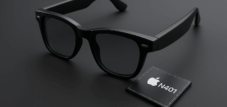
Smart glasses with a hidden camera and AI-powered foreign language translation: The Ray-Ban Meta Wayfarer RW4008 – Image: meta.com
More than just sunglasses: These Ray-Bans have AI, a camera, and a translator on board
"Hey Meta, what am I seeing?": These features make the new Ray-Ban the smartest glasses on the market
What exactly are these new Ray-Ban Meta smart glasses that everyone's talking about?
The Ray-Ban Meta Wayfarer RW4008 is an innovative eyewear technology that combines the classic design of the iconic Wayfarer sunglasses with modern technology. These smart glasses are equipped with hidden cameras, speakers, microphones, and AI features that provide a completely new eyewear experience.
The glasses represent a collaboration between Meta (formerly Facebook) and Ray-Ban and aim to seamlessly integrate technology into everyday life without compromising the stylish appearance of classic designer sunglasses.
Fittingly,


Technical specifications
Dimensions and design
How big and heavy is the Ray-Ban Meta Wayfarer, actually?
The Ray-Ban Meta Wayfarer RW4008 is available in various sizes, with the standard version featuring a lens width of 53 mm, a bridge width of 22 mm, and a temple length of 155 mm. The total weight is approximately 44-50 grams, making it only slightly heavier than a conventional Ray-Ban Wayfarer frame.
The glasses are made of high-quality acetate plastic and retain the classic rectangular Wayfarer design, making them virtually indistinguishable from regular sunglasses. This is a crucial advantage over other smart glasses, which often appear futuristic and flashy.
Camera technology
What can the integrated camera record?
The Ray-Ban Meta is equipped with a 12-megapixel ultra-wide-angle camera discreetly integrated into the right temple. This camera can capture portrait-oriented photos at a resolution of 3024 x 4032 pixels, a significant improvement over the 5-megapixel camera of the first generation.
For video recording, the glasses offer a resolution of 1440 x 1920 pixels at 30 fps, also in portrait mode. The camera is positioned to capture what the wearer sees, thus enabling authentic first-person perspective recordings. Videos can be recorded for up to 60 seconds, which is perfectly adequate for spontaneous moments or short clips.
Audio system
How good is the audio quality of the integrated speakers?
The Ray-Ban Meta features a sophisticated audio system with two custom-designed open-back speakers and a digital 5-microphone array. The speakers are engineered to deliver rich sound with 50 percent more volume and twice the bass of its predecessor.
The open-ear design means the ears remain uncovered, allowing the wearer to still hear ambient sounds. This is particularly beneficial for safety when walking or cycling. The audio quality is surprisingly good for such a compact system, although it naturally can't compete with high-end headphones.
The five microphones enable effective noise cancellation and ensure clear voice recordings for both phone calls and voice control. The system is able to reduce wind noise and understand the wearer's voice even in noisy environments.
Storage and connectivity
How much storage capacity can the glasses offer and how do they connect to other devices?
The Ray-Ban Meta is equipped with 32 GB of internal flash memory, a significant improvement over the 4 GB of the first generation. This memory is sufficient for over 500 photos and approximately 100 videos of 30 seconds in length.
Connectivity is provided via Bluetooth 5.3 and WiFi 6, ensuring a stable and fast connection to the smartphone. The glasses are compatible with iOS (version 14.4 and later) and Android (version 10 and later) and require the Meta View app to be installed for full functionality.
Battery and charging times
Battery life in practical use
How long does the battery actually last with normal use?
The official battery life is stated as up to 4 hours with active use. In practice, this translates to about 4 hours with mixed use including photos, music, and occasional video clips. With intensive video recording, the battery life is reduced to approximately 1.5 to 2 hours.
A particularly useful feature is that the glasses automatically announce the current battery level when put on, so the wearer always knows how much power is left. Clear warnings are given when the battery is low, so there are no surprises.
With occasional use throughout the day, the glasses can last up to 18 hours, making them a practical everyday companion. The actual battery life depends heavily on which functions are used and how frequently.
Charging case and charging
How does charging the glasses work?
The Ray-Ban Meta comes with a sleek charging case that itself has an integrated lithium-ion battery. This case can fully recharge the glasses up to eight times before it needs to be recharged itself.
The case takes approximately 3.5 hours for a full charge or 90 minutes for a 50% fast charge via USB-C. The glasses themselves fully charge in the case in about 2 hours, although just 20 minutes in the case is enough for approximately 50% charge.
An LED on the case indicates the charging status: green means fully charged, yellow indicates that it is still charging. This practical indicator helps you always know when the case and glasses are ready for use.
AI functions and Meta AI
Voice control
How does the voice control of the Ray-Ban Meta work?
The glasses are activated with the command "Hey Meta", similar to other voice assistants. Once activated, the user can give commands directly without waiting for a beep, making operation very natural.
After Meta AI responds, a beep often sounds, indicating that the system is waiting for further input. This allows for a smooth dialogue without having to repeat "Hey Meta" for every follow-up question. If necessary, the user can pause at any time and issue new commands.
Voice control now also works in German, following a corresponding update released by Meta in July 2025. This allows German-speaking users to operate the glasses entirely in their native language.
Visual AI analysis
What can Meta AI see and understand?
Meta AI is able to see what the wearer sees and can analyze objects, landmarks, texts, and scenes in real time. For example, the AI can recognize products and provide information about them, which is particularly helpful when shopping or exploring new places.
One particularly useful feature is the AI's ability to remember things captured by the camera. For example, the glasses can save the location of your parking spot at the airport and remind you of it later. Voice-based reminders are also possible, turning the glasses into an intelligent personal assistant.
The AI can also read texts aloud, scan QR codes, or automatically call phone numbers from flyers. These functions make the glasses a versatile tool for everyday life.
Live translation
How the AI simultaneous translator works
How does the live translation function work in practice?
Live translation is set up in the Meta app, where the user selects the source and target languages. The function is started with the command "Hey Meta, start translation," and the AI begins translating spoken sentences and playing them back through the speakers.
The translation is performed almost in real time, with the AI recognizing and translating spoken language and announcing the result verbally. Additionally, a written transcript of the translation is saved on the connected smartphone, which is useful for later reference.
The feature currently works with four languages: English, Italian, Spanish, and French. German is available as a target language, but not as a source language for translation. Meta is working on expanding language support, but a concrete timeline for additional languages has not yet been established.
Related to this:

Practical application scenarios
In which situations is the translation function particularly useful?
A classic scenario is a holiday abroad when you discover an interesting souvenir at a market and want to speak to the vendor, who only speaks the local language. The glasses can then translate the vendor's answers in real time, so the wearer understands everything.
This feature is particularly valuable in lecture or conference situations where the speaker uses a different language. The wearer of the glasses can follow the presentation as if it were being given in their native language. This application is more discreet than conventional translation devices or smartphone apps.
One limitation, however, is that the translation currently only works in one direction – only the person wearing the glasses hears the translation. For real conversations, the other person would also need to use a similar technology or a common language would need to be found.
Technical features
Can live translation also work offline?
Yes, one of the remarkable features of live translation is that it works even without an internet connection once the relevant language packs have been downloaded. This makes the feature particularly useful when traveling, where a stable internet connection is not always guaranteed.
On-device processing also means that sensitive conversation content does not need to be transmitted via external servers, which is advantageous from a data protection perspective. However, the available language packs and their quality are still limited compared to cloud-based translation services.
Operation and control
Touch control
How are the glasses operated without voice commands?
In addition to voice control, the Ray-Ban Meta features a touch panel on the right temple that recognizes various gestures. A short tap starts the camera for taking photos, while a longer press initiates video recording.
The touch controls also allow for music playback: a single tap pauses or starts the music, a double tap skips to the next track, and a triple tap returns to the previous song. Volume can be adjusted by swiping on the touchpad.
The touchpad can be used to answer and end calls, or to switch between different functions. This tactile control is particularly useful in situations where voice commands are not appropriate.
Meta View App
What role does the smartphone app play?
The Meta View app is the heart of the Ray-Ban Meta Experience and essential for its full functionality. All settings are configured via the app, from selecting the language for Meta AI to managing privacy settings.
The app allows photos and videos to be transferred from the glasses to a smartphone, where they can be edited and shared. Live streaming to social media platforms like Instagram or Facebook is also controlled via the app.
In addition, the app provides detailed information about the battery level and memory usage, and enables software updates for the glasses. Without the app, many of the advanced functions remain inaccessible, making it an essential component of the system.
A new dimension of digital transformation with 'Managed AI' (Artificial Intelligence) - Platform & B2B solution | Xpert Consulting


A new dimension of digital transformation with 'Managed AI' (Artificial Intelligence) – Platform & B2B solution | Xpert Consulting - Image: Xpert.Digital
Here you will learn how your company can implement customized AI solutions quickly, securely and without high entry barriers.
A managed AI platform is your all-inclusive, worry-free solution for artificial intelligence. Instead of dealing with complex technology, expensive infrastructure, and lengthy development processes, you receive a ready-made solution tailored to your needs from a specialized partner – often within just a few days.
The key advantages at a glance:
⚡ Rapid implementation: From idea to ready-to-use application in days, not months. We deliver practical solutions that create immediate added value.
🔒 Maximum data security: Your sensitive data stays with you. We guarantee secure and compliant processing without sharing data with third parties.
💸 No financial risk: You only pay for results. High upfront investments in hardware, software, or personnel are completely eliminated.
🎯 Focus on your core business: Concentrate on what you do best. We take care of the entire technical implementation, operation, and maintenance of your AI solution.
📈 Future-proof & scalable: Your AI grows with you. We ensure continuous optimization and scalability, and flexibly adapt the models to new requirements.
More information here:
Wayfarer practical test: Battery, camera and everyday usability put to the test
Data protection and privacy
LED warning system
How do other people know when they are being filmed?
The Ray-Ban Meta features a white LED light on the front of the glasses that illuminates during recording. For still photos, the LED flashes briefly, while for video recording, the light remains on continuously for the duration of the recording.
This LED has been significantly enlarged compared to the first generation and is now hard to miss. Additionally, the wearer of glasses also receives a small light signal on the right inner rim of their glasses to confirm that a recording is in progress.
Despite these improvements, concerns remain as to whether a small LED is sufficient to adequately inform others about recordings. In private or intimate situations, the signal could easily be overlooked or perceived as insufficient.
Data processing and storage
What happens to the recorded data?
According to the manufacturer, photos and videos are initially only synchronized between the glasses and the Meta View app and can be stored locally on the smartphone. Transfer to Meta servers only occurs if cloud processing functions are explicitly activated.
However, the privacy policy has recently changed: When using Meta AI with the "Hey Meta" command, the camera is automatically activated, and these interactions are saved by default. Audio data from Meta AI interactions is also used to improve the AI models.
Users can disable this data collection, but this significantly impairs the hands-free functionality. A Meta account is mandatory for use, which means that certain personal data will inevitably be shared with Meta.
Related to this:

Concerns from data protection experts
What risks do experts see with smart glasses?
Data protection experts are warning about the inconspicuous surveillance capabilities of smart glasses. A particularly worrying example was provided by Harvard students with their "I-XRAY" project, in which they used Ray-Ban Meta glasses to automatically identify individuals and uncover personal information such as names, addresses, and even social security numbers.
The project demonstrated how smart glasses can be linked to publicly available facial recognition services and databases to create comprehensive profiles of random passersby within seconds. The students emphasize that anyone with basic programming skills could develop similar systems.
What is particularly problematic is that the individuals affected have no way of knowing that they are not only being filmed, but also analyzed and identified. This represents a new dimension of surveillance that goes far beyond conventional camera recordings.
Pricing structure and availability
Current prices in Germany
How much does the Ray-Ban Meta Wayfarer cost in Germany?
The entry-level price for Ray-Ban Meta sunglasses starts at around €329 for the Skyler model and €349 for the Wayfarer and Headliner versions. Depending on the features, lens type, and size, the price can rise to over €400.
Retailers like Idealo offer the glasses starting at €328.95, with different color combinations and lens options affecting the price. Transitions lenses, which automatically adjust to changing light conditions, cost extra.
Ray-Ban regularly offers promotional deals with prices reduced by 10-20 percent. These limited-time offers are often available in the Ray-Ban online store or at authorized retailers.
Availability and distribution channels
Where can I buy the Ray-Ban Meta?
The glasses are available in Germany through various channels, including authorized opticians, online retailers such as Mister Spex, Edel-Optics and the official Ray-Ban stores.
Many opticians offer the option of fitting glasses with corrective lenses, making them suitable for people with visual impairments. However, prescription lenses are often only available in physical stores and not online.
The availability of individual models and colors may vary, as this is a relatively new and popular product. Some retailers offer pre-orders or notifications when available.
Competition and alternatives
Other smart glasses on the market
What alternatives are there to the Ray-Ban Meta?
The smart glasses market is developing rapidly, and various manufacturers now offer interesting alternatives. The Solos AirGo V smart glasses rely on an open AI architecture and allow users to choose between different AI frameworks such as ChatGPT-4, Claude, or Google Gemini.
The Rokid Glasses, developed in collaboration with Bolon, even offer augmented reality features with a display directly integrated into the lens. This displays translations and other information directly in the field of vision, representing a significant improvement over the purely audio-based Ray-Ban Meta.
Loomos is developing a model similar to the Ray-Ban Meta, but with a 16-megapixel camera and 4K video recording capabilities, it is said to be technically superior. Battery life is also expected to be significantly improved with a 450 mAh battery and an optional power bank.
Audio-focused smart glasses
Are there smart glasses that primarily focus on audio?
Yes, several manufacturers offer smart glasses primarily designed as audio wearables. Anker's Soundcore Frames, for example, feature four speakers and offer 5.5 hours of listening time with interchangeable front frames for different situations.
The HUAWEI Eyewear 2 offers up to 11 hours of continuous music playback and features sophisticated technology to reduce sound leakage into the surrounding environment. These glasses forgo cameras and focus entirely on the audio experience.
Razer also offers a gaming-oriented alternative with its Anzu Smart Glasses, featuring blue light filters and polarized lenses. These models are often cheaper than camera-based smart glasses, but consequently offer fewer features.
Practical applications
Everyday usage scenarios
How does the Ray-Ban Meta integrate into daily use?
In summer, when you're wearing sunglasses anyway, the Ray-Ban Meta becomes an unobtrusive tech companion. Listening to music while walking, taking spontaneous photos of special moments, or making hands-free phone calls while shopping are just a few of its practical uses.
The glasses are especially valuable for people who are often on the go and need to keep their hands free. Cyclists can take calls without stopping, hikers can photograph landscapes without taking off their backpacks, and parents can capture moments with their children while they play.
Voice control makes the glasses particularly practical in situations where a smartphone isn't easily accessible, such as while cooking, gardening, or exercising. The AI functions can assist with shopping by recognizing products and providing information about them.
Professional applications
Can smart glasses also be used professionally?
Absolutely, there are various professional scenarios that lend themselves to smart glasses. Journalists can discreetly record interviews, real estate agents can present properties from their perspective, and tradespeople can document their work without using their hands.
In education, smart glasses enable new forms of distance learning or the documentation of experiments and demonstrations. Medical professionals could record and transmit training sessions or complex procedures from their perspective.
However, strict data protection and compliance rules must be observed when using it professionally, especially in sensitive areas such as healthcare or when working with confidential information.
Ray-Ban AR generation: Improved battery life, translations and object recognition
Planned further developments
What are Meta's plans for the future of smart glasses?
Meta has already announced several enhancements that are expected to be available in the coming months. These include an improved live view function, which will allow Meta AI to better understand what the user is currently seeing and respond accordingly in a context-sensitive manner.
Instagram integration will be expanded so that messages and photos can be sent and received directly via the glasses. Audio and video calls will also be possible, making the glasses a fully functional communication device.
Music access is being expanded, with direct integration of Spotify, Apple Music, Amazon Music, and other streaming services. Users will be able to search for and play songs, artists, or albums using voice commands.
Technological developments
What technological advances can be expected?
The next generation of smart glasses is expected to feature true augmented reality displays that overlay information directly into the user's field of vision. Meta is already working on an AR version of Ray-Ban glasses, which is expected in the second half of 2025.
AI capabilities are continuously being improved, with better object recognition, enhanced translation abilities, and more intelligent context understanding. The integration of different AI platforms could give users more choice in their preferred assistant.
Battery life and component miniaturization are also being further improved. Future models could last all day without charging and offer even more features.
Societal impact
How could smart glasses change our society?
Smart glasses have the potential to revolutionize how we interact with information and our environment. The constant availability of AI assistants and translation functions could reduce language barriers and democratize access to information.
At the same time, they raise important questions about privacy and surveillance. The younger generation is already showing resistance to inconspicuous recording technology and demanding stricter regulations to protect privacy.
The technology could also create new forms of social interaction where digital and physical worlds seamlessly merge. This could offer opportunities for improved learning and working, but also risks to genuine human connection and attention.
Stylish Ray-Ban Meta Wayfarer: Everyday smart glasses with compromises in battery life and data privacy
Strengths of the Ray-Ban Meta Wayfarer
What are the biggest advantages of these smart glasses?
The Ray-Ban Meta Wayfarer is particularly impressive due to its understated design, which sets it apart from futuristic-looking competitors. The integration of cutting-edge technology into a classic eyewear design is remarkably successful.
The audio quality is surprisingly good for such a compact system, and the open-ear design allows you to listen to music while remaining aware of your surroundings. The 12-megapixel camera is sufficient for spontaneous photos and short videos, especially for social media.
The AI features with German language support make the glasses a practical everyday companion. The live translation, while still limited, demonstrates the potential for future applications. The convenient charging case with multiple charges makes the glasses travel-friendly.
Weaknesses and limitations
Where are the limits of the current Ray-Ban meta?
The battery life of 4 hours is relatively short for intensive use and requires regular charging. The video quality, although in HD, is not comparable to modern smartphones, and the 60-second limit restricts longer recordings.
Live translation only works in one direction and currently supports only four languages, with German not being available as a source language. The heavy reliance on meta-services and the requirement for a meta-account may be problematic for privacy-conscious users.
The privacy concerns are justified, as the small LED may not be sufficient to adequately inform other people about recordings. The risk of misuse for unnoticed surveillance remains.
Overall rating
Is it worth buying a pair of Ray-Ban Meta Wayfarers?
For tech-savvy users already immersed in the Meta ecosystem and who value stylish design, the Ray-Ban Meta offers a compelling overall package. It is particularly suitable for people who are frequently on the go and need to keep their hands free.
The glasses are less suitable for users who primarily want to take high-quality photos and videos, as conventional smartphones are superior in this regard. They are also not the right choice for people with strong privacy concerns or an aversion to metadata services.
The price of over 300 euros is relatively high for a gadget with limited functionality, but reasonable for the combination of designer sunglasses and cutting-edge technology. The Ray-Ban Meta represents an important step towards everyday smart glasses, even if it doesn't yet fulfill all the promises of the technology.
In conclusion, the Ray-Ban Meta Wayfarer RW4008 is an impressive demonstration of how far smart glasses have come. It offers a glimpse into a future where technology is seamlessly integrated into our daily lives, but also raises important questions about privacy, data protection, and societal impact. For early adopters and technology enthusiasts, it is already a fascinating gadget, while more conservative users might want to wait for the next generation, which could offer even more sophisticated features and better data protection solutions.
We are here for you - Consulting - Planning - Implementation - Project Management
☑️ SME support in strategy, consulting, planning and implementation
☑️ Creation or realignment of the AI strategy
☑️ Pioneer Business Development

Konrad Wolfenstein
I would be happy to serve as your personal advisor.
You can contact me by filling out the contact form below or simply call me on +49 7348 4088 965 .
I'm looking forward to our joint project.
Write to me


Xpert.Digital - Konrad Wolfenstein
Xpert.Digital is a hub for industry focusing on digitalization, mechanical engineering, logistics/intralogistics and photovoltaics.
With our 360° Business Development solution, we support renowned companies from new business to after-sales.
Market intelligence, smarketing, marketing automation, content development, PR, mail campaigns, personalized social media and lead nurturing are part of our digital tools.
You can find more information at: www.xpert.digital - www.xpert.solar - www.xpert.plus
Keep in touch