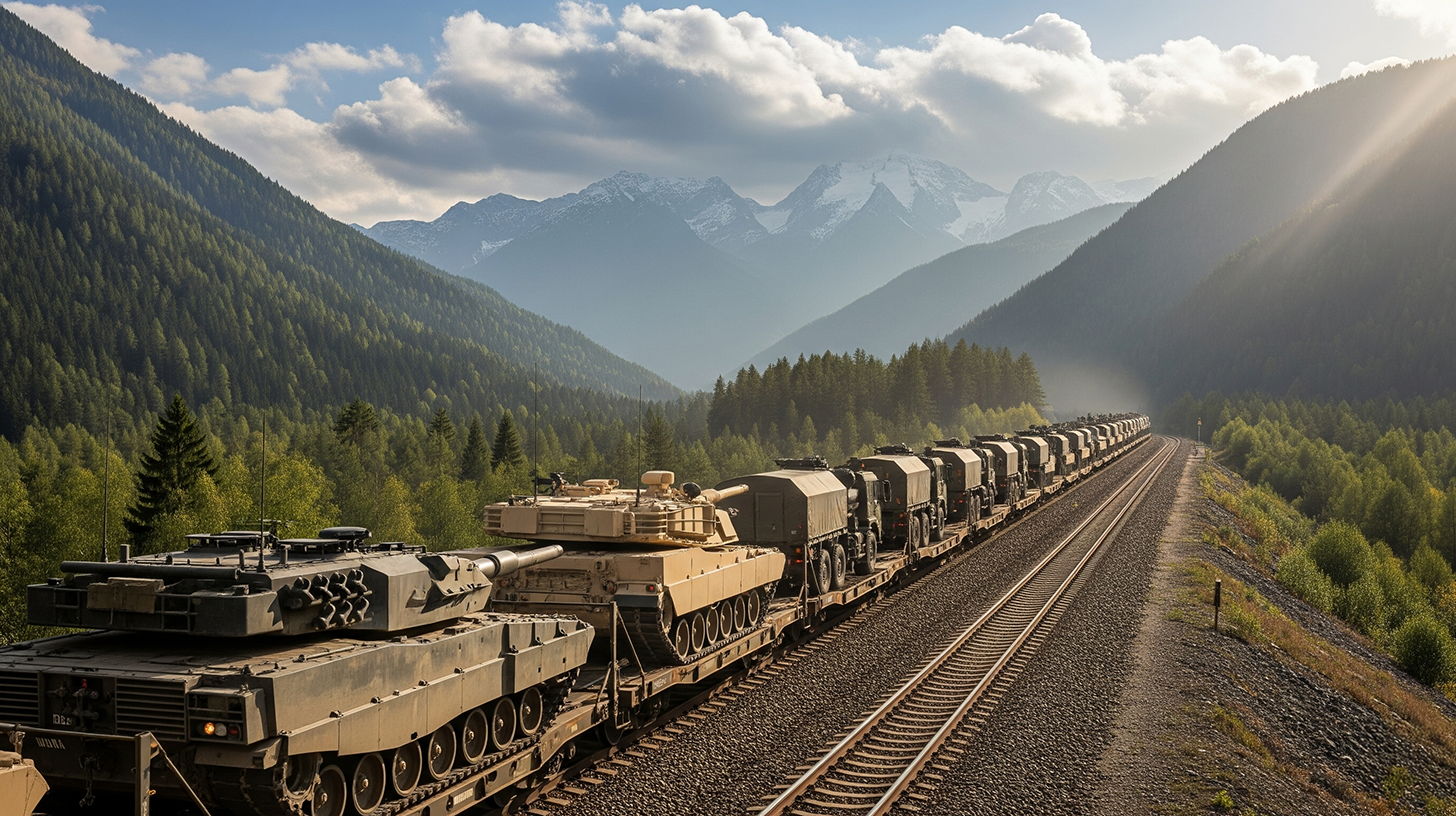
Sabotage, blackout, chaos: How NATO protects its supplies when all else fails – Creative image: Xpert.Digital
Tanks by train, not truck: The surprising reason why rail is unbeatable in a crisis – Why rail is the true lifeline in an alliance situation
Secure supplies by rail – why the railway is indispensable in a crisis
How rail freight transport can be secured against attacks in the event of a national defense or alliance emergency (V-case), what technical monitoring options exist, and why rail remains the more strategically reliable option compared to road transport despite recent acts of sabotage. In doing so, I have specifically considered NATO and EU structures, current security policy insights, and strategies of the German Armed Forces and the police.
Background: Sabotage spree and growing doubts
Recently, acts of sabotage against railway lines have been making headlines. For example, cable fires along the Hamburg-Berlin line in September 2023 caused significant disruptions to train services. Back in October 2022, a targeted attack on railway communication cables paralyzed train traffic in northern Germany for hours before the damage was repaired within a few hours. Such incidents raise doubts about whether rail transport would still be practical and safe in a crisis. Yet, in the event of a NATO alliance conflict, the railway is indispensable for the rapid deployment of large quantities of troops and equipment to the eastern flank. The following sections use data, facts, and examples to illustrate why, despite the risk of sabotage, rail transport remains the safer and more efficient mode of transport in an emergency.
Rail as a logistical key to NATO's eastern flank
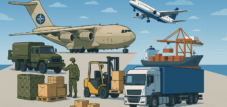
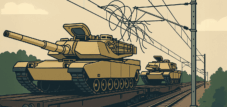
Only rail can move large troop contingents, including heavy equipment, in the shortest possible time. Studies confirm that rail transport is the "key branch of land transport for rapid operations with large troop strengths." The practical experience of NATO allies underscores this: In 2017, as part of Operation Atlantic Resolve, the complete equipment of a US armored brigade was transported via Germany to Eastern Europe. From the port of Bremerhaven alone, around 900 railcars full of military equipment were sent by train to Poland – equivalent to a train length of approximately 10 kilometers. By comparison, only about 40 vehicles had to be transported by road. In another instance, US troops used 21 freight trains plus 150 trucks to transport their tanks and equipment from a landing port to the training area. These figures clearly demonstrate that a single military train can replace dozens of heavy transport vehicles and move hundreds of tons of equipment in one go. The railway is therefore the backbone of military mobility – Germany in particular, with its dense network of ~38,000 km of track and central location in Europe, is considered a logistical “hub” for deployments to NATO’s eastern border.
Road congestion risk: In a crisis, an incalculable bottleneck
In contrast, road traffic is extremely vulnerable to disruption in a crisis or defense situation. While plans stipulate that military traffic would have priority over civilian vehicles on highways in the event of war, reality could be chaotic: fleeing civilians and panicked evacuations could clog the roads even before official regulations take effect. Even during peacetime exercises, military convoys must adhere to time-consuming restrictions – such as traveling only at night to avoid disrupting civilian traffic. However, sudden evacuation traffic or accidents along the routes could severely impede progress, even with prioritization. Historical experience shows that uncontrolled refugee flows can paralyze entire highways (e.g., observations at the beginning of the war in Ukraine in 2022, where civilian vehicles were backed up while trains continued to run).
Furthermore, roads are more difficult to secure: thousands of potential routes and access roads would need to be monitored, as alternative routes via country roads or even unpaved tracks would be sought. A single blocked highway – for example, due to broken-down vehicles or targeted attacks – can disrupt entire supply plans. Rail offers an advantage here: there are a few, clearly defined main corridors to the east that can be specifically protected and kept clear. In an emergency, civilian rail traffic could be quickly reduced or stopped, allowing military freight trains unimpeded – without the risk of sudden traffic congestion caused by civilians.
Monitoring and securing of railway lines
A crucial advantage of rail in the event of an attack is the superior monitoring and security of the infrastructure. Railway lines are fixed routes, not sprawling networks like roads – potential danger points are therefore more localized. Rail security is already a topic of discussion: Following the attacks, the police union called for state-of-the-art surveillance technology for railway lines, such as drones, motion sensors, and camera surveillance along the tracks. Particularly sensitive sections – for example, high-speed lines or junctions – should be secured with fences equipped with electronic alarm systems. Federal Interior Minister Nancy Faeser announced plans to significantly expand video surveillance at railway facilities (from 9,000 to 11,000 cameras).
Infrastructure operators are also working on technical solutions. In 2024, Deutsche Bahn unveiled a new long-range drone designed to monitor the rail network. Around 100 of these drones are planned for deployment across Germany starting in 2025. They have a range of approximately 150 kilometers and can patrol even during train operations, at night, and in inclement weather. The drones' high-resolution cameras and sensors provide operational teams with real-time images of the track conditions. This allows for the rapid detection of damage and foreign objects after incidents or severe weather, for example, without having to send personnel into dangerous areas. In addition, modern railway safety systems incorporate failsafe mechanisms: if a track section is interrupted or tampered with, track circuits or sensors register this – signals turn red, and trains automatically come to a stop. Sabotage would therefore be detected immediately, before accidents occur.
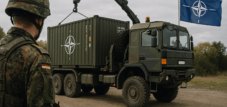
Personnel deployment for security is also crucial. In Germany, railway monitoring is primarily the responsibility of the Federal Police, who would increase their presence along the routes in an emergency. Additionally, the German Armed Forces can contribute their forces within the framework of territorial defense: German military police (Feldjäger) have already escorted and secured transports during Host Nation Support exercises for US troops. This experience would be expanded in the event of an alliance-wide attack – for example, through continuous patrols on critical bridges or tunnel sections, mobile surveillance teams with thermal imaging cameras at night, and coordinated helicopter flights along the railway lines. Following the Nord Stream sabotage, NATO and the EU also emphasized that the protection of critical transport arteries is a top priority. Cooperation between European railway police forces (such as in the Railpol network) and NATO support forces would ensure that railway lines are closely monitored. In short, in the event of an attack, far more security resources would be available to protect the tracks than are possible or necessary in peacetime.
Rapid repairs and high resilience of the rail network
What if something does happen? Another reason why rail is considered a safe mode of transport is its relatively quick repairability and reliability. Experience shows that railway engineers can often repair damage in a very short time. In the aforementioned act of sabotage in 2022, it only took about three hours for train traffic to resume after important cables were severed. The arson attack on cable ducts in 2023 also did not cause lasting chaos: despite more than 30 train cancellations, traffic had largely returned to normal by the next morning. Well-coordinated railway emergency teams are on standby around the clock to bridge damaged lines, rewire switches and signals, or, in serious cases, even replace sections of track. For larger damage – such as to bridges – the military and the Federal Agency for Technical Relief (THW) have temporary replacement structures ready. While a crater on the motorway forces large-scale detours, a damaged track can often be bypassed via alternative routes or quickly covered with temporary track sections. Europe's rail network is dense enough to divert trains to alternative routes in the event of a local disruption.
Furthermore, the sheer volume of regular rail operations clearly demonstrates the heavy load the railway system can handle and how efficiently disruptions are managed: In 2022 alone, over 398 billion ton-kilometers of freight were transported by rail within the EU – Germany accounted for the largest share with 125 billion ton-kilometers (31%), followed by Poland (15%). This enormous volume of traffic is handled largely according to schedule despite weather conditions, construction work, or isolated disruptions. The operational control and maintenance systems are robust and scalable – in a crisis, civilian goods and passengers would take a back seat, allowing the network's full capacity to be used for military transport. EU plans explicitly mention the expansion and maintenance of dual infrastructure: Roads, railways, and bridges across Europe are being inspected and reinforced for heavy military equipment. This also includes rapid repair concepts to ensure that damaged sections are immediately passable in the event of conflict.
In the event of a crisis, the railway remains the more reliable option
Despite legitimate concerns due to recent acts of sabotage, there is strong evidence to suggest that rail transport is safer and more efficient than road convoys in the event of a defense emergency. Rail can bundle and rapidly move enormous quantities of materials – it is the logistical backbone of NATO's eastern flank. Unlike the flexible and chaotic road network, the rail network offers clear, controllable corridors that can be monitored seamlessly. Technical aids such as drone patrols, sensor fences, and intelligent surveillance systems further enhance the security of the track. Should damage nevertheless occur, examples from both peacetime and wartime (such as in Ukraine) demonstrate that rail crews can repair lines in record time. Ultimately, in a crisis, the military and police will prioritize the protection of railway lines with combined forces – from the German Federal Police and military police to NATO forces that monitor Europe's critical infrastructure.
In short: Rail transport is predictable, monitorable, and resilient. While chaos threatens on congested roads, train traffic remains more calculable – and therefore, in a crisis, the safest way to reliably transport troops and supplies to their destination.
Consulting - Planning - Implementation

Markus Becker
I would be happy to serve as your personal advisor.
Head of Business Development
Chairman SME Connect Defense Working Group
Your dual-use logistics experts
Dual-use logistics experts - Image: Xpert.Digital
The global economy is currently undergoing a fundamental transformation, a watershed moment that is shaking the foundations of global logistics. The era of hyper-globalization, characterized by the relentless pursuit of maximum efficiency and the "just-in-time" principle, is giving way to a new reality. This new reality is marked by profound structural breaks, geopolitical power shifts, and increasing fragmentation of economic policy. The once taken-for-granted predictability of international markets and supply chains is dissolving and being replaced by a period of growing uncertainty.
Related to this:
Hub for Security and Defense - Advice and Information
Hub for Security and Defense - Image: Xpert.Digital
The Security and Defence Hub offers expert advice and up-to-date information to effectively support companies and organizations in strengthening their role in European security and defence policy. Working closely with the SME Connect Defence Working Group, it particularly promotes small and medium-sized enterprises (SMEs) that wish to further develop their innovative capacity and competitiveness in the defence sector. As a central point of contact, the Hub thus creates a crucial bridge between SMEs and European defence strategy.
Related to this: